
culture

Mashrou' Leila performs in Paris. Photo by Hinda Zahra via femmesdetunisia.com.
Mashrou’ Leila performs in Paris. Photo by Hinda Zahra via femmesdetunisia.com. Click to read an interview with the band.

The Middle East and North Africa (MENA) is a contested space for queer folks. Persecution is common in Egypt, where gay men are continuously subjected to mass arrests, and queer Palestinians are often blackmailed. In contrast, Lebanon has led the LGBT*Q movement with a recent court ruling that homosexuality is not “unnatural or a crime. Celebrities like Hamed Sinno, the gay lead singer of Mashrou’ Leila, can even use music to address gender expression and gay love there. Research on the origins of queerness and homophobia in the region and why governments repress queer communities can help us understand such conflicting trends.

Contrary to beliefs that queerness is un-MENA, un-Islamic, or un-African, Abu Nawas (756-814) wrote uninhibited erotic poetry about men and, in the 18th and 19th centuries in Egypt, homosexual and homosocial relations were quite common. Lesbianism is documented in the 9th century throughout the region.
Contemporary state repression often involves torture, surveillance, and harassment of gays and lesbians by state actors. After the Arab Spring revolutions, social science sheds light on how such politically unstable governments attempt to maintain and enforce social stability and societal moral. This larger sense of a need for control could fuel queer community repression.

For more on sexuality in the MENA, see lectures from the ““Sexualities and Queer Imaginaries in the Middle East/North Africa’ conference at Brown University.

In September 2015, the hashtag #masculinitysofragile first swept across the greater twitter community—even gaining its own twitter account. Tweeters use the hashtag to point out how masculinity and expectations for men to be “manly” are not only unattainable, but also harmful to both men and women. Some posts called out the gendered marketing of men’s products like man-sized soap bars, and others the need to qualify affection between two men with “no homo” and the way boys are taught to reserve, rather than express, emotions.

So, is #masculinitysofragile? Luckily for all of us, there’s research on that!

Scholars define masculinity as more than just an individual trait. It involves social practices that privilege men over women and some men over other men. Traits associated with the “ideal” man—what scholars refer to as “hegemonic masculinity”—include sexual aggression, violent behavior, and lack of outward emotion, as well as whiteness, middle-class status, and heterosexual desire for women. Men actively work to maintain a spot in the dominant gender group. Sometimes this involves demonstrating masculinity through behaviors like fighting discrediting women at work.
Masculinity faces crises when the dominant status of manhood is threatened. For instance, during periods when women’s rights and freedoms expand—like during the three waves of American feminism—men felt their advantages as the more powerful group were threatened. Men also police other men by calling out their lack of toughness using homophobic language. In this case, one man is deemed feminine or weak, while the other’s straightness and dominance is affirmed. Finally, parents may participate in constructing their sons’ masculinity by limiting access to feminine toys and clothing. Men with privilege—those who are white, straight, and/or middle- or upper-class—can afford to be more flexible with their masculinity.
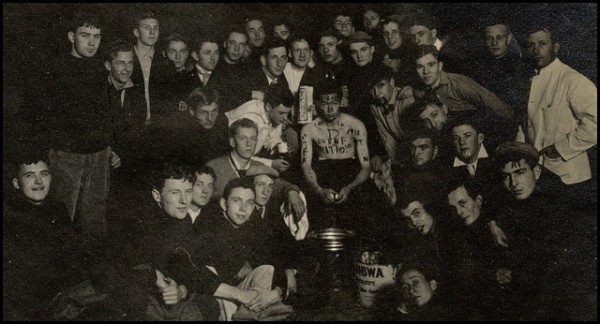
Hazing at the University of Michigan in 1907. Photo via VasenkaPhotography, Flickr CC.

Hazing has been in the news a lot recently. It exists across a variety of settings, including sports and the military.

Why does hazing occur? Some research discusses the function of hazing as rites of passage or as an expression of group solidarity. Hazing can bring members together, validate one another in the group’s eyes, symbolize transition into group membership, bolster group cohesion, and create group conformity within particular hierarchies.
Research on insider’s attitudes towards hazing highlights interesting dynamics within organizations. Individual members often have negative thoughts about hazing, but individuals are unlikely to protest the practice in-group settings. Power dynamics within those groups normalize hazing and silence opposition to it.
The research suggests that hazing takes on a particular character within Greek Letter Organizations (GLOs). In fraternities, for example, where membership and group identity are constructed around ideas of the “all-male” group, hazing can serve as a validation of masculinity and a suppression of femininity. In addition, in GLOs that have been historically raced, hazing can express racial identities, in-group unity, and belonging.
Taki Steve, Flickr CC.

A study published earlier this month in the Journal of the American Medical Association (JAMA) reports that over half of adults in the United States use prescription drugs, and as many as 15% of adults report using more than five prescription drugs each month. Recent coverage of these findings at NPR explores how increases in obesity and obesity-related illnesses may contribute to the increase in prescription drug use. Several sociological studies provide other potential explanations, including the increasing influence that pharmaceutical companies have over the doctor-patient relationship.

Though physicians are the ultimate gatekeepers for prescription drugs, the pharmaceutical industry drastically shapes prescription drug use. Through internal research studies and trials, pharmaceutical companies produce new knowledge about illnesses and treatment options. Pharmaceutical companies can even play an increasing role in medicalization—the process of constructing issues as specifically medical problems. By promoting the idea that something is a medical problem, pharmaceutical companies then offer a solution. Pharmaceutical salespeople aggressively promote their wares to clinicians, even promoting the off-label use of drugs to increase distribution.
Direct-to-consumer advertising may also lead to increase prescription drug use. Patients who see such ads may be more likely to self-diagnose and directly request drugs, and patients who request medication (whether a specific drug or just drug treatment in general) are more likely to be prescribed medication. Despite the potential for over-prescribing, direct-to-consumer advertising also encourages positive interactions between patients and physicians by providing patients with more information about current and undiagnosed conditions.
Twitter screenshot.
Twitter screenshot.

In the ongoing battles around whether to defund Planned Parenthood, Lindy West and Amelia Bonow created the Twitter hashtag #ShoutYourAbortion to encourage women to share their abortion stories, express their experiences, and recognize the stigma that often silences women who have an abortion. Consequently, many have criticized the hashtag and attacked the women involved. Supporters of #ShoutYourAbortion argue that sharing real women’s stories on social media produces cultural change around an issue surrounded by legal rhetoric. Sociological research details why women have generally felt compelled to stay silent about having abortions and the potential benefits of speaking up.

Many women believe that disclosing their abortion experiences will lead to negative responses from relatives and friends, due to widely held norms of femininity and motherhood that assert women are “natural nurturers” and the idea that having an abortion negates those qualities. In a classic study of pro-life and pro-choice activists, Kristin Luker notes that abortion is often seen as a “referendum on the place and meaning of motherhood.” For pro-life activists, terminating a pregnancy may be the ultimate example of being a “bad mother.” Rather than face anticipated judgment and condemnation around moral codes of appropriate feminine behavior, women then choose to conceal their procedures.
A major source of stress and frustration women experience centers on the gendered imbalance of responsibility for contraception and abortion decisions. Research finds that women are often expected be responsible for providing or taking contraception, but are heavily criticized when they take responsibility by choosing to have an abortion. Thus, Sally Brown argues, where women are held responsible for reproductive decisions, “decision making, if ‘decisions’ happen at all, is bound up with notions of hegemonic masculine and feminine roles.”
Stigma, however, does not reduce the likelihood that a woman will have an abortion. Cockrill and Nack write that even women who “believe abortion is morally wrong and that women who have abortions are careless and irresponsible will still have abortions.” Instead, the primary consequences of abortion stigma are decreased mental and physical health, strained relationships, and loss of social status. Spaces of affirmation and support like the #ShoutYourAbortion campaign allow women to engage in “collective stigma management,” offering a supportive network where their public presence can work to change social attitudes and shatter the silence surrounding abortion experiences.
spatz_2011, Flickr CC

Volkswagen’s CEO, Martin Winterkorn, recently stepped down amid a scandal over manipulated emissions tests. Researchers at West Virginia University found that VW diesel models used “defeat devices” that activated emission control systems only when being tested—that’s how they dodged emissions standards set by the Environmental Protection Agency. To what extent is Winterkorn responsible for this corporate skullduggery? And does the use of these devices constitute a “crime”?

Classic theories about corporate scandal stress “amoral calculus,” where individual decision makers of an organization weigh the costs and benefits of their actions. One example is the Ford Pinto debacle, when the company failed to recall Pintos with defective gas tanks because its “internal ‘cost-benefit analysis’” indicated the financial costs of a recall outweighed the potential cost of human lives (Dowie 1977). The media often responds to these corporate scandals by labeling white-collar criminals “bad apples,” shifting the public’s attention to the guilt of individual decision makers while hiding the social context that shapes norms within organizations
Sociologists show risky decision making stems from the “normalization of deviance” within an organization. Conforming to the culture, work group members can redefine deviant actions as normal or commonplace. In the Ford Pinto case, fuel tank ruptures were categorized as acceptable risk due to prevailing safety priorities and long-standing industry norms. In the Challenger Space Shuttle Disaster, escalating levels of technical failure were redefined as normal and acceptable due to increased bureaucratic pressures, NASA’s cultural understandings of risk acceptance, and high levels of organizational secrecy.
Other scholarship suggests that the Volkswagen emission fraud will not be labeled as criminal. Our definitions of what is criminal reflect societal beliefs rather than the “objective” dangers and risks posed to us. As such, we tend to emphasize poor or petty “street crime” while downplaying the acts of elites and corporations, or “white collar crime.” These corporate acts, however, result in serious harm and often parallel (or exceed) the harm caused by “street crime”. Fudging emission performance, however, might be defined as “corporate non-compliance,” rather than a criminal act. Subsequently, some of the costs, both physical and social, of corporate crime can go unnoticed.
Elvert Barnes, Flickr CC

Since his election in March 2013, Pope Francis has gained attention for his efforts to refocus the Catholic Church on issues of social justice. His recent visit to the U.S. was met with acclaim from religious leaders and political liberals, but also sparked consternation among cultural and political conservatives. U.S. Rep. Paul Gosar (R-AZ), a Catholic himself, boycotted Francis’s address to Congress and accused him of adopting “socialist talking points presented to guilt people into leftist politics.”

The cultural divisions within American Catholicism exposed by Pope Francis’s visit are not new. While Gosar may be more vocal than most conservative Catholics, his protest reveals a split between interpretations of the Catholic faith that have been simmering for generations.

Mary Ellen Konieczny shows that the narratives American Catholics use to construct their religious identities have profound political consequences. Some congregations use the language of community to structure their worship, while others structure their activities around the concept of family. In parishes where community talk is dominant, social justice is usually the focus of ministry, but in congregations where family is the main narrative, concerns about personal and sexual morality get more attention. Neither model is more Catholic than the other: both types of congregations draw upon doctrines and use ritual practices central to the Catholic tradition. Hence, the variation Konieczny observes has less to do with texts or doctrines than with the ways people interact in group settings.

The ideological divide in Catholicism also has historical roots in the relationships between the papacy and states. Gene Burns argues that as European states liberalized in the 19th century, Popes struggled to retain political influence for the church. Attempts to engage questions of poverty were seen as intrusions into government affairs, but through discussions of personal morality, the Church could carve out a space where its authority still dominated. As a result, the Church’s ideological emphases turned toward sexual morality and family issues, while sociopolitical concerns grew peripheral.
The postwar period saw a revitalization of Catholic religious activity in the politics of economic justice. Jose Casanova shows how the Solidarity movement in Poland and letter-writing campaigns among American nuns after Vatican II helped to steer church activity back toward social justice work, and John O’Brien charts the influence of labor activist-priest George G. Higgins on Catholic social thought in the 20th century.

Pope Francis’s return to social justice issues does not necessarily make him a “liberal” pope. We might better view him as interested in returning the Catholic church to a language of social justice, firmly rooted in Church history, despite being obscured by previous Popes’ focus on other issues.

Right: Taylor Swfit performing. Right: Ryan Adams performing. “Taylor Swift 007” by GabboT is licensed under CC BY-SA 2.0. “Ryan Adams, Clapham Common, Calling Festival, London” by Drew de F Fawkes is licensed under CC BY 2.0)

In 2019, after this post was published, Ryan Adams was accused of engaging in a pattern of manipulative behavior including verbal, emotional, and sexual harassment. You can read more of this coverage here.  (Updated, October 26, 2022)


The release of Ryan Adams’ cover of Taylor Swift’s 1989 resulted in a media frenzy about which album is “better” and who deserves credit for the “depth and complexity” that many say Adams brought to Swift’s poppier original. Some reviews argue Adams “vindicated” Taylor Swift as an artist; others argue that emotional depth was already present in Swift’s songwriting and reviews of Adams’ cover operate under gendered understandings of emotions and legitimacy in pop music. Many publications that reviewed Adams’ version did not review Swift’s original. Ironically, the albums will be competing for a Grammy this year, and many think Adams will take it over Swift. Sociological studies of popular music show how gender affects who gets credit for creativity in the industry.

Research finds that male musicians, regardless of genre, are more likely to receive critical recognition and be “consecrated” into the popular music canon. Women are less likely to be seen as “legitimate” artists and are more often judged on their emotional authenticity and connections with “more” legitimate, male artists. Further, newspapers and music critics are more likely to cover music written and produced by male artists.
Style doesn’t stem from the artist’s creative mind alone. Musical genres are gendered, as well as raced and classed. Industry norms require women and men to adopt different styles depending on the music genre in which they work. For example, women are more often expected to be sexual and/or emotional in their presentation of self and their music.

For more on gender in culture industries, check out this Discovery on fashion design.


Photo by Andrew Mager via Flickr.

With Apple Music’s launch and services like Spotify and Pandora going strong, music streaming is here to stay. Spotify recently released data on music preferences, giving us a new look into listeners’ lives. Metal rules over pop worldwide with the highest listener loyalty, especially with a tight-knit fan community. On the other hand, rigid genre boundaries may fade away as streaming listeners feel more comfortable trying just about anything. Demographics also matter; listeners “age out” of following popular music, and they do so much faster if they have children. Genres are more than labels on the shelf, though, and have more staying power when they represent social groups. Research shows these changes aren’t just about personal taste—social structure as a stronger effect.

We still use genre preferences to mark out a range of social boundaries. Education and political tolerance relate to “musical tolerance,” but people with these broad tastes are also more likely to say they don’t like music associated with uneducated fans (gospel, country, rap and metal).
Streaming allows more listeners to quietly cross these boundaries, but fan subcultures remain powerful social groups that encourage devotion—and sometimes deviance. Genre preferences associate with different kinds of substance use, and loyalty to a community of fans can create a strong culture of sharing and collection that sustains music file-sharing.
Most importantly, genre hopping is not new. The way music marks class and status has changed since the 1980s. While high status listeners used to prefer particular genres, younger generations mark status by “omnivorous” music habits—consuming a wide range of popular and obscure tunes.
Caitlyn Jenner in Vanity Fair, via Celebuzz.

You may have heard that Caitlyn Jenner’s Vanity Fair cover broke the Internet. The feature publicly introduced Caitlyn’s name and correct gender pronouns, as well as gender presentation. Within hours of the cover photo’s debut, Jenner’s new Twitter account amassed over one million followers, setting the record for the fastest growing Twitter account (knocking previous record-holder President Obama down to second).

The general public has varying attitudes about trans*, lesbian, gay, and bisexual people, both as the LGBT group and as distinct identities. Sexual orientation, beliefs about sexuality, adherence to a binary conception of gender, religiosity, and personal contact with sexual and gender minorities best predict attitudes towards lesbians, gays, bisexuals, and trans* individuals, but also vary based on the distinct group(s) being considered. For example, heterosexual females are more likely to hold positive opinions about gay men and trans* individuals, but are also more likely to hold negative opinions about lesbians.
Though increasing visibility is promising, researchers argue that media representations and discourses of trans* people often still conform to a rigid gender binary that reinforces cultural norms of masculinity and femininity. Jenner’s style choices are already under the microscope, and media outlets are labeling her a “diva” for her Diane von Furstenburg-clad appearances in New York City.
Limiting the hype about Caitlyn’s cover to her newly revealed gender identity overlooks other reasons why her photo shows up on so many Facebook and Twitter feeds. People already know Jenner as a celebrity, and celebrities arguably fall into a special category when it comes to class, status, and power. Fame can heavily influence individual opinions, but those effects depend on the celebrity in question and a person’s context within the larger population.