crime

Photo by The All-Nite Images, Flickr CC

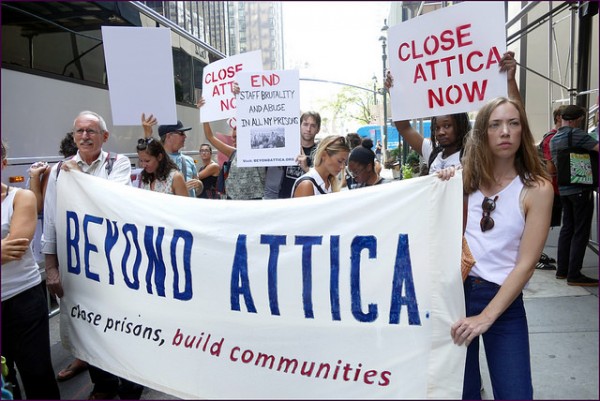
On the recent 45th anniversary of the Attica prison uprising, prisoners in at least 24 states protested inhumane living and working conditions, in what some observers are calling the largest national prison strike in American history. Led by inmate movements in Alabama and Texas that critique prison slavery, protests are still ensuing in many states, with demonstrations ranging from work stoppage to hunger strikes. As historian Heather Ann Thompson reveals in a recent article in the Atlantic, the parallels between these modern prison protests and the Attica prison uprising are clear:

“The root causes of the Attica rebellion were, as they are with the rebellions today, abysmal conditions in our nation’s correctional facilities.”

Thompson argues in her book that the political consequences of the misinformation surrounding Attica helped to legitimate the punitive turn in American imprisonment. Although Attica may have helped to perpetuate some of the problems in American prisons, Thompson believes that it also provides an example to those who are incarcerated that they have ways to take action.
The current uprising highlights not only unpaid labor but also issues of dismal healthcare and high rates of suicide in prisons, as well as the overuse of solitary confinement. Prison suicide rates are extremely high compared to the general population, and imprisonment may contribute to racial disparities in midlife physical health functioning.  Moreover, solitary confinement significantly damages the mental health of prisoners, especially if used for extended periods of time.
Not only are these protests in response to conditions within prisons, but also for related causes such as the school-to-prison pipeline. Recent evidence suggests a strong relationship between school sanctioning and future involvement with the criminal justice system.  Thus, many of the concerns of this prisoner movement are empirically supported but have yet to capture attention outside of the prison system.   

Want to know more? See here for live updates on the national prison strike.  

Actress Kerry Washington portrays Anita Hill in an ad for "Confirmation."
Actress Kerry Washington portrays Anita Hill in an ad for “Confirmation.”

In April, HBO premiered “Confirmation,” the story of Supreme Court Justice Clarence Thomas’s 1991 confirmation hearings. In those hearings, a former colleague, lawyer Anita Hill, testified about the ongoing sexual harassment she endured while working for Thomas. HBO’s film, some 25 years after the hearings that Thomas famously called a “high-tech lynching,” reminds us of the murky waters women must drudge through when facing and reporting sexual harassment—as well as how complicated the intersections of race, gender, law, and work can be.

Hill testified that Thomas sexually harassed her as her supervisor at the Department of Education and the EEOC. Various studies find that at least 40% of all women report experiencing sexual harassment at work during some point of their lives. Women of color experience higher rates of both sexual and ethnic workplace harassment.
Hill testified that she continued working for Thomas despite the ongoing harassment because she had no other job alternatives. This is unsurprising given that women in law professions encounter a glass ceiling that limits upward mobility, often pushing women to pursue a limited track of jobs when seeking promotions. Further, women in law professions report hearing sexist jokes, having their authority questioned, and being complimented on looks rather than achievements—all at higher rates than their male colleagues.
Even women in power are subject to sexual harassment. One study finds that sexual harassment can actually increase when some women occupy supervisory positions. Sexual harassment has much more to do with power than simple workplace hierarchies.
An officer wears a body camera in North Charleston, NC. Photo by Ryan Johnson, Flickr CC.

The issue of police brutality has long been a problem in U.S. criminal justice. Police-worn body cameras are one potential “remedy” to these violent encounters, but they have both benefits and drawbacks.

The cameras may increase transparency and improve police legitimacy, promote legally compliant behavior among both police officers and citizens, enhance evidence quality that can improve resulting legal proceedings, and deter officers’ use-of-force. Conversely, body-worn cameras could create privacy concerns for the officer and the citizenry and place a large logistical and financial burden on already cash-strapped law enforcement agencies.
This issue is so timely that research is only now starting to see publication, but we do have some early insights. The first observational studies examining the use of police-worn body cameras were carried out in England and Scotland. They found rates of citizen complaints dropped after body cameras were introduced. Preliminary results from an experimental study in Phoenix, Arizona also suggest that the use of body cameras reduces both self-reported and official records of citizen complaints.
The first experimental evidence concerning use-of-force comes from a large study in the Rialto, California Police Department, and the results should encourage advocates of body cameras. The study randomly assigned particular police shifts to wear body cameras (the “treatment”). Police shifts in the treatment condition are associated with reduced use-of-force: shifts in the control condition saw roughly twice as much use-of-force as the treatment condition and citizen complaints against the police were significantly reduced in the treatment condition.
Kurdish YPG fighters in Syria have skirmished with ISIS/ISIL militants said to especially fear death at the hands of a woman. The unofficial militias have been reluctantly accepted as allies in global attempts to destroy terror cells. Photo: Flickr CC https://flic.kr/p/qkxigM

From last year’s attacks in Paris to recent bombings in Ankara, Brussels, and Lahore, transnational terrorism is at the forefront of public concern. The media often gravitates toward focusing on who the perpetrators are and what drove them to commit these heinous acts. There is a wealth of research on the individual and psychological factors that may be at play, but sociological studies highlight the strong influence of social context and institutions in turning people toward terror, challenging easy explanations that focus on individual ideology alone.

Quantitative analysis shows how radical Islamic groups are motivated by many of the same social and political factors as older radical groups. Social and political change, especially international development, urbanization, and western military dependency, is associated with more frequent attacks. Higher foreign investment associates with a lower frequency of attacks, however, and research on terror in Israel shows this kind of conciliatory action may do more to limit terror than repressive strategies alone.
Research also shows that individual attackers are actually fairly “normal.” They are not more likely to be poor or poorly educated, and, often, they are not psychologically pathological. Instead, scholars look to the social arrangements of the institutions and networks that recruit and empower individuals. These terror groups are rarely centralized, hierarchical organizations that train bombers from on high; attacks stem from struggles for power among fractured organizations, local splinter groups, and state forces. As these conflicts escalate, local groups mobilize network relationships to recruit attackers and build the autonomy to develop their own motivational strategies to spur attacks. These local relationships and networks matter much more than individuals’ beliefs alone.
Photo by Faris Algosaibi, Flickr CC. https://flic.kr/p/j7hLsu
Photo by Faris Algosaibi, Flickr CC.

The FBI now says they may not need Apple’s help to break into a terrorist’s iPhone, but for months they have insisted Apple’s programmers must write a program enabling them to bypass security on this and other Apple devices. The demand raised questions about security and surveillance in a time of rapid technological change. Apple’s refusal to comply stemmed from both a philosophical stance on privacy and concerns that such a program could easily be exploited. The company and its programmers further argued that code should be covered by free speech protections—no one can be forced to write code against their will. Sociological research shows how assumptions about the objectivity of computer code work against arguments like Apple’s and how these assumptions are often used to legitimize the policing of already marginalized populations.

Apple’s concerns about controlling how and when a “break-in” program gets used are valid. Not only can it fall into the hands of hackers and the like, technologies like this can be used by law enforcement to maintain social inequalities and reinforce harmful stereotypes. Sociologists show how computer code and surveillance technologies are not value-neutral, but are instead composed of the values and opinions of those who write and use them. The result is that the police often use these presumably objective technologies to justify intrusive policing of the already at-risk.
From this perspective, it becomes easier to understand code as speech. Codes are the expression, intentional or otherwise, of the values and beliefs of the programmer. What makes code in some ways more powerful than speech is that it is also highly functional. Jennifer Peterson explains that code is at once the writing of a program as well as the program’s execution—it is both expressive and functional—but the legal system overlooks the functional capacity of code as speech and the ways that it can be used to protest, dissent, and discriminate.

And for a great read on surveilling sociologists, check out Stalking the Sociological Imagination: J. Edgar Hoover’s FBI Surveillance of American Sociology by Mike Forrest Keen.

Robert Elyov, Flickr CC https://flic.kr/p/8RUdpc
Robert Elyov, Flickr CC

In July 2015, four California state prisons began supplying condoms to prisoners, and more will follow suit in the next next five years. California, however, is only the second state to address infectious diseases in prisons. Prison officials are skeptical of the new law, though its ability to slow the spread of HIV and other sexually transmitted diseases among inmates may prove significant.

Sexual contact amongst U.S. prisoners is a complex issue emanating from societal expectations of sexuality and masculinity. Many of those who are incarcerated are young, unmarried, working-class men who are effectively cut off from the outside world and heterosexual encounters. As a result, many who identify as straight engage in male-to-male sex behind bars. This “institutional homosexuality” separates sexual behavior from sexual orientation.

Preventing the spread of sexually transmitted diseases in prison populations is a complicated matter. In the past, condom distribution was refused for two main reasons: the denial that male-to-male sex occurred in prison, and the illegal status of such encounters. To slow the spread of sexually transmitted diseases in prison and when inmates are released, both facts must be acknowledged.

U.S. prisoners are guaranteed access to health care. Unfortunately, rather than receiving cost effective, preventive measures to combat STIs, inmates usually only receive treatment after contracting one—and that’s costly in terms of money and health.

Sara Anderson will graduate from University of the Pacific in May 2016 with a degree in social sciences. She will attend law school in the fall.

A sculpture in Bangladesh commemorates atrocities of wartime rape. Photo via Wikimedia Commons.

Nadia Taha, a Yezidi woman, recently spoke to the UN about her horrendous experience as a sex slave for ISIS. The so-called Islamic State has also exploited Christian, Turkmen, and Shia women. Wartime rape is an age-old weapon, seen still in conflicts in Sierra Leone, Bosnia-Herzegovina, and Rwanda. Social scientists reveal the power dynamics at play by studying both the victims and perpetrators.

Rape is an individual crime as well as a weapon of war that enforces social power. Social groups use it to help carry out genocide, instilling fear, and force displacement. Rape also alters the racial and ethnic demographics of the targeted group and intimidates groups where women are considered to be bearers and keepers of culture.
Women and men are victims of rape during conflict. Women are targeted according to their cultural beliefs, desirability, reproductive ability, and virginity. Rape is used against men to “feminize” them, emasculating and implying homosexuality and weakness.
Perpetrators of rape during conflict include agents of the state (military, police, etc.), political groups (paramilitaries, terrorist groups, etc.), and politicized ethnic groups (e.g., Rwanda’s Hutu). As such, the International Criminal Tribunal for Rwanda decided that perpetrators of rape can be punished as individuals and states would be held responsible for either perpetrating sexual crimes or for failing to protect their citizens from such terror.
Job application via PBS.org.

Conservative and liberal legislators alike are calling for criminal justice reform. Last November, President Obama proposed a “ban the box” initiative that prevents federal agencies from inquiring about an applicant’s criminal history during the initial stages of the hiring process. The plan mirrors similar policies in over 100 U.S. cities that seek to reduce employment discrimination against people with criminal records and alleviate the socioeconomic burdens they often face as they reenter the job market. Social science highlights the scope of this problem and how ban the box policies may help.

Employers often dismiss applicants with criminal records, which disproportionately affects black men. A Milwaukee study revealed employers contacted only 5% of black men who disclosed a record; even black men without a criminal record were less likely to receive a callback than their white male peers with a criminal record. Thus, even in the absence of criminal background checks, employers may use racial indicators, education levels, and gaps in employment to evaluate potential criminality among job applicants.
Among candidates with a record, employers may consider the severity of the crime, the time since the crime was committed, and the outcome of the crime. Felony crimes and convictions appear to create the most barriers, while job applicants with misdemeanor arrests face lower hurdles. Since interviews with employers show that making personal contact with job applicants can help overcome the negative effects of a criminal record, “ban the box” measures that delay consideration of the criminal record until the interview process could make a real difference in individuals’ job prospects.
Innocence Project Stats
Click to visit the Innocence Project.

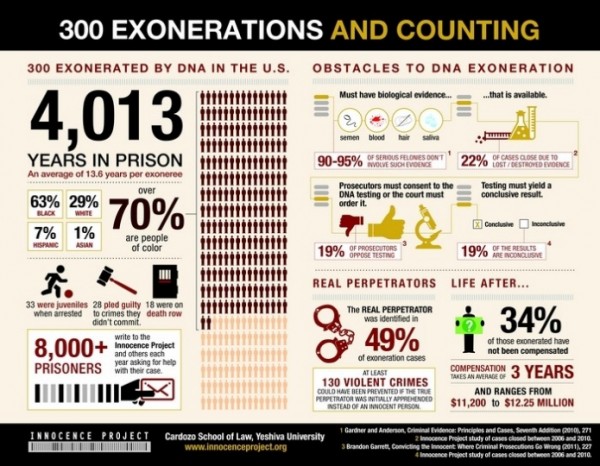
Netflix made a big splash in “true crime” with its series Making a Murderer, chronicling the investigations and trials of Wisconsin man Steven Avery. Exonerated after 18 years in prison for sexual assault in 2003, Avery was arrested for a new crime—murder—in 2007. Public debate about the documentary revolves around whether Avery’s innocent, potential misconduct in the justice system, and the ethics and consequences of documentary “vigilante justice,” but there is little doubt Avery was wrongfully convicted the first time around, in 1985. Social science helps us understand the more systematic consequences of incarceration and exoneration that cultural phenomena like Making a Murderer, the Serial podcast, and even the upcoming miniseries “The People v. O.J. Simpson: American Crime Story” bring to our attention.

Pop culture tends to focus on errors, like witness misidentification and shoddy forensics, but those are not the only things that lead to wrongful convictions. Sociological research shows blacks and Hispanics are at a higher risk, and these groups are, in fact, overrepresented in samples of exonerees. Black exonerees suffer longer periods of incarceration between their conviction and exoneration than other groups. And exonerations often raise questions about the criminal justice system’s authority and legitimacy in the eyes of the public.
Exonerees, even those who aren’t in a media spotlight, face practical problems after they are released from prison. The stigma of having served time diminishes chances in the employment and housing markets, even for those who are exonerated. Like others experiencing reentry after incarceration, exonerees also face unmet needs with regard to physical, dental, and mental healthcare, as well as the myriad challenges of rebuilding social networks and reintegrating to everyday life.
At the Indiana Women's Prison. Lwp Kommunikáció, Flickr CC.
At the Indiana Women’s Prison (established in 1873, the first adult women’s correctional facility in the U.S.). Lwp Kommunikáció, Flickr CC.

Many more men are incarcerated than women, but from 1980 to 2014, the number of women in state and federal prisons rose from just over 13,000 to more than 106,000, making women the fastest growing prison population in the U.S. This drastic increase is due in part to the War on Drugs and the shift to a “tough-on-crime” logic in the 1970s and ‘80s. For women, the mass incarceration era doesn’t just exert tougher penalties; it also carries over an earlier, paternalistic way of disciplining women.

Before mass incarceration, women’s prisons operated under rehabilitative models. These viewed women’s criminal behavior as a result of their vulnerability or dependency, rather than dangerousness. Inmates were sometimes called “girls” and referred to the warden as “daddy.” Later tough-on-crime policies increased security, abolished mandatory counseling, and emphasized order and control in women’s prisons. Still, some contemporary prisons maintain a paternalistic attitude by offering women “treatment” that focuses exclusively their perceived inability to make good choices in the face of challenges from men, drugs, or a history of abuse.

In other words, incarcerated women are hit with a double bind. Strict sentencing policies ignore social context and drastically increase the number of women in prison, while the paternalism of the past shapes how the criminal justice system interprets and judges their behavior and prospects for rehabilitation.