crime

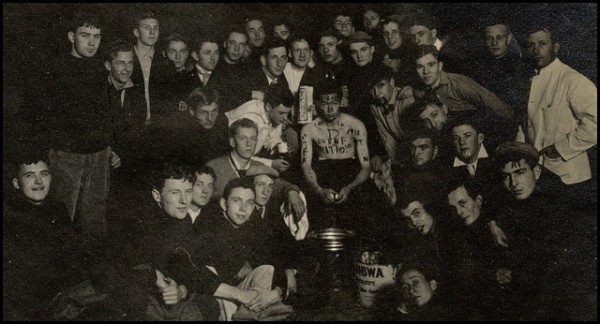
Hazing at the University of Michigan in 1907. Photo via VasenkaPhotography, Flickr CC.

Hazing has been in the news a lot recently. It exists across a variety of settings, including sports and the military.

Why does hazing occur? Some research discusses the function of hazing as rites of passage or as an expression of group solidarity. Hazing can bring members together, validate one another in the group’s eyes, symbolize transition into group membership, bolster group cohesion, and create group conformity within particular hierarchies.
Research on insider’s attitudes towards hazing highlights interesting dynamics within organizations. Individual members often have negative thoughts about hazing, but individuals are unlikely to protest the practice in-group settings. Power dynamics within those groups normalize hazing and silence opposition to it.
The research suggests that hazing takes on a particular character within Greek Letter Organizations (GLOs). In fraternities, for example, where membership and group identity are constructed around ideas of the “all-male” group, hazing can serve as a validation of masculinity and a suppression of femininity. In addition, in GLOs that have been historically raced, hazing can express racial identities, in-group unity, and belonging.
Coates' latest book reflects on race and the justice system. Click for publisher site.
Coates’ latest book reflects on race and the justice system. Click for publisher site.

In The Atlantic, Ta-Nehisi Coates’ “The Black Family in the Age of Mass Incarceration” details the historical development of the carceral state, its consequences on current and formerly imprisoned black Americans, and the unique challenges families face during their absences and returns. Coates cites and interviews several prominent sociologists for their insight into the carceral state’s repercussions for black Americans specifically. We rounded up some of their best work on the topic.

The 1970s saw increasing unemployment and concentrated poverty. Legislators developed “tough on crime” policies that resulted in the start of a massive increase in the number of incarcerated individuals in jails and prisons. Increases in incarceration, however, do not appear to have had a significant effect on decreasing crime rates.
Mass imprisonment has a wide range of collateral consequences. Those who serve time face health risks, familial struggles, and barriers to employment before and after they are released.
spatz_2011, Flickr CC

Volkswagen’s CEO, Martin Winterkorn, recently stepped down amid a scandal over manipulated emissions tests. Researchers at West Virginia University found that VW diesel models used “defeat devices” that activated emission control systems only when being tested—that’s how they dodged emissions standards set by the Environmental Protection Agency. To what extent is Winterkorn responsible for this corporate skullduggery? And does the use of these devices constitute a “crime”?

Classic theories about corporate scandal stress “amoral calculus,” where individual decision makers of an organization weigh the costs and benefits of their actions. One example is the Ford Pinto debacle, when the company failed to recall Pintos with defective gas tanks because its “internal ‘cost-benefit analysis’” indicated the financial costs of a recall outweighed the potential cost of human lives (Dowie 1977). The media often responds to these corporate scandals by labeling white-collar criminals “bad apples,” shifting the public’s attention to the guilt of individual decision makers while hiding the social context that shapes norms within organizations
Sociologists show risky decision making stems from the “normalization of deviance” within an organization. Conforming to the culture, work group members can redefine deviant actions as normal or commonplace. In the Ford Pinto case, fuel tank ruptures were categorized as acceptable risk due to prevailing safety priorities and long-standing industry norms. In the Challenger Space Shuttle Disaster, escalating levels of technical failure were redefined as normal and acceptable due to increased bureaucratic pressures, NASA’s cultural understandings of risk acceptance, and high levels of organizational secrecy.
Other scholarship suggests that the Volkswagen emission fraud will not be labeled as criminal. Our definitions of what is criminal reflect societal beliefs rather than the “objective” dangers and risks posed to us. As such, we tend to emphasize poor or petty “street crime” while downplaying the acts of elites and corporations, or “white collar crime.” These corporate acts, however, result in serious harm and often parallel (or exceed) the harm caused by “street crime”. Fudging emission performance, however, might be defined as “corporate non-compliance,” rather than a criminal act. Subsequently, some of the costs, both physical and social, of corporate crime can go unnoticed.
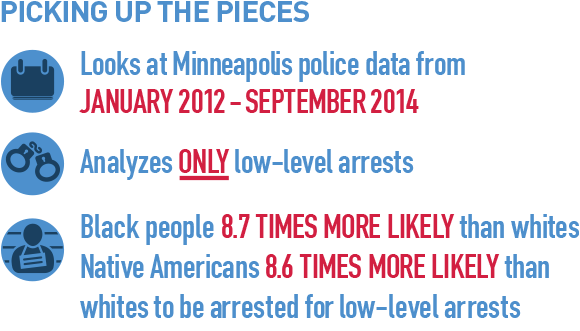
Via aclu.org.
Via aclu.org.

A recently released ACLU investigation a found that black residents of Minneapolis were 8.7 times more likely to be arrested for low-level offenses than white residents between January 2012 and September 2014. The report is the latest in eight city case studies, all of which “describe police departments that reserve their most aggressive enforcement for people of color.” The Minneapolis City Council also recently repealed spitting and lurking ordinances, two examples of the low level offenses cited by the report. Recent sociological research strikes a similar chord; it demonstrates how modern law enforcement isn’t just about crime, but controlling groups of people with minor rules and regulations.

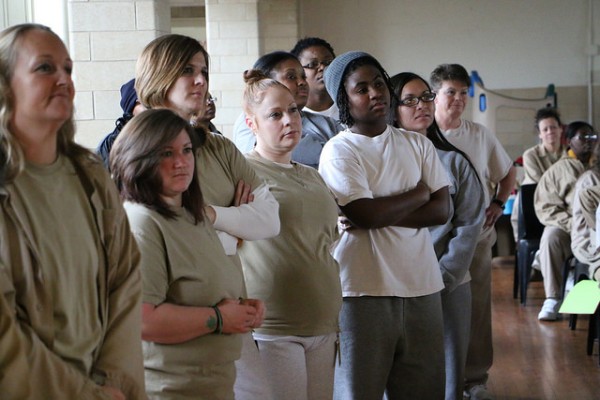
Public discussion about crime tends to focus on felonies, but the majority of law enforcement activity today is geared toward misdemeanors. Even without conviction and sentencing, these minor offenses bring more people into the criminal justice system. The procedural hassle of dealing with a minor criminal record means more people are under this systematic control at any given time, regardless of their guilt or innocence.
The ACLU report finds people experiencing homelessness are the most vulnerable to this system, and many are charged for minor offenses that directly result from being homeless (like panhandling or sleeping outside). Many cities criminalize these behaviors as a way to control space, even to the point that those with criminal records are barred from entering certain neighborhoods.
This law enforcement isn’t just about crime, but also about power in communities of color. Neighborhood-level analysis shows that the stereotypical relationship between race and violent crime rates disappears for communities with more African Americans politically organizing and serving, either in office or on civilian review boards for the police. One of the ACLU’s recommendations to improve the situation in Minneapolis is to establish such review boards.

By Evan Stewart, Jack Delehanty, Ryan Larson, and Stephen Suh

The shooting of three young adults in Chapel Hill, North Carolina, raises a number of questions about hate crimes in the United States. All three victims were Muslim, and interviews with their family members about previous conflicts indicate the killings may have been motivated by anti-Islamic sentiment. On the other hand, police released a statement that the killings were motivated by a parking dispute, and the regional U.S. attorney called them “an isolated incident.” Research shows the social context of a crime matters, even when it isn’t officially labeled a “hate crime.”

Hate crimes are retaliatory and respond to particular social events and contexts. Racialized talk of hate crime, especially when discussed over the Internet, is provoked by anxieties over close social ties to minorities—such as interracial marriage or integrated neighborhoods—more than economic competition. Time, neighborhood, and labeling factors all point to social context as a necessary tool to understand hate crimes.
Social context is often ignored in hate crime data. Government offices and watchdog organizations often define hate crimes differently than others, and their data focus on the number of attacks rather than contextual risk factors. This makes it difficult to study hate crimes, especially when witness reports or police records show a parking dispute.
Anti-Islamic attitudes are also central to the UNC case. Emerging research indicates these attitudes are unique in the U.S. context as well, where racial bias interacts with cultural bias against public religious practice in a particular political climate.

Attorney General Eric Holder has reduced the ability of law enforcement agencies to seize assets without a criminal conviction, an “informal measure” of policing known as civil forfeiture. The program had been expanded by the 1984 Comprehensive Crime Control Act in an effort to curtail the sale and distribution of illegal drugs, and it has since allowed law enforcement agencies to divide and keep the majority of proceeds seized from forfeitures.

Proponents argue that civil forfeiture makes certain crimes less profitable and redistributes resources for socially beneficial programs. Critics say it might be part of a “hidden economic agenda” behind “tough on crime” initiatives and can lead to due process infringements
Institutional contexts are important: 40% of law enforcement agencies report dependence on the revenue produced from civil forfeitures. Agencies in states with strict forfeiture policies tend to use federal “equitable sharing” policies more often, even after accounting for factors such as official crime rates and drug arrests. This suggests agencies try to maximize their returns on civil forfeiture seizures.
Law enforcement agencies operating in high inequality areas and more conservative voting districts seize more value per drug arrest. This ratio also increases with agency complexity but drops in districts with higher black populations. Agencies may use more formal measures, such as arrests, in majority minority areas.

Charles Blow recently devoted his Times column to relaying the news that his son, a junior at Yale, was racially profiled and detained at gunpoint by campus police. Blow mentions that he was glad he had had “the talk” with his son—how to deal with police as a black man:

This is the scenario I have always dreaded: my son at the wrong end of a gun barrel, face down on the concrete. I had always dreaded the moment that we would share stories about encounters with the police in which our lives hung in the balance, intergenerational stories of joining the inglorious “club.”

When that moment came, I was exceedingly happy I had talked to him about how to conduct himself if a situation like this ever occurred. Yet I was brewing with sadness and anger that he had to use that advice.

Blow is not the only parent to impart such advice—recall New York Mayor Bill de Blasio’s controversial comment about advising his biracial son in dealings with police. Poor, middle-class, and even rich and well-known* parents of children of color advise their children on how to stay safe—to thrive, they must survive.

Scholars call how parents talk to their children about racial discrimination and how to cope with it “preparation for bias,” and it is just one practice among several that comprise ethnic-racial socialization.
Sociologist Patricia Hill Collins powerfully conveys how this work is done by black women sharing child-rearing responsibilities within woman-centered networks.
And these lessons seem necessary: Black adolescent males report repeated negative interactions with police and black mothers report constant worry about the well-being of their sons, who they believe are profiled and targeted by both police and other citizens.
Parents emphasize racial barriers and protocol to prepare their children for racism, often using role-playing to demonstrate how to reduce risk in reacting (or not reacting) to discrimination.

*For his part, Blow’s son acknowledged his own class privilege in having his experience so widely publicized, a statement his father shared on Twitter.

Last month the Senate Intelligence Committee released its report on the CIA’s use of “enhanced interrogation techniques.” News outlets have raised a number of disturbing takeaways from the report’s 500+ page summary, including the gritty details of torture, the failure of many of these practices to get results, and the $81 million paid out to the advisors who helped design them. We typically think of torture as either a barbaric practice or a necessary, if extreme, evil in some limited cases. But while the public wonders whether it actually works, research shows this question doesn’t really decide whether an organization will turn to torture in the first place.

Torture only works because of a highly developed social relationship where the perpetrator can perceive the victim’s pain, but continue with the practice. Randall Collins argues this makes it an extreme way to symbolize human social boundaries—who is in with the powerful community and who is not. This relationship maintains dominance, regardless of whether it gets information.
When torture hits the news, leaders care more about managing the public response than ending this social relationship. Analysis of the Senate Armed Services Committee meetings after Abu Ghraib came to light in 2004 shows how leaders interpreted widespread torture as “isolated incidents.” Experimental surveys of Iraqi judges found they were more likely to give lenient sentences in hypothetical cases of Coalition torture if they felt secure from future crime and protected by police.
All this points to a broader claim about the “dark side of organizations:” their misbehavior is often routine. When the public finds out, organizations are often more concerned with making sure the routine isn’t destroyed by being labeled as a widespread mistake, misconduct, or disaster. Instead, they admit to individual wrongdoing—like isolated incidents of torture that didn’t work—to avoid bigger questions about why torture happens in the first place.

The U.S. Supreme Court recently heard arguments in Young v. United Parcel Service. The outcome will affect many American women’s ability to financially support their families and even have children.

Pregnancy discrimination, while widely illegal, happens when some employers illegally terminate their female workers. They are not explicitly fired for being pregnant, but instead branded “bad workers” by managers. The organizations then use run-of-the-mill meritocratic policies to fire the women.

Reginald A. Byron and Vincent J. Roscigno. 2014. “Relational Power, Legitimation, and Pregnancy Discrimination,” Gender & Society 28(3):435–62.

Pregnancy is a particularly vulnerable time for women; it holds health, legal, and employment risks. A systematic examination of arrests of and forced interventions in the lives of pregnant women in the U.S. shows a variety of concerns about their health, dignity, and autonomy.

Lynn M. Paltrow and Jeanne Flavin. 2013. “Arrests of and Forced Interventions on Pregnant Women in the United States, 1973–2005: Implications for Women’s Legal Status and Public Health,” Journal of Health Politics, Policy and Law.

A variety of laws and their sometimes-selective enforcement affect women’s ability to be healthy and valued members of society.

Jeanne Flavin. 2009. Our Bodies, Our Crimes: The Policing of Women’s Reproduction in America. New York: NYU Press.

Beyond pregnancy discrimination, mothers are paid less than childless women. A portion of this motherhood wage penalty is due to discrimination.

Stephen Benard and Shelley J. Correll. 2010. “Normative Discrimination and the Motherhood Penalty,” Gender & Society 24(5):616–46.

Just when we thought the season’s hottest tablet or smartphone picked up on Black Friday might be a new FBI black site, The Economist reports some tech giants are working extra privacy measures into their gadgets to protect user data. By making services like text encryption available by default, this trend provides extra privacy for some users (mostly those who aren’t already targeted for surveillance), despite criticism from law enforcement that it shields criminal networks from investigation. While we usually think about privacy as an individual right to be left alone, social science shows why these trends are important for a public conversation about what privacy should be.

Americans’ emphasis on the right to privacy remains high, and while public opinion did tend to favor increased government surveillance immediately following September 11th, 2001, support for these practices has declined since.
But privacy isn’t just isolation from governments or other people. Classic research argues it is an ongoing social relationship where we negotiate interactions with others, and more current work shows this relationship changes across time and place.
Current studies of how people use technology show that privacy concerns kick in when people share information online. It also finds this focus on individual behavior ignores structural privacy concerns about the devices themselves and how people learn to interact with them. The “encrypted by default” trend starts a new conversation about what our shared, social definition of privacy should be.