work

Beth T. sent us this picture of some books for sale at the NASA John Glenn Research Center in Cleveland.  I found some more at the website. They nicely illustrate the gendering of jobs.  Only because we implicitly think that zoologists, oceanographers, paleontologists, and architects are men, is it necessary to modify the term with “woman.”

Before there were flight attendants, there were stewardesses.  Below a vintage commercial for airlines (found here thanks to AdFreak, see also this print ad):

While pressure on airlines to be less sexist means that we don’t see ads like this anymore, Stephen W. alerted us to the ongoing sexism in “general aviation,” that is private planes and jets owned by individuals and companies.

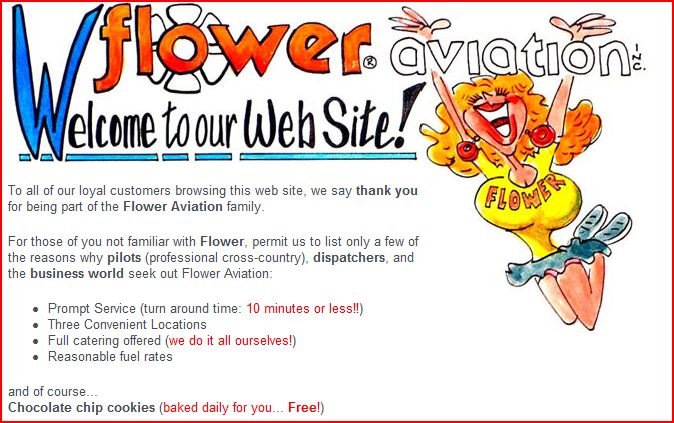
Airports have FBOs (or “fixed based operators”) which are, essentially, glorified gas stations for planes.  A private pilot can choose which airport and thus FBO, or which FBO at which airport, to patronize.  So FBOs will compete for customers.  Stephen pointed to one strategy: plying pilots, assumed to be men, with sex.

This website allows pilots to see what “FBO Girls” all over the country, the women working behind the counters at FBOs, look like.  Another website, FBO Hotties, allows pilots to submit their favorite girls.

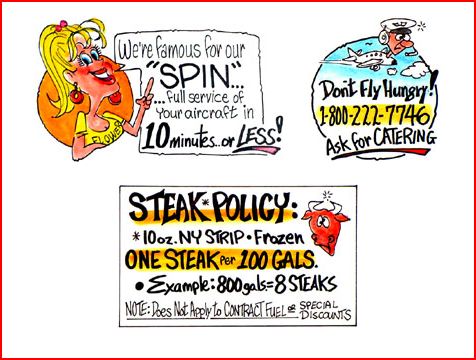
Flower Aviation promises that you will be guided into your parking spot by “girls in short ‘skorts’ and tank tops.”

Here are some of the images from the website, notice that when you spend money on fuel, they reward you with red meat (and fresh baked chocolate chip cookies):

So, there you have it.  Private aviation, still very much a man’s world.

Other than the objectification, I think an interesting sociological question might be: Why have the airlines dropped overt sexist advertising, while general aviation has not? One possibility is that general aviation is, literally, less public and, thus, less vulnerable to public censor. Another may be that pilots are still overwhelmingly men, unlike the customers served by airlines, and so there may still be profit in sexism for general aviation, but not in commercial aviation. I’d welcome your thoughts as well.

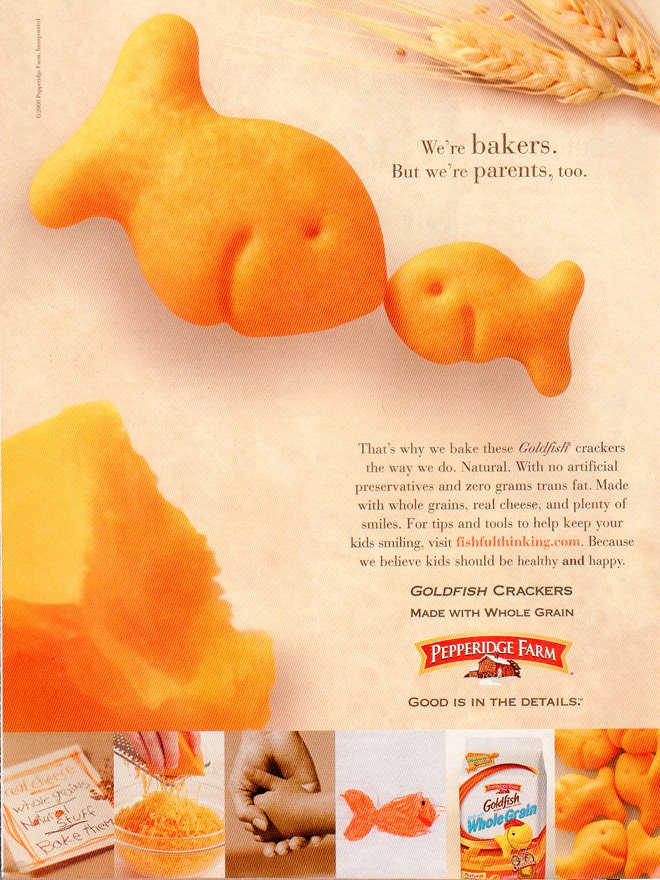
There is a lot going on here.  Comments after the image (found at MultiCultClassics):  

First, notice how this ad mobilizes a nostalgia for a simpler past (“We’re bakers”).  Goldfish crackers are likely baked not by bakers (how quaint), but in large automated factories.  Second, in line with this nostalgia, Pepperidge Farm, the company, is recast as a parents (“We’re bakers. But we’re parents, too”) instead of a corporation in a capitalistic society likely employing low-wage workers (who are not, by the way, busy caring about consumers kids).  Notice that, by re-casting the company as parents, they encourage you to think of the company’s motives not as profit, but nurturing.  Third, the Goldfish crackers themselves are anthropomorphized into a happy parent and child. Finally, happiness and family togetherness are commodified. Text:

That’s why we bake Goldfish crackers the way we do. Natural. With no artificual preservatives adn zero grams trans fat. Made with whole grains, real cheese, and plenty of smiles. For tips and tools to help keep your kids smiling, visit fishfulthinking.com. Because we believe kids should be happy and healthy.

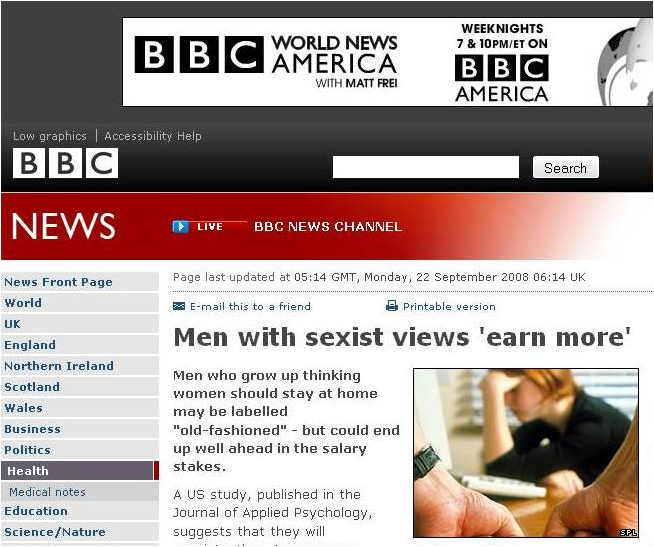
Jessica at Scatterplot notes the difference between the BBC coverage and the U.S. coverage of a recent research report noting that the real gender gap is between men who believe men should be breadwinners and women homemakers and everyone else (men who believe women and men should share in both breadwinning and homemaking, women who believe the same, and women who believe that they should be homemakers and men breadwinners) (i.e., at msnbc).  Here are two screenshots of the coverage:

Did you catch the difference?

Angela B. brought our attention to an animated map showing, over the space of some seconds, the growth of Walmart across the United States from 1962 to 2007.  Below is the final image.  It’s worth a click to watch the growth yourself.

Blanca M. sent in this picture she took here in Las Vegas of a truck advertising Air Conditioning Technical Institute. The truck says “Hot City, Cool Career,” and then had this image on the side.

When you go to the website, you see a video (which I can’t embed, sorry) of a man driving up to a house in a sports car. A blonde woman comes out and gushes over the car. The man then says “Six months ago she wouldn’t have given me a second look. I had no job, no education, I was living with my parents.”

So apparently air conditioning tech school is appropriate only for men, and guarantees that you will make enough money to get the hot women you’ve always wanted. Aside from the clear objectification of women as sexual rewards for men, it reinforces the idea of women as opportunistic gold-diggers. It’s also an interesting perspective on how men should view relationships–that they should be perfectly happy to be with women who don’t like them for who they are, and who would presumably leave them if they lost their job or got a pay cut. As long as the woman’s hot, a guy is apparently supposed to be satisfied with the relationship and not worry about little things like whether his wife actually loves him–we reserve concerns about love and emotional closeness for women only.

Thanks, Blanca!

Sine A. sent in this awesome photo that she and Kayt S. took at a construction site in Fairbanks, Alaska:

As Sine points out, given the history of frequent resistance to women in male-dominated jobs and in unions, it’s “refreshing and quite startling to see this sign on a job site.”

Thanks for an awesome pic, Sine!

This sign was posted in sight of the customer at the Days Inn (where I stayed when I failed to get out of Logan airport after the American Sociological Association meetings in August of 2008).  I have incuded three observations after the image and text.

Text:

At Days Inns…

We Promise…
“Service with a smile, a cheerful greeting, a pleasant Hello.”

We Mean It When We Say…
“It’s no trouble at all.”

We Want To Know…
“If you enjoyed your stay.”

Because At Days Inn…
“We look forward to seeing you again.”

That’s our promise to you from every member of the Days Inn family.

(1) It is a nice example of the kind of emotional work that employees are required to do.  It’s not just about getting customers into rooms efficiently and politely, it’s about a putting on a shit-eating grin and kissing their asses.  Or else you’re fired.

(2)  It’s also an example of a for-profit company calling itself a “family.”  You are supposed to do things selflessly for your family, but you work at a job for money.  Comparing a company to a family, I suspect, is one way to get employees to give to the company out of kinship-like duty instead of on contractual terms for money.  This, of course, and ironically, lines the pockets of executives quite nicely.

(3) The logic behind their use of quotation marks eludes me.

NEW: I took these picture in a Kaiser Permanente hospital in Hollywood in October 2008.  Close-ups and remarks below.


Like in the Days Inn example, employees at Kaiser are to do more than simply do their job effectively, they must do it “pleasant[ly]” and with “care.”  It is one thing to be instructed to “gather information with consideration for confidentiality,” and quite another to be asked to “convey trust and confidence.”  Scholars of emotion work note that the emotional part of jobs is (1) rarely seen as a skill or (2) a toll that makes your job trying and is, therefore, (3) undercompensated.  Yet, the ability to “convey trust and confidence” in strangers is certainly a special one and the health insurance employee that can do that is certainly valuable.  Unfortunately, like with other type of care work (i.e., nursing, teaching), that “value” is mostly lipservice and rarely translates into anything with exchange value (i.e., CASH).

For another example of emotion work, this one a sneak look behind the counter, click here.