race/ethnicity: Whites/Europeans

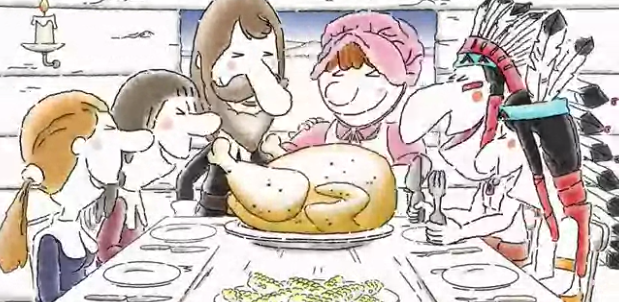
Still from a 2013 Red Bull commercial:
Red Bull TV Commercial

The winter of 1620 was a devastating one for the colonists who had just arrived from England in New Plymouth.  They suffered from scurvy, exposure to the elements, and terrible living conditions.  Almost half (45 out of 102) died; only four of the remaining were women.

They made contact with the Wampanoag tribe in March.  The tribe taught them how to grow corn and donated food to the colony.  Thank to their help, the pilgrims were able to celebrate a harvest, or thanksgiving, that fall.  It was attended by the 53 remaining pilgrims and 90 indigenous Americans.

That’s why this Red Bull commercial is so annoying.  In the final 12 seconds, you see four pilgrims and two Indians, three women and three men. So, by pure numbers, reversed and heavily female.  The turkey is served by a pilgrim, sending the message that the pilgrims were feeding the Indians and not vice versa.  It’s a woman, of course, but likely most of the food preparation would have done by men, since they were 77% of the colonist population.

But, it nicely lines up with how we apparently think the world should be today: multicultural but majority white, with women cooking, and everyone paired up in same-race, heterosexual monogamy.

It’s the little things, you know.

Thanks to Jeff S. for the tip!

Lisa Wade, PhD is an Associate Professor at Tulane University. She is the author of American Hookup, a book about college sexual culture; a textbook about gender; and a forthcoming introductory text: Terrible Magnificent Sociology. You can follow her on Twitter and Instagram.

131105124405-04-richie-incognito-horizontal-gallery
Source: Doug Benc/Getty Images.

On October 28th, Miami Dolphins offensive lineman Jonathan Martin left the National Football League citing emotional distress as a result of abuse at the hands of his teammate Richie Incognito.  Incognito admits to having sent Martin racist, homophobic, and threatening text messages and voicemails but argues that rather than hazing or bullying, this was merely an instance of miscommunication between the two men.

While a great deal of media attention has questioned the behavior of Richie Incognito, a disproportionate amount of attention has also been given to Martin’s choice to report the abuse.  Why has Martin’s choice to report the abuse received so much attention?  What has been the main theme of those critiquing Martin’s choice?  And, what does this discussion mean for our national discourse on bullying and hazing?  The answers to these questions, I argue, are all linked to masculinity.

The media talks about Martin’s choice to report because his decision violated accepted cultural norms of masculinity.  Some may call these norms, more colloquially, the “bro code,” “guy code,” or “man code.”  Whatever we choose to call it, there are accepted ways in which men and boys are expected to conduct ourselves and our relationships to other men.  Martin stands accused, especially within the athletic community, of having broken the code.

In a very telling interview, Channing Crowder, a former teammate of Incognito, made it clear that this conversation is really about masculinity.  According to Crowder, Incognito tests his teammates.  He “tests you to see if you have enough manhood or enough testosterone” (even though this type of bullying is just as much about the perpetrator’s masculinity as it is the victim’s).

In this case Martin’s masculinity is under attack on two fronts.  First, it is under attack because he failed Incognito’s “test” of his manhood.  Second, he is under attack because his solution to Incognito’s bullying violated guy code.  According to the code, real men solve their problems with one another through violence.

Sports Illustrated reported that many NFL personnel consider Martin to be a coward or a wimp for reporting the abuse.  One NFL informant was even quoted saying “I think Jonathan Martin is a weak person.  If Incognito did offend him racially, that’s something you have to handle as a man.”  Others said it would have been preferable for Martin to “go down swinging” or to “fight.”  Even NPR ran a piece in which a regular guest argued:

Martin should have taken that dude outside and put his lights out.  I do not – I absolutely do not believe in a society where we run to the principal’s office every time these petty tyrants make a threat… Only power dispatches bullies… Jonathan Martin is a grown man and you can’t bully a grown man.

To be fair, in that same NPR piece, another interviewee stated that “not everybody resorts to violence in response to bullying and I applaud him for that.”

Nevertheless, by reporting the abuse rather than physically confronting Incognito, Jonathan Martin has been publicly stripped of his “man card.”

But, so what?  Why should we care about how grown men address bullying?  We should care because just as Jonathan Martin is being told to “man up,” so are young boys all over the country when they are bullied.  Boys are told that when they cannot physically confront a bully they are inadequate and unworthy.  They are taught to remain silent in the face of insurmountable violence because speaking out is a sign of weakness, or worse, femininity.  Too many boys are left with nowhere to turn when bullying makes trauma a daily experience.  In this sort of environment can we really be surprised that boys are committing suicide, developing depression, and lashing out violently at incredibly high rates?

Incognito on film:

Cliff Leek is a PhD student in the Department of Sociology at Stony Brook University.  He is a News Editor for Sociology Lens, co-founder of Masculinities 101, a Program Director for the Center for the Study of Men and Masculinities and a Research Assistant to TrueChild.  

Cross-posted at Sociology Lens and The Good Men Project.

“It’s worth recalling that Loving v. Virginia, the Supreme Court case that struck down laws prohibiting interracial marriage, centered on the union of a white man and a black woman. These laws ended at least in part because, in an ironic twist, racism had interfered with a white man’s right to choose.”

— Jelani Cobb for The New Yorker.

Many critics are praising 12 Years a Slave for its uncompromising honesty about slavery. It offers not one breath of romanticism about the ante-bellum South.  No Southern gentlemen getting all noble about honor and no Southern belles and their mammies affectionately reminiscing or any of that other Gone With the Wind crap, just an inhuman system. 12 Years depicts the sadism not only as personal (though the film does have its individual sadists) but as inherent in the system – essential, inescapable, and constant.

Now, Noah Berlatsky at The Atlantic points out something else about 12 Years as a movie, something most critics missed – its refusal to follow the usual feel-good cliche plot convention of American film:

If we were working with the logic of Glory or Django, Northup would have to regain his manhood by standing up to his attackers and besting them in combat.

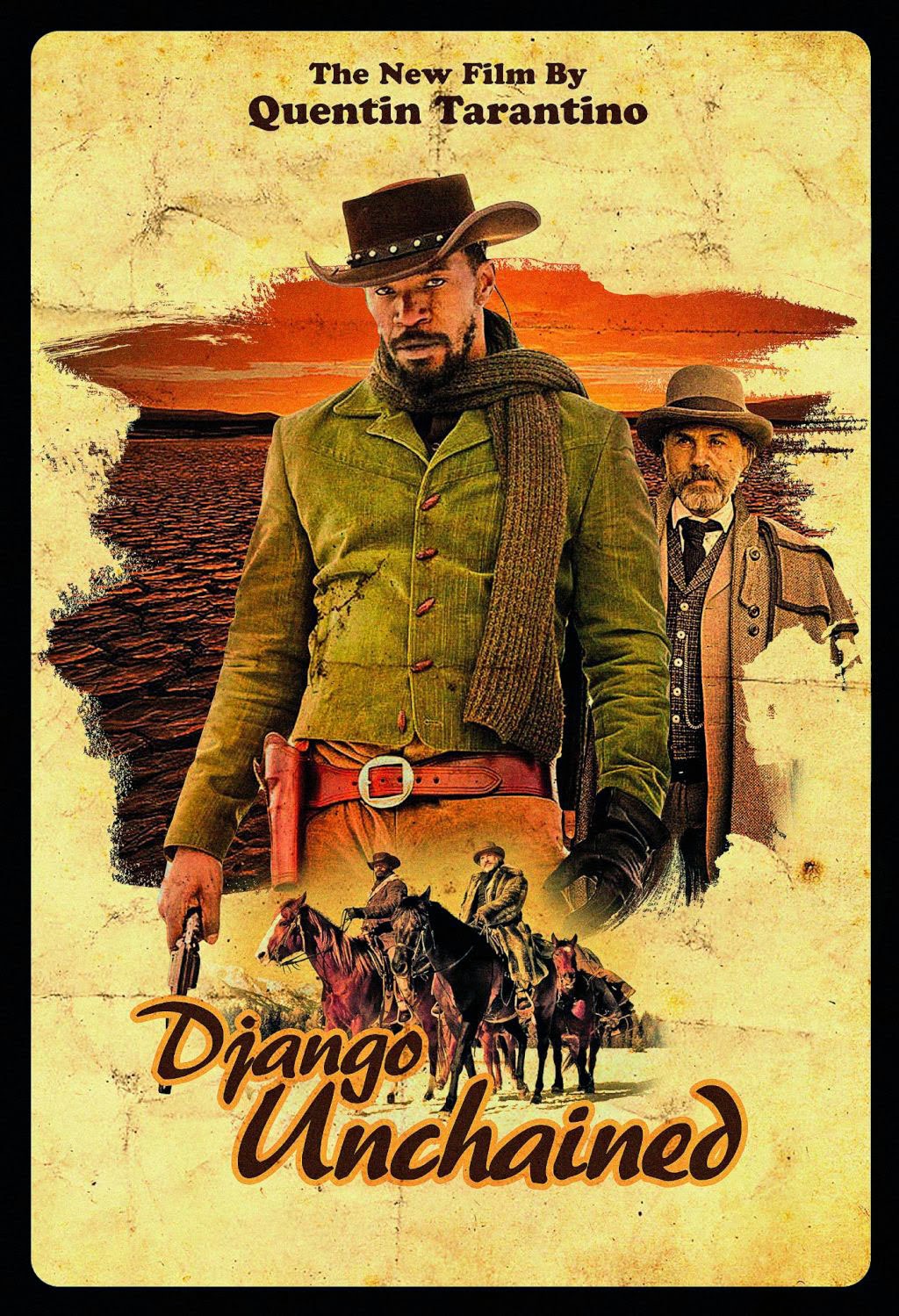
Django Unchained is a revenge fantasy. In the typical version, our peaceful hero is just minding his own business when the bad guy or guys deliberately commit some terrible insult or offense, which then justifies the hero unleashing violence – often at cataclysmic levels – upon the baddies. One glance at the poster for Django, and you can pretty much guess most of the story.

1

It’s the comic-book adolescent fantasy – the nebbish that the other kids insult when they’re not just ignoring him but who then ducks into a phone booth or says his magic word and transforms himself into the avenging superhero to put the bad guys in their place.

This scenario sometimes seems to be the basis of U.S. foreign policy. An insult or slight, real or imaginary, becomes the justification for “retaliation” in the form of destroying a government or an entire country along with tens of thousands or hundreds of thousands of its people. It seems pretty easy to sell that idea to us Americans – maybe because the revenge-fantasy scenario is woven deeply into American culture –  and it’s only in retrospect that we wonder how Iraq or Vietnam ever happened.

Django Unchained and the rest are a special example of a more general story line much cherished in American movies: the notion that all problems – psychological, interpersonal, political, moral – can be resolved by a final competition, whether it’s a quick-draw shootout or a dance contest.  (I’ve sung this song before in this blog, most recently here after I saw Silver Linings Playbook.)

Berlatsky’s piece on 12 Years points out something else I hadn’t noticed but that the Charles Atlas ad makes obvious: it’s all about masculinity. Revenge is a dish served almost exclusively at the Y-chromosome table.  The women in the story play a peripheral role as observers of the main event – an audience the hero is aware of – or as prizes to be won or, infrequently, as the hero’s chief source of encouragement, though that role usually goes to a male buddy or coach.

But when a story jettisons the manly revenge theme, women can enter more freely and fully.

12 Years a Slave though, doesn’t present masculinity as a solution to slavery, and as a result it’s able to think about and care about women as people rather than as accessories or MacGuffins.

Scrapping the revenge theme can also broaden the story’s perspective from the personal to the political (i.e., the sociological):

 12 Years a Slave doesn’t see slavery as a trial that men must overcome on their way to being men, but as a systemic evil that leaves those in its grasp with no good choices.

From that perspective, the solution lies not merely in avenging evil acts and people but in changing the system and the assumptions underlying it, a much lengthier and more difficult task. After all, revenge is just as much an aspect of that system as are the insults and injustices it is meant to punish. When men start talking about their manhood or their honor, there’s going to be blood, death, and destruction – sometimes a little, more likely lots of it.

One other difference between the revenge fantasy and political reality: in real life results of revenge are often short-lived. Killing off an evildoer or two doesn’t do much to end the evil. In the movies, we don’t have to worry about that. After the climactic revenge scene and peaceful coda, the credits roll, and the house lights come up. The End. In real life though, we rarely see a such clear endings, and we should know better than to believe a sign that declares “Mission Accomplished.”

Cross-posted at Montclair SocioBlog.

Jay Livingston is the chair of the Sociology Department at Montclair State University. You can follow him at Montclair SocioBlog or on Twitter.

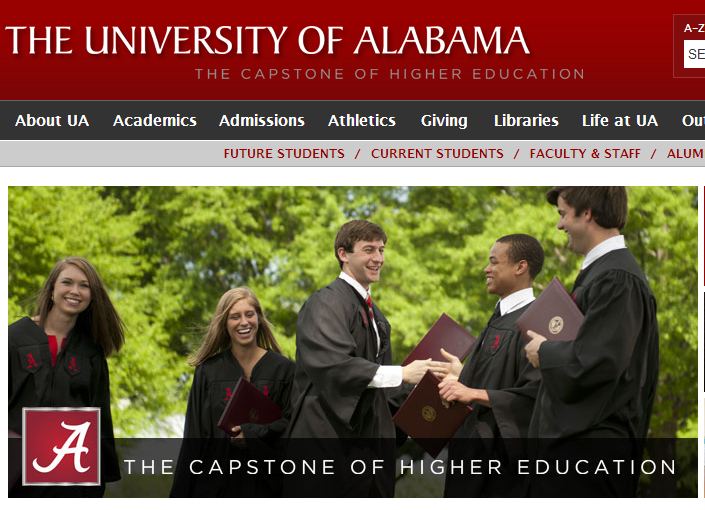
UPDATE: I may have been wrong about this one and, if so, I apologize.  The Univ. of Alabama has released a statement saying that the image is not photoshopped, including a quote from the student saying “It’s kind of funny, but people are blowing it out of proportion a little bit.”  If anyone has further information on this story, please email it to socimages@thesocietypages.org.

In 2000, the University of Wisconsin – Madison was sued by a man named Diallo Shabazz.  Because the college wanted to present itself as a diverse place, Shabazz, a black man, had been featured in university marketing materials for several years.  That year, however, his face was photoshopped into a picture of a crowd at a football game.   He complained, but was blown off.  He’d had enough.  In his lawsuit, he asked not for a settlement, but for a “budgetary apology”: money dedicated to increasing the actual diversity of the campus.

Today @EricTTung sent us another example of this kind of doctored diversity, currently the first slide on the homepage of the University of Alabama.  Do you see it?

Screenshot_31

How about now?

BXOzfqKCMAARAlE (1)

Note the skin color of the African American man’s hands.

As I’d written in the post about Shabazz, this teaches us both that colleges believe that diversity is a useful commodity with which to market their institutions and that, “if real diversity isn’t possible, cosmetic diversity will do.”

Recruitment of minorities to a mostly white campus: tricky.  Addressing the systematic educational underinvestment in minorities prior to arriving: expensive.  Retaining minorities in that environment: challenging.  Photoshop: easy.

Lisa Wade, PhD is an Associate Professor at Tulane University. She is the author of American Hookup, a book about college sexual culture; a textbook about gender; and a forthcoming introductory text: Terrible Magnificent Sociology. You can follow her on Twitter and Instagram.
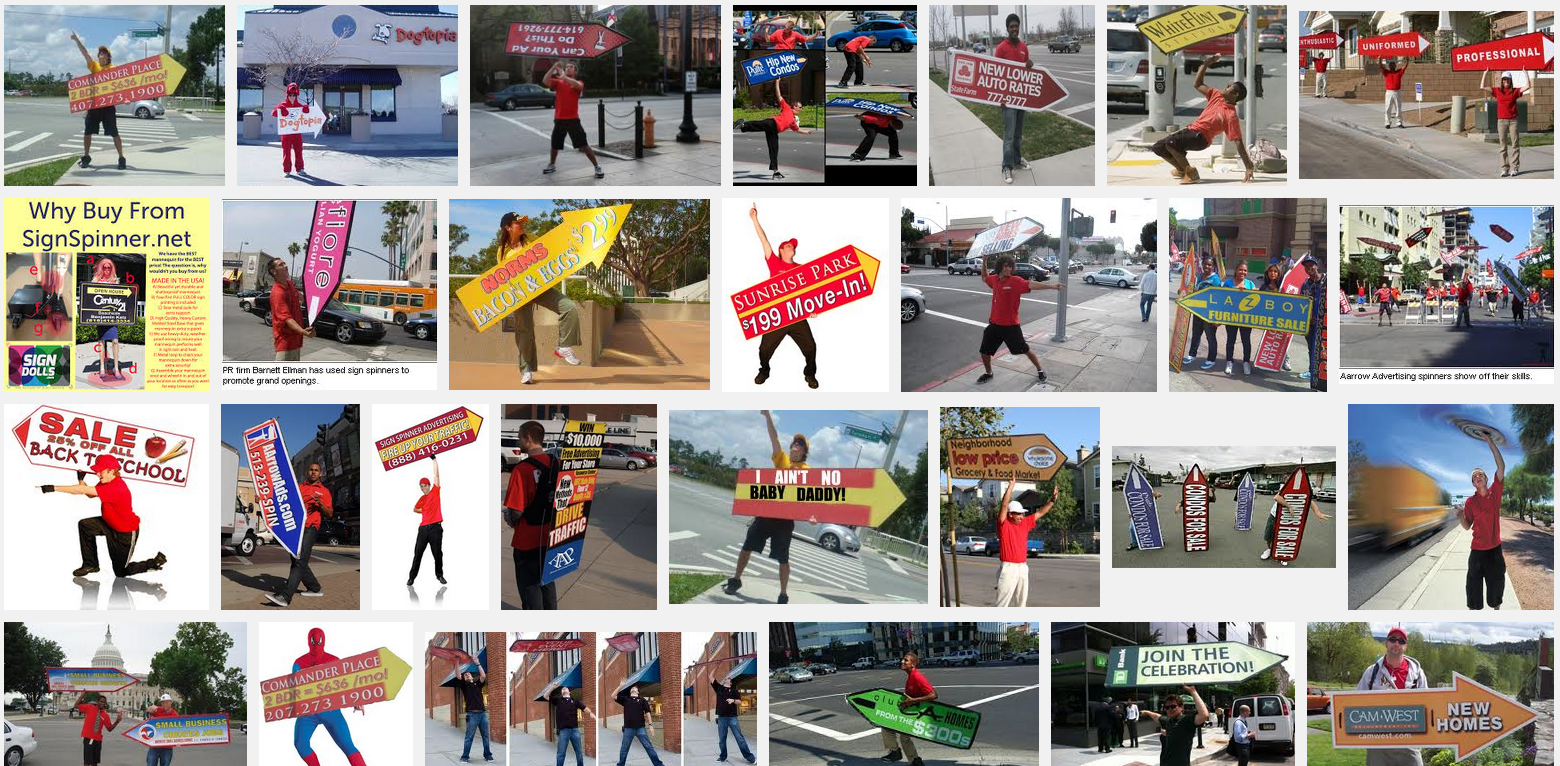
In the midst of the recession a new occupation emerged: the sign spinner.  These individuals stood on sidewalks outside of businesses, dancing with signs or arrows that they threw and twisted in the air and around their bodies.  Some of them were pretty cool, actually.

Yesterday NPR discussed the replacement of some of these spinners with mannequins. Robots that are programmed to spin the sign.  Of course, they aren’t nearly as good as a halfway decent human sign spinner.  But, it was argued, they’re getting the job done.

From human to machine, then.  But no one commented on the bizarre race- and sex-change that accompanied this shift.  In my part of the country, most human sign spinners are black or Latino men.  I suspect that’s true wherever there’s a substantial non-white, non-Asian population.  But the mannequins appear to be overwhelming white women.

The Google image search for each somewhat supports this narrative.  The mannequins are overly white women and the humans are almost all men and, arguably, disproportionately men of color.

Google search for “sign spinners” (click to enlarge):

Screenshot_2

Google search for “‘mannequin sign spinners”  (click to enlarge):

Screenshot_1

Isn’t. This. Interesting.

When the business owner or manager can make choices about what race and gender they prefer, they choose white females.  Presumably because “sex sells,” the female body (in a bikini) is the universal symbol for sex, and white women are the most valuable commodity in that market.

When we’re hiring low wage human workers, however, business owners and managers have less control over the race and gender composition of their workforce.  It appears most would prefer to hire white women in bikinis for everything but, because of institutionalized racism and the sex segregation of occupations, they get men and, perhaps, men of color.

How amazing that something so simple — the evolution of the sign spinner — can tell us so much about who we value and why.

Here’s a commercial for the new robotic sign spinners, to drive the point home:

Cross-posted at Racialicious and Pacific Standard.

Lisa Wade, PhD is an Associate Professor at Tulane University. She is the author of American Hookup, a book about college sexual culture; a textbook about gender; and a forthcoming introductory text: Terrible Magnificent Sociology. You can follow her on Twitter and Instagram.
The Redskins have been in the news lately — on the front page of the Times, for example — and not for their prowess on the gridiron. It’s their name. Many native Americans find it offensive, understandably so.  “Redskins” was not a name they chose. It was a label invented by the European-Americans who took their land and slaughtered them in numbers that today would be considered genocide.

President Obama offered the most tepid hint of criticism of the name. He did not say they should change their name. He said that if he owned the team, he would “think about” changing the name. But that was enough for non-Indians to dismiss the idea as yet one more instance of “political correctness.”

Defenders of the name also argue that the name is not intended to be offensive, and besides, a survey shows that most Americans are not bothered by it.  I would guess that most Americans also have no problem with the Cleveland Indians logo, another sports emblem that real Indians find offensive.

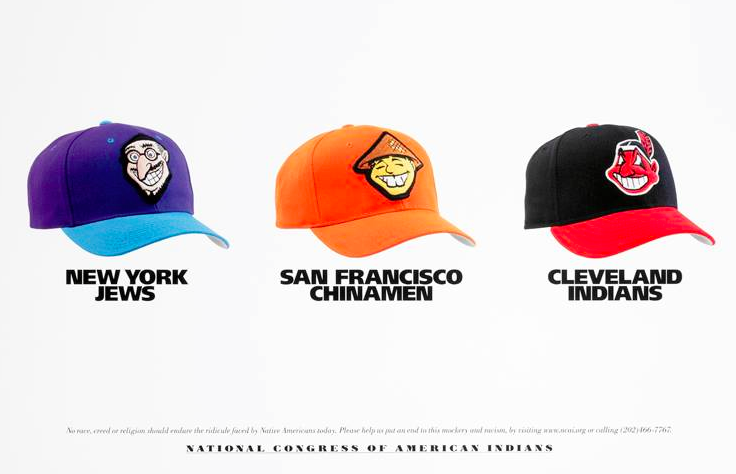
In response the National Congress of American Indians offers these possibilities.  The Cleveland cap is the real thing.  The other two are imagined variations on the same theme.

Caps

The pro-Redskins arguments could also apply here. The New York Jews and San Francisco Chinamen and their logos are not intended to offend, and a survey would probably find a majority of Americans untroubled by these names and logos.  And those who do object are just victims of “the tyranny of political correctness.”  This last phrase comes from a tweet by Washington quarterback Robert Griffin III, an African American.  His response seems to make all the more relevant the suggestion of years ago by the American Indian Movement’s Russell Means: “Why don’t they call them The Washington Niggers?”

Cross-posted at Montclair Socioblog; HT to Max.

Jay Livingston is the chair of the Sociology Department at Montclair State University. You can follow him at Montclair SocioBlog or on Twitter.

The partial U.S. map below shows the proportion of the population that was identified as enslaved in the 1860 census.  County by county, it reveals where the economy was most dominated by slavery.

1

A new paper by Avidit Acharya, Matthew Blackwell, and Maya Sen has discovered that the proportion of enslaved residents in 1860 — 153 years ago — predicts race-related beliefs today.   As the percent of the population in a county accounted for by the enslaved increases, there is a decreased likelihood that contemporary white residents will identify as a Democrat and support affirmative action, and an increased chance that they will express negative beliefs about black people.

Avidit and colleagues don’t stop there.  They try to figure out why.  They consider a range of possibilities, including contemporary demographics and the possibility of “racial threat” (the idea that high numbers of black people make whites uneasy), urban-rural differences, the destruction and disintegration caused by the Civil War, and more.  Controlling for all these things, the authors conclude that the results are still partly explained by a simple phenomenon: parents teaching their children.  The bias of Southern whites during slavery has been passed down intergenerationally.

Cross-posted at Pacific Standard.

Lisa Wade, PhD is an Associate Professor at Tulane University. She is the author of American Hookup, a book about college sexual culture; a textbook about gender; and a forthcoming introductory text: Terrible Magnificent Sociology. You can follow her on Twitter and Instagram.