gender

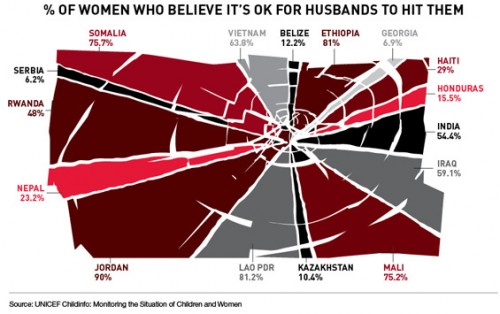
Teresa C. sent in this image created using UNICEF data to show what percent of women surveyed in various countries said it was acceptable for their husbands to hit them:
international-womens-attitudes-towards-domestic-v-28079-1250786064-13

(Found at BuzzFeed.)

You can find the data and a breakdown of UNICEF data collection methods here. The data for many more countries are available there too. I can’t quite figure out why these particular countries were used in the image; they aren’t all of the countries with the highest percentages. As far as I can tell, the UNICEF data table only includes numbers for the “developing” nations and some countries from eastern Europe, which is UNICEF’s focus. But I do wonder what the numbers would be if you asked women in the U.S. a question along the lines of “is it ever acceptable for a man to hit a woman?” or “can you think of any situation where it might be understandable that a man would hit his wife or girlfriend?” You might get higher “support” for violence against women than you’d think. The UNICEF page doesn’t provide the wording of this question, which would be interesting to know.

That’s not to downplay the issue of women justifying or accepting violence against women, just that those of us in the “developed” nations need to be sure not to pat ourselves on the back too much about how enlightened we are about domestic violence.

And I can’t help but dislike the image, in that at first glance it would appear to be a pie chart in which all of the sections add up to 100%; really a bar graph would be a better way to illustrate this. But then, I had a dissertation advisor with a 5-page single-spaced document outlining his standards for data presentation.

UPDATE: Reader P. makes the point I was getting at above (that the wording might greatly impact how much “support” you find for violence against women) much better than I did:

What they were actually asked, in the MICS and the DHS (the two primary sources for the data), was this question:

“Sometimes a husband is annoyed or angered by things that his wife does.  In your opinion, is a husband justified in hitting or beating his wife in the following situations:

– If she goes out with out telling him?
– If she neglects the children?
– If she argues with him?
– If she refuses sex with him?
– If she burns the food?”

I bet you get very different rates for different “justifications,” which is important both for data-gathering/presentation and for anti-domestic violence campaigns. And, again, I bet if you broke down various “reasons” for hitting a woman, I bet you’d get higher-than-expected acceptance of them in countries in the “developed” countries that weren’t presented in the table.


Giorgos S. sent us a link to a story in the Guardian about the cover of DVDs of the movie “Lesbian Vampire Killers.” Some stores are carrying censored versions. Giorgos says he’s seen the censored version at Borders stores in the U.K.:

Lesbian-Vampire-Killers-c-001

So apparently the phrase “they won’t go down without a bite” is fine, and major cleavage requires just a tad bit of coverage with a sticker that says “Warning: Contains explicitly fit bloodsucking hotties!” The sticker that nearly entirely obscures the word “lesbian” says, “Warning: may display sexually suggestive cover image.”

The distributors blame stores, saying a number of large retailers requested that they obscure particular parts of the cover. The stores say they didn’t request that the word “lesbian” be hidden. I suppose we’ll never know what happened there. It does crack me up that you’d be willing to sell a movie called “Lesbian Vampire Killers,” but then be worried about the cover.

The issue of censorship leaves aside, of course, the content of the film itself. This may surprise you, but it was apparently widely negatively reviewed. IMDb summarizes the plot thusly:

Their women having been enslaved by the local pack of lesbian vampires thanks to an ancient curse, the remaining menfolk of a rural town send two hapless young lads out onto the moors as a sacrifice.

Here’s the original marketing poster:

200px-Lesbian_vampire_killers_film

I like how her nipples have been photoshopped out (unless lesbian vampires have nipples on the sides of their boobs).

If anyone’s seen it, I’d be interested to know if it portrays lesbians as ridiculously as I suspect it does.

See also: airbrushing out men’s nipples.

Kitty sent us this cover for Wad, an “urban fashion and culture magazine.”

retro_image

It kind of sums things up, doesn’t it?

1. Women are objects.
2. Women are for consumption.
3. Women are violable.
4. Women are interchangable.
5. Women are rewards.
6. Violence against women is cute and funny.

Anything else?

UPDATE!  In our comments, KJK notes that there appears to have been a male version of the cover too.  There is no #10 and no text beneath the magazine title… so I’m a little confused as to whether it was a cover.  The production quality seems the same, though.  For what it’s worth, here it is:

WAD

—————————

Lisa Wade is a professor of sociology at Occidental College. You can follow her on Twitter and Facebook.

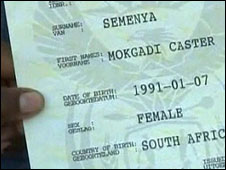
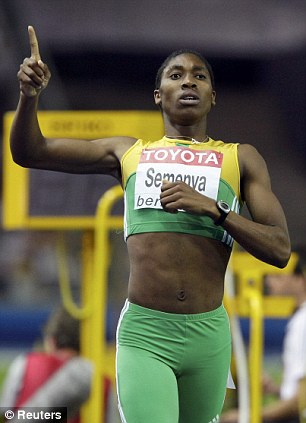
Chrissy Y., Stacey S., and a former student of mine, Kenjus Watson, have all suggested that we post about the controversy over Olympic athlete Caster Semenya’s sex.

_46245340_certificate2226
A lot of people are talking about whether or not it’s appropriate to be asking about her sex and why we would be so obsessed with knowing the answer. Those are fine questions (and I address them secondarily).  But first I would like to suggest that, even if we were to decide that it is appropriate to want to determine her sex (that we are obsessed with it for a good reason), it would be impossible to actually determine her sex definitively. Let me explain:

If you were to try to decide what qualifies a person as male or female, what quality would you choose?

I can think of eight candidates:

1. Identity (whatever the person says they are, they are)
2. Sexual orientation (boys dig girls, vice versa)
3. Secondary sex characteristics (e.g., boobs/no boobs, pubic hair patterns, distribution of fat on the body)
4. External genitalia (e.g., clitoris, labia, vaginal opening/penis and scrotum)
5. Internal genitalia (e.g., vagina, uterus, and fallopian tubes/epididymis, vas deferens, seminal vesicles, prostate, etc)
6. Hormones (preponderance of estrogens/androgens)
7. Gonads (ovaries/testes)
8. Chromosomes (XX/XY, the SRY gene)

Most of us assume that these criteria all line up. That is, that people with XY chromosomes have testes that make androgens which creates a penis, epididymis, vas deferens etc… all the way up to a male-identified person who wants to have sex with women.  We also assume that these things are binary (e.g., boobs/no boobs), when in reality most of them are on a spectrum (e.g., hormones, also boobs, likely sexual orientation).

But these criteria don’t always line up and sex-linked charactertics aren’t binary.  Examples of “syndromes” that disrupt these trajectories abound (e.g., Klinefelter’s syndrome).  And all kinds of practices, including surgeries, are sometimes used to force a binary when there isn’t one (e.g., intersex surgery to fix the “micropenis” and “obtrustive” clitoris and breast reduction surgery for men).

If these criteria don’t always line up, then we have to pick one as THE determinant of sex.  But any choice would ultimately be arbitrary.  The truth is that none of these criteria could ever actually definitively qualify a person as male or female.

The alternative would be to require that a person qualify as male or female according to ALL of the criteria.  And you might be surprised, then, how many people are neither male or female.

I think the debate over whether we should test Semenya’s sex is getting ahead of itself, given that there is no such test.

———————————————–

Yet, while we won’t be learning anything definitive about Semenya’s sex, the controversy does teach us something about our obsession with sex difference.  On MSNBC, Dave Zirin explains what the controversy over is really about:

[youtube]http://www.youtube.com/watch?v=eK-w6lDOZ5Q[/youtube]

To me, one of the most interesting things that Zirin says is that sex isn’t actually a good indicator of athletic ability.  He may be a guy, he says, but having a penis doesn’t translate into outrunning anyone.

He is implying that sex segregation in athletics, as a rule, is more about an obsession with sex categories and their affirmation than it is about sports. Remember, Semenya’s sex is being questioned not just because she appears masculine to some (she always has), but because she kicked major ass on the track.

Kenjus, my former student, writes:

…why didn’t they test Usain Bolt?  He did amazingly well… Yet, his otherworldly accomplishments are considered the result of his never-before-seen body structure… Usain, however, is a big, strong, fast Black man. The fact that his times are just as mind-boggling as Caster’s gets lost in the widely accepted narrative that big, strong, fast Black men accomplish amazing athletic feats. It’s what they’re built for.

But this woman has apparently baffled the athletic and scientific experts because her body is not doing what a woman’s body is supposed to do. More specifically, her shape is too muscular, her voice is too deep, and her time is too fast. Essentially, “Semenya-the-woman” CANNOT exist in an exclusively two-gendered (i.e. men and women) society in which men are innately bigger, stronger, more deeply-voiced, and particularly FASTER than women…

article-0-061D19E9000005DC-924_306x423

Semenya is getting far more media attention than the recent cheating scandals of higher profile athletes. This is precisely because there’s something that separates Caster from an A-Rod, a Marion, a Sosa… The world is captivated by Caster because something that should be certain; unquestionable; medical; pre-ordained, is in flux.  It is regrettable that some athletes take illegal drugs to gain an edge over the competition. It’s entirely unethical, unnatural, and ungodly for an athlete to not fit into our narrow specifications of what constitutes gender or sex.

Indeed.  Our obsession with Semenya’s sex, in addition to being hurtful and invasive, says a great deal more about us, than it does about her.  And perhaps the reason we are so obsessed with proving Semenya’s sex, to bring this post back to its beginnings, is because binary sex doesn’t actually exist.  Me thinks we protest too much.

(Thanks to Mimi Schippers, via the Sociologists for Women in Society listserve, for alerting me to the video. Images found here and here.)

—————————

Lisa Wade is a professor of sociology at Occidental College. You can follow her on Twitter and Facebook.

Lisa Wade, PhD is an Associate Professor at Tulane University. She is the author of American Hookup, a book about college sexual culture; a textbook about gender; and a forthcoming introductory text: Terrible Magnificent Sociology. You can follow her on Twitter and Instagram.

Sociologists who study social movements note that the tactics available to activists are shaped by the activism that has proceeded them. We call this a “repertoire of contention,” or a set of tools available to any activist that most people in a society would recognize as “protest.” In most industrialized countries today, this repertoire includes things such as sit-ins, boycotts, strikes, and marches.

Repertoires of contention are shared and they pass from one social movement to another.   The sit-in, for example, was invented by civil rights U.S. labor activists, but all types of activists use sit-ins today (perhaps most memorably by the civil rights movement). Sidney Tarrow calls this kind of tactic “modular.” It can be borrowed from one kind of activism and applied to many different causes.  Similarly, protest tactics can in one country can be borrowed and applied in another, so long as the conditions for activism are similar.

I was reminded of this theory of modular protest tactics when fds and Mordicai K. sent us this link to photographs from a protest by the Alliance for Animal Rights in Russia. Like the protests PETA in the U.S. and Animals Awake in the Netherlands, this Russian protest personifies animals as (mostly) women and then displays them brutally murdered.  I think the trio (Russia, the Netherlands, and the U.S.), together, is an interesting example of the way that a social movement tactic can travel transnationally.

Lisa Wade, PhD is an Associate Professor at Tulane University. She is the author of American Hookup, a book about college sexual culture; a textbook about gender; and a forthcoming introductory text: Terrible Magnificent Sociology. You can follow her on Twitter and Instagram.

Men and women are often pitted against each other, as if they are naturally and inevitably in opposition. This creates the conditions for a “battle of the sexes.” The implication is, of course, that it’s a zero sum game. When women win, men lose.

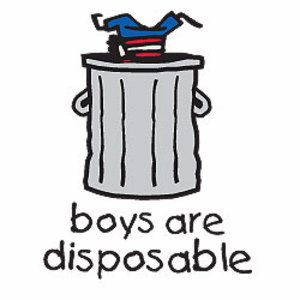
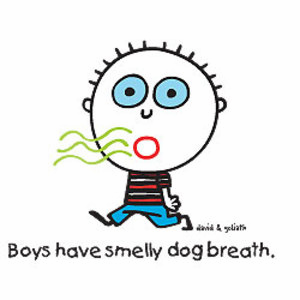
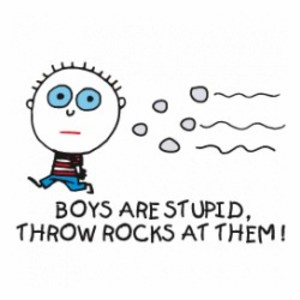
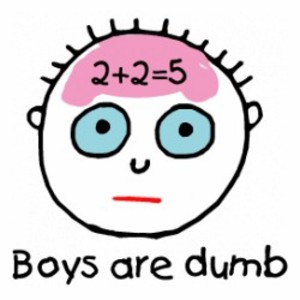
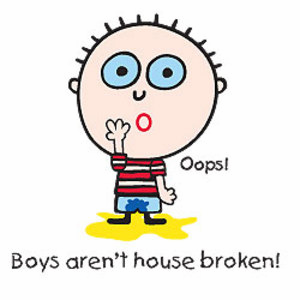
We socialize young children into thinking with gender (it’s always, somehow, boys vs. girls) and seeing the other sex as an enemy or competitor. Illustrating this, izhero sent us links to a set of t-shirts for young girls sold at David & Goliath Tees. The message for girls is, essentially, “boys drool, girls rule,” situating women and men in opposition, and setting girls up for a lifetime of battling the “opposite” sex.

Picture3Picture4Picture5Picture6

Picture7Picture8

—————————

Lisa Wade is a professor of sociology at Occidental College. You can follow her on Twitter and Facebook.

Clayton W. alerted us to this September’s issue of Harper’s Bazaar. Paul Goude decided to photograph Naomi Campbell as if she were in Africa with animals.  Clayton writes that it “…very nearly turns her into some sort of animal.”  Below are some images from the photo shoot, courtesy of Womanist Musings (via Feministing):

image[3]

On this cover of Vibe, Lil’ Kim is posed animalistically and, it is asserted, she is “ready to roar”:

NEW! Naomi Campbell, is also put in leopard print in this photo in the December 2008 issue of Russian Vogue (found here):

Naomi-Campbell

ALSO NEW! Iman with a cheetah, and with a cheetah print scarf on her head, as photographed by Peter Beard, 1985 (found here):

Iman-Cheetah-Peter-Beard-1985

ALSO ALSO NEW! These two pictures of Grace Jones (from here) involve animalization (explicitly in the second case). These images may not be safe for work, so I’ve put them after the jump, along with another example:

more...

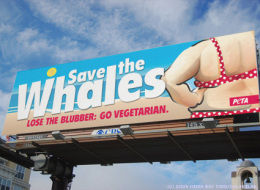
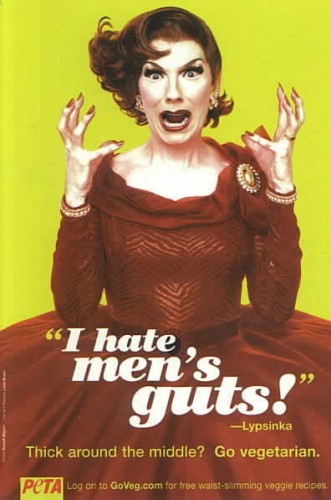
Often when we have an image related to PETA we add it to one of our existing posts, since they tend to be similar–mostly sexualizing women or showing them as bloody meat. But Jessica B. and Dmitriy T.M. told us about a PETA billboard that takes a different angle, and I thought it was worth its very own post:

s-SAVE-THE-WHALES-large

Found at The Huffington Post.

This is just…ugh. Erg. !!! ??? !!!

I’m sorry, but that’s the most coherent I can be about this. I’m sure our commenters will be able to make more useful points about it.

Well, ok, I have one more thought: the implication is that being a vegetarian will automatically make you lose weight. That’s just dumb, or more likely intentionally misleading.

UPDATE: Anomie let me know that there’s at least one version about men (found here):

41963

Two more examples with men here.

Related posts: women in (fake) lettuce bikinis, Dutch animal rights ad shows stripper brutally murdered, not sexualizing older women, PETA ad banned from Superbowl, women as bloody packaged meat, Holocaust on Your Plate campaign, using domestic violence to oppose animal abuse, Christina Applegate naked, more naked celebrities, and leftist balkanization.