gender

Abby Kinchy (and Assistant Professor at Rensselaer Polytechnic Institute) and Emily Birch  sent us another example of the pressure put on female athletes to be not just amazing at their sports, but attractive while doing it. The New York Times ran an article about changes in the Badminton World Federation’s required dress code for players. The BWF issued guidelines that sought to “ensure attractive presentation” at tournaments. They also insisted on reinforcing gender differences; women players “must wear skirts or dresses.” The policy, initially intended to be implemented by May 1st, said it was acceptable to wear shorts or tracksuit pants under a skirt “where cultural or religious sensitivities require legs to be covered.” However, the guidelines stressed that it was not acceptable to wear a sheer skirt over the shorts or pants, and was absolutely unacceptable to wear shorts or pants alone.

The dress code was roundly criticized as a sexist marketing ploy that might hamper some players’ performance. While the Iranian players would be able to continue wearing their long pants, they would have to wear a skirt over them — which, as the NYT article points out, could be cumbersome and restrictive, putting some players in the position of having to accept potentially negative effects on their performance in return for being allowed to wear shorts or pants.

The BWF argued that this was for women’s players’ own good, since it would bring more attention to the sport, pointing out that they recently increased the prize money for women’s tournaments to be equal to men’s and added women’s competitions to be sure men and women have the same options for participation. The argument seemed to be that they are trying to make women’s badminton more popular, and thus the least the women can do is play their part — which means not just being excellent players, but looking more attractive to viewers.

However, as some players and other critics pointed out, the concern with using dress code to enhance the popularity of the sport seemed to fall disproportionately on women, and seemed to focus primarily on making women conform to ideals of femininity:

Interest is declining, Rangsikitpho said, adding that some women compete in oversize shorts and long pants and appear “baggy, almost like men.”

[From NYT.]

The dress code for men, on the other hand, simply requires “proper attire.”

After all the criticism, the BWF delayed implementation of the rules for a month to provide time for more discussion. Finally, in late May, they put off implementation indefinitely.

Though the dress code is on hold for the moment, it’s a great example of the way that concerns about appearance may trump functionality when it comes to women’s sports. In addition, it shows how a particular version of femininity — one that involves showing significant amounts of skin and that accepts skirts and dresses as default women’s clothing — is elevated as the ideal presentation. The fact that many badminton players have cultural or religious reasons to want (or have) to wear pants to play doesn’t require rethinking standards of femininity, but only a work-around that still upholds the ideal by requiring a skirt over pants.

Gwen Sharp is an associate professor of sociology at Nevada State College. You can follow her on Twitter at @gwensharpnv.

Cross-posted at OWNI.

Something has been nagging me about the Representative Weiner (D-NY) sexting scandal: how would this story would play out differently had the sexting-congressperson been female? I wrote earlier about how differently “sexy” pictures of male and female political candidates are handled.

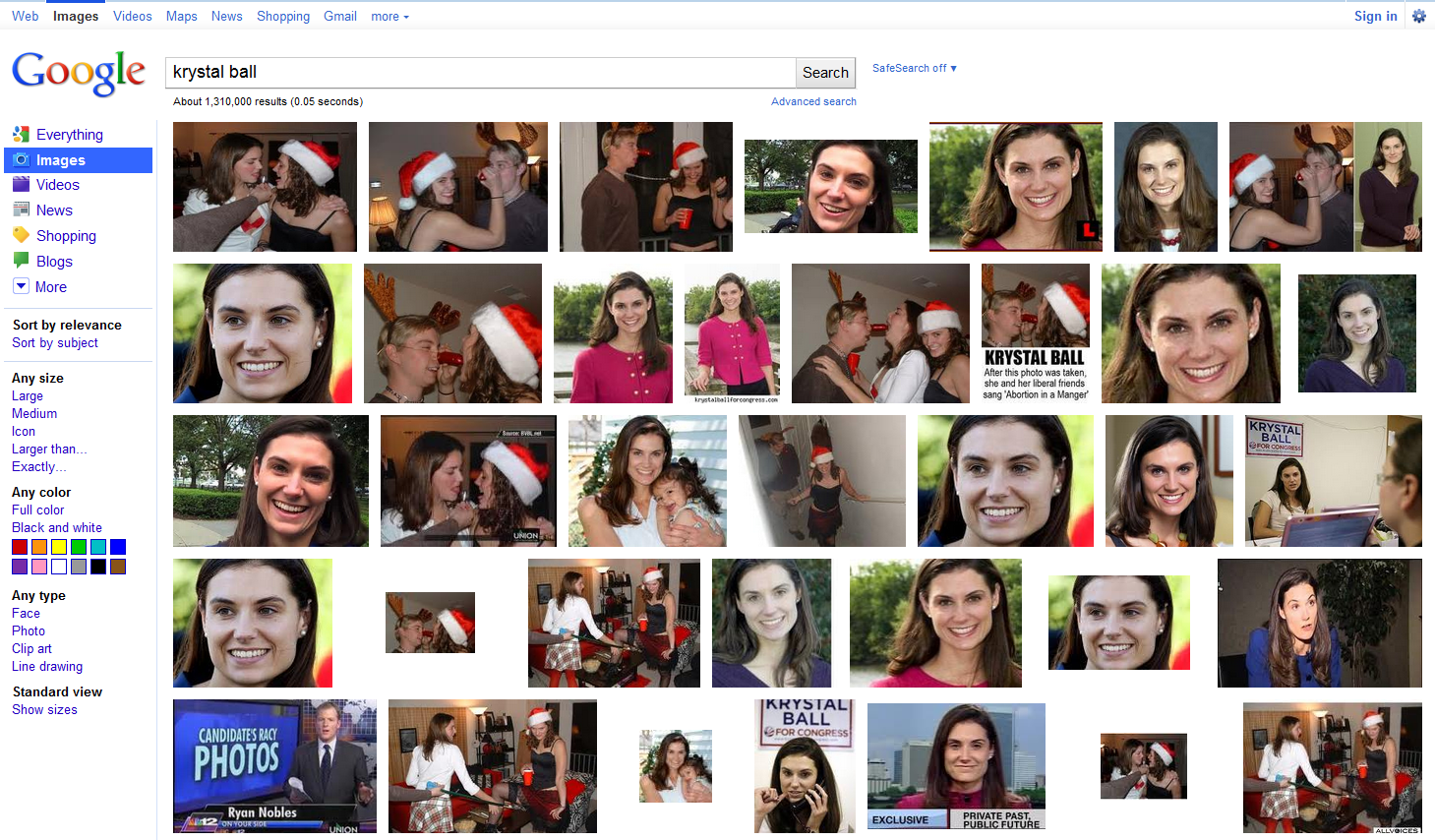
When Krystal Ball ran for congress, images of a past Halloween party became some of the most Google’d images in the world, unlike male politicians running for office at the same time who were also involved in scandals about images of their past behaviors. The images of women in general, and, in this case, female politicians, become poured over, detailed, dissected, analyzed and obsessed upon to a far greater extent than what is occurring with Rep. Weiner. Yes, the images he sent are being shared on and offline, but had Weiner been female the images might be shown akin to the Janet Jackson “wardrobe malfunction”: the media would scowl at the perversion while simultaneously showing them on a constant loop, dissecting every pixel in detail.

So let’s do quick Google Image searches for Krystal Ball and Anthony Weiner. (In these screenshots I am logged out of Google and “SafeSearch” is off, however, neither of those factors influenced the results much).


Krystal Ball’s results are dominated by the images that caused scandal. You have to scroll through pages of images in Weiner’s results to find the “offending” images. Given that Google’s resultsare based in part on popularity and website inter-linking, we have to wonder how Weiner’s post-scandal online presence would be different had he been female. [We should note that Weiner had a larger online presence before the scandal than did Ball. However, many of the top images in the search are post-scandal, so that is not a complete explanation for the discrepancy]. In fact, it is easier to find women showing skin in Weiner’s results than the so-called “lewd” images themselves.

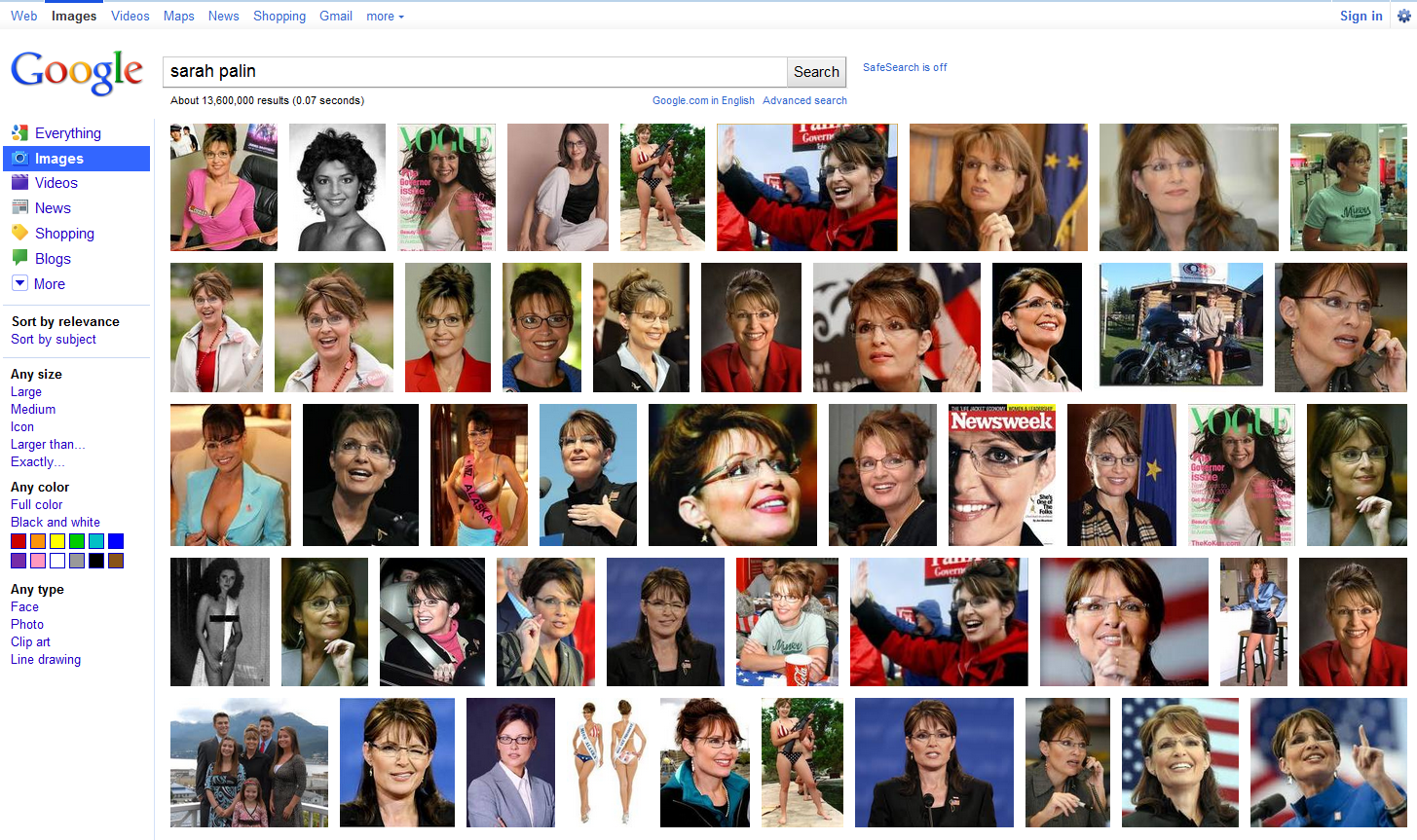
Even Sarah Palin, who has never tweeted “lewd” photos of herself to all of the Internet, has search results more focused on her body than does Weiner.

Michel Foucault noted that sexual repression is closely related with sexual obsession; and the obsessively prying “gaze” is really the regulation and controlling of ourselves and our sex. The relative lack of obsession of the images in this scandal strikes me as evidence of the weaker regulation of the male body and men’s sex.

How else would this scandal play out differently had Rep. Weiner been female?

—————————

Please welcome guest blogger Nathan Jurgenson.  Jurgenson is a graduate student in sociology at the University of Maryland and co-edits the Cyborgology blog.

Cross-posted at Family Inequality.

Sociologist, segregate thyself? A little inside-sociology post.

A report from the research folks at the American Sociological Association (ASA) got me thinking about gender-segregated sociology. I added a few numbers from other sources to provide a quick look at three moments of gender segregation within the discipline.

People may (or may not) want to be sociologists, they may or may not be accepted to graduate schools, thrive there (with good mentoring or bad), freely choose specializations, complete PhDs, publish, get jobs, and so on.  As in most workplaces, gender segregation represents the cumulative intentions and actions of people in different institutional settings and social locations.

#1: Phds

Since the mid-1990s, according to data from the National Science Foundation, women have outnumbered men as new sociology PhDs, and a few years ago we approached two-thirds female. In the three years to 2009, however, the number of PhDs has dropped by a third, and women have accounted for two-thirds of that drop. I have no idea what’s going on with that.

For the time being, then, we’re close to 50/50 in gender balance for producing PhDs. But academic careers can be long, so all those years in the 1970s and 1980s when men outnumbered women by so much still affect  today’s discipline. Among members of the ASA today, women are 7 years younger than men, on average. Which means the men are in higher positions, on average, as well.

#2: Specialization

Choosing what area of sociology to study is a combination of personal interest and ambition, institutional setting and mentoring, and happenstance of various kinds. (This is separate from the question of how narrowly to specialize in one’s specialization, which has a big impact on the quantity of publication, since switching topics is risky and costs valuable time.) So it wouldn’t be accurate to describe this as simply a free choice. But, once someone is a member of the ASA, which is open to anyone, then the choice of identifying with a certain area of research is free (or, actually, costs a few dollars a year), through joining sections of the association.

The pattern of section belonging shows a striking level of gender segregation. On a scale of 1 to 100, I calculate the sections are segregated at a level of .28. (That is the same level of segregation I calculated in the gender distribution between major fields for PhDs, such as engineering and social sciences.) Put another way, the correlation between the percentage of women and percentage of men across the sections is a strong -.64. And by both measures the segregation has increased since 2005.

Joining a section means voting to increase the number of presentations in that area at the national conference, getting a newsletter, maybe an email list, being invited to a reception, and having the chance to serve on committees and run for office arranging all those things. At its best it’s a community of scholars interested in similar subjects. Anyway, the point is it’s not a restrictive club or job competition.

#3: Editorial boards

Finally, prestigious academic journals have one or more editors, often some associate editors, and then an editorial board. In sociology, this is mostly the people who are called upon to review articles more often. Because journal publication is a key hurdle for jobs and promotions, these sociologists serve as gatekeepers for the discipline. In return they get some prestige, the occasional reception, and they might be on the way to being an editor themselves someday. I didn’t do a systematic review here, but I looked at the two leading research journals — American Sociological Review and American Journal of Sociology, as well as two prestigious specialized journals — Sociological Methods and Research, and Gender and Society (which is run by its own association, Sociologists for Women in Society, whose membership includes both women and men).

(I included the editors, book review editor, consulting or associate editors, and editorial board members, but not managing editors. The number included ranged from 33 to 73.)

I’m not attributing motives, describing gender discrimination, or even making a judgment on all this. There are complicated reasons for each of these outcomes, and without more research I couldn’t say nature/nurture, structure/agency, system/lifeworld, etc.

But gender segregation never happens for no reason.

Update: Kim Weeden pointed me toward the complete list of section memberships by gender for 2010. So here is a a graph of the gender compositions expanded to include all 49 sections. Also, with that expanded data, I recalculated the segregation level, and it’s .25.

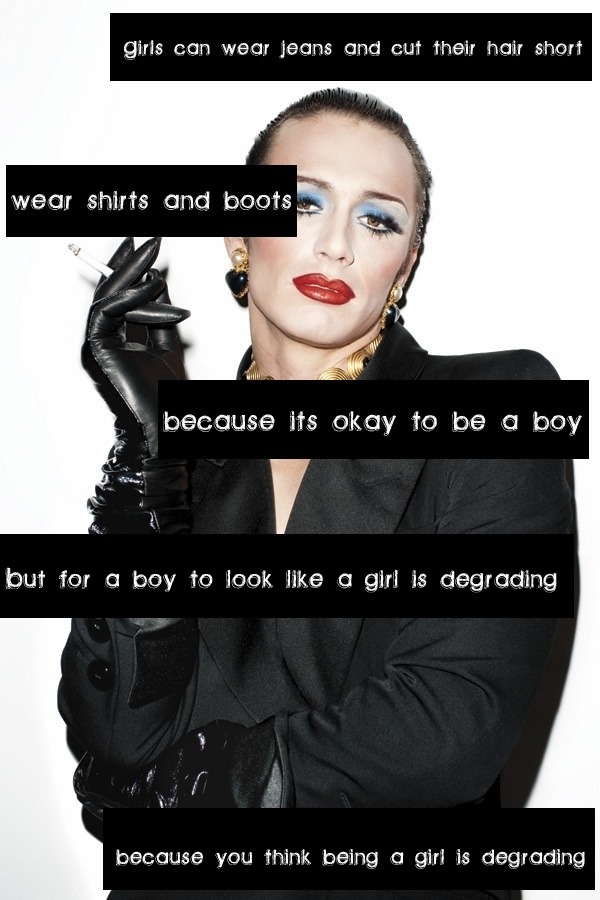
Sociologists use the term “androcentrism” to refer to a new kind of sexism, one that replaces the favoring of men over women with the favoring of masculinity over femininity. According to the rules of androcentrism, men and women alike are rewarded, but only insofar as they are masculine (e.g., they play sports, drink whiskey, and are lawyers or surgeons w00t!). Meanwhile, men are punished for doing femininity and women… well, women are required to do femininity and simultaneously punished for it.

Illustrating this concept, much more concisely, is this altered photograph of James Franco in drag. Sent along by Stephanie V., the photo was originally for the cover of Candy, a “transversal style” fashion magazine.  I’m not sure who added the copy,* but I like it:

* So Caro Visi, where I found the image, credits Virus, but I can’t find it there.  I’m happy to properly credit if someone can point me in the right direction.

UPDATE: Sarah and John, in the comments thread, pointed out that the language is borrowed from a movie titled The Cement Garden.  Jennifer points out that Madonna used it, as well, in her song What it Feels Like For A Girl.

Clip from The Cement Garden:

More posts on androcentrism: “woman” as an insult, making it manly: how to sell a car, good god don’t let men wear make up or long hair, don’t forget to hug like a dude, saving men from their (feminine) selves, men must eschew femininity, not impressed with Buzz Lightyear commercial, dinosaurs can’t be for girls, and sissy men are so uncool.

Lisa Wade, PhD is an Associate Professor at Tulane University. She is the author of American Hookup, a book about college sexual culture; a textbook about gender; and a forthcoming introductory text: Terrible Magnificent Sociology. You can follow her on Twitter and Instagram.

In the contemporary Western world, naked and near-naked bodies are revealed everywhere.  But most of the bodies we see are those of models and actors, carefully cultivated, chosen, and digitally altered to look a particular way.  Except, artist Clarity Haynes notes, the “before” pictures in advertisements for diet plans and cosmetic surgeries.  She writes:

“Before” pictures pop up constantly on our computers and in magazines, as part of the daily landscape of imagery. These “before” pictures, meant to shock and scare, show bodies that are presented as needing urgent correction and control, through weight loss or plastic surgery.

In an effort to reclaim these “before” bodies, Haynes has lovingly painted a range of female bodies.  The Breast Portrait Project, she continues:

…is about finding dignity and beauty in the physical characteristics of the body that our popular culture often ridicules and heaps with shame, and in the process allowing the models who participate to feel pride in their particular selves — and by extension, the viewers of the work as well, regardless of their gender.


Visit Hayne’s gallery.  And, for more normalizing of normal bodies, see these selections of breasts,  bellies, and vulvas.

Lisa Wade, PhD is an Associate Professor at Tulane University. She is the author of American Hookup, a book about college sexual culture; a textbook about gender; and a forthcoming introductory text: Terrible Magnificent Sociology. You can follow her on Twitter and Instagram.

Katrin and Danny sent in a heart-breaking video that highlights the damage that has sometimes been inflicted on children, with the guidance of researchers, because of adult concerns about behavior that deviates from socially-accepted gender norms. In this segment with Anderson Cooper, two siblings and their mother discuss the treatment their brother suffered, with the approval and encouragement of UCLA researchers, as a form of “anti-sissy” therapy:

It would be nice to be able to write this off as completely debunked practices of an earlier time, based on premises that would never recur today. But as the video makes clear, the publications that resulted from this study continued to be cited by those who argue that through therapy, gays and lesbians can be “cured.”

Here’s the second part of the story:

There will be a third installment tonight; I’ll update the post once the final segment is available online.

UPDATE: Here’s the third segment, about a boy who underwent anti-gay therapy in the ’90s:

UPDATE 2: Also, Danny was wonderful enough to type up transcripts of the first two videos! They’re after the jump.

more...

Yesterday, I was at the grocery store in the checkout line, when I saw a Disney book about how Tinkerbell and her fairy friends “Nature’s Little Helpers.”  Intended to interest small children in being environmentally conscious, the fairies, all female, help nature go about its daily tasks.  The connection to the nymphs of Greek mythology at once is evident.  Nymphs were essentially fairies that embodied parts of nature: water, trees, etc. They were almost always female, and often played the role of temptress to the male gods.  These Disney fairies play on the same idea; they tend to nature and are connected with nature because of their being female.

(source)

Why is this a problem?  First, the book connects women to nature on the basis of biology, the idea that women are naturally nurturing.  This suggests that only women can really take care of nature, because they are better suited for it than men.  Second, by linking women and nature, they suggest that being Green is ‘girly,’ when in fact being Green should be gender-neutral.

“Nature’s Little Helpers” ties women and nature together in harmful ways: it assumes that women are caretakers of nature because of an inherent nurturing ability and it feminizes the teaching of environmental studies, even interest in nature.  I have no doubt that Disney intended for this book to up its Green profile, but its message is as harmful as the Disney princess line. We should be teaching children about nature without gendering the process.

—————————

Lisa Seyfried is recent graduate of the George Washington University Women’s Studies Master’s Program.  Her interest is in the intersection of women and the environment, and generally helping the world to become a more just and sustainable place.  She is also a blogger at Silence is Complicit.

If you would like to write a post for Sociological Images, please see our Guidelines for Guest Bloggers.

On the heels of our post about race, ideas of beauty, and the controversy about Satoshi Kanazawa’s blog post at Psychology Today claiming Black women are “objectively” less attractive than women from other races, Lisa C. sent in the 9-minute trailer for the documentary Dark Girls. In it, African American women discuss their own experiences of bias toward dark-skinned women, both in pop culture broadly and from people in their own lives. It’s a stunning and heart-breaking illustration of the personal costs of beauty standards that define dark skin as inherently and automatically problematic:

Dark Girls: Preview from Bradinn French on Vimeo.