Search results for embed


For years biologists, anthropologists, and sociologists have all agreed that racial categories are social constructs.  Recently, however, new genetic information about human evolution has required that scientists re-think the biological reality of race.  In this 6-minute video, sociologist Alondra Nelson describes this re-thinking:

Lisa Wade, PhD is an Associate Professor at Tulane University. She is the author of American Hookup, a book about college sexual culture; a textbook about gender; and a forthcoming introductory text: Terrible Magnificent Sociology. You can follow her on Twitter and Instagram.


In this video we see people trampled at a 4am opening of a North Buffalo Target on the Friday after Thanksgiving. There is an analysis to be made here, and it involves something about American materialism and the orgy of consumption that is called “Christmas.”   But I would be happy if we would just stop calling sales “Doorbusters” given that, y’know, sometimes people actually break down doors and people die.

Via Blame it on the Voices.

Lisa Wade, PhD is an Associate Professor at Tulane University. She is the author of American Hookup, a book about college sexual culture; a textbook about gender; and a forthcoming introductory text: Terrible Magnificent Sociology. You can follow her on Twitter and Instagram.

Abby Kinchy, Assistant Professor at Rensselaer Polytechnic Institute, Richard M., and Alana B., who blogs at Pecan Pie, sent us a link to a post by Maya at Feministing about an anti-domestic violence PSA from South Africa. The group that created the ad, People Opposing Women Abuse, set up an experiment of sorts. A man first played drums loudly in his townhouse, quickly leading to multiple complaints by neighbors about the noise and a written warning. On a different night, the group loudly played a tape of what sounded like a violent dispute between a man and a woman.  The reaction? Watch:

Aside from the obviously horrifying implications about domestic violence, I think it’s an interesting illustration of what people feel comfortable intervening or complaining about. As Maya points out in the original post, we all  like to think we would immediately be at the door or on the phone with police, but many of us have, at one point or another, encountered a situation where we didn’t know whether to intervene or not:

…I once sat in a subway station in Manhattan late at night and watched a man try to get a sobbing, drunk woman to leave with him. I hesitated, not sure what to do. A few minutes later the police arrived; someone had acted, but it wasn’t me. Just last week, I saw a man aggressively slap a woman’s butt as she walked past in my neighborhood. I looked the other way, and she didn’t say anything either. I ignore sexual harassment—directed at me or others—pretty much every day.

I suspect what is going on here is a mixture of factors: that we put violence between partners into a different, less serious category than, say, a fist-fight between strangers at a bar, an unwillingness to intervene in what many think of as a private family matter, and fear about our own safety if we get involved or call authorities, among others.

For a thorough discussion of the so-called “bystander effect,” and the complex reasons people may not report behavior they find inappropriate, check out this article (free of charge) from the Journal of the International Ombudsmen Association.


Annie Leonard tackles e-waste (what happens after we’re done with our computers, cell phones, etc) in the latest 7-minute edition in her Story of Stuff series (see also her first story of stuff and her analysis of bottled water and cap and trade).

Via Reports from the Economic Front.

Lisa Wade, PhD is an Associate Professor at Tulane University. She is the author of American Hookup, a book about college sexual culture; a textbook about gender; and a forthcoming introductory text: Terrible Magnificent Sociology. You can follow her on Twitter and Instagram.

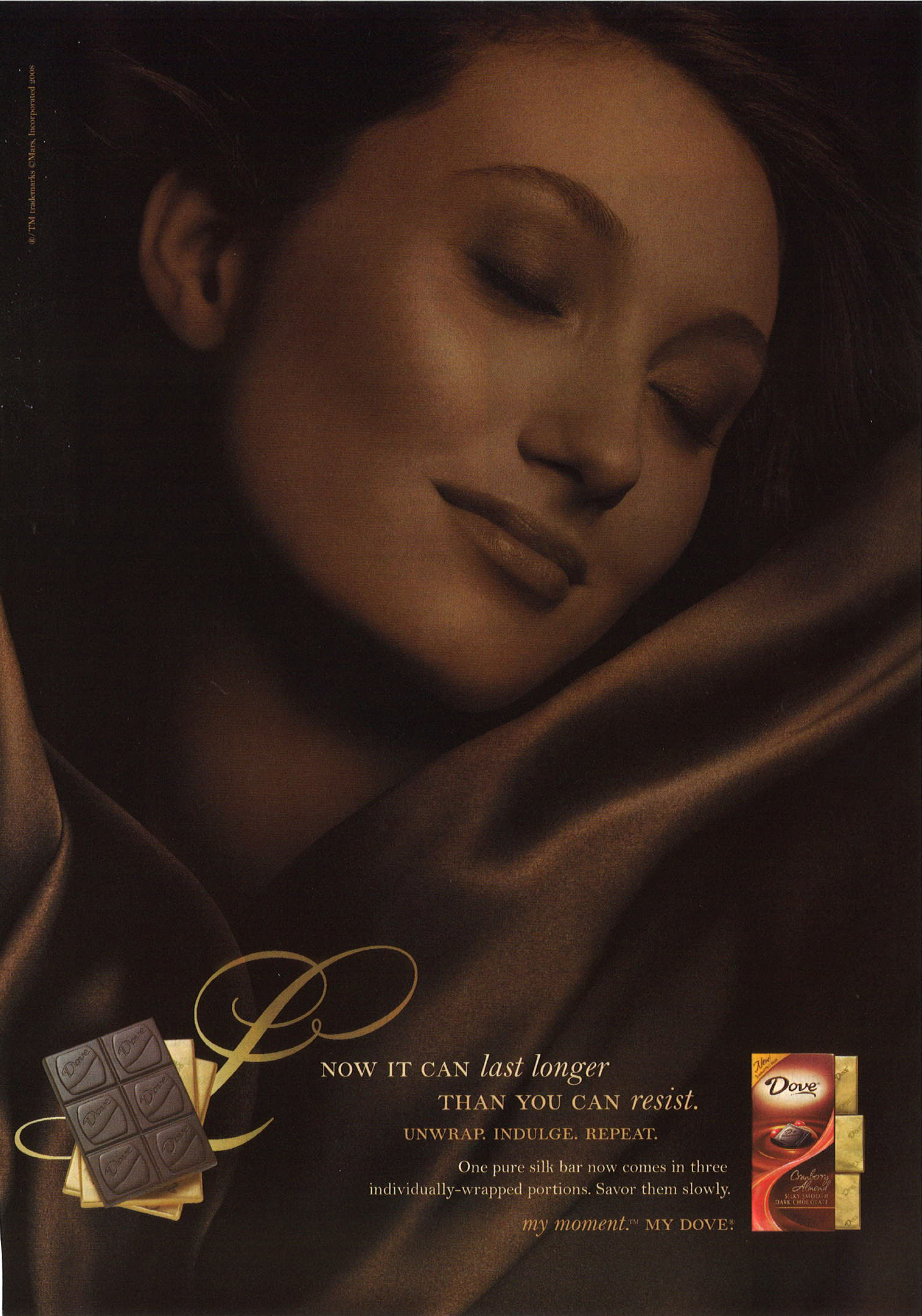
Advertisers have mystified chocolate, portraying it as an intoxicant possessing the power to comfort, reward and satisfy women’s sexual desires. In doing so, these ads instruct the viewer to frame and interpret their own chocolate cravings in ways that overcome any resistance to consuming it.

To begin, consider this commercial for Dove:

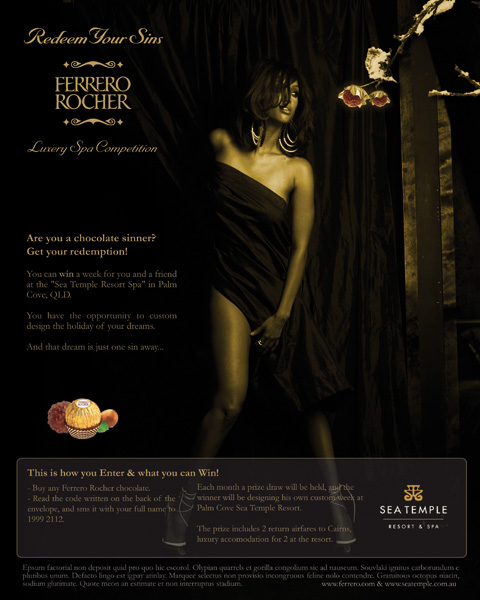
Consider, also, this ad for Ferrero Rocher:

In particular, advertisers portray chocolate as satisfying female sexual desires. Such advertisements lead female viewers to understand their own desire for chocolate as a natural expression of their sexy femininity.  The association of chocolate with luxury and the upper classes renders this sexuality socially acceptable. The symbolic sex is not that of the “crude lower class,” but the refined upper-class.

Text:

NOW IT CAN last longer THAN YOU CAN resist.

UNWRAP.  INDULGE.  REPEAT.

The misconception that chocolate is an aphrodisiac is exploited by these advertisements. The idea that chocolate contains chemicals that are similar to the mild-altering components found in ecstasy and marijuana, and evoke a feeling similar to falling in love, is now widespread.  In actuality, studies have found that the amounts of these mood-enhancing chemicals are at such a low level that it is unlikely they lead to the euphoria that some feel when they consume chocolate. The findings of what could be called “chocolate propaganda research,” then, are negligible.  Yet, marketing continues to perpetuate chocolate’s association with love and sex and its implied special relevance to women.

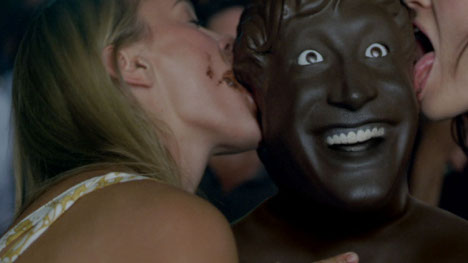
The association is so ubiquitous that it was mocked in an Axe commercial.  Screenshot:

So why the insistence on indulgence?

Chocolate marketing must overcome the chief factor inhibiting women’s consumption: the fact that consumption of a fat, sweet food is inherently taboo for women, who are supposed to watch their weight.  As a result, advertisers have replaced this food taboo with a sexual one. They have turned chocolate into a sexual, self-indulgent, private experience that invokes a taboo similar to that of masturbation. The intent is to equip her with an automatic inner-response to overcome her moment of self-restraint: the belief that chocolate consumption represents and enhances her femininity via satisfying her sexually, but tastefully, of course.  Advertisers, then, overcome viewer resistance by shaping how they interpret and frame their own desires.

————————–

Jamal Fahim graduated from Occidental College in 2010 with a major in Sociology and a minor in Film and Media Studies. He was a member and captain of the Occidental Men’s Tennis team. After he graduated, Jamal moved from San Francisco to Los Angeles with the intention of working in the film industry as a producer. His interests include film, music, digital design, anime, Japanese culture, improvising, acting, and of course, chocolate!

If you would like to write a post for Sociological Images, please see our Guidelines for Guest Bloggers.


Dmitriy T.M. sent in a video where Hans Rosling illustrates changes in wealth and life expectancy in 200 countries over the past 200 years, all in four minutes. Pretty neat!

…and more in this 3-minute TED talk by Derek Sivers, sent in by AJ S.   As AJ points out, the examples show that “…just because something is different doesn’t mean it is not logical in context.”

Lisa Wade, PhD is an Associate Professor at Tulane University. She is the author of American Hookup, a book about college sexual culture; a textbook about gender; and a forthcoming introductory text: Terrible Magnificent Sociology. You can follow her on Twitter and Instagram.

David Sparks created this video that uses blue and red to show shifts in voting patterns (Democratic vs. Republican) in all the presidential elections since 1920:

Sparks points out several interesting patterns that emerge:

1. Voting in urban areas often differs from other parts of their states (for example, Salt Lake City stands out from the rest of Utah, as did San Francisco from the rest of California in 1980).

2. We can see the South swing from solidly Democratic to predictably Republican (as Sparks highlights, the 1924 and 2004 maps are nearly inverted).

3. Despite clear patterns (such as the South going Republican, a coasts vs. interior voting split), we often see fairly drastic shifts between one presidential election and the next, as well as temporary disruptions to the overall trend (for instance, the reliably Republican South went Democratic in 1980).

As Sparks puts,

More broadly, this video is a reminder that what constitutes “politics as usual” is always in flux, shifting sometimes abruptly. The landscape of American politics is constantly evolving,  as members of the two great parties battle for electoral supremacy.

He also has a thorough explanation of his methodology for creating the map, if you’re interested.