
Search results for embed


In the 2-and-a-half-minute video below, sent in by Lisa G., a decorated concert violinist named Joshua Bell plays in a Metro station at L’Enfant Plaza in Washington D.C. for 45 minutes. Over 1,000 people walk by without turning their heads, 27 give money, and 7 people stop to listen for a minute or more (source).  Lisa G. summarizes:

Bell recalls that an awkward moment ensued every time he was done with a song because no one applauded or even acknowledged his existence because to these passengers he was just another street performer begging him for a dollar.

What makes Joshua Bell worth listening to?  The experiment points to the importance of context.   How do we know that we are listening to a master musician?   One important clue is where they are playing, and how expensive it is to have the opportunity to listen.   In a concert hall full of seats paid for with large bills, Bell’s talent is authenticated by the arbiters of taste who are the gatekeepers of the venue. Concert-goers do not necessarily know whether or why Bell is any good. They rely on the arbiters to determine who is worth listening to. And listening to who it is that is worth listening to provides them with expensive, and therefore scarce, cultural cred. They have seen Bell in concert (“oh and it was glorious!”); have you?

But in the Metro, Bell is no one. The context of the Metro fails to authenticate Bell’s music. Everyone can listen, thus hearing offers no distinction at all. And almost no one cares.

Lisa Wade, PhD is an Associate Professor at Tulane University. She is the author of American Hookup, a book about college sexual culture; a textbook about gender; and a forthcoming introductory text: Terrible Magnificent Sociology. You can follow her on Twitter and Instagram.


In Deadly Persuasion, Jean Kilbourne discusses the tactics of car advertisers.  Cars, she argues, are offered as keys to happiness.  Often they are anthromorphized, even positioned as a lover or a soul mate.

In this commercial, sent in by Jennifer G., we see just this sort of advertising. The car is described with the words “luxury,” “fire,” “bold,” and “daring.” It is, indeed, “…capable of moving your soul…”

The idea that we are moved by this advertising might seem patently ridiculous.  Phil Patton of the New York Times, however, reports the findings of a Mercedes/Roper survey:

…36 percent of Americans said they loved their car and 23 percent considered their car their best friend. The poll found that 12 percent of respondents said their car understood them better than their significant other.

Lisa Wade, PhD is an Associate Professor at Tulane University. She is the author of American Hookup, a book about college sexual culture; a textbook about gender; and a forthcoming introductory text: Terrible Magnificent Sociology. You can follow her on Twitter and Instagram.
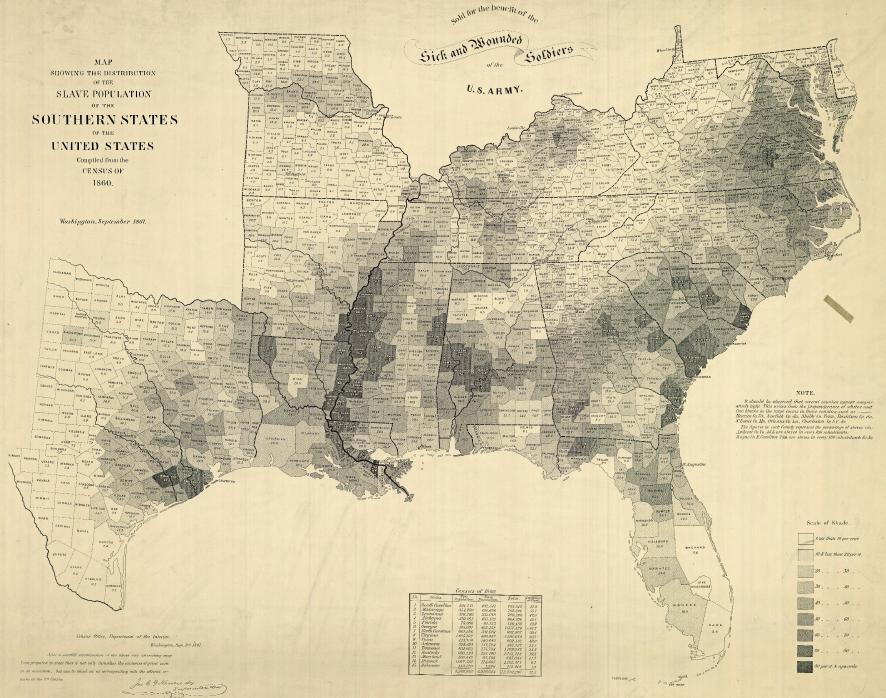
The NYT has posted an interesting interactive map showing the results of the last slave Census taken in the U.S., in 1860, which I discovered via Jessica Brown and Jim Yocom. The map, which shows county-level data, illustrates how slave ownership varied throughout the South

The shading (a new technique at the time, according to the NYT article) indicates what percent of the entire county’s population was enslaved:

You can see the percentage for each county, which is listed on the map, more easily if you zoom in on the pdf version. The cotton-belt area along the Mississippi River clearly stands out, as does Beaufort County, South Carolina, all with over 80% of the population enslaved. The highest rate I could pick out (the map got a little blurry as I zoomed) is in Issaquena County, Mississippi, where slaves appear to have made up 92.5% of the population.

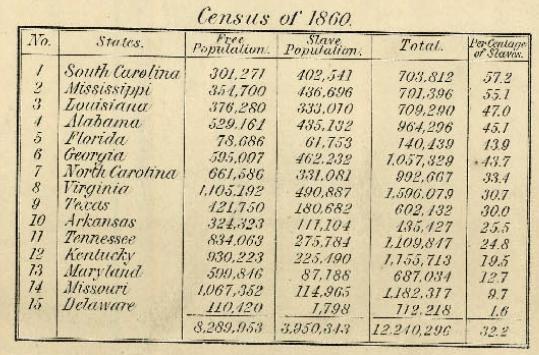
The map also included information on the overall population and % enslaved at the state level; in South Carolina and Mississippi, over half of the total state population was made up of slaves:

Also check out Lisa’s post on geology, the economy, and the concentration of slavery in the U.S.

As the NYT post points out, the map doesn’t show the dramatic increases in slavery in some areas. For instance, while Texas ranked fairly low in terms of the overall slave population, the number of slaves in the state had tripled between 1850 and 1860. The number had doubled in Mississippi between 1840 and 1860. Those growth rates make it rather hard to swallow the argument sometimes presented by those romanticizing the Confederacy that slavery was actually on the wane and would have soon been ended in the South anyway, without any need for federal interference, and wasn’t why the South seceded at all.

Jon Stewart and Larry Wilmore discussed this effort to frame discourses about the Civil War to erase the issue of slavery on The Daily Show:

Allegra K. suggested that we take a look at Palin-based pro-conservative message from PalinPAC for this past November’s election. The nearly-two-minute commercial is an excellent example of a gender-specific populism. We recently discussed populism in response to Christine O’Donnell’s “I’m Not a Witch, I’m You” commercial.  Populism is, by definition, in opposition to elitism.  Political populists believe that the average person is better suited to lead than the exceptional person.  In this ad, Palin attempts to personify not just the average person, but the average mom.  Allegra writes:

Throughout the video, numerous women are pictured. However, they are a specific type: they are the “real” women; not models, or especially good-looking, dressed up, or even business or political figures. They are “average moms”…

The average woman, according to Palin, is the American hockey mom (just like her), who is (supposedly) middle class, an at-home mom, who cooks and cleans, takes her multiple children to school, and then to after school sports, probably drives a mini van, and uses Clorox on her sons’ jerseys after they get muddy at practice.  Palin puts the power of change in their hands because, she says, “moms just kinda know when somethin’s wrong.”

A “just kinda know” kind of knowledge (based on the notion of female intuition) is a great example of Palin’s gendered populist message.

Lisa Wade, PhD is an Associate Professor at Tulane University. She is the author of American Hookup, a book about college sexual culture; a textbook about gender; and a forthcoming introductory text: Terrible Magnificent Sociology. You can follow her on Twitter and Instagram.


In this video, which I found via my friend Captain Crab, Kate O’Beirne (editor of the National Review) attacked the federal subsidized school breakfast and lunch programs. She did so by stating that parents who would find the program necessary must be “criminally negligent,” since they can’t put food on the table:

Transcript (via):

The federal school lunch program and now breakfast program and I guess in Washington DC, dinner program are pretty close to being sacred cows… broad bipartisan support. And if we’re going to ask more of ourselves, my question is what poor excuse for a parent can’t rustle up a bowl of cereal and a banana? I just don’t get why millions of school children qualify for school breakfasts unless we have a major wide spread problem with child neglect.

You know, I mean if that’s how many parents are incapable of pulling together a bowl of cereal and a banana, then we have problems that are way bigger than… that problem can’t be solved with a school breakfast, because we have parents who are just criminally… ah… criminally negligent with respect to raising children.

It’s an excellent example of the stigmatization of poverty: letting your kids go to class hungry would make you a bad parent, but taking advantage of programs set up to be sure kids don’t go to class hungry (and thus less able to learn) also makes you a bad parent. The problem here isn’t structural, or even about poverty. The problem, from O’Beirne’s manner of framing it, is that individuals who enroll their children in such programs are, by default, negligent “poor excuses” for parents.


The illuminating 3:49 minute video below, borrowed from Michael Shaw’s BagNews, features photographs taken by New York Times photojournalist Mike Kamber while he was embedded with the U.S. military in Iraq. Narrating the images, Kamber discusses the censoring of his photos by the U.S. and the ethics of documentary photography.

Lisa Wade, PhD is an Associate Professor at Tulane University. She is the author of American Hookup, a book about college sexual culture; a textbook about gender; and a forthcoming introductory text: Terrible Magnificent Sociology. You can follow her on Twitter and Instagram.


Religious people around the world express their devotion to God(s) in widely disparate ways. When children are raised in a particular religious institution, then, it is not enough to believe; they must also learn how to worship as others around them do.

The amazing one-minute video below shows Ava Grace, a child of about two, at Ignited Church in Lakeland, Florida (source).  The clip beautifully illustrates the socialization of children into particular kinds of worship.  With hand motions, body movements, and facial expressions, this child is doing a wonderful job learning the culturally-specific rules guiding the performance of devotion.

See also: The Evangelical Habitus. Via Blame it on the Voices.

Lisa Wade, PhD is an Associate Professor at Tulane University. She is the author of American Hookup, a book about college sexual culture; a textbook about gender; and a forthcoming introductory text: Terrible Magnificent Sociology. You can follow her on Twitter and Instagram.

Tim Wise answers just this question in this 2 1/2 minute clip featured on his website.  Sneak peak: His answer begins with “No. You should feel angry.”

Laurie J graciously pasted the transcript in the comments; I’ve added it after the jump.

more...