Search results for embed


In this TED video sent in by BlackCat and Chana Messinger, Tony Porter gives a nice introduction to what it means — for men, women, sons, and daughters — that men are confined by the dictates of masculinity.  (Trigger warning: at about the 9 minute mark, there is a story about a sexual assault.)

Transcript after the jump (thanks to DECIUS for posting it in the comments).

more...


Chris Rock makes a downright profound observation about race discourse in this 2 1/2-minute clip, sent along by Collin College sociologist John Glass:

Lisa Wade, PhD is an Associate Professor at Tulane University. She is the author of American Hookup, a book about college sexual culture; a textbook about gender; and a forthcoming introductory text: Terrible Magnificent Sociology. You can follow her on Twitter and Instagram.


Kristie C. sent in a Hardee’s commercial for their turkey burger that is an example of something we’ve talked about before: the conflation of women with food products to be consumed and the sexualization of both women and food in ads. But watch closely! It’s very subtle, so you might miss it the first time.

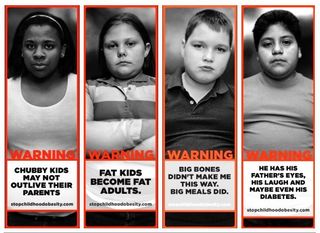
Sometimes public service announcements miss the mark.  Like really, really miss the mark.  In 2009 I described an anti-teen pregnancy PSA as gut-wrenchingly horrible and the feeling has not waned with time.  It suggests that teenagers who have gotten (someone) pregnant are dirty, cheap pricks, nobodies, and rejects.  We’ve also highlighted PSAs against statutory rape featuring children with giant breasts and an anti-domestic violence campaign in which you “hit the bitch.”

The campaign I’d like to discuss in this post is along these lines.  Brought to my attention by Debbie at Body Impolitic, it is the Georgia Children’s Health Alliance’s anti-childhood obesity campaign.  And it shames fat children and encourages viewers to retain negative stereotypes about them.  First, I wonder how it must feel to be chosen to be the posterchild for this campaign?

Second, some of the short videos available on the website confirm nasty stereotypes about fat people.  Like, all they do is eat:

Ironically, some of the videos acknowledge that fat children are subject to discrimination (at least from other kids), but that doesn’t appear to have stopped them from feeding that prejudice with their message.

Lisa Wade, PhD is an Associate Professor at Tulane University. She is the author of American Hookup, a book about college sexual culture; a textbook about gender; and a forthcoming introductory text: Terrible Magnificent Sociology. You can follow her on Twitter and Instagram.

Forbes magazine recently ranked Stockton California as the most miserable city in the US, a dubious award that comes as little surprise to the city’s struggling residents. Home prices have declined 67% since 2005, unemployment averaged a whopping 17.2% in 2010, and Stockton has the second highest crime rate in California.

In response, Gregory Basso, a retired Stockton businessman, created a video disputing Forbes’ findings. This clip went viral, at least locally, and was discussed by many Stockton residents. In his video, Basso highlights the attributes of Stockton he believes contribute to his high quality of life. These include “debating whether to wear my sun glasses or not in February,” and the many nearby opportunities for golfing, biking and hiking. He speaks of the seven professional sports teams found within a 2-hour radius, and the ability to sail from the yacht-lined downtown marina, along the Sacramento Delta, all the way to the San Francisco Bay. He ends by describing how Stockton has a great first time homebuyers market, and is a cheap central location for large businesses to come and set up shop.

But Basso’s lifestyle represents only a small minority of Stockton’s residents. The color of Mr. Basso’s skin, wealth, and class standing afford him privileges that most residents do not have access to. In a city with a median per capita income of $19,000, few residents have the opportunity to spend their days playing golf and yachting. Neither can they afford to live in the exclusive gated community where the beginning of the video was filmed. And Basso’s excitement about Stockton’s “first time home buyers market” might seem less compelling to the 58% of Stockton homeowners who owe more on their mortgages than their houses are worth.

It’s also worth noting that nearly all of the people depicted in Basso’s video (with the exception of University of the Pacific students) appear to be white. This is striking in a city where 32% of residents identify as Hispanic or Latino/a, 11% as African American and 20% as Asian (source). Because people of color tend to be less well off economically than whites, it stands to reason that many of these people are experiencing the misery that Basso claims that Forbes magazine “got all wrong” are people of color. And although Basso highlights many positive things about Stockton, he mentions neither its rich diversity nor its wide variety of ethnic cuisine.

Sociologist Ruth Frankenberg writes that “privilege is the (non) experience of not being slapped in the face.”*  What she means by this is not only that that white and middle class individuals have advantages over working class people and people of color, but that those of us with privilege often don’t see just how much these differences matter. She argues that race and class disparities are reproduced when those with more privileges do not look, and therefore do not see, just how different our circumstances can be.

Clearly, the goal of this video’s creator is not to erase the experiences of other Stockton residents. To the contrary, it seems he wants to diminish the stigma attached to being named the most miserable city in the US, and to cast it as a place that businesses might want to locate. This could even help generate opportunities for the very people experiencing hardships. However, in this video, Basso chooses not to see the real problems that affect many Stockton citizens. Without an understanding of these problems, Stockton residents are less prepared to address them.

* Frankenberg, Ruth. 1996. “When we are capable of stoppoing we begin to see” in Thompson and Tyagi (eds), Names We Call Home. NY: Routledge. p. 4

——————————

Brianna Gall is a senior sociology major at the University of the Pacific and was born and raised in Stockton, CA. Dr. Alison Hope Alko is Assistant Professor of Sociology at University of the Pacific, where she teaches a seminar in public sociology. Her research interests include inequality, environment, food and the social construction of place.

If you would like to write a post for Sociological Images, please see our Guidelines for Guest Bloggers.

When Alexandra Wallace’s video – the epiphanus interruptus* complaint about Asians at UCLA using their cell phones in the library – went viral, most of the reactions were accusations of racism. I’m not sure where the line between racism and ethnocentrism lies, but I was struck more by the underlying ethnocentric assumptions about family, assumptions that are widely shared here and by people who would never be accused of racism.

We Americans all agree that we value family. When I begin the unit on culture, I ask students to jot down three American values. The one that appears most frequently is family. If I asked students what things they themselves value, I’m sure many of them would say family. So, I suspect, would Ms. Wallace.

But here’s how she begins her rant, after a brief disclaimer:

It used to really bug me but it doesn’t bother me anymore the fact that all the Asian people that live in all the apartments around me – their moms and their brothers and their sisters and their grandmas and their grandpas and their cousins and everybody that they know that they’ve brought along from Asia with them – comes here on the weekends to do their laundry, buy their groceries, and cook their food for the week. It’s seriously, without fail. You will always see old Asian people running around this apartment complex every weekend. That’s what they do.

These Asian families, in Ms. Wallace’s view, include too many peripheral members (grandparents, cousins). And family members spend too much time together and do entirely too much for one another.

The trouble apparently is that Asians really do value family.

The too-much-family motif runs through her objections about cell phones as well.  She obviously doesn’t know what the callers are saying or who they’re talking to, but she suspects that it’s family back in Asia:

I swear they’re going through their whole families, just checking on everybody from the tsunami thing.**

Many international students in the US have noted this same contradiction between Americans’ proclaimed value on family in the abstract and what to the international students seems like a fairly thin and compartmentalized connection to family in the real world. As Rebekah Nathan says in My Freshman Year,

Americans, they felt, sharply distinguished their family from their friends and schoolmates; more than one international student remarked about the dearth of family photos on student doors,*** as if family didn’t exist at school. . . .Peter [a student from Germany] told me . . . “No one here says, “come on and meet my family.”

Do, do Americans value family? Yes, but. . . . The ‘but’ is a competing value that pervades American culture, including the family – Independence.**** As Ms. Wallace says in the conclusion to her complaint about Asian families, “They don’t teach their kids to fend for themselves.”

————————————-

* “I’ll be in like deep into my studying . . . getting it all down, like typing away furiously, blah blah, blah, and then all of a sudden when I’m about to like reach an epiphany… Over here from somewhere, ‘Ooooh Ching Chong Ling Long Ting Tong, Ooohhhhh.’”

** Adding “thing” to “the tsunami” makes Wallace seem especially callous. Linguists must have looked into this, but for some reason, “thing” here implies, “I don’t know or care much about this because it’s not very important.”  I vividly recall a scene in the 1993 film “Searching for Bobby Fischer,” where Joe Mantegna, as the competitive chess father, is at a parent-teacher conference. The teacher is concerned that Mantegna’s chess-prodigy son (age 8 or so) is falling behind academically and socially. She adds, “I’m sure he’s very good at this chess thing, but that isn’t really the issue.” Mantegna loses it. “My son has a gift. He has a gift, and once you acknowledge that, then maybe we’ll have something to talk about. Chess is what it’s called. Not the ‘chess thing.'”

*** If you watch the Wallace video, look at the board of photos behind her and try to find parents.

**** See my earlier post on the family-vs-independence conflict as it appears on American television, especially in sitcoms that have pretensions of seriousness.

To great acclaim, we previously featured the work of Adriel Luis after Occidental student Samantha Figueroa illustrated his poem “Slip of the Tongue” with clips from Pocahontas.  Luis is back with a touching spoken word performance inspired by the Watts riots in Los Angeles.

Visit Luis at Ill-literacy.

Lisa Wade, PhD is an Associate Professor at Tulane University. She is the author of American Hookup, a book about college sexual culture; a textbook about gender; and a forthcoming introductory text: Terrible Magnificent Sociology. You can follow her on Twitter and Instagram.

My great-grandma was born in 1914 and lived until 2005, so she witnessed an enormous amount of technological and cultural change during her life. I asked her once what single thing she found most impressive or was most grateful had been invented. She answered, without hesitation, “the electric washing machine.” As the mother of 7 children with a husband who did not do housework, laundry had been the bane of her existence. Getting a washing machine that had a hand-powered wringer helped, but it was still exhausting. The way she saw it, getting an electric washing machine changed her life. Her fear of ever again having to do laundry by hand with a washboard was so great that she kept the hand-crank-powered washer next to her electric one until the early 1990s, just in case.

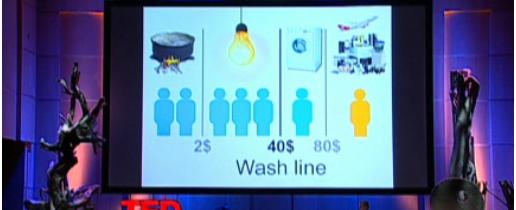
In this TED clip, “Hans Rosling and the Magic Washing Machine,” sent in by Dmitriy T.M., Rosling discusses the ethical problems involved in efforts to combat climate change that rest primarily on telling individuals in developing nations that because we need to use less energy globally, they just can’t have the same appliances and conveniences, like electric washing machines, that those of us living in (post-) industrialized nations do:

Transcript after the jump.

more...