Search results for 2008/08/06/for-normal-to-darker-skin

I recently put together a Pinterest board featuring our examples of light-tan clothes and products described as “nude,” “skin-colored,” or “flesh-colored.”  The practice erases or marginalizes people with medium or dark-colored skin by presuming that everyone’s flesh is light tan… even Michelle Obama can be a victim of this kind of insensitivity.  Lil’ Kim, too!

Inspired by our older posts, I decided to check up on the Internets and see if the trend was still alive.  Indeed, and alas.  The first example I stumbled upon was Vera Wang’s 2012 wedding dress collection.  The collection isn’t up on Wang’s website at the time I’m writing, but media outlets are consistently describing the collection as featuring “nude” and “black” dresses.  The Huffington Post is one example.

I decided to go with the wedding theme. At Martha Stewart, she suggests a “powder blue and nude palette” for the ceremony and reception. Project Wedding had many examples of nude clothing and other items. Finally, Belle had a collection of “nude” wedding shoes.

To reiterate, calling this color “nude” reminds us all that light-skinned people are regular people and everyone else needs a modifying adjective.  In addition to the many other examples of this that we encounter everyday — like lotion for “normal to darker skin,” ornaments in “bride and groom” and “African-American bride and groom,” and dolls in “dolls” and “ethnic dolls” — these instances can be constant and exhausting examples of one’s marginality.

Lisa Wade, PhD is an Associate Professor at Tulane University. She is the author of American Hookup, a book about college sexual culture; a textbook about gender; and a forthcoming introductory text: Terrible Magnificent Sociology. You can follow her on Twitter and Instagram.
Here’s another one for our collection of instances in which we describe light tan as “nude,” “skin-,” or “flesh-colored” (symbolically erasing the existence of people without light tan skin).  Yahoo’s OMG! describes uses the word “nude” to describe the color of Lil’ Kim shirt.

It’s always particularly amazing when they use the word to talk about something a black person is wearing.  Like, um, Michelle Obama.

For more examples, see our posts on products designed for white people, the widespread use of such language to describe light tan in the fashion world,  and lotion marketed as for “normal to darker skin.” See also our Contexts essay on race and “nude” as a color.

For contrast, see this post about how the generic human in Russian cartoons is colored black instead of white.

Lisa Wade, PhD is an Associate Professor at Tulane University. She is the author of American Hookup, a book about college sexual culture; a textbook about gender; and a forthcoming introductory text: Terrible Magnificent Sociology. You can follow her on Twitter and Instagram.
Two new submissions inspired me to revive this post from 2008.

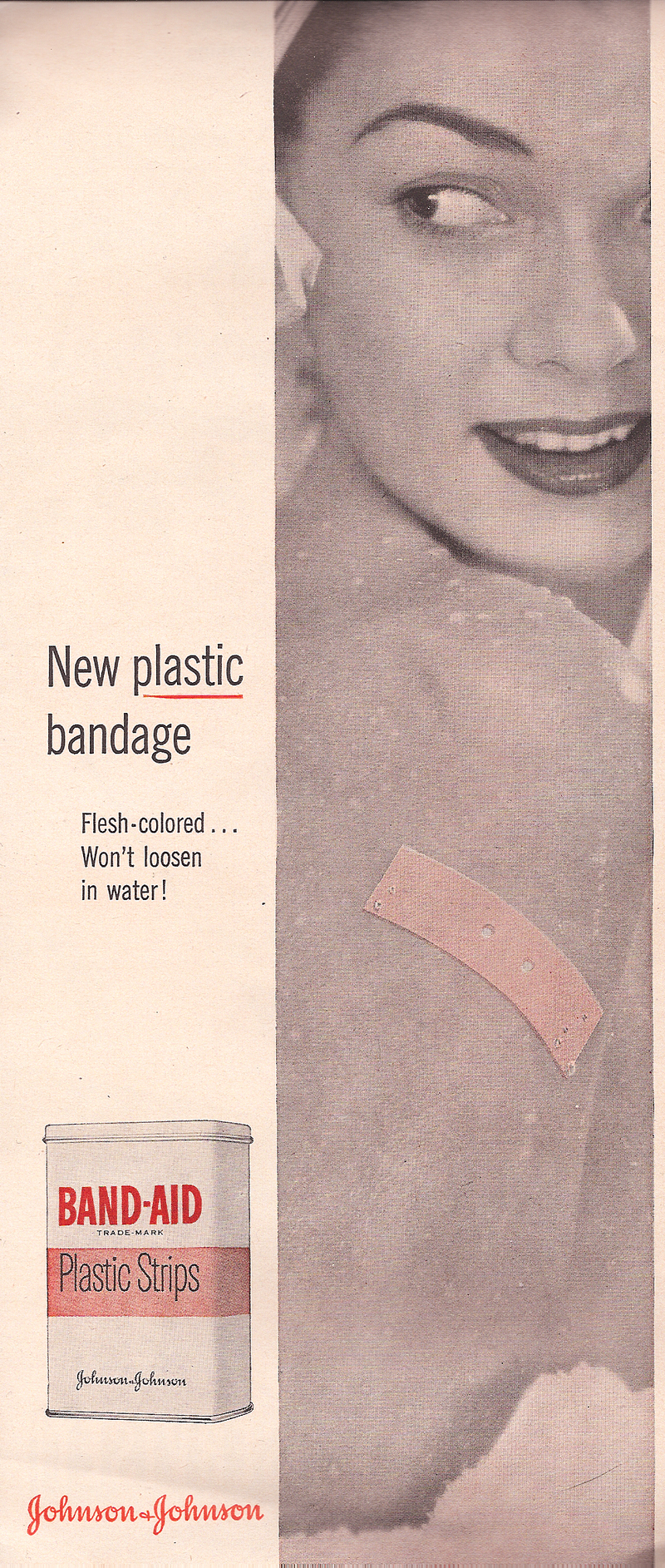
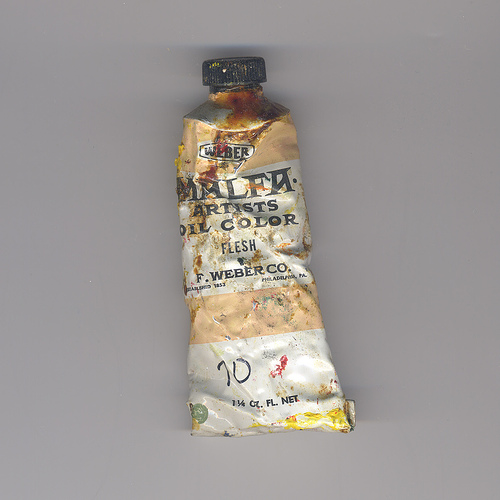
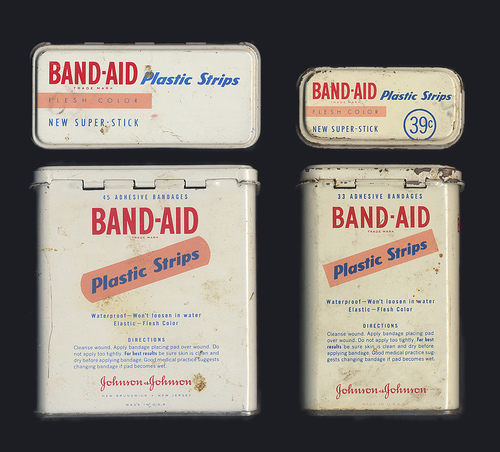
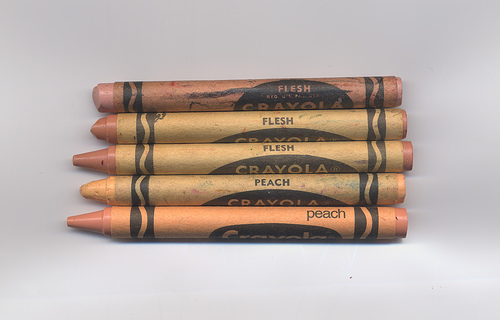
Part of the privilege of being white is having a society that considers you the norm and is, therefore, organized around you.  A really nice example of this is “flesh” color.  What is flesh color?

Ben O. sent us this 1952 ad for bandaids (from Vintage Ads)

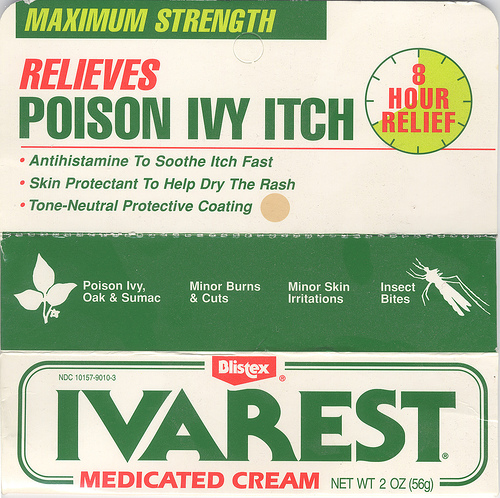
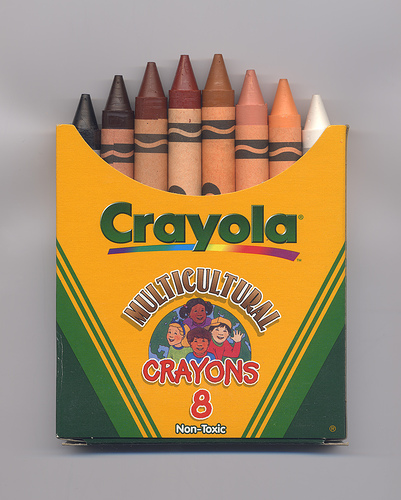
The next set of images come from Nathan Gibbs’ flickr photostream:

A lot of companies have gotten a clue.  Crayola doesn’t have flesh color anymore (or so I’ve heard, let me know if I’m wrong).  And now they make “multicultural crayons.”  Though, Nathan notes:

It’s interesting how “culture” here is a substitute for “race.”

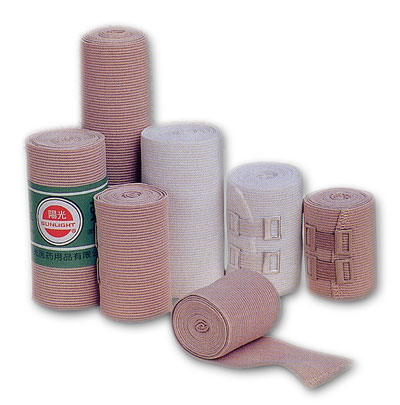
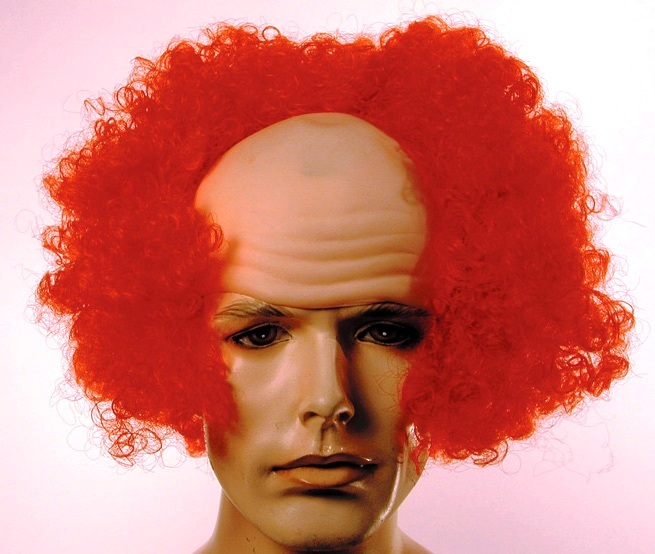
“White” skin is still taken-for-granted in many products.  Here are a couple examples I’ve collected (found here and here):

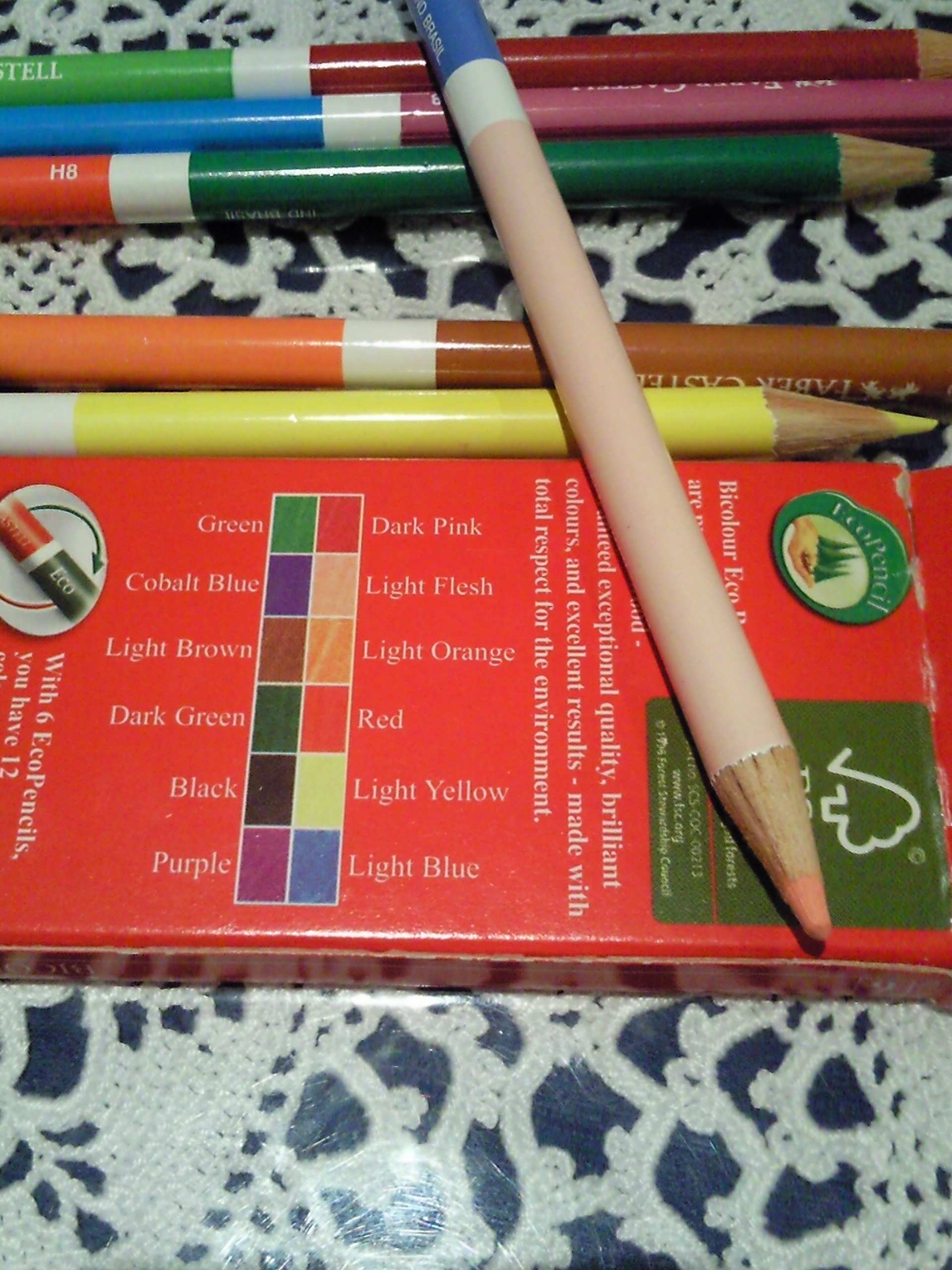
Perhaps trying to walk the line, EcoPencil has a “light flesh” color, but no other flesh colors to choose from (sent in by kelebek in Australia):

Caroline observed that Breathe Right not only centers whiteness in their logo…

…but calls white skin “normal” (see second-to-bottom line):

For more examples, see our posts on (the irony of) Michelle Obama’s champagne-colored described as “flesh-colored”, the widespread use of such language to describe light tan in the fashion world,  and lotion marketed as for “normal to darker skin.” See also our Contexts essay on race and “nude” as a color.

For contrast, see this post about how the generic human in Russian cartoons is colored black instead of white.

Lisa Wade, PhD is an Associate Professor at Tulane University. She is the author of American Hookup, a book about college sexual culture; a textbook about gender; and a forthcoming introductory text: Terrible Magnificent Sociology. You can follow her on Twitter and Instagram.
This Course Guide is in progress and will be updated as I have time.

Disclaimer: If you’re thinking about writing a course guide.  I totally overdid it on this one!  It doesn’t have to be nearly this extensive.


Course Guide for
INTRODUCTION TO SOCIOLOGY

(last updated 5/2012)

Developed by Gwen Sharp
Nevada State College


C. Wright Mills and the Sociological Imagination

Intersection of biography and history as illustrated by:

“the capacity for astonishment is made lively again”

Karl Marx/Marxist analysis

Emile Durkheim

[Because the course guide has gotten to be so long, I’m putting the rest of it after the jump.]

more...

We’ve written several posts about how the words “nude” and “flesh” tend to be used to refer to colors associated with light-colored skin.  For examples, see our posts on “flesh-colored,” Michelle Obama’s “nude” colored dress, the new in-color, “nude is the new black” (and by black we mean white), lotion for “normal to darker skin,” and color-assisted medical diagnosis.  Readers have sent in an additional example and several counter-examples.

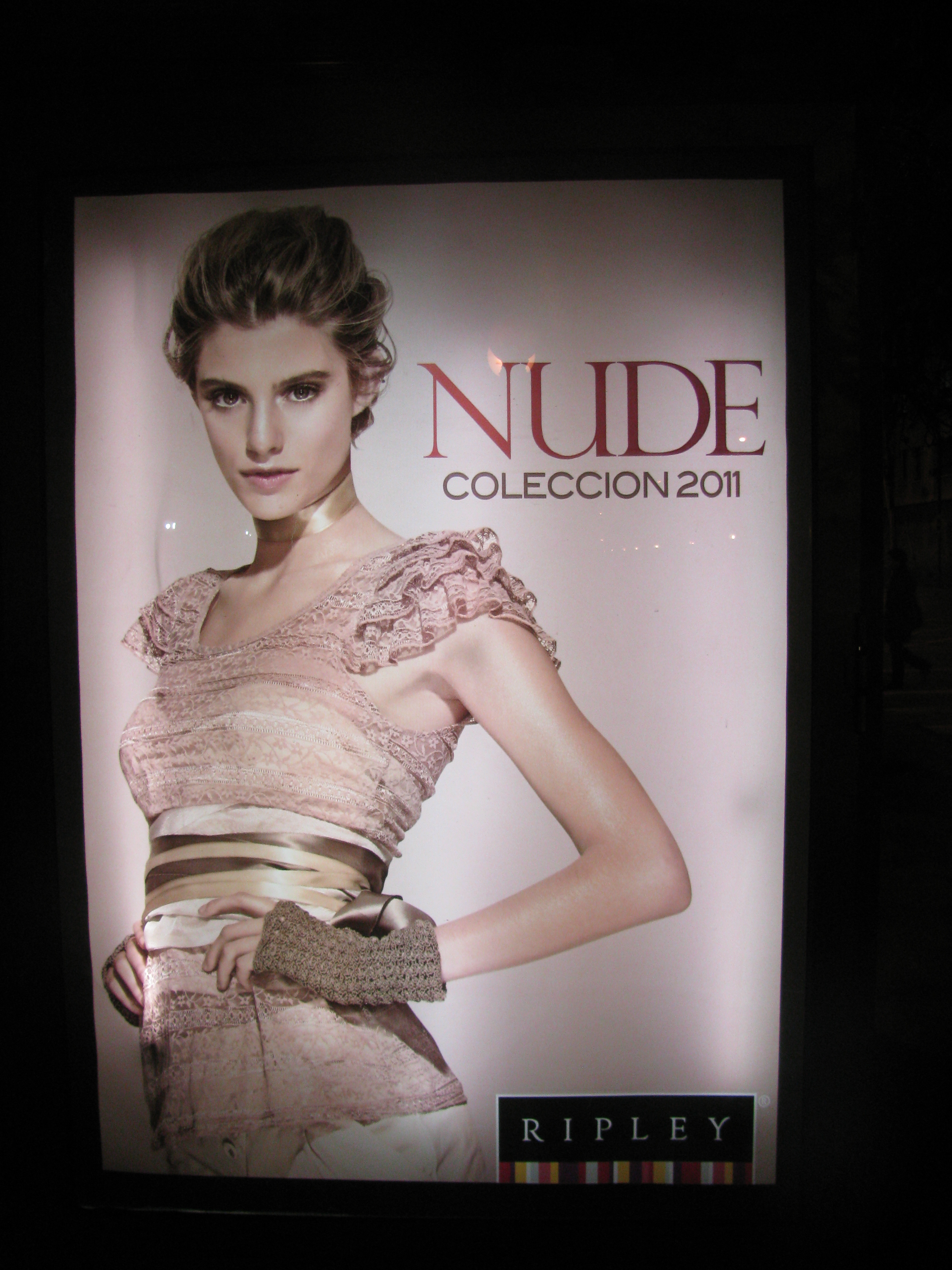
Catherine M.P. snapped this photo of an ad for Ripley in Santiago, Chile (she says English is often used to make a product seem “edgy”):

Lisa Wade, PhD is an Associate Professor at Tulane University. She is the author of American Hookup, a book about college sexual culture; a textbook about gender; and a forthcoming introductory text: Terrible Magnificent Sociology. You can follow her on Twitter and Instagram.
Justin A. B. drew our attention to a Marie Claire fashion slide show titled “Nude is the New Black.”  By “nude” (ironically) they mean, “white-person-color.”  Every single picture featured a tan or cream item.  Every. Single. One.

We’ve been covering this phenomenon.  See our posts on “flesh-colored,” Michelle Obama’s “nude” colored dress, the new in-color, lotion for “normal to darker skin,” and color-assisted medical diagnosis.

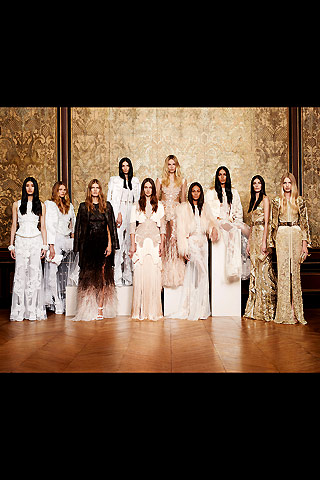
NEW! (July ’10): Anna sent in another example, this time an article about Givenchy’s Fall 2010 collection. According to the article (at style.com), “everything was white, flesh-colored, or gold, with a salon dedicated to each shade.” On the Givenchy website, they use the term “nude.” An example of a “flesh-colored/nude” dress:

A group photo that shows the range of colors; the two in the middle are the “nude” dresses:

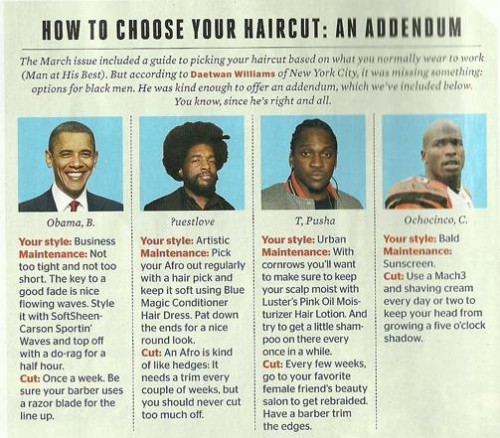
Also NEW! (July ’10): Juliana B. pointed out that in the May 2010 issue of Esquire an article on haircuts completely ignored Black men, who might not be able to use the suggestions on their hair…but in the June issue, the editor responded to a letter from a reader by acknowledging “he’s right.” They then included a segment on haircuts for Black men:

Lisa Wade, PhD is an Associate Professor at Tulane University. She is the author of American Hookup, a book about college sexual culture; a textbook about gender; and a forthcoming introductory text: Terrible Magnificent Sociology. You can follow her on Twitter and Instagram.
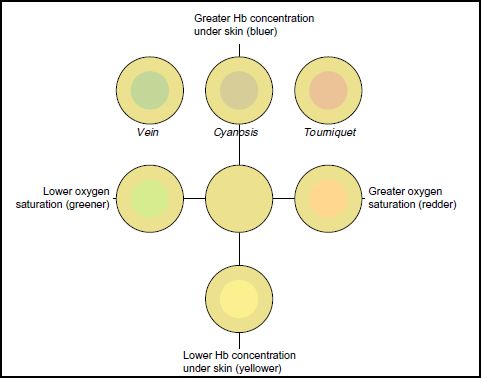
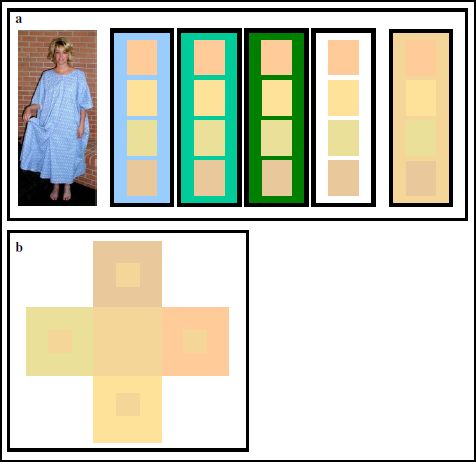
An article in press at the journal, Medical Hypotheses, suggests that detection of underlying medical problems that affect skin color can be facilitated by placing patients in hospital gowns matching their skin. If their skin starts to change color, then the contrast will make it suddenly obvious; without the contrast, it might go entirely unnoticed.

The article, though, includes only illustrations featuring light skin. These are them:

A search for words that might suggest even a nod to the idea that darker-skinned people exist — e.g., black, race, ethnicity, Latino, etc — turned up nothing.

Via BoingBoing.  See also our posts on “flesh-colored,” Michelle Obama’s “nude” colored dress, the new in-color, and this post on lotion for “normal to darker skin.”


Lisa Wade, PhD is an Associate Professor at Tulane University. She is the author of American Hookup, a book about college sexual culture; a textbook about gender; and a forthcoming introductory text: Terrible Magnificent Sociology. You can follow her on Twitter and Instagram.
Elle, at Shakesville, writes:

…sometimes I am struck by how many times, in so many little ways, people of color are reminded that “white,” in terms of race, is presumed to be the default or that white people are presumed not to “have” race in the same ways that we are.

Skada sent us another great example of this phenomenon: Netflix genres include “Action and Adventure” and “African-American Action” (“and Adventure” would be too many As I guess).

For more examples of the neutrality of whiteness and the marked nature of blackness, see our two posts on recent descriptions of beige as “flesh-colored” (featuring Michelle Obama and Beyonce et al.) and our posts on bandaids and other “flesh-colored” items and lotion for “normal to darker skin.”

Lisa Wade, PhD is an Associate Professor at Tulane University. She is the author of American Hookup, a book about college sexual culture; a textbook about gender; and a forthcoming introductory text: Terrible Magnificent Sociology. You can follow her on Twitter and Instagram.