This commercial I recently saw on Comedy Central for Progene male enhancement supplement warns men who are “not 20 anymore” that, without their product, they won’t be able to satisfy a woman.
Here’s a screenshot of a graph from the video which purports to show how men’s sexual performance declines with age:
Of course, we women “know it’s not your fault,” “it’s natural.”
Obviously you could could use this for a discussion of the increasing scrutiny men’s bodies are put under (much as women’s long have). But it’s also a good example of the way sex is often discussed; the implication here is that the only way to satisfy a woman sexually is to be able to have sex like a 20-year-old man, and the emphasis is clearly on penile-vaginal intercourse as the main source of sexual pleasure (though it does come with the handy DVD about the female orgasm). I might also use it when I talk about the ways we construct biology and treat some “natural” processes as inevitable and unalterable while attempting to change others.
For the unbelievers, I know this ad may very well look fake, but I swear to you I saw it on TV. Multiple times, because it was during a show I’d recorded, so I had the opportunity to rewatch it to my heart’s content.
Gwen Sharp is an associate professor of sociology at Nevada State College. You can follow her on Twitter at @gwensharpnv.
Seemingly just seconds after the news leaked this weekend that current Alaskan governor Sarah Palin was McCain’s pick for vice president, merchandise appeared to capitalize on her conformity to current white bourgeois beauty standards. [Thanks to Shakesville’s Sarah Palin Sexism Watch for alerting me to the existence of this stuff.]
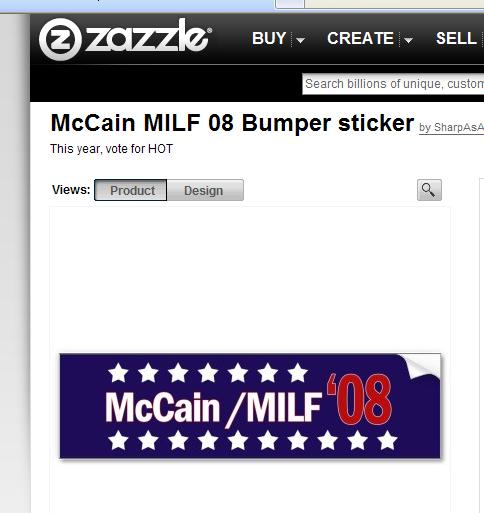
For example, I found this bumper sticker on zazzle.com, a site where users can upload their own images for use on T-shirts, stickers, baseball caps, etc. The caption above the sticker says, “This year, vote for HOT!” See screengrab below.
Zazzle bumper sticker saying "McCain / MILF '08"
“MILF” is a slang term for “Mother I’d Like to F**k.”
This [and the many other examples that I’m sure will be added to this post] would be useful in an ongoing discussion about the deployment of gender in this year’s presidential elections, especially comparing/contrasting the popular portrayals of Hillary Clinton with those of Sarah Palin.
The AFP disembodies Palin in a “news photo” published on September 1. When body parts of male candidates are shown, they are identified as, for example, “the hand of Candidate X was seen waving.” However, in this example, Palin is identified as her legs. [Again, hat tip to Shakesville for photo and commentary.]
Palin reduced to body parts by AFP
Caption accompanying photo reads:
Republican vice presidential candidate Alaska Governor Sarah Palin stands on stage during a campaign rally in O’Fallon, Missouri on August 31. Palin got comfortable in her new role as a vice presidential candidate as she made the Republican case to stay in power. (AFP/Robyn Beck)
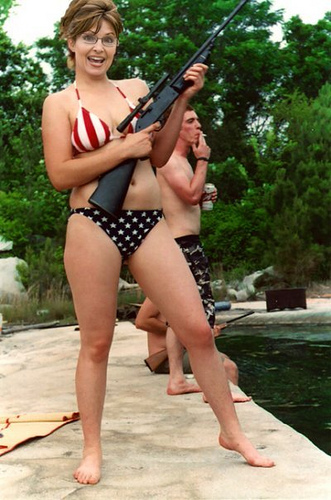
Dubi K. sent us the following picture that has been making the round on the Internet [it is reportedly the icon for a Facebook group called “I’d Bang Sarah Palin!”]. It is a manipulation of a photo of a woman in a bikini with a gun. Palin’s head is superimposed on the woman’s body. Snopes, clearinghouse on Internet memes and urban legends, summarily debunks the picture’s supposed authenticity and supplies simiilar examples.
Photo manipulation of Sarah Palin
An opinion piece, “The Dominatrix,” by Gary Kamiya on Web magazine Salon is advertised on the front page [as of September 9, 2008] with the following poorly done Photoshop of Palin as a stereotypical dominatrix, bringing America [as moose?!] to heel:
Salon advertises editorial about Palin with image of her as a moose-dominating sex worker.
Note the equation of a powerful, assertive woman with non-heteronormative, kinky sexuality that some people find morally repugnant. My point is not to start a debate on bdsm, but to show that this picture and the accompanying article make the tired old connection between a powerful woman and “perverted” sex.
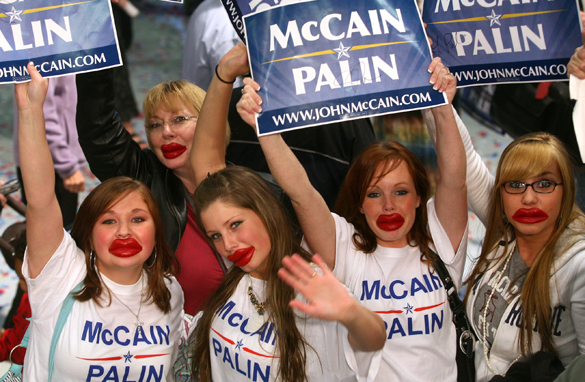
Laura C. sent in a link to this image (found at Carrion Bag) of Palin supporters:
Might be good for a discussion of the ways in which sexualization of Palin is coming from both opponents (see here) and supporters, and the ways that women may actively take part in sexualization that trivializes women as a group.
Thanks, Laura C.!
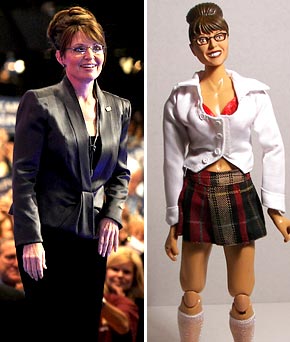
Finally, there are now action figures of Sarah Palin. The one below is the “Sarah Palin School Girl Action Figure.” Setting aside how I feel about Sarah Palin personally and politically, I hate to see a woman’s political power attributed to how sexy she might be. There are already dozens of groups on Facebook about how “sexy” or “hot” Palin is, and they have thousands of members.
We crafted four sample class assignments using Sociological Images. One for a lower-division class and three for an upper-division class. Check them out here.
By the way, if you have crafted assignments using our blog, we’d love to publish them here! Please send them along! Email us at socimages@thesocietypages.org.
AND BACK TO THE OL’ BEHIND YOUR BACK:
A series of toys by Playmobil, sent in by Kirsten D., were added to our post illustrating what it means to be a neutral versus a marked social group. See it here.
We add another beer commerical to the three we posted trivializing love, sex, and relationships in favor of beer. This one was pointed out in our comments by Pharmacopaeia. Thanks!
Daniel B. sent in a picture of the Spanish women’s Olympic basketball team in the infamous “slant-eyed” pose (meant to make them look, um, Chinese) and we added it to this post that showed the Spanish men’s team in the same pose. We added another image he found of the Spanish tennis team in that same pose to this post showing the Argentine women’s soccer team doing it too. Then we sat around and scratched our heads and wondered if every Olympic team felt the need to pose like that before leaving for Beijing.
We added a Budweiser ad in which foaming surf on the beach forms a phallus pointing to a bikini-clad woman’s crotch to our post on “subliminal” sex in ads. (Somehow a month rarely goes by without a new addition to this particular post!)
We added a Mini Cooper ad that brags about the car’s “carfun footprint” to this post about the commodification of environmentalism. While it would be great if a car’s effect on the environment actually became a major selling point, when you look at the Mini’s gas mileage ratings (which I report in the post), it’s not clear that the “carfun footprint” is much more than a tagline.
We added another commercial, sent in by Corey, to this post about Just for Men’s Touch of Grey line, a product that allows the user to decide how much grey they would like to leave in… something we can’t image a woman’s hair dye company ever offering, since women don’t get to benefit from the “distinguished look.”
We added Paris Hilton’s humorous response to this post about John McCain’s campaign ad that associated Barack Obama with Hilton and Britney Spears in an attempt to portray him as a lightweight with no experience.
Elizabeth sent in a PETA ad that compared slaughtering animals to the beheading of a man on a Canadian bus. We added it to this post about the use of Holocaust imagery in PETA ads and who claims the right to use horrific incidents (both historic and current) in their attempts to frame social issues.
In the contemporary U.S., the feminist movement has been so thoroughly intertwined with the pro-choice movement that the rhetoric of choice has become a common way to talk, more generally, about women’s liberation. And women’s liberation, as we have demonstrated (see here, here, here, here, here, here, and here), is frequently co-opted for the purposes of selling women all sorts of products (including those in decided conflict with mainstream feminism, like this one and this one).
A reader, Tracy in Canada, saw these ads at Sears. In them, the phrase “the right to choose” is used to invoke feminist ideals and applied to the right to select a “gift adapted to your beauty concerns.”
NEW! (Nov. ’09): Kristyn G. sent in this commercial for a cable company in India that also co-opts the right to choose…in this case, the right to choose her own husband:
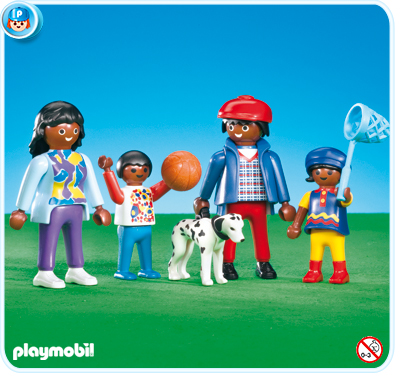
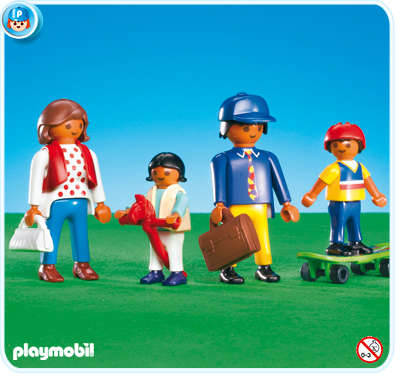
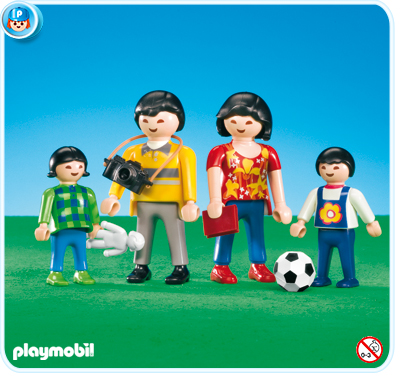
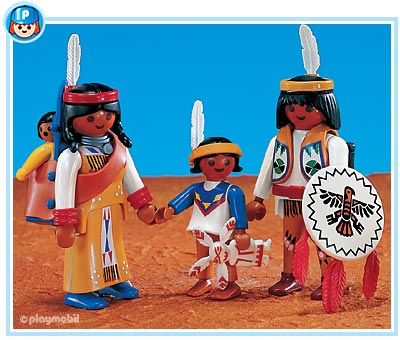
Kirsten D. sent us this link to a series of Playmobil families. She notes how the families are all racially marked (using racial categories like “Asian” and “African” instead of nationality categories like “Japanese” and “Somalian”). The “Mediterranean/Hispanic” category also points to the social construction of race and the way in which social construction varies across cultures (Playmobil are made in Germany).
They families are also racially homogeneous. In the world of Playmobil (at least how it is sold, though not necessarily how it is played with) there are no interracial families and, therefore, no bi- or multi-racial people. In this way the toys reify racial categories and naturalize racial matching in relationships.
African/African American Family:
Mediterranean/Hispanic Family:
Asian Family:
Native American Family:
Notice also that all of the families are in contemporary clothes except for the Native American family. Ethnicized groups are often represented in “native” costume, but this is especially true for American Indians (at least in the U.S.). It is as if, in the popular imagination, American Indians are extinct; as if there are no American Indians alive today walking around in Nikes (there are).
So, in the world of Playmobil, American Indians are, like Romans, a historical artifact:
Also, because it warrants pointing out, all the female and male children all have gender stereotypical toys.
I took this picture of a “rapid weight loss” product at a Walgreens:
I think this product it all-too-clearly illustrates Jean Kilbourne‘s contention that, when it comes to women, “less is more.” Aspire to be a size zero. Aspire to be nothing. Aspire to be defined by what you lack.
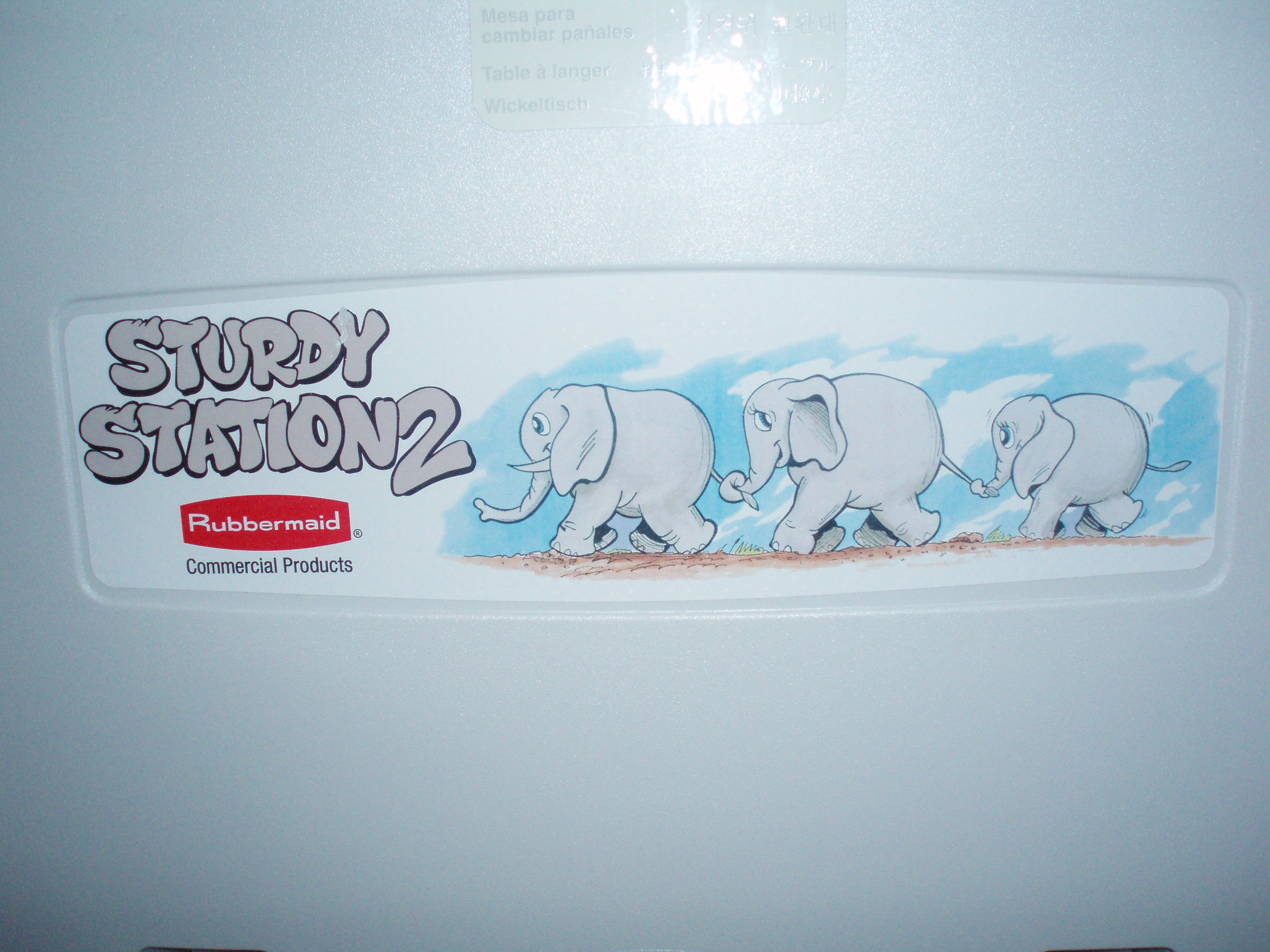
This is a picture of the illustration on a “sturdy station,” an infant changing table I found in a women’s bathroom (click on the image for a closer look).
I thought it nicely illustrated a number of normative expectations/social constructions:
1. Families include two parents.
2. Those two parents include a male and a female.
3. Males don’t have eyelashes.
4. Males are (at) the head of the family.
5. Females are the primary caretakers of children. While the male is looking ahead, the female is either looking at the baby or looking at the person using the changing table (and is, therefore, identifying with the person using the changing table who is, presumably, also female).
This poster was affixed to a tree on my block:
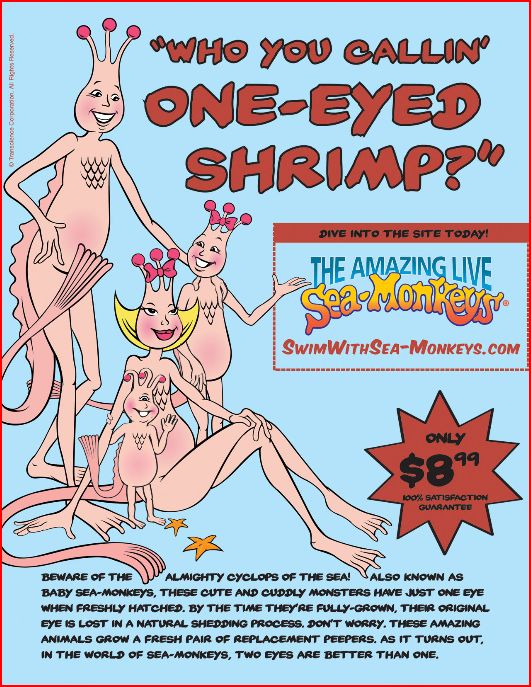
NEW! This ad for sea monkeys, found at AdFreak, portrays them in a nuclear family (mom and dad, son and daughter):
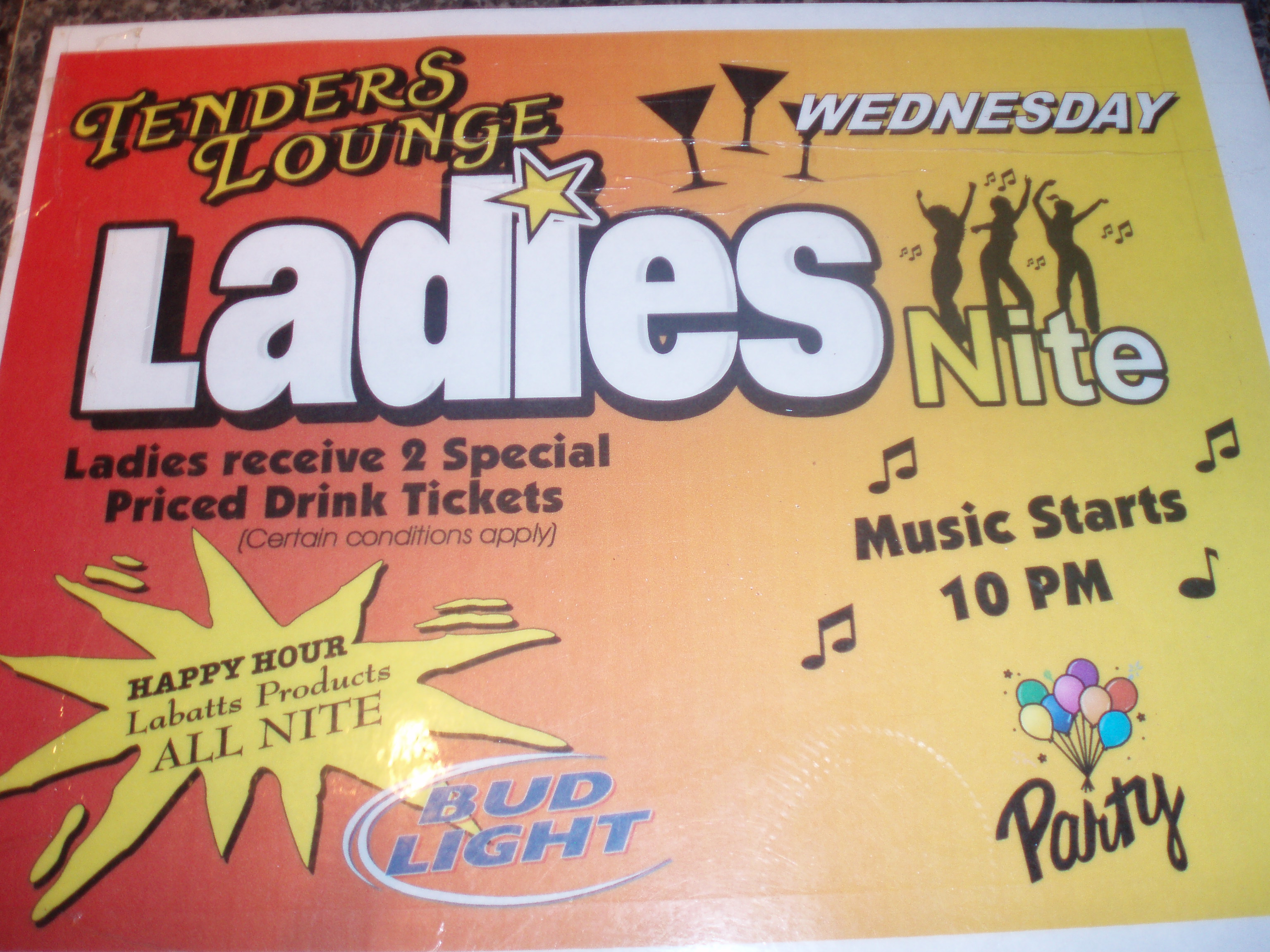
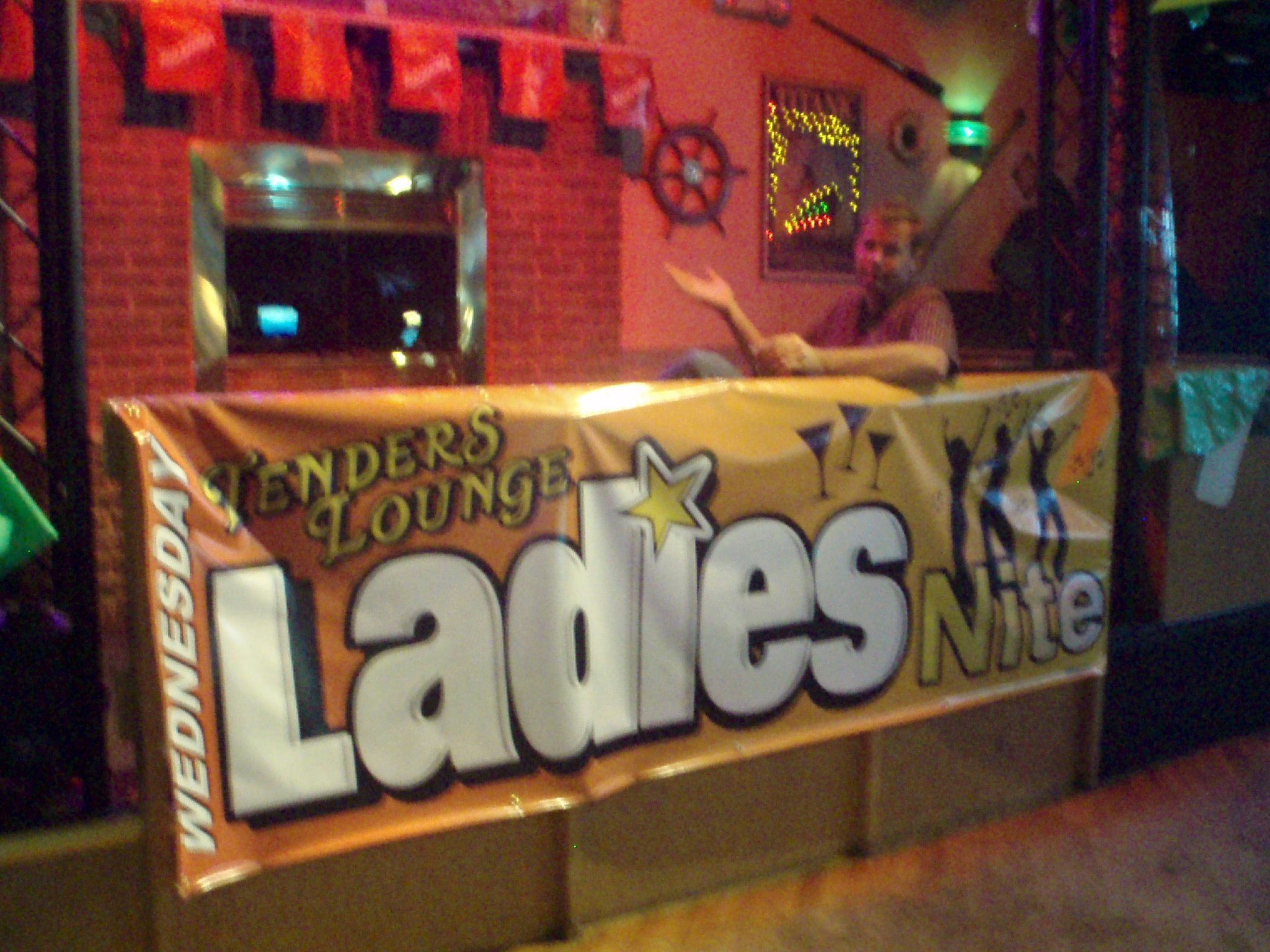
I took these pictures of a flyer and a banner for “Ladies Night” at Tenders Lounge in Goose Bay – Happy Valley, Canada. I noticed that the word “Ladies” did not include an apostrophe: it’s “Ladies Night,” not “Ladies’ Night.” That is, it is advertised as a night of ladies, not a night for ladies. To put it more bluntly, the ladies are not guests, they’re bait.
(That’s Steve. It was not, in fact, Ladies Night and I asked him to look disappointed. He is worried that you will think he was really disappointed. I assure you, he was not.)
I am wondering if this is typical or unusual. Readers, feel free to send in pictures of advertising for Ladies(‘) Nights. I’m curious what we’ll find!
About Sociological Images
Sociological Images encourages people to exercise and develop their sociological imaginations with discussions of compelling visuals that span the breadth of sociological inquiry. Read more…