Way back in June Missives from Marx sent in a link to a story at Dark Roasted Blend about tourism in the rainforest along the Amazon River near Manaus, Brazil. One stop was at a small riverside village where tourists are taken to have an “encounter of two different cultures.” Here’s a photo from the post:

54i67uer6jurthgfc

Underneath the photo was the following caption:

A cruise ship arrival is a great event for the small village located on the mouth of Valeria River. The friendly villagers are always happy to welcome all visitors, eager to make contact and get news from foreign lands.

“Friendly villagers” “eager to make contact” and learn about “foreign lands”? It’s an incredibly patronizing description that sounds like it could have been in a travel brochure for the British Empire decades ago.

From the post:

Because of the small space, the visitors are literally poking into the river people’s lives. But they look happy enough to share with us their ways of life: we are being shown their schools, the local market and even the way their houses are made.

They seem to understand that visits like these sustain the little trade they are able to make by selling souvenirs and exquisite crafts. There are very few inhabitants and they are all very proud of their amazonian heritage. Although modern living is slowly making its way through, they dress up with traditional costumes.

Yes, they do understand that the tourist visits sustain their economy. They let people poke into their lives because they need the money. And they dress up in traditional “costumes” (?) because it makes tourists happy and then the tourists give them more money.

The kids, apparently, haven’t learned the etiquette for dealing with tourists. The post has several images of children with labels like “Little Warrior,” with descriptions such as:

They are not used being on display for the large audience and they all look like they would be happier playing, rather than demonstrating their skills. One particular girl attracted the crowds with her beautiful, magnetic eyes. She was demonstrating archery, but her eyes were throwing the real darts.

The poster acknowledges that the children don’t like being on display, but doesn’t think that might mean that a) you shouldn’t then treat them like tourist attractions or b) maybe the adults don’t really like being on display much either but have learned to play along better. I also wonder whether the children are demonstrating “their skills” or whether a kid holding a bow and arrows is part of the play-acting for tourists.

I once went on a river tour outside of Manaus; the one described here sounds almost identical. I felt uneasy about the idea of visiting the village but there wasn’t really a choice (they forced us off the boat at each stop) and my boyfriend at the time was excited, and so we walked around. It was an incredibly creepy experience. The people there were obviously poor, and tourists were walking around gawking at them, feeling entirely comfortable looking right into their yards and houses. I felt terribly awkward; even my boyfriend felt weird and just wanted to leave. I would not say the people looked thrilled to see us. Some did, especially those selling soda at the cantina (part of that “modern world”). But more than one person, mostly children, glared. And it was very clear that they were being nice to us and offering to be in photos with tourists in hopes of making a little money.

The whole thing felt like cultural tourism–hey, Americans/Europeans! Look at these people in their pre-modern villages and traditional “costumes”! Isn’t this a neat cultural encounter? Feel free to roam around and look at anything you want–the jolly villagers are just thrilled to death to have you here!

In another case of this, James T. sent in this video, found at 3quarksdaily:

It’s distressing to see this type of tourism prestened in such a positive light without at least discussing the ethical issues that might arise when relatively wealthy tourists encounter an impoverished group dependent on tourists’ money for some of their livelihood.
Sandra H. sent us a link to a story about a field of empty container ships parked off the coast of Singapore:

Simon Parry reports that the field includes about 12 percent of the world’s container ships.  More than “the U.S. and British navies combined,” he writes.

The idle ships are another visual indication of the worldwide economic downturn, alongside the images of Detroit’s decline, unsold cars, abandoned homes, and empty malls.

—————————

Lisa Wade is a professor of sociology at Occidental College. You can follow her on Twitter and Facebook.

Lisa Wade, PhD is an Associate Professor at Tulane University. She is the author of American Hookup, a book about college sexual culture; a textbook about gender; and a forthcoming introductory text: Terrible Magnificent Sociology. You can follow her on Twitter and Instagram.

Ben O. sent us this vintage airline commercial for Braniff International.  In it, a “stewardess” models new uniforms to stripper music and narration.  What struck Ben was the final uniform and commentary.  The commercial ends with the assertion that Braniff International “believes that even an airline hostess should look like a girl.” Sexism aside, Ben argues, and I agree, that what she is wearing is hardly feminine at all given today’s standards. The commercial, then, nicely demonstrates how norms for gendered appearance shift and change.

—————————

Lisa Wade is a professor of sociology at Occidental College. You can follow her on Twitter and Facebook.

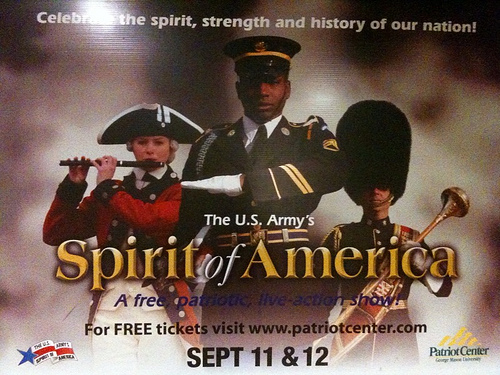
Jamy B. snapped this photo of an ad for a U.S. Army “live action” show in the D.C. metro:

3928437675_ec49ef44a6

The show is called “Spirit of America” and the slogan along the top reads: “Celebrate the spirit, strength and history of our nation!”   The inclusion of a white woman and a black man alongside what appears to be a white man, suggests that the ad-makers want us to understand that the “spirit of America” involves racial and gender inclusiveness.  Of course, this is in contrast to historical fact.   Being “patriotic,” I guess, means erasing historical injustices.

Frankly, I have some sympathy for the promoters of this event.  Inclusiveness is a nice idea.  Unfortunately, they’re stuck between a rock and a hard place in trying to bring together ideology and reality.

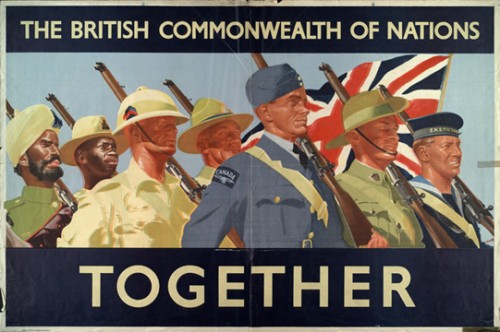
NEW! Simon H. sent in a British poster (found at Free Market Fairy) urging men to sign up to serve in World War I. In this case, the British Empire is portrayed as a family of nations, all happily working together with the same patriotic aims:

British War Posters 4

—————————

Lisa Wade is a professor of sociology at Occidental College. You can follow her on Twitter and Facebook.

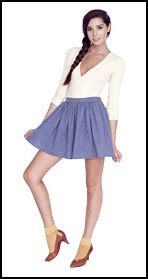
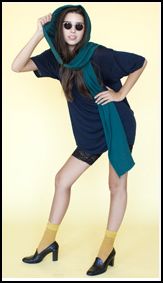
Lynn drew our attention to the American Apparel webpages for men’s and women’s clothes.  She notes a distinct difference:

On the Women’s clothing pages, the girls are modelling THEMSELVES in addition to the clothes.  You see a butt purposefully sticking out here, a shirt pulled up to there, a head thrown back in a coquettish manner, a back arched this way and that.

On the Men’s pages, the men are essentially just “standing there”, letting the clothes speak for themselves.

I’ve included screen shots of all of the models in the slide show, so you can judge for yourself (sorry for the funky formatting; there were more images of women than men).

The men:

Capture1Capture2Capture3Capture4Capture5Capture6Capture7Capture8Capture10

The women:

Capture8Capture4Capture5Capture0Capture1Capture2Capture3Capture6Capture7Capture9Capture10Capture11Capture12Capture13Capture14Capture15Capture16Capture17Capture18Capture22Capture23Capture24Capture27Capture19Capture20Capture25Capture21Capture26

—————————

Lisa Wade is a professor of sociology at Occidental College. You can follow her on Twitter and Facebook.

NEWS:

Remember, if you’re so inclined, we’re on Facebook and Twitter!

We’d like to draw your attention to the comments thread on an old post, Marketing Asian Women to Anti-Feminist Men.  While, to be frank, I don’t think the post was very strong in itself, it attracted the attention of the very men to whom I argued Asian women were being marketed.  Their comments are a really fascinating insight into the logics of white men who prefer Asian women.  It’s a pretty amazing read.

If anyone without access to journal databases would like a copy of my most recent publication, “Defining Gendered Oppression in U.S. Newspapers: The Strategic Value of ‘Female Genital Mutilation’” (Gender & Society, 2009), I’d be happy to email you a copy.  Just send us a note at socimages@thesocietypages.org.

FROM THE ARCHIVES:

One year ago in September, we dissected a news story about “black and white twins.” The story reveals a great deal about how Americans think about race and so we decided to revive it for today.

Two years ago in September, when we were but a wee blog, we posted our first PostSecret about the pressure one man feels to perform masculinity.

NEWLY ENRICHED POSTS (Look for what’s NEW!):

Race

We found more examples of black models (Naomi Campbell again, Iman, and Grace Jones) being posed with or as animals and added them to our post on the topic (not safe for work).  Bri A. also sent in some photos of Bratz Nighty Night dolls; only the dark-skinned doll is in leopard print pajamas.

We added an image that questions why we accept American Indian sports mascots when we’d surely express outrage if other minorities were used as mascots to our post on Native American mascots.

Discourse

Man poisons wife; Reuters says it was an act of love.  Screenshot here (scroll down).

Gender and Symbols

I snapped two pictures at the Dublin airport of warning signs for moving sidewalks that, like an earlier example, mark stick figures as female as soon as a child is involved.  Also new to the same post, Emanuelle sent us an example of a sign showing a stick figure with a child… and the figure isn’t clearly marked as female.

We also added a photograph to our collection of traffic signals that feature a female instead of a male figure.  This one, from New Zealand, was spotted by Pharmacopaeia.

Sarah D. sent in another example of the feminization of sugar.

Socialization and Gendered Products

We added commercials for two more toys that socialize girls into cooking and other housework to our post about the Hasbro Rose Petal cottage.

The trailer for the movie Teenage Doll, another old movie about teens going crazy with lust, made a nice addition to our post with other examples on the same theme.

As we often do, we have more examples of gendered kids’ products: boys’ and girls’ versions of a book on “how to be the best at everything.” They make a nice pair with the girls’ and boys’ doodle books we posted here.

More pointlessly gendered products! Now sunscreen comes in a version just for girls (scroll all the way to the bottom of the post).

Objectification of Women

Giorgos sent us another fantastic PETA ad, this one implying that you might get to see “explicit footage” of Pamela Anderson. We added it to our post on how PETA objectifies women.

How many boob-focused ads for the video game Evony can there be? At least three more.  Thanks to D.R.S., Alex B., Wtfcats, and Kim H. for sending them in!

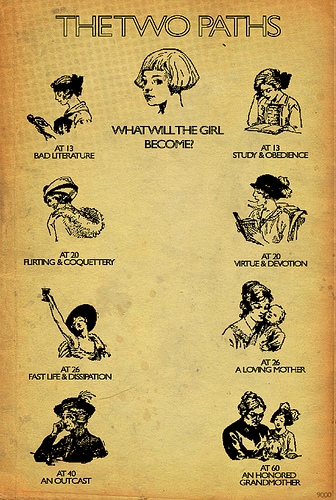
Kristyn G. sent in this excellent image showing the clear division of the world into two paths: that of the sexually active flirt, destined to a life of shame and loneliness (by age 40), and the good girl who can become a happy mother and grandmother:

tumblr_kqnumyaNpl1qzyj2xo1_400

Apparently it appeared in a “social hygiene” manual in the early 1900s.

Also see these trailers for old movies about teens gone wild.

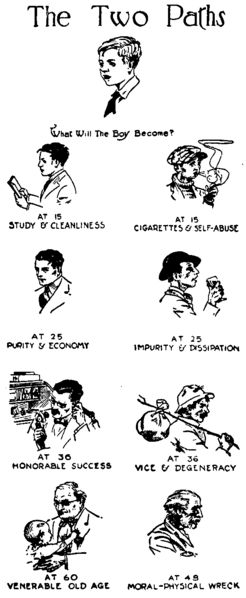
NEW! Awesome reader Maria found the boys’ version:

246px-The_two_paths_(m)

Nikki L. sent us a link to this fascinating Tickle Me Elmo commercial.  In introduces a new Tickle Me Elmo product, “Tickle Hands.”

The ad takes place on what appears to be an urban street (reminiscent of Sesame Street).  Two of the kids appear white, while the other two look (probably deliberately vaguely) “racial,” maybe Asian and Latino (perhaps biracial).  At the very end of the commercial the kids pose in front of a brick wall with a picture of Elmo graffiti-style.  Two of them look like they’re flashing gang signs and Elmo, no joke, says “Yeahhhhhh Booooy.”  Here’s a screen shot of the moment:

Capture

So let’s trace the evolution of the gangster meme.

1.  Government policy strips urban centers of resources, jobs leave (along with useful things like grocery stores), housing prices fall and the poor become concentrated, and those with means move to the suburbs.  With few “above ground” economic options, people turn to “underground” economies.  With only the “underclass” left, politicians (who tend to listen more to those with economic power and cultural clout) continue policies that disinvest in urban communities of color.  Say “goodbye” to things like nice parks and excellent fire protection.

2.  In a world where obeying the rules gets you nowhere fast, violence flourishes.

3.  The suffering and resourcefulness of young black, Latino, and Asian men in these communities appeals to a (mostly) white “mainstream” America for whom depictions of men of color doing violence confirms their beliefs about white superiority and advanced “civilization.”  Hip hop and rap music becomes a huge money maker for music studios and producers (and a handful of men of color).

4.  As hip hop and rap become commodified, they are depoliticized.  The “oppositional consciousness” that once characterized these art forms becomes largely lost.  For the most part, any artist that wants to “make it” has to be and say what producers think that mainstream Americans want them to do and say.

5.  Now depoliticized, being “hard” and “urban” becomes synonymous with being “cool.”  Everyone wants to be cool.

6.  Being “gangster” is appropriated by white suburban youth.

7.  Stripped of any meaning, it filters down to younger and younger kids.

Enter: Tickle Me Elmo “tickle hand” gang signs.

For more examples of this phenomenon, see these advertising images at a shoe store, Beyonce’s House of Dereon clothing line for girls, the marketing for the Alvin and the Chipmunks remake, and these candy “grills.”

—————————

Lisa Wade is a professor of sociology at Occidental College. You can follow her on Twitter and Facebook.

Lisa Wade, PhD is an Associate Professor at Tulane University. She is the author of American Hookup, a book about college sexual culture; a textbook about gender; and a forthcoming introductory text: Terrible Magnificent Sociology. You can follow her on Twitter and Instagram.