Earlier this month I read an essay that explained to me why I am not married. These reasons included:

  • I’m a bitch.
  • I’m shallow.
  • I’m a slut.
  • I’m a liar.
  • I’m selfish.
  • I don’t think I’m good enough.

I’m not kidding.

Coincidentally, the Pew Research Center released 2010 data showing that just 51% of all American adults were currently married. This is an all time low, down from 72% in 1960.
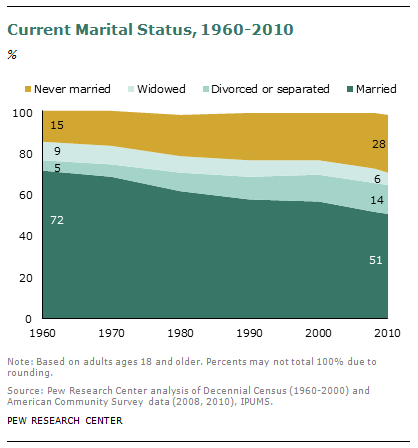
Comparing this data with the essay above is a nice illustration of the difference between “normative” and “normal.”  Normal is what is typical in a statistical sense; it is what actually holds.  Normative is what is believed to be good and right in an ideological sense; it is what it is believed does or should hold.

If you go by the essay, written by the thrice married and now single Tracy McMillan, marriage is an ideal state that we all should, or do, desire.  In her reality, if you aren’t married, it’s because you’re doing something wrong.  Marriage is normative.  In actual reality, though, the state of being married is not any more normal than the state of being unmarried.

Only if marriage is normative does the non-normality of marriage become something that needs explaining.  McMillan jumps in with hateful stereotypes, but social science has much better explanations.

  • Low-income women often do not take-for-granted (as many middle class people do) that they can sustain a marriage through tough times.  Accordingly, they wait much longer before marrying once they meet someone they like (as long as 10 years or more), so that they can be as sure as possible about the match.  In other words, they take marriage very seriously and are reticent to just jump right in.  They know they’re “good enough,” Tracy; in fact, they value themselves and their relationships enough to really put them to the test.  (Read Promises I Can Keep for more.)
  • Other women get divorced because men don’t do their fair share.  Unresolved conflicts over childcare and housework are one of the top reasons that couples dissolve.  Women struggle to keep up when they’re working a full time job and doing 2/3rds to 3/4ths of the childcare and housework.  They may not see the data, but they may intuit that single mothers do less housework than married ones (it’s true).  So they divorce their husbands.  They’re not “selfish,” they’re just trying to survive. (Read The Second Shift for more.)
  • Other people aren’t married because they’re in love with someone of the same sex.  They’re not “sluts,” they’re discriminated against.

And, just for the record:

  • I’m not married because I don’t want or need the state’s approval of my relationship and  I certainly don’t want it interfering if we decide to part.
  • I’m not married because the history of marriage is ugly and anti-woman; because I don’t like the common meanings of the words “wife” and “husband”; and because even today, and even among couples that call themselves feminist, gender inequality in relationships is known to increase when a couple moves from cohabitation to marriage (and I don’t think I’m so special that I’ll be the anomaly).
  • I’m not married because I’m opposed to the marriage industrial complex. It’s exploitative, stereotypical, and wasteful.
  • I’m not married because I value the fact that my partner and I decide to be together every day, even though we don’t have to jump through legal hoops to do otherwise.
  • I’m not married because I don’t want to support a discriminatory institution that has and continues to bless some relationships, but not others, out of bigotry.
  • I’m not married because I don’t believe in giving social and economic benefits to some kinds of relationships and not others.  I don’t believe that a state- or church-endorsed heterosexual union between two and only two people is superior to other kinds of relationships.

After reading some of the great comments, I’d like to add that I’m not married because of several points of privilege:

  • I’m not married because I live in a society that allows women to work, keep their paychecks, rent an apartment, and have a bank account.  (And, frankly, I think it’s kind of neat to be in the first generation of American women who can realistically choose not to marry. I like the idea of embracing that.)
  • I’m not married because both my partner and I are lucky enough to have  a stable, full-time job that offers benefits, so we don’t need to get married so that one of us can get the other health insurance or some other benefit.
  • I’m not married because we are both U.S. citizens and don’t have to marry in order to live together.

I could go on, but you get the idea.

The point is that when the normal and the normative don’t align it often leads to social conflict over the meaning of the gap.  Some people, like McMillan, may jump in to tongue-lash the deviants.  Others may revel in defending non-conformity.  In any case, it will be interesting to see how the conversation about marriage continues, especially if, as the trend suggests, married people become a minority in the near future.

Lisa Wade, PhD is an Associate Professor at Tulane University. She is the author of American Hookup, a book about college sexual culture; a textbook about gender; and a forthcoming introductory text: Terrible Magnificent Sociology. You can follow her on Twitter and Instagram.
Cross-posted at Family Inequality.

Let’s just stipulate that using a personal electronic device while driving increases the risk of an accident and should be avoided.

Let me just make sure I have the rest of the facts straight.

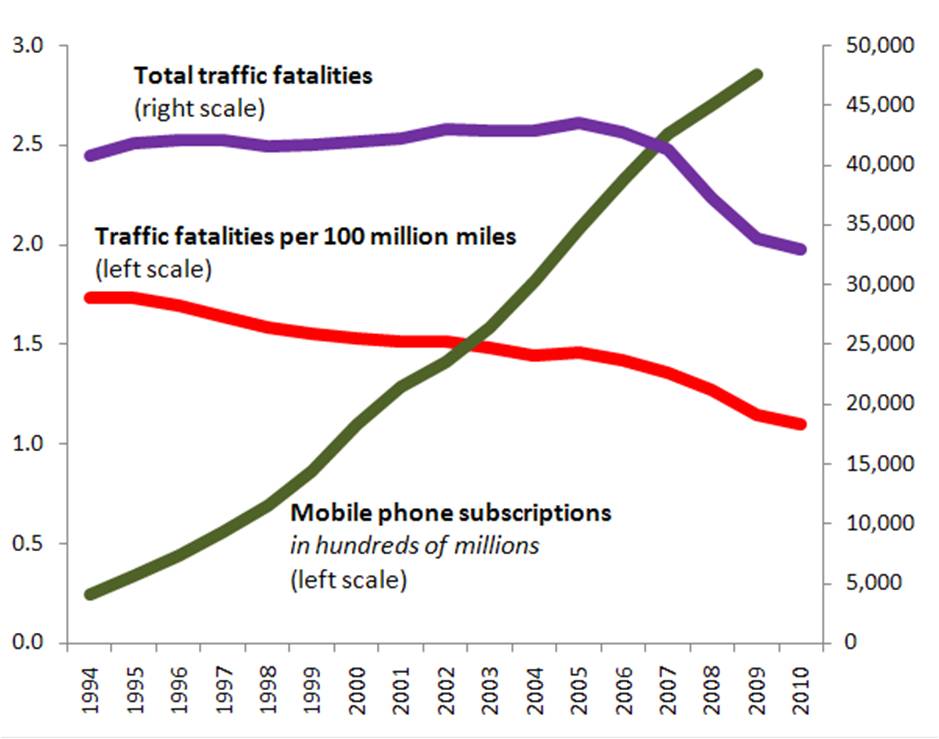
1.  The total number of traffic deaths is at its lowest level since 1949, even as the population, number of vehicles, and number of miles driven have all increased radically.

2.  The number of mobile phone subscribers has increased more than 1,000% since the early 1990s.

3.  “Distraction-affected” crashes accounted for less than 10% of traffic fatalities in 2010.

4.  Deaths attributed to drivers age 17 and younger have fallen by about half since 1990.

5.  The National Transportation Safety Board “is recommending that states prohibit all drivers from using cellphones, for talking or texting.”

Here’s a visual on some of the trends, in one figure:

Pay no attention to the man behind the curtain. Here are my previous posts on this.

————————

Sources: National Highway Traffic Safety Administration: 2009-2010 deaths, deaths trends;  Federal Communications Commission: phone trends; CTIA: 2009 phone subscriptions.


With the college football championship games coming up, Dmitriy T.M. thought it was a good time to highlight the NCAA’s database that provides detailed information on graduation rates of college athletes. For each school, you can select particular sports and years. I decided to look up graduation rates for 2010-2011 at the two schools I attended: University of Oklahoma (undergrad) and University of Wisconsin-Madison (grad school).

The database reports two numbers. The Federal Graduation Rate (FGR) reports numbers for individuals who were first-time college students when they enrolled at the institution (that is, no transfer students are included, and students who transfer count negatively in the rate for their initial school, the equivalent of a drop-out); the FGR indicates how many students graduated from their initial institution within 6 years. The Graduation Success Rate (GSR) takes into account transfer students; as long as they’re in good academic standing when they transfer, they aren’t counted against the initial school’s graduation rate.

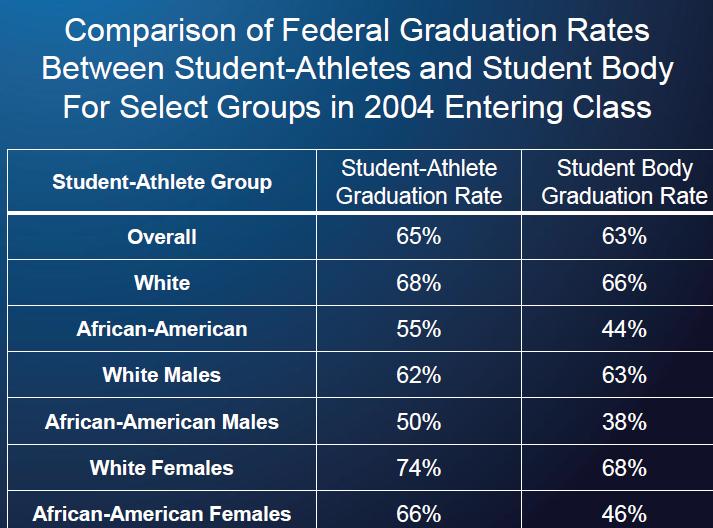
So how are student athletes doing? According to the NCAA’s analysis, if we look at the  more restrictive FGR for students who began college in 2004, student athletes actually have higher graduation rates in general, especially for African Americans:

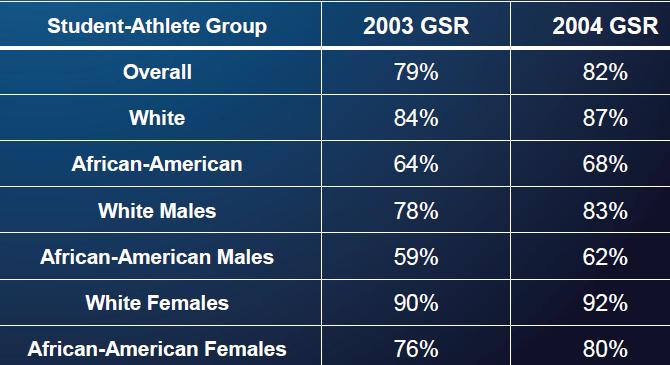
If we switch to looking at the GSR (which, again, drops transfers from the data for the initial school, rather than counting them as non-graduates), for students who began college in 2003 and 2004, overall graduation was pretty high (79 and 82 percent), but we see pretty wide disparities. White student athletes were significantly more likely to graduate than African Americans, and for both races, women were more likely to graduate than men:

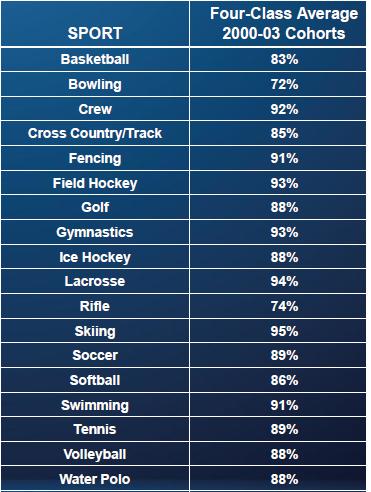
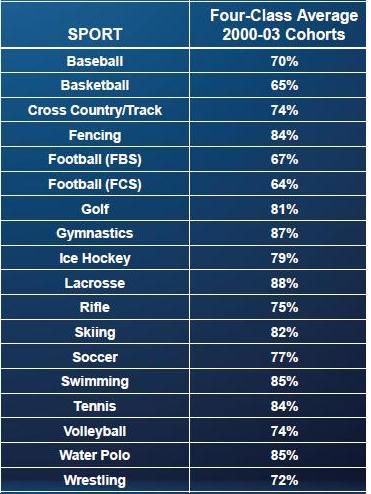
Graduation rates also vary by sport. Here are the averages for male athletes who enrolled between 2000 and 2003; we see basketball and football at the lower end, while lacrosse graduated 88% of its players from that period (the two football #s refer to the different divisions):


Female athletes from the same cohorts; the only sport where they didn’t have (usually significantly) higher graduation rates than men playing the same sport is rifle:

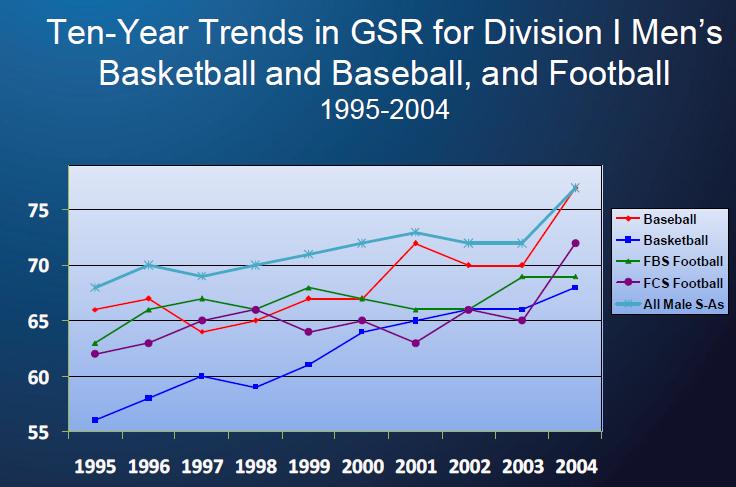
Ten-year trends for men in Division I schools in the “big three” sports:

There’s lots more detailed info available if you click the “Trends in Graduation Success Rates and Federal Graduation Rates at NCAA Division I Institutions” link at the top of the website; you can also get reports for particular schools broken down by sport, race/ethnicity, sex, etc.

Late Night TV host Jimmy Kimmel encouraged his viewers to film their children getting early Christmas presents that they would surely hate.  The result is a collection of children acting badly: bursting into tears, saying they hate their parents, lecturing them on proper gift giving protocol, etc.  It’s funny and also a great illustration of the gift-giving rules that Theodore Caplow meticulously lists in his article, Rule Enforcement Without Visible Means: Christmas Gift Giving in Middletown (pdf) (btw: this is the very first article I assign in Soc101).

(UPDATE: I was quoted briefly on this phenomenon in a New York Times story on the prank.)

In a number of cases, the gift is considered bad because the recipient is a boy and the gift is for a girl.  One boy, for example, gets a Hello Kitty gift, another gets a pop star-themed coloring book.  The boys’ reaction at being presented with a girls’ gift reveals their internalization of androcentrism, the idea that masculinity is superior to femininity.   They express both disgust and, in some cases I think, fear at being poisoned by contact — especially such personal contact as “I got this for you” — with girlness.

More posts on androcentrism: “woman” as an insult, being a girl is degrading, making it manly: how to sell a car, good god don’t let men have long hair, don’t forget to hug like a dude, saving men from their (feminine) selves, men must eschew femininity, not impressed with Buzz Lightyear commercial, dinosaurs can’t be for girls, and sissy men are so uncool.

Lisa Wade, PhD is an Associate Professor at Tulane University. She is the author of American Hookup, a book about college sexual culture; a textbook about gender; and a forthcoming introductory text: Terrible Magnificent Sociology. You can follow her on Twitter and Instagram.
This commercial is good evidence that we still think nothing of being cruel towards people deemed “overweight”:

Via Copyranter.

Lisa Wade, PhD is an Associate Professor at Tulane University. She is the author of American Hookup, a book about college sexual culture; a textbook about gender; and a forthcoming introductory text: Terrible Magnificent Sociology. You can follow her on Twitter and Instagram.
Cross-posted at Montclair SocioBlog.

Children in American movies are typically superior to adults.  The kids are not only all right, they are wiser, less corrupt, and more competent.  “Home Alone” is a classic example, where the plucky, resourceful kid triumphs over both the vindictiveness of the burglars and the mindlessness of his parents.  (An earlier post on children in films is here.)

“The Descendants,” the recent film with George Clooney (I saw it last night), starts more like a French film, where children are, well, children, and it’s the parents who must endure and learn to cope with the kids’ immaturity and thoughtlessness.

Clooney is Matt King, and the name is a deliberate irony.  Kinglike, he must decide the fate of a huge tract of pristine Kauai land that his family has owned for many generations.  The money from the sale will make him and his many cousins and their families rich.  Which developer will he sell the land to?But as a husband and father he is far being monarch of all he surveys.  His wife has been in an accident and lies in a coma.  His two daughters are unapologetically impudent and insufferable.  As the film starts, Scottie, age ten, has sent a nasty, obscene text to a classmate.  Alex, seventeen, now at an expensive private rehab/therapeutic school, first appears on screen drunk, having  sneaked out of her room at night with another girl.  Then there’s Sid, Alex’s friend, a slightly older boy, all stupidity and insensitivity, a chubby incarnation of Beavis and Butthead.Then the film magically transforms the kids.  Each has been introduced as obtuse, obscene, or obnoxious. But now Alex, it turns out, knows more than her father does, at least in one crucial area – that his wife, now on life support, had been cheating on him.

The kids change from being French, a burden for the grown-up, to becoming almost classically American, not superior but equal.  They are now his partners.  Teens and adult are a team trying to discover the identity and location of the seducer so that King can confront him.  The teenagers are suddenly much less difficult and much more helpful, while King sometimes appears uncertain and even silly, peering over hedges to spy on his wife’s lover.   He asks his daughter for advice.  He even asks Sid what he should do.(You can get some sense of this transformation in the trailers here and here, which also outline the rest of the story.)

Still, the movie doesn’t go pure Hollywood.  It does not present the world as a character contest where good faces evil, where the right action is clear and the only question is how the hero will come to make it.  Instead, it shows a grown-up trying to understand and cope with problems and people he cannot really control.

And nobody blows up a helicopter.

At Flowing Data, the Venn Diagram illustrated by a platypus playing a keytar. Go there.

Lisa Wade, PhD is an Associate Professor at Tulane University. She is the author of American Hookup, a book about college sexual culture; a textbook about gender; and a forthcoming introductory text: Terrible Magnificent Sociology. You can follow her on Twitter and Instagram.
Cross-posted at Family Inequality.

Poverty is usually described as a status, as there are people below and above the poverty line. We need to do more to capture and represent the experience of poverty.

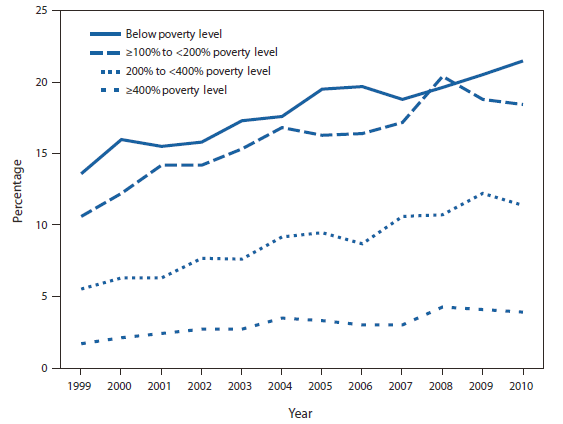
There are ways this can be done even in a single survey question, such as this one: ”During the past 12 months, was there any time when you needed prescription medicine but didn’t get it because you couldn’t afford it?” Below are the percentages answering affirmatively, by official poverty-line status.

Percentage of Adults Aged 18-64 Who Did Not Get Needed Prescription Drugs Because of Cost, by Poverty Status (National Health Interview Survey, 1999-2010)

This is not the same as not having any of the prescription drugs you need. What it indicates is economic insecurity rather than deprivation per se, a more nuanced measure than simply being above or below (some percentage of) the poverty line.