For the last week of December, we’re re-posting some of our favorite posts from 2011.

————————

The US economy faces a number of challenges—among them a lack of job creation and an ever-growing trade deficit. Many policy-makers believe that encouraging business innovation is the best response to these particular challenges. Sounds plausible but experience suggests otherwise.

The best example of why simply encouraging business innovation is not the answer for our employment and trade problems is Apple and its iPhone.

The iPhone was introduced in 2007 and has been incredible successful.  U.S. sales soared from 3 million units in 2007 to over 11 million in 2009.  Global sales topped 25 million in 2009.

While the iPhone is designed and marketed by Apple, almost all the phone’s components are produced by foreign companies operating outside the United States.  These components are then shipped to China where Foxconn, a Taiwanese company, oversees their assembly and their export to the United States and other countries.  As a result, the iPhone generates few jobs in the United States.

Two economists, in an Asian Development Bank working paper, examined the iPhone 3G production process in some detail.  The table below, taken from their study, highlights the main suppliers and the costs of the components they produce for a single phone.  Most of the components are supplied by Japanese, South Korean and German firms, although there are also some U.S. suppliers (although who knows where they actually produce their compnents).

The total component cost of an iPhone in 2009 was $172.46.    Workers in China assemble the iPhone, but because their wages are low the assembly cost per phone (labeled manufacturing costs in the table below) is quite small, only $6.50 a phone.  The total production cost per phone is $178.96.

costs.jpg

Because the iPhone is assembled in China all sales in the U.S. mean an increase in Chinese exports (even though the phone is largely composed of inputs produced outside of China) and an increase in U.S. imports.  In 2009, China exported more than $2 billion worth of iPhones to the United States.  Thus, the iPhone, because of the Apple’s production strategy, also adds to the U.S. trade deficit.

Apple is not alone in embracing China as its production base.  China is now the world’s largest exporter of manufactured goods. And, as the chart below shows, the share of Chinese exports that are labled high technology is growing.  This trend has encouraged many analysts to claim that the U.S. is now locked in fierce economic competition with China.

hitech.jpg

However, as we see next, more than 80% of China’s high technology exports are actually produced by foreign companies operating in China.  Moreover, these foreign companies have significantly increased their control over this production.  In 2002 foreign owned firms that were 100% foreign owned (which means that they had no Chinese partner) accounted for only 55% of Chinese high technology exports.  In 2009 they accounted for 68%.

foreign-owned.jpg

Why do so many transnational corporations choose to locate production in China?  The answer is obvious: profits. Apple again serves as a good example.  The table below, taken from the Asian Development Bank working paper cited above, shows Apple’s profit-margin on the iPhone.  In 2009 it was a whopping big 64%.

profits.jpg

Struck by the size of Apple’s profit-margin, the authors of the Asian Development working paper considered whether the iPhone could reasonably be made in the United States.  As they note:

The role of the PRC in the production chain of iPhones is primarily the assembly of all parts and components into the final product for re-shipment abroad. The skills and equipment required for the assembly are very basic and there is no doubt that American workers and firms are capable of assembling iPhones in the US. If all iPhones were assembled in the US, the US$1.9 billion trade deficit in iPhone trade with PRC would not exist. Moreover, 11.4 million units of iPhone sold in the non-US market in 2009 would add US$5.7 billion to US exports.

For the sake of discussion, they assumed that assembly line wages in the U.S. are ten times higher than in China.   Given that Chinese production workers earn roughly $1 an hour, that is not an unreasonable assumption.  The higher wages would mean that the total assembly cost per phone would rsie to $65 and the total manufacturing cost would approach $238.  If Apple continued to sell the iPhone for $500, the company would still earn a very respectable 50% profit margin.

Moreover, as the authors point out:

In this hypothetical scenario, iPhones, the high-tech product invented by the U.S. company, would contribute to U.S. exports and the reduction of the U.S. trade deficit, not only with the PRC, but also with the rest of world. More importantly, Apple created jobs for U.S. low skilled workers; those who could not be the software engineers needed by Apple. Giving up a small portion of profits and sharing them with low skilled U.S. workers by Apple would be a more effective way [than depreciation of the exchange rate] to reduce the U.S. trade deficit and create jobs in the United States.

Of course, shifting production to the United States would mean that Apple would earn less money and there is little reason to believe that the company is prepared to sacrifice its profits for the good of the country.  If we want to tackle our employment and trade problems were are going to have to do more than promote more attractive conditions for business.


 

For the last week of December, we’re re-posting some of our favorite posts from 2011.

————————


People seem to love to talk about human nature. But when they do, they often do so with the smallest of imaginations. The 10-minute video below suggests that scientists have only begun to understand what humans are capable of. Prepare to be amazed:

Via Oscillatory Thoughts.

Lisa Wade, PhD is an Associate Professor at Tulane University. She is the author of American Hookup, a book about college sexual culture; a textbook about gender; and a forthcoming introductory text: Terrible Magnificent Sociology. You can follow her on Twitter and Instagram.

For the last week of December, we’re re-posting some of our favorite posts from 2011.

————————


Jay Livingston, at MontClair SocioBlog, alerted me to a fascinating phenomenon called “change blindness.”  The term refers to the fact that people must choose what to pay attention to in any given setting. Accordingly, when the details they’ve decided aren’t important change, they don’t notice. This often includes the very people they are interacting with.
In an experiment by psychologist Daniel Simons, an assistant behind a counter, pretending to sign students in for an experiment, is surreptitiously replaced by another person. A full three-quarters of the people don’t notice. Awesome:

Here is a shorter illustration of a similar experiment with the same results (pictured above):

If you haven’t had enough yet, here’s one more example that shows that you can even switch race and gender and it still works!

See also our post on Privilege and Perception.

Lisa Wade, PhD is an Associate Professor at Tulane University. She is the author of American Hookup, a book about college sexual culture; a textbook about gender; and a forthcoming introductory text: Terrible Magnificent Sociology. You can follow her on Twitter and Instagram.

For the last week of December, we’re re-posting some of our favorite posts from 2011.

————————

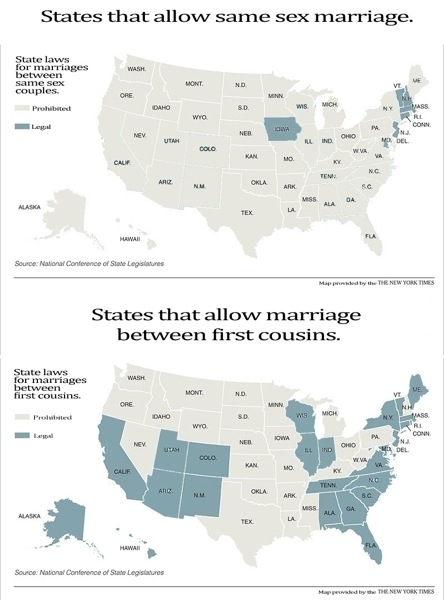
Kristina Killgrove, anthropology professor at University of North Carolina, Chapel Hill, asked a great question about a set of maps posted at Move On.  The maps compare the states that allow gay marriage with the states that allow cousin marriage.  Most Americans find cousin marriage to be disturbing and testimonials from married cousins about their deteriorated family relations and social stigma attest to it.  The idea behind these maps, then, is that cousin marriage is genuinely weird or gross, and yet many states grant cousins the right to marry, but not gays and lesbians.

In fact,  emerging evidence that cousin marriages do not significantly increase the risk of birth defects suggest that the stigma and laws against cousin marriage are unwarranted.  A doctor cited in the study suggests that disallowing their marriages or rights to have children are tantamount to “eugenics or forced sterilization.”  Even if there were significantly increased risks of genetic disorders, Dr. Bittles argues, “People with severe disorders like Huntington’s disease, who have a 50 percent chance of passing it on to their offspring, are not barred from marrying because of the risk of genetic defects… so cousins should not be, either.”

In any case, U.S. aversion to cousin marriage is culturally and historically contingent.  That is, it is related to our particular time and place.  Worldwide, more than 10 percent of marriages occur between first cousins and cousin marriage, historically, has been quite desirable.

Lisa Wade, PhD is an Associate Professor at Tulane University. She is the author of American Hookup, a book about college sexual culture; a textbook about gender; and a forthcoming introductory text: Terrible Magnificent Sociology. You can follow her on Twitter and Instagram.

For the last week of December, we’re re-posting some of our favorite posts from 2011.

————————

In this hilarious two minute video, twin toddlers practice having a conversation. They don’t really know words, but they know HOW to do it. They’ve figured out how to sound sure of themselves, how to sound inquisitive, how to gesticulate, how to aim their efforts at a second person, and how to take turns. They’ve learned, in other words, the rules of talking to another person, even before they’ve learned how to talk. A fun example of socialization.

For more really great examples of children learning to act like grown ups, see our posts on the baby worshipper, the baby preacher, the baby rapper, and the baby Beyonce. Via Blame it on the Voices.

Lisa Wade, PhD is an Associate Professor at Tulane University. She is the author of American Hookup, a book about college sexual culture; a textbook about gender; and a forthcoming introductory text: Terrible Magnificent Sociology. You can follow her on Twitter and Instagram.

For the last week of December, we’re re-posting some of our favorite posts from 2011. Originally cross-posted at Ms.

————————

The New York Times has a fascinating 3-minute video on “roster management”, sent in by Emma M.H.  The term refers to manipulating Title IX rules in order to appear like you’re following them when you’re not.  Title IX is an amendment to the U.S. Civil Rights Act that requires that all schools allocate their resources to men and women in proportion to their interest and enrollment.  It is most famous for what it required of college athletics, and this is what this story is about.

As the article explains, schools demonstrate compliance with Title IX:

…by showing that the number of female athletes is in proportion to overall female enrollment, by demonstrating a history of expanding opportunities for women, or by proving that they are meeting the athletic interests and abilities of their female students.

Once implemented, women responded enthusiastically to the new opportunities.  But spectators and donors are less interested in women’s sports, it turns out.  And so colleges have found various ways to resist Title IX rules, including simple non-compliance.

In this case, the strategy is  to put men on women’s teams and then report them as female athletes.

Case in point: This is Cornell’s women’s fencing team:

It turns out, 15 of the 34 team members are men:

The men don’t actually compete, they are simply “practice players” (helping the women improve due to their greater speed and strength, says the coach).

The basketball team has a similar strategy.  A number of males practice with the team and then are reported to the authorities as female players.

Revealing that this is an attempt to manipulate Title IX rules and not a simple weird way of accounting for athletes, the five female coxswain’s on the men’s rowing team is reported not as male, but as female.

So there you have it.  Despite Title IX, these schools are finding ways to continue to spend a disproportionate amount of money on male athletes.  According to the Department of Education, this is well within the law.

Other sneaky moves documented in the article:

Quinnipiac University in Connecticut had violated Title IX by engaging in several questionable practices, including requiring that women cross-country runners join the indoor and outdoor track teams so they could be counted three times. The judge found earlier that Quinnipiac had been padding women’s rosters by counting players, then cutting them a few weeks later.

At the University of South Florida, more than half of the 71 women on the cross-country roster failed to run a race in 2009. Asked about it, a few laughed and said they did not know they were on the team.

Sarah Till, who graduated from South Florida in 2009, was a more extreme case. She said that she quit and returned her track scholarship in her sophomore year, but her name was listed on the rosters of all three squads through her junior year.

The University of California, Irvine, is among at least five California universities that sponsor women’s indoor track teams despite a mild climate and a dearth of indoor facilities. Those universities do not offer men’s indoor track.

Last year, an investigation by the Office for Civil Rights concluded that Irvine was not complying with Title IX because its indoor track team was essentially a ruse. It competed in just one meet per year and several women on the roster “vigorously stated” that they were not on the team.

Read the article and watch the video here.

Lisa Wade, PhD is an Associate Professor at Tulane University. She is the author of American Hookup, a book about college sexual culture; a textbook about gender; and a forthcoming introductory text: Terrible Magnificent Sociology. You can follow her on Twitter and Instagram.

For the last week of December, we’re re-posting some of our favorite posts from 2011.

————————

Hennessey has previously treated us to his recipe for being a successful artist. In this 3-and-a-half minute video, he helps us understand what art is. Tongue-in-cheek, be forewarned, and with plenty of language that is NSFW:

Thanks to Duff McDuffee for introducing me, and now us, to The Pharaoh Hennessey.

Lisa Wade, PhD is an Associate Professor at Tulane University. She is the author of American Hookup, a book about college sexual culture; a textbook about gender; and a forthcoming introductory text: Terrible Magnificent Sociology. You can follow her on Twitter and Instagram.