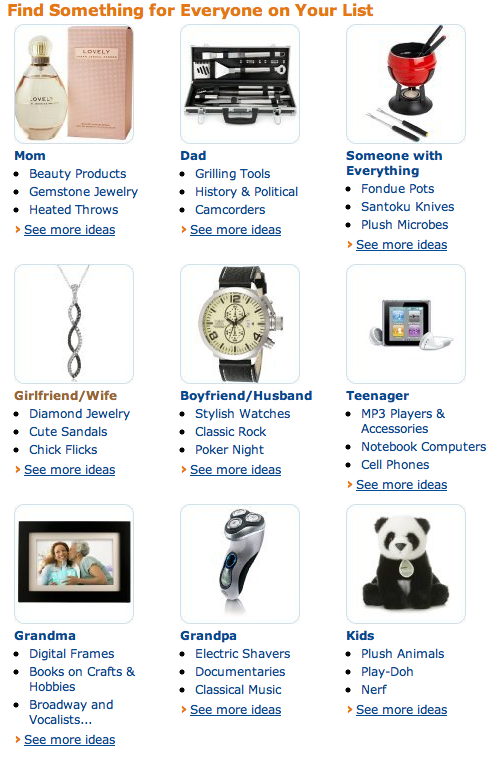
Fraulion sent in this screenshot from the Amazon.com homepage.  In case you needed help buying gifts, dads like history and politics, moms like to smell nice and look shiny, girlfriends and wives like chick flicks and cute stuff, boyfriends and husbands like classic rock and knowing what time it is, grandpas like to watch documentaries (probably about “the war”), and grandmas just want to look at pictures of their grandchildren.

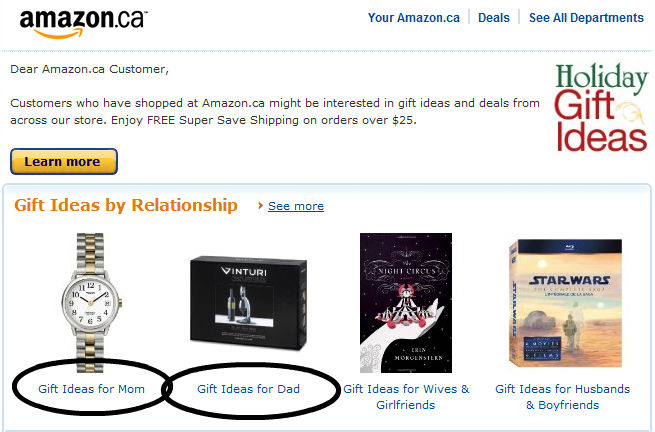
Last but not least, Rob W. sent in another Amazon.com gift guide that suggests that women want a masculine-looking watch and men want a wine aerator (I don’t know what that is, but wine is woman-y right?).  So… counter-stereotypical push back against the gender machine?  Or a typo?  I’m going with typo.  Funny typo.

More after the jump:

more...

Time for another round-up of gendered kids’ items!

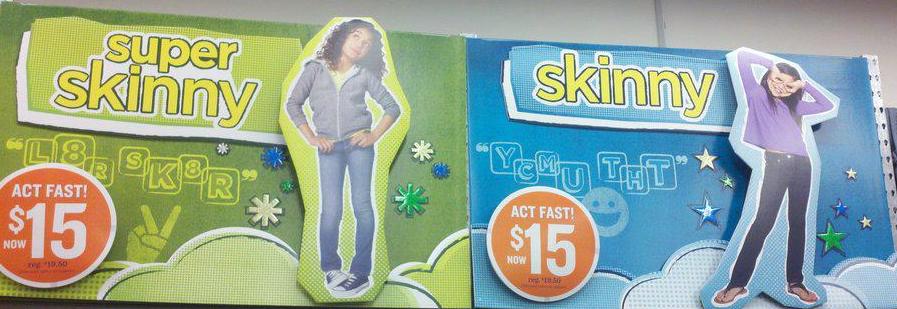
Will L. noticed something interesting recently at Old Navy. The boys’ section offered two styles of jeans, Skinny and Regular:

But when he looked at the corresponding section in the girls’ clothing, he found not Skinny and Regular, but Skinny and…Super Skinny:

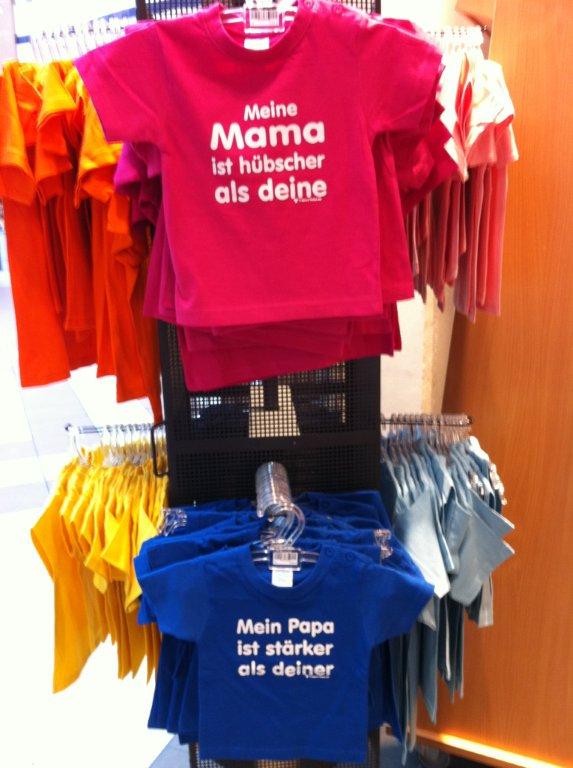
Caro Reusch sent us an example of kids;’ t-shirts with messages about what we value for men and women. She saw the following at a mall in Berlin:

The blue one says “My daddy is stronger than yours,” while the pink announces, “My mommy is prettier than yours.”

Similarly, Lindsey B. saw two themed bibs for sale at Target. The blue bib is a doctor and the pink one is a ballerina:

Shantal Marshall, a postdoc student at UCLA with a Ph.D. in social psych and blogger at Smartie Pops, noticed that Crayola has a new product out, the Crayola Story Studio.  It lets you upload a photo of yourself, have it turned into a cartoon, and then it’s inserted into one of 3 themed templates: Disney Princess, Spiderman, or Cars. You can then print off various versions of coloring books based on those templates. The commercial for the Spiderman version shows a boy excitedly becoming a superhero:

For the Disney Princess version, we see a girl excited to become a princess, then dancing in the background with her very own Prince Charming:

As Shantal said, it’s a bit dispiriting that Crayola’s slogan for these items is “give everything imaginable,” but the pre-existing templates, and their marketing, don’t seem to include an imaginable alternative to the “boys = superheroes” and “girls = princesses” division we see so often in kids’ toys.

Madelyn C. saw a store in Warsaw, Poland, that just goes ahead and makes the gendered division of the toy industry explicit:

Finally, Jessica M. sent in a link to a GOOD post by Christopher Mims about the Toy Industry Association’s 2011 Toy of the Year Awards. There are general categories of toys, such as educational, innovative, and action, but of course also girl and boy categories (also, I personally can’t think of “boy toy of the year” without thinking of Madonna’s outfit in her “Like a Virgin” performance at the first MTV Video Music Awards, but maybe the ’80s are sufficiently behind us that the phrase resonates differently for most people). Anyway, Mims discusses the gendered messages in the commercials for the nominees in the two categories. Among other things, the categorization is rather confusing. Hexbugs are nominated in the boy category, even though commercials for them show girls as well:

Also, Mims points out that the boys’ category “includes a strong undercurrent of Beyond Thunderdome via WWE.” Exhibit A: The commercial for Beyblade Metal Masters, “performance tops” to be used in “strategic battles”:

Playing with tops has gotten super hardcore, I guess. Probably they should look into a sponsorship from an energy drink.

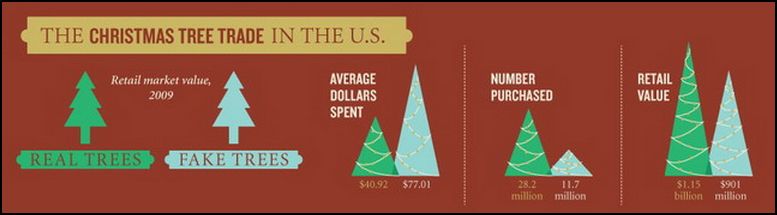
Billions of dollars are spent on christmas trees — real and fake — each year.  The data for 2009:


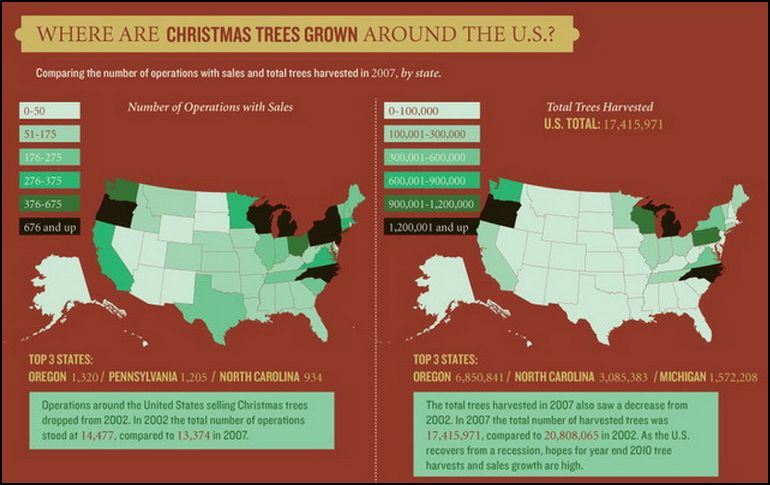
Most of the companies benefiting from this spending are small businesses:


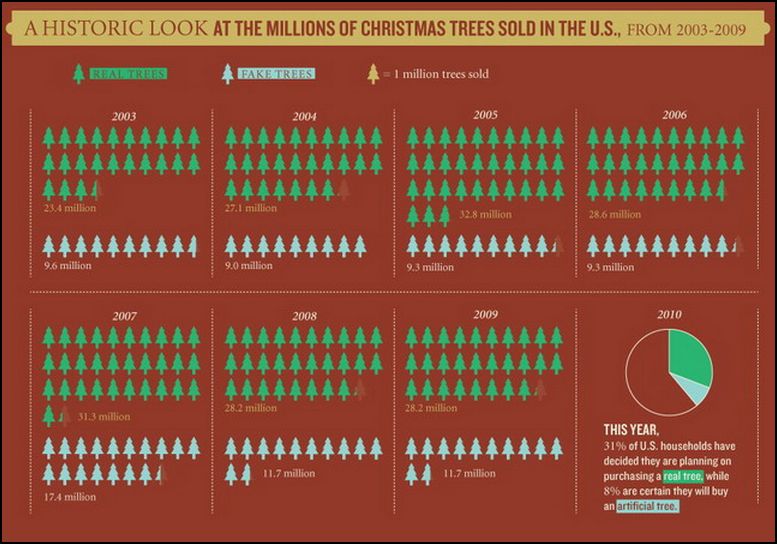
Fake trees appear to be growing in popularity, but the sales of real trees do not appear to be slowing:


The states that benefit most from Christmas tree sales include Oregon, Michigan, North Carolina, New York, New Jersey, Ohio, Pennsylvania, and Washington, and Wisconsin:

Found at Intuit.

Lisa Wade, PhD is an Associate Professor at Tulane University. She is the author of American Hookup, a book about college sexual culture; a textbook about gender; and a forthcoming introductory text: Terrible Magnificent Sociology. You can follow her on Twitter and Instagram.

The extent of our labor market problems has been highlighted many times and in many ways.  Yet, with little being done to correct them, it is worth keeping the issue in the public eye.

What follows are three charts from the Economic Policy Institute.  This one highlights the ratio of unemployed persons to job openings.  Although the ratio has fallen since the “end” of the recession, it remains considerably higher than a decade ago.  It currently stands at 4 unemployed per job opening.

dec2011_jolts.png

This one breaks down the data by industry.  It reveals that there are problems across the board. 

unemployed_openings_by_industry.png

This final one shows that the job crisis is hitting everyone.  As the Economic Policy Institute explains: “Those with higher levels of education are leaving (or never entering) the workforce at the same rate as those with just a high school degree.” Only those with less than a high school diploma seem to be experiencing improved employment opportunities.

snapshot_labor_force_erosion_main.png

And the response of many political and business leaders to this dismal situation?  Primarily calls for austerity–or better said cuts in social spending.  Some economists have even developed a theory of austerity-led growth, arguing that slashing government spending will unleash private investment and job creation. 

We have been witnessing a test of this theory in Europe and not surprisingly it hasn’t produced positive results.  As the economist Kevin O’Rourke explains:  “One lesson that the world has learned since the financial crisis of 2008 is that a contractionary fiscal policy means what it says: contraction. Since 2010, a Europe-wide experiment has conclusively falsified the idea that fiscal contractions are expansionary.”

I am willing to bet that this outcome wasn’t a surprise to most workers.

L. Edmondson sent in a commercial for Littlewoods, a catalog-based company in the U.K. Like much advertising around this time of year, it reminds us that holidays are women’s work.  It is your mother who is responsible for buying gifts, but also for making holidays magical.  So you know who to blame if you’re left unsatisfied.

Lisa Wade, PhD is an Associate Professor at Tulane University. She is the author of American Hookup, a book about college sexual culture; a textbook about gender; and a forthcoming introductory text: Terrible Magnificent Sociology. You can follow her on Twitter and Instagram.

Katrin sent in an interesting example of an effort to (re)masculinize an occupation. Often when we see these efforts, they’re aimed at attracting men to traditionally-female jobs such as nursing by asserting that only “real men” would be able to handle the demands of the job, or emphasizing compatibility with masculinity.

In this case, the occupation that is being framed as highly masculine isn’t one dominated by women; it is, in fact, open only to men: the Catholic priesthood. The image, originally posted at NYPriest, is taken from Fishers of Men, a video released as part of the Archdiocese of New York’s Office of Vocations “The World Needs Heroes” campaign, meant to attract men to the priesthood:

Usually, a male-dominated occupation wouldn’t be in need of having its masculinized character stressed so openly. However, the child sex abuse scandals that have rocked the Catholic Church in the U.S. and elsewhere have damaged the image of the priesthood. Not only did many priests sexually abuse children, but many of the abused children where boys. Had the abuse involved primarily girls girls in late childhood or their teens, the public may very well have expressed revulsion and disgust, but we also have cultural narratives available, such as the idea of the sexually precocious Lolita who entices men against their better judgement, that are often used to at least partially justify or explain adult men’s sexual attraction to or abuse of even young girls (such as the judge who, in 1982, called a 5-year-old rape victim “unusually sexually promiscuous” and gave the adult man who assaulted her only 90 days in a work-release program).

But the fact that so many victims were boys meant those cultural narratives, which implicitly reinforce assumptions about adult masculine sexuality (men can’t quite control themselves; they’re easily led astray by female temptresses, even inappropriately young ones) didn’t apply. Abusing boys undermines the assumption of heterosexuality that is essential to hegemonic masculinity.

Given this social context, it’s not surprising that the NY Archdiocese felt the need to reassert the priesthood as masculine as one element of their image rehabilitation campaign.

In the video below, borrowed from Geoffrey Arnold’s blog on heightism, people on the street in New York are asked to evaluate the likely occupational and class status of two men: one short, one tall.  The results are striking (if also edited and non-random, but still):

See also Arnold’s guest posts introducing the concept of heightism as a gendered prejudice and discussing heightism (and other icky stuff) at Hooters.

Lisa Wade, PhD is an Associate Professor at Tulane University. She is the author of American Hookup, a book about college sexual culture; a textbook about gender; and a forthcoming introductory text: Terrible Magnificent Sociology. You can follow her on Twitter and Instagram.

Cross-posted at Family Inequality.

There’s an interesting example of how to interpret scientific results — and draw policy implications from them — from the world of birth practices and safety.

The subject of the debate is a major new study from the British Medical Journal. The study followed more than 60,000 women in England with uncomplicated pregnancies, excluding those who had planned caesarean sections and caesarean sections before the start of labor. They compared the number of bad outcomes — from death to broken clavicles – for women depending on where they had their births.

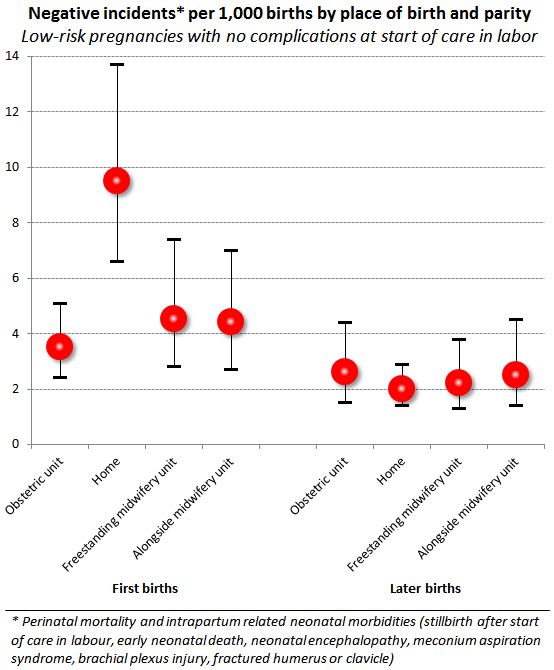
One comparison stands out in the results. From the abstract: “For nulliparous women [those having their first birth], the odds of the primary outcome [that is, any of the negative events] were higher for planned home births” than among those planned for delivery in obstetric units. That is, the home births had higher rates of negative events. The difference is large. Here’s a figure to illustrate:
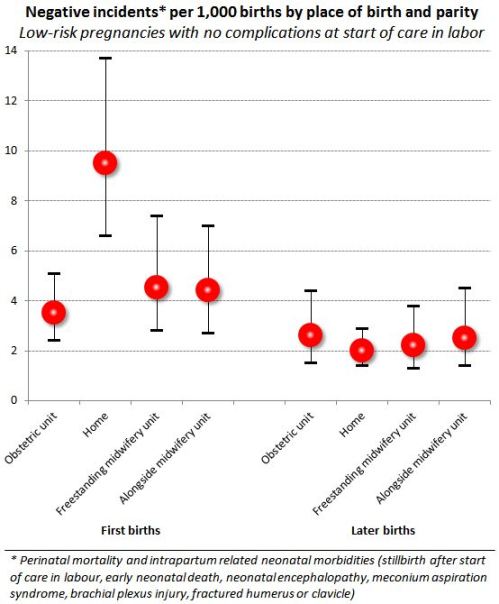
The error bars show 95% confidence intervals, so you can see the difference between home births and obstetric-unit births is statistically significant at that level. These are the raw comparisons, but the home-versus-obstetric comparison was unchanged when the analysts controlled for age, ethnicity, understanding of English, marital or partner status, body mass index, “deprivation score,” previous pregnancies, and weeks of gestation. Further, by restricting the comparison to uncomplicated pregnancies and excluded all but last-minute c-sections, it seems to be a very strong result.

But what to make of it?

In their conclusion, the authors write:

Our results support a policy of offering healthy nulliparous and multiparous women with low risk pregnancies a choice of birth setting. Adverse perinatal outcomes are uncommon in all settings, while interventions during labour and birth are much less common for births planned in non-obstetric unit settings. For nulliparous women, there is some evidence that planning birth at home is associated with a higher risk of an adverse perinatal outcome.

But in what way do the results “support a policy”? The “higher risks” they found for planned home births are still “uncommon,” by comparison, with those in poor countries, for example. But the home birth risk is 2.7-times greater.

The Skeptical OB, who is a reliable proponent of modern medical births, titled her post, “It’s official: homebirth increases the risk of death.” She added some tables from the supplemental material, showing the type of negative events and conditions that occurred. Her conclusion:

“In other words, any way you choose to look at it, no matter how carefully you slice and dice the data, there is simply no getting around the fact that homebirth increases the risk of perinatal death and brain damage.”

I guess the policy options might include include whether home births should be encouraged, more regulated, covered by public and/or private health insurance, banned, penalized or (further) stigmatized.

Home birth seems safer than letting children ride around unrestrained in the back of pickup trucks, which is legal in North Carolina – as long as they’re engaged in agricultural labor. On the other hand, we have helmet laws for kids on bicycles in many places. And if a child is injured in either situation, hopefully an ambulance would take them to the hospital even if the accident were preventable.

In other words, I don’t think policy questions can be resolved by a comparison of risks, however rigorous.