We’ve enjoyed documenting the recent trend of sexifying toys, including Dora the Explorer, Strawberry Shortcake, Holly Hobbie, Lisa Frank, Trolls, Cabbage Patch Kids, My Little Pony, Rainbow Brite, and Candy Land, and Lego (you can see them all together on our Sexy Toy Make-Overs Pinterest board).

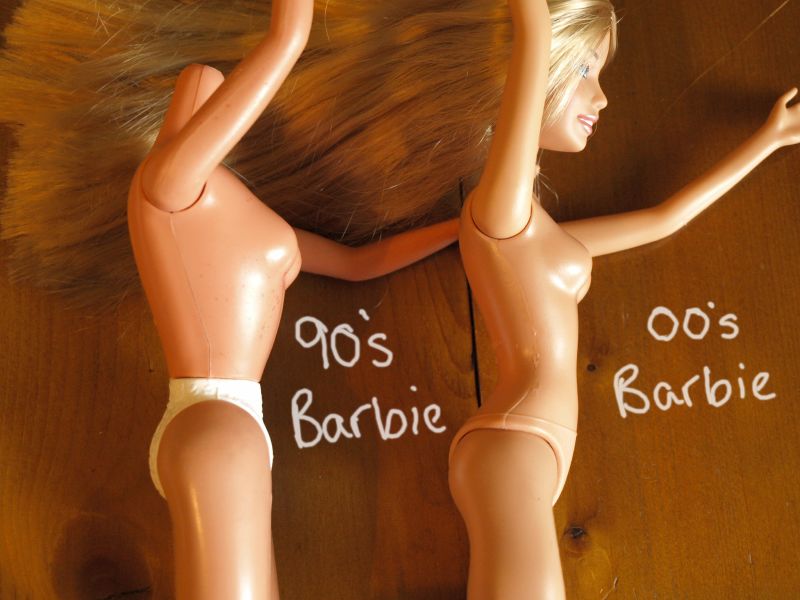
Let’s start with Barbie because given how she’s the quintessential sexy toy, I think it’s surprising that she’s been made over.  I found evidence for the Barbie make-over at Feminist Philosophers.  They put up the image below showing how Barbie’s torso was changed in the 2000s to one that was slimmer and with a more arched back:
Cynical Idealism posted about the Care Bear make-over.  The toys have been made both thinner, more flirty, and less androgynous.

Care Bears Then:
Care Bears Now:

I learned about the Polly Pocket make-over at Feminist Fatale.  Whereas in the 1980s, Polly Pocket looked kind of like an infant and came with various accessories, today’s Polly Pocket is decidedly more Barbie-like.

1980s Polly Pocket:

Today’s Polly Pocket:

(source: Mattel)

So, there you have it! Three more sexy toy make-overs.

Lisa Wade, PhD is an Associate Professor at Tulane University. She is the author of American Hookup, a book about college sexual culture; a textbook about gender; and a forthcoming introductory text: Terrible Magnificent Sociology. You can follow her on Twitter and Instagram.

Cross-posted at Sociology in Focus.

Back in 1987, Raewyn Connell coined the term hegemonic masculinity in a seminal text, Gender & Power. Hegemonic masculinity refers to the dominant form of masculinity that exists within a particular culture. Relative to this ever changing, idealized form of masculinity are different subordinated masculinities – those within a culture that do not live up to the so-called masculine gold standard. Put simply, there are “real men” and then there are all other men.

In watching the 2012 Super Bowl commercials, we can see versions of hegemonic masculinity demonstrated. Perhaps the most vivid version was seen in H&M’s Super Bowl ad, utilizing soccer (futbol) star, David Beckham:

[youtube]https://www.youtube.com/watch?v=fjd6i0S67HQ[/youtube]

Tattooed, rugged, athletic, showcasing a lean musculature and menacing glare, Beckham embodies a hegemonic masculinity that would surely resonate with sporting audiences. And while not presented in this commercial, it is important to also note that Beckham carries other cultural traits that ad to his hegemonic masculine status – he is globally recognized, financially wealthy, and married to a woman who also holds currency in popular culture. This last point is critical. By being married, Beckham confirms his heterosexuality, and her extraordinary beauty and international popularity raise his standing as a “real man”.

In contrast to Beckham, other males were presented in this year’s Super Bowl commercials, who represent a marginal masculinity, meaning they would love to hold hegemonic masculine status and are pursuing such an identity, but for any number of reasons are unable to achieve it. You could say these are the “wannabe real men”. A good example of marginal masculinity is presented in the following commercial for FIAT:

[youtube]https://www.youtube.com/watch?v=GxQsLdwCtMU[/youtube]

In contrast to the commercial with Beckham, the male in this commercial lacks qualities that would otherwise provide him with a sense of hegemonic masculinity. Although he appears to be employed (wearing business attire), he is relatively short in comparison to the woman in the ad, cast as nerdy and lacking confidence. Given the fantasy he has with the female actor, we can see he desires hegemonic masculine status. But because he lacks a kind of physical prowess, he is marginalized.

Of even greater importance here, the concept of hegemonic masculinity is not only about men and their relation to one another. Hegemonic masculinity also represents a cultural system that dominates women. Thus, the FIAT commercial is also useful because it illustrates women’s overall subordination. Connell also defined the term “emphasized femininity”, which refers to women’s “compliance with this subordination… oriented to accommodating the interests and desires of men” (p. 183).

When women emphasize their femininity – or are coerced to emphasize their femininity – they are often times objectified. Objectification refers to the depersonalization of someone, such that her/his humanity is stripped and the person(s) is turned into an inanimate object. Sociologists have argued that when humans are objectified, they tend to be “seen as less sensitive to pain,” and, “we care less about their suffering” (Loughnan et al., 2010, p. 716). In other words, when we turn people into object, we remove their humanity, and it is easier to commit violence against them. Feminists commonly argue the objectification of women in the media facilitates women’s ongoing victimization in society at large.

In the FIAT commercial, the woman “emphasizes her femininity” by catering to the male’s sexual desires. She is also objectified – likened to an inanimate car that would lack human feelings and emotion. Go Daddy also aired a commercial clearly objectifying women, where female celebrities paint another female, who is used as an inanimate, sexualized prop to promote the Go Daddy company.

[youtube]https://www.youtube.com/watch?v=q9ucBY_2WEA[/youtube]

While the Super Bowl is known primarily as a sporting event where millions of Americans tune in each year to watch men engage in athletic competition, the event also includes advertising content that is highly gendered. With so much attention attention directed to this advertising, it is important to dissect it through a gendered framework.

———————————–

David Mayeda is an Assistant Professor in the Department of Sociology and Legal Studies at Hawaii Pacific University.  His recent book publications include Celluloid Dreams: How Film Shapes America and Fighting for Acceptance: Mixed Martial Artists and Violence in American Society.  He also blogs at The Grumpy Sociologist.

Lisa Wade, PhD is an Associate Professor at Tulane University. She is the author of American Hookup, a book about college sexual culture; a textbook about gender; and a forthcoming introductory text: Terrible Magnificent Sociology. You can follow her on Twitter and Instagram.
At The Color Line, sociologist C.N. Le highlighted an instance in which racist language was used in reference to pro-basketball player Jeremy Lin.  A headline at ESPN read, “Chink in the Armor.”  “Chink” is a term used to denigrate the Chinese and Asians more generally.

Le observes astutely that the word likely wasn’t meant as a slur, but instead a pun.  And, in fact, ESPN “quickly and decisively” took action, changing the headline, firing the person who wrote the headline, and suspending a sportscaster who repeated the phrase.

Instead of outright racism, Le suggests that the appearance of the word is symptomatic of a (false) belief that we’re in a colorblind post-power society.  In this society, every group is on equal footing, so making fun is just equal opportunity offensiveness; it may be off-color, but it’s all in good fun (think of South Park as an example).  The approach assumes that slurs like “chink” are no more harmful than slurs like “cracker.”

Le was disappointed to see that this kind of ongoing insensitivity to real power differences remains, but pleased to see ESPN react so swiftly and strongly to it.

—————————

Lisa Wade is a professor of sociology at Occidental College. You can follow her on Twitter and Facebook.

 Los Angeles SocImages Meet Up this Sunday!

Gwen Sharp, Caroline Heldman, and I will be at The Escondite (downtown L.A.) on Sunday, March 4th starting at 6pm.  All ages.  Food and drink.  Great company guaranteed.

Please RSVP to socimages@thesocietypages.org.  Thanks to Dolores R. for picking the place!  And, yes, she’ll be there too!

SocImages News:

Sociological Images has been awarded a Public Sociology Award from the Sociology Research Institute at the University of Minnesota!  Thanks so much to our nominators, the professors who support us, and to our readers who make it all worthwhile!

I have a new paper out tracing 30 years of academic debate about female genital “mutilation” (full text). I try to tease out the constructive and destructive parts of the discussion, closing with some observations about how these lessons translate to other topics.

Ben Martin put together a nice interview, hoping to help advertise my talks at Harvard University later this semester.  Meanwhile, Yale student Anya Grenier did a nice follow up piece to my visit there.

And, well shucks, Gwen Sharp and I are among the top 50 sociologists on Twitter.

Upcoming Lectures and Appearances:

Gwen and I will both be visiting the University of Minnesota to accept our award.  That fun day will be Apr. 20th, during the annual Sociology Research Institute.

I’m also looking forward to giving talks at the University of Massachusetts, Amherst (Mar. 27), Boston University,  (Mar.  27 and 28), Harvard (Mar. 26 and 28), Dartmouth (Mar. 29), and Indiana State University (Sept. 17-19).  If you’re in town, I would love to meet you! Details here.

New Pinterest Boards:

I admit, I’m a little bit in love with our Pinterest page.  New this month:

Best of February

Our hard-working intern, Norma Morella, collected the stuff ya’ll liked best from this month.  Here’s what she found:

Social Media ‘n’ Stuff:

Finally, this is your monthly reminder that SocImages is on Twitter, Facebook, Google+, and Pinterest.  Gwen and I and most of the team are also on twitter:

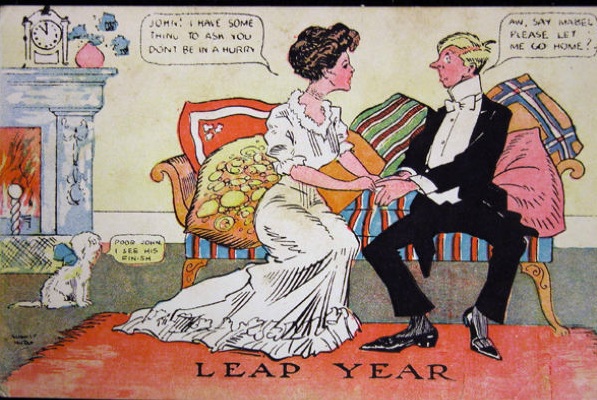
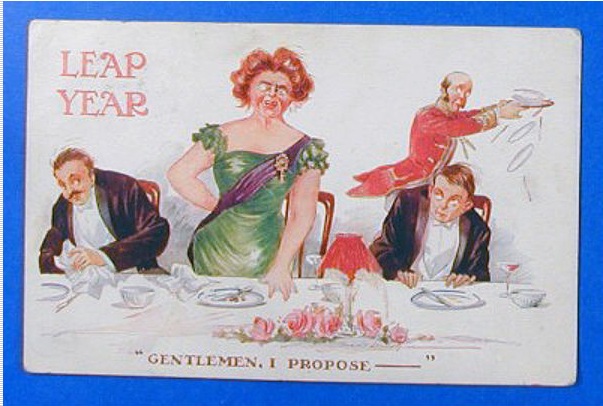
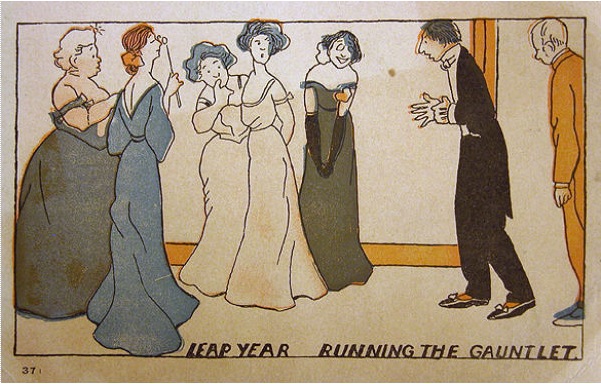
It’s a Leap Year for those using the Gregorian calendar, noteworthy because we get an extra day in February to correct the slight difference between our calendar year (365 days) and the actual amount of time it takes the Earth to revolve around the sun once (365 days, 5 hours, 48 minutes, and 46 seconds). Over the last few days I’ve heard several news stories about the Leap Day tradition of gender norms being inverted, so that women are able to ask out or propose to men. I was either entirely unaware of this or perhaps I learn it and promptly forget it every four years, but Laura E. sent in a link to a set of vintage postcards posted at Slate that illustrate the existence of this idea in the early 1900s. The postcards present this upending of the accepted gender script as a terrifying situation for men, who become prey to suddenly emboldened husband-hunters:


Text:

“John! I have some thing to ask you. Don’t be in a hurry.”

“Ah, say Mabel, please let me go home?”

The dog: “Poor John. I see his finish.”

In a recently-published article on this tradition, Katherine Parkin points out that women in such postcards are often presented as larger, brawnier, and more aggressive than their poor male prey; the women empowered to ask men to marry them are inherently unfeminine:

For more on portrayals of gendered dating/proposal norms and the Leap Year exception, see the full Slate slideshow and Parkin’s article. Now excuse me, I’m going to go see about ambushing myself a husband.

[Full cite: Katherine Parkin. 2012. “Glittering Mockery: Twentieth-Century Leap Year Marriage Proposals.” Journal of Family History 37(1): 85-104.

London filmmaker Michael Story sent in a short video he made about the mismatch between crime as presented in TV reports and the reality of crime in the UK. TV reports, Michael argues, misrepresent how common crime is, where it occurs, and who is most likely to be involved in violent crime; in so doing, they reinforce stereotypes about race, ethnicity, class, and criminality:

London’s 66,000 guns – by Michael Story from chichard41 on Vimeo.


On this second-to-last day of Black History Month, let us return to posts past.

We have been urged to celebrate Black History Month…

<sarcasm> Good times. </sarcasm>

Lisa Wade, PhD is an Associate Professor at Tulane University. She is the author of American Hookup, a book about college sexual culture; a textbook about gender; and a forthcoming introductory text: Terrible Magnificent Sociology. You can follow her on Twitter and Instagram.

My Occidental College colleague, politics professor Caroline Heldman, snapped this photograph of a billboard on an L.A. freeway.  It suggests that one may celebrate Black History Month by calling 1-800-GET-THIN.  The billboard is another stunning example of the trivialization of black history by companies using it only as an excuse to market their product or service.

Lisa Wade, PhD is an Associate Professor at Tulane University. She is the author of American Hookup, a book about college sexual culture; a textbook about gender; and a forthcoming introductory text: Terrible Magnificent Sociology. You can follow her on Twitter and Instagram.