During the height of the Occupy Movement, thousands of individuals submitted pictures of themselves to the We are the 99 Percent tumblr blog.  They posed with letters and signs, telling individual stories of what it’s like to be in the 99%.

There’s been a solid critique of how whites, youth, and those with college access have a larger voice on this site, as well as dismissive responses from those on the right, but I’m struck by the rhetoric used. One word stands out to me as particularly jarring: Luck.

[Written for a child] “I am 3 years old and lucky to go to preschool, have a roof over my head and spaghetti-o’s in my belly. I am lucky to have Medicaid while my parents don’t qualify.”

“i am 22, living in a trailer in exchange for labor… We eat 69c mac’n’cheez or ramen; i drive a car illegal with disrepairs. And i’m lucky.”

“I am lucky my husband has a decent job because before I was on his health insurance my coverage  denied normal, annual GYN visits because ‘Being a woman is a pre existing condition.’ And we are the lucky ones!!”

“But I am one of the lucky ones. I was finally diagnosed with borderline personality disorder I am properly medicated”

“I’m one of the lucky ones. I enjoy my part-time job… yet… [have a] $65,000 [student] loan. 4 side jobs – not enough for rent. No health insurance. No children, so I don’t qualify for any aid, but I’m one of the lucky ones.”

“I am a lucky one. I have enough money to eat 3 of 4 weeks of the month…”

Luck is a word that comes up incredibly frequently among the 99 percenters, alongside words like debt, crisis, and unemployment. But what kind of luck is this? What does it mean to be “one of the lucky ones?”

In these posts, people struggling to hold multiple jobs call themselves “lucky” for having food most of the month, enough work to survive, or health care for part of their family — even as they report drowning in debt, losing work, and losing hope.

This isn’t our usual meaning for luck, and it only makes sense in comparison — to the “unlucky ones.” But if the “99 percent” is lucky, who exactly is unlucky? And how does this “luck” relate to the accompanying uncertainty, stalled careers, and failure to attain personal and collective dreams?

After sending in an early picture, I was startled to realize I’d also used the rhetoric of luck as a frame for my complaint. Of course I live in relative privilege to others, but why subsume my experience of uncertainty and dislocation beneath that privilege?

On the one hand, the rhetoric of luck acknowledges our relationships to other human beings, including those with greater struggles. To observant readers, it can also point to the structural and economic challenges that even “lucky” people face.

But I’d argue that the same rhetoric turns our lives into happenstance. It moves our stories harmlessly to the side, so that larger — and often deceptive — narratives about luck, hard work, and the American Dream can continue as planned. By prefacing our stories with an admission of luck, we displace our own voices and cast doubt on our experiences as something that just “happened to us.”

Yet the current economic and political situation didn’t just happen to either the “lucky” or the “unlucky” ones. As in other periods of U.S. economic history since the 1700s, the underemployment, debt, financial instability, and lack of affordable life-goods that Americans face are the result of deliberate policies designed to streamline and protect growth for investors, large corporations, and other profiteers — often at the expense of individual citizens, workers and business owners without large amounts of capital or political access.

So rather than slip into the rhetoric of luck, what other frames can we use to talk about our experiences? Framing our experiences in light of multiple takes on economic history may allow us to draw from previous generations in assessing our options for greater involvement in setting the guidelines for our society. Initiating discussion on the civic responsibility of every stakeholder may involve bringing to task those who have instituted policies beneficial only to a small minority of elite Americans. And collective effort from the left and the right could enable us to ensure that economic activity bears appropriate fruit for individuals, households, and families, and that the people actually have a voice in our towns, states, and nation at least equivalent to other sources of power.

 ————————

Celia Emmelhainz, M.A., is an economic anthropologist who conducts ongoing research on citizenship, economics, and religion in Central Asia. With a degree in anthropology from Texas A&M University, she currently works as an academic librarian in Kazakhstan.

Lisa Wade, PhD is an Associate Professor at Tulane University. She is the author of American Hookup, a book about college sexual culture; a textbook about gender; and a forthcoming introductory text: Terrible Magnificent Sociology. You can follow her on Twitter and Instagram.


Happy Fat Tuesday to all our friends in New Orleans! Don’t do anything we wouldn’t do!

If you’re not in the middle of the revelry, enjoy these Mardi Gras posts from previous years:

Lisa Wade, PhD is an Associate Professor at Tulane University. She is the author of American Hookup, a book about college sexual culture; a textbook about gender; and a forthcoming introductory text: Terrible Magnificent Sociology. You can follow her on Twitter and Instagram.
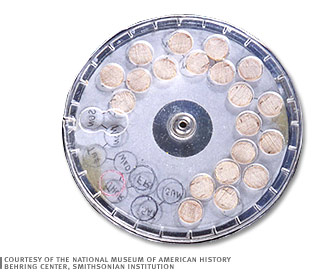
PBS has a gallery of images of oral contraceptives that provides a nice illustration of the way product design can be used as a form of behavior modification, while also needing to adapt to the way people actual use products — or forget to do so, the ever-present problem with the pill.

Initially , the pill came in bottles, like other prescriptions:

Notice the bottle contains 100 pills; there was no effort to package it into quantities for a single month. Women were supposed to take 20 pills in a row, then none during their period. It was up to them to keep track of everything and remember when it was time to start taking the pills again.

In 1962, an engineer created a prototype of a dispenser pack, designed to hold exactly a month’s worth of pills and help women remember to take them correctly:

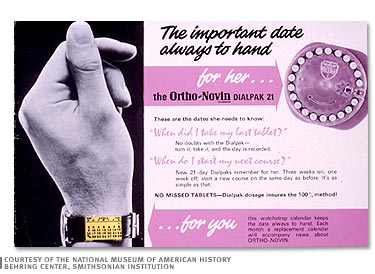
The first contraceptive in a pack of this type, Dialpak, appeared the next year; oral contraceptives packaging has been designed to help women remember to take them accurately ever since. This became a major selling point, with Dialpak 21 even offering a small calendar you could attach to a special watch band so you could more easily keep track of whether you’d taken the pill:

In 1965, Eli Lilly introduced a new packaging design, with differently-colored pills arranged in a sequence; however, it didn’t label the days of the week, so it didn’t help women figure out if they’d remembered to take their pill on any given day:

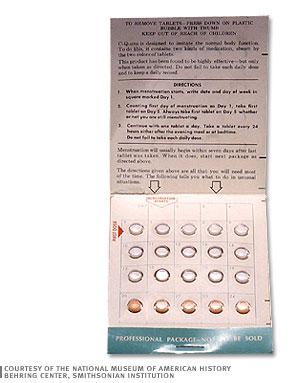
Norinyl came in a package that took the sequential design but added several features that enhanced compliance. An extra pill was added, so that pills with active ingredients were taken for 21 days, not 20. Then a row of placebo pills were added so that women took a pill every day of the month, so they were less likely to forget to start a new pack:

When we think about the emergence and success of the pill, we tend to focus on the product itself. But the packaging tells an interesting story on its own. The pharmacological effectiveness of oral contraceptives meant little if women forgot to take them reliably. The design of the packaging helped play a crucial role, increasing users’ ability to follow the prescribed schedule.

Today, there’s an entire trade organization, the Healthcare Compliance Packaging Council, dedicated to promoting attention to the design of packaging as an important element in all areas of healthcare. The pill was the first prescription drug sold in a so-called “compliance pack,” serving as an example of the potential effectiveness of packaging design as a way to encourage patients’ conformity to prescribed medication regimens.

The Bureau of Labor Statistics recently published its employment/wage projections for the years 2010-2020.   The following table lists the 30 occupations that the BLS believes will have the largest numerical growth in employment over the period.  

The table is worth a long look.  Among other things it challenges the assertion that more education is the key to a better employment future.  More education is, of course, generally a good thing.  But given BLS projections, it appears that our corporations have little interest in creating jobs requiring (and thus paying) a more highly educated workforce.

Of the 30 occupations with the largest projected numerical employment growth, 10 require less than a high school education and an additional 13 require only a high school diploma or its equivalent.  Only 4 require a bachelor’s degree or higher.

 job-growth.jpg

The following table, which comes from the same report, shows the distribution of projected job openings by education level for all occupations: 79.7% of all projected jobs will require less than a bachelor’s degree.

education-and-jobs.jpg

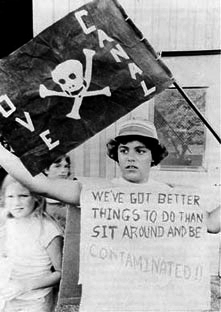
This photograph is of the Love Canal neighborhood in Niagara Falls, New York, where Hooker Chemical (now Occidental Petroleum Corporation) buried 21,000 tons of toxic, chemical waste:
In 1953, Hooker Chemical sold the land that they had been using for toxic waste disposal to the Niagara Falls School Board for $1. The sale deed contained warnings about the chemical waste and a disclaimer of liability. However, planners hastily built schools and homes on the contaminated land to accommodate the city’s growing postwar population. By the late 1970s, residents were reporting a litany of illnesses and birth defects. Scientists discovered high levels of carcinogens in the soil, groundwater, and air. The community mobilized to bring attention to the situation, and President Carter declared a federal health emergency in the area.
Elizabeth Blum, a professor of history at Troy University, has written about the environmental activism of Love Canal residents. Such activism, called “popular epidemiology,” attempts to link spikes in localized health issues to their origins. Despite such grassroots movements, though, the media tends to show little interest in the causes of cancer and greater interest in finding the cure.

The many “Stand Up to Cancer” ads, for example, urge people to donate money (or just use their credit card for purchases) to help fund the development of cancer treatments:

When media attention is focused on the causes of cancer, it usually takes an individualistic tone. Risk factors (smoking, poor diet, etc.) are blamed for various forms of cancer.

The thing is: there’s no money in prevention.

Mainstream media outlets have a vested interest in not exposing the causes of cancer.  The companies that pay to advertise on their channels, and often their parent companies or subsidiaries, often traffic in known carcinogens. Pharmaceutical companies, likewise, have a perverse incentive. Healthy people make them no money, neither do dead people; sick people though, they’re a goldmine.  Many organizations, including the multi-million dollar Susan G. Komen Foundation, are in the business of raising money “for the cure,” more so than prevention.

The politics of cancer, then suffer from the individualism characteristic of modern American and capitalist imperatives, leaving the causes of the cancer epidemic invisible and, accordingly, the unethical and illegal behavior of companies like Hooker Chemical.

Dan Rose is an assistant professor of sociology at Chattanooga State Community College in Tennessee.  His research focuses on medical sociology and health inequalities in minority neighborhoods.

Lisa Wade, PhD is an Associate Professor at Tulane University. She is the author of American Hookup, a book about college sexual culture; a textbook about gender; and a forthcoming introductory text: Terrible Magnificent Sociology. You can follow her on Twitter and Instagram.
In 1964, in Jacobellis v. Ohio, a case regarding an allegedly obscene film, Supreme Court Justice Stewart Potter Stewart famously wrote in his opinion,

I shall not today attempt further to define the kinds of material I understand to be embraced within that shorthand description [of hard-core pornography]…But I know it when I see it…

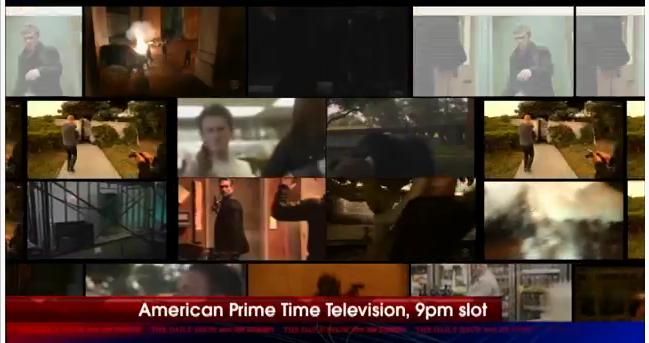
Of course, the problem is that not everyone has the same reaction to what they see. While the 1964 case specifically dealt with a film, and a judgment on whether it crossed the line from pornographic (legal) to obscene (not), similar arguments are common regarding what is appropriate on TV. The Federal Communications Commission may impose penalties, including large fines or revoking a broadcaster’s license, on networks that air “indecent or profane programming during certain hours.” Last month the Supreme Court agreed to hear a case regarding the FCC’s regulations and whether they violate free speech guarantees.

Dmitriy T.M. sent in a segment from The Daily Show that highlights some of the inconsistencies and contradictions in the FCC’s standards for prime time, and the seeming arbitrariness of decisions about what is “indecent”:

I’m a particular fan of looking at ways that society and nature intersect and a new study is a fantastic example.  Analysis of 15 years of storm data revealed that twisters and hailstorms were significantly more likely to occur during the week as compared to weekends.

According to the authors, Daniel Rosenfeld and Thomas Bell, the cause is pollution caused by commuting.  Charles Choi, writing for National Geographic, explains:

…moisture gathers around specks of pollutants, which leads to more cloud droplets. Computer models suggest these droplets get lofted up to higher, colder air, leading to more plentiful and larger hail.

Understanding how pollution can generate more tornadoes is a bit trickier. First, the large icy particles of hail that pollutants help seed possess less surface area than an equal mass of smaller “hydrometeors”—that is, particles of condensed water or ice.

As such, these large hydrometeors evaporate more slowly, and thus are not as likely to suck heat from the air. This makes it easier for warm air to help form a “supercell,” the cloud type that usually produces tornadoes and large hail.

So, there you have it. No need to choose between nature and nurture. We interact with our environment and shape it, just as it shapes us.

(Via BoingBoing.)

Lisa Wade, PhD is an Associate Professor at Tulane University. She is the author of American Hookup, a book about college sexual culture; a textbook about gender; and a forthcoming introductory text: Terrible Magnificent Sociology. You can follow her on Twitter and Instagram.

When I learned of Whitney Houston’s untimely death, I was in the process of re-reading James Baldwin’s short story “Sonny’s Blues.” Sonny, like so many entertainers struggled with addiction and the rigors of being an artist. I couldn’t help but think of Whitney. The tragedy of her death has resonated throughout our culture in both artistic and social contexts. It also ripped the curtain off the destructive underbelly of celebrity and its trappings.

We engage in the public consumption of images of the rich and famous as a way of life now. They live under an intensely bright and hot spotlight. Baldwin relates this quite eloquently.  In the process of Sonny’s recovery from heroin addiction, he returns to doing what he loves best –playing jazz piano. Sonny’s older brother agrees to accompany him to one of his performances. The brother, seated in a dark corner of the club, watches Sonny and his band mates prepare to perform. While sitting there he contemplates just how many of them have struggled with addiction like Sonny and how they would negotiate Sonny’s homecoming performance. The narration reads:

Then I watched… while they horsed around, standing just below the bandstand. The light from the bandstand spilled just a little short of them and, watching them laughing and gesturing and moving about, I had the feeling that they, nevertheless, were being most careful not to step into that circle of light too suddenly; that if they moved into the light too suddenly, without thinking, they would perish in flame.

Baldwin provides a powerful metaphor for the dangers of the spotlight and stepping into it too soon. When I read that passage, I thought of this image of Whitney from her 2009 American Music Awards performance. She sang “I Didn’t Know my Own Strength.” It was a “comeback” performance in which Whitney was trying to reclaim her image. She is wearing white, which looks absolutely beautiful against her cinnamon caramel skin. The stage is black and Whitney is lit from the back with a piercingly bright spotlight. In that moment we can see her balancing darkness with light, hope with pain, insularity with exposure.

We loved her voice. We rooted for her comeback. But perhaps she moved into the spotlight too suddenly. Perhaps the flame from the light burned her in places no one could see. As I write this, there have been no rulings on the cause of her death. So I do not want to speculate what contributed to her untimely passing. But I love this image because it is how I would like to remember Whitney. Regal, angelic, light and dark, embodying the very essence of humanity and its many contradictions.

————————

Stacie McCormick, PhD, is a literature scholar whose work focuses primarily on African Diaspora and Women’s literature. Presently she is working on a project exploring the black female body and how it is represented in print and visual culture (photographs, artist renderings, the theatrical stage, etc.).

Lisa Wade, PhD is an Associate Professor at Tulane University. She is the author of American Hookup, a book about college sexual culture; a textbook about gender; and a forthcoming introductory text: Terrible Magnificent Sociology. You can follow her on Twitter and Instagram.