Originally posted at In Transit and Racialicious.

I’m still trying to work my way through my discomfort and analyze exactly where my discomfort of this Sociological Images post is coming from, so if this critique seems a bit scattered, it’s because my thoughts about it, at the moment, are that way.

First: I agree with where the post is coming from, in that the disenfranchised rarely ever have a voice of their own in mainstream Western culture, are always portrayed as the Other, which is defined as everything that said mainstream Western culture isn’t (at best as something that props it up and provides an aesthetically pleasing contrast, at worst as something that must be exterminated). And this leads to remarkably similar cycles of dehumanization and disenfranchisement. As so many minority thinkers/activists have noted, manufactured binaries between the privileged West and everyone else, even seemingly positive ones, ultimately end up reinforcing destructive hierarchies.

Where I disagree with the poster is the framing, which I feel makes the post, in some ways, as reductive as what it’s critiquing. Because there are different contexts in which the above cycle/process of exotification occurs, and those contexts matter and shouldn’t be handwaved, even (and I would say especially) if you’re taking the pov of the white outsider and attempting to deconstruct it. Social justice discourse loses its meaning when it becomes divorced from one of power relations.

In this specific example, while making its comparison of India as a magical negro, the post fails to both note and appreciate the following bits of context:

That both the main white actress and the main desi actor in the film are British, with Dev Patel adopting an Indian accent and playing the part of a “native”. That all the featured Indian characters are coded as middle/upper class (the dress, able to speak fluent English, etc) and light skinned. That in many ways this is how India is actively marketed by its tourism sector (and also its government. Did a project once which involved collecting promo material from the Indian consul — I think in Chicago? — and it was quite hilariously illuminating), because they’ve judged that this type of pandering will bring in the tourist dollars.

And this exotification of India in the West has been happening since before the time of Columbus, and reducing said things to a “phenomenon in which a white character in a tv show or movie finds enlightenment…” seems rather glib. (Just because it appears in tvtropes does not mean TV created it!) And that’s not even getting into how most isms seem to inevitably become just like the racism that blacks (had) face(d) in the US.

I also thought it was telling how none of the links elaborating on the “magical negro” trope went to one of the many black writers who’ve done the major work of deconstructing and dissecting it, much less linking to desi writers talking about colonialism and othering.

So what my disagreement boils down to, I think, is this: that this is a discussion about the Othering/exotification of India in mainstream Western culture that succeeds in further marginalizing/disenfranchising desis and other minorities. It doesn’t consider that we might be among the audience for this post (much less making room in the conversation for us, much less acknowledging all the times we’ve already discussed this), and in the way it takes something that rose out of certain contexts, misidentifies said contexts while applying it to different ones with no mention of the consequences of the differences, makes it, again, similar to what it’s aiming to critique.

And it brings home the point that, for all its social justice aims, this is a blog for a specific group of white people, by a specific group of white people, with all the marginalizations that entails.

Another note: it is interesting to read the comments, to see all the places East/West binaries crop up. For example, this comment (which thankfully was critiqued):

So, this is probably why you’ll never find a movie about a Westerner in Latvia trying to find himself- “finding oneself” usually requires immersing oneself in a setting completely different from the everyday humdrum norm.

I do find India humdrum normy, actually. And infrastructure specifically designed to ape the west is increasingly common in cities, and you can always find people in the touristy parts who speak English and cater to Western tastes in a thousand and one ways. (Actually, you won’t need to find them, if you are white they will find you and you will not be able to escape them!) Latvia, I am assuming not so much?

I feel as if the manufactured differences that so many Westerners create for India, while completely missing the deeper and more significant ones, are part of the same binary that Fanon was talking about when he said: “The settler is all that is good and of value. The native is the negation of the settler’s value”. And a lot of the appeal of India, the reason for it not being “everyday humdrum normy”, is that it still gives middle class white Westerners who go there chances to personally experience the colonial British sahib lifestyle.

————————-

Colorblue blogs at In Transit.

Jiang Tao, a child of farmers, graduated from law school only to discover that law firms discriminate against short employees.  After confronting minimum height requirements, he sued.

See also guest posts from The Social Complex introducing the concept of heightism as a gendered prejudice and discussing heightism (and other icky stuff) at Hooters.

Lisa Wade, PhD is an Associate Professor at Tulane University. She is the author of American Hookup, a book about college sexual culture; a textbook about gender; and a forthcoming introductory text: Terrible Magnificent Sociology. You can follow her on Twitter and Instagram.

Symbolic interactionism, one of the most common theoretical perspectives adopted by sociologists, explains human behavior through the meanings we place on objects or symbols in our environment. These symbols can be material objects, but they can also be words, gestures, actions, events, as well as people and groups. The symbols’ meanings are not innate. They are created and applied through human relations and interactions. In other words, they are socially constructed. Consequently, our behaviors and relationships change as meanings are altered. Some social conflict is the result of different groups defining objects differently.

This extends to human cognition, as a previous post on cultural differences in susceptibility to optical illusions demonstrated.  Another example involves how we hear animal sounds, illustrated in this clip from the television show “Family Guy.” In this segment, we see Stewie playing with a European see and say, a toy designed to teach animal noises. He is frustrated because the animals are said to make sounds that do not ring true to his ear.

For a list of the various sounds animals make in different parts of the world, see this compilation by Derek Abbott at The University of Adelaide.

————————

Deeb Kitchen is an assistant visiting professor at Drake University specializing social movements, the sociology of knowledge and poplar culture. He has done research on higher education, graduate labor unions, and the culture industry.

A while back, we featured a post by Mary Nell Trautner and Erin Hatton about the gap in depictions of men and women on Rolling Stone covers. Their study found that women on the cover are not just sexualized, but are generally hypersexualized, whereas men are generally not sexualized at all, and this gendered trend has grown over time.

An anonymous reader sent in an example that highlights this pattern. The British version of GQ is putting out a comedy issue in April. The issue has two covers, one featuring actress Olivia Wilde (via):

The fully-dressed men are “kings of comedy,” while Wilde is a “fantasy figure.” Notice also that the cover on the right that the four female comedians at the bottom are introduced as “sexy.” While these women may be funny, it’s clearly essential that they be hot while being funny; comedic skills alone just won’t do.

GQ created a trailer featuring some of the comedians in the issue. The video consists of 17 male comedians. One woman does make it into the video; at 0:14, Wilde jiggles her boobs:

Because apparently none of those female comedians are worth including as representatives of comedy in the same manner as the men, but only in an explicitly sexualized manner.

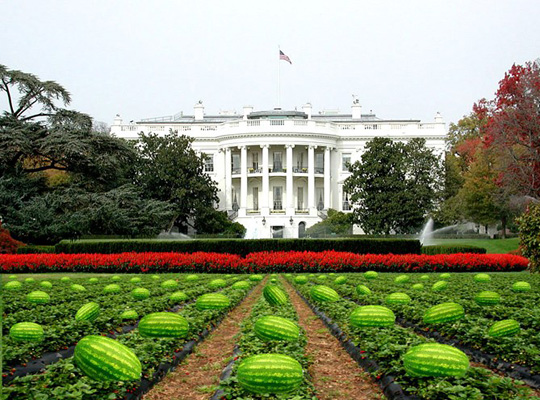
Last week I posted about the stereotype that Black people love watermelons, explaining that it originated with efforts to justify slavery.  Black people were simple, slavery proponents argued, so a delicious watermelon was enough to make them happy.

This stereotype, long past its strategic usefulness, nonetheless persists.  Barack Obama’s election to the U.S. presidency, for example, inspired a rash of watermelon-themed commentary, including this one:

(source)

In light of this history, as well as the ongoing racism, the product below — a Valentine’s Day candy that pairs two Disney princesses — is rather, let’s say, insensitive.  The White Cinderella Aurora character decorates the vanilla flavored side; the Black Tiana character decorates the watermelon flavored side.  Just… wow.

Thanks to Caroline H. for forwarding this along.

Lisa Wade, PhD is an Associate Professor at Tulane University. She is the author of American Hookup, a book about college sexual culture; a textbook about gender; and a forthcoming introductory text: Terrible Magnificent Sociology. You can follow her on Twitter and Instagram.

Cross-posted at Thick Culture.

As of the 2010 Census, Latinos represent 17 percent of the US population, but are woefully underrepresented in traditional forms of political participation like voting and making campaign contributions. The Pew Hispanic center reports that while Latinos represented 21% of all eleigible voters in 2010, they accounted for only 6.6% of midterm election voters.

One area where Latinos are more likely to participate when compared to non-Latino whites is in outsider forms of participation like protest activity. This form of activity became synonymous with Latino political participation during the 2006 Grand Marcha where 500,000 protesters packed streets to protest immigration bills. A 2006 CIRCLE study finds that Latino youth, while not engaged in formal types of participation were much more likely to report having engaged in a protest:

Although young Latinos are generally not as engaged as other racial/ethnic
groups, 25% said that they had participated in a protest—more than twice the
proportion of any other racial/ethnic group.

By comparison, only 11% of all youth surveyed had reported taking part in a protest. The accounts for why Latinos protest more than other groups vary but a main causal fator is the lack of access to formal political channels, particularly for non-citizens and undocumented immigrants. Lisa Martinez (2008) points out that Latinos are less likely to engage in protest activity when they live in places with high numbers of elected officials. Is the increase in Latino political engagement via protest simply the result of demographic realities (e.g. residents can’t vote) or is it a leading indicator of an overall dissatisfaction with politics?

——————————

Jose Marichal, PhD, is an assistant professor of political science at California Lutheran University. He teaches and writes about: public policy, race and politics, civic engagement, the Internet and politics, and community development.  He is founder of the blog ThickCulture.

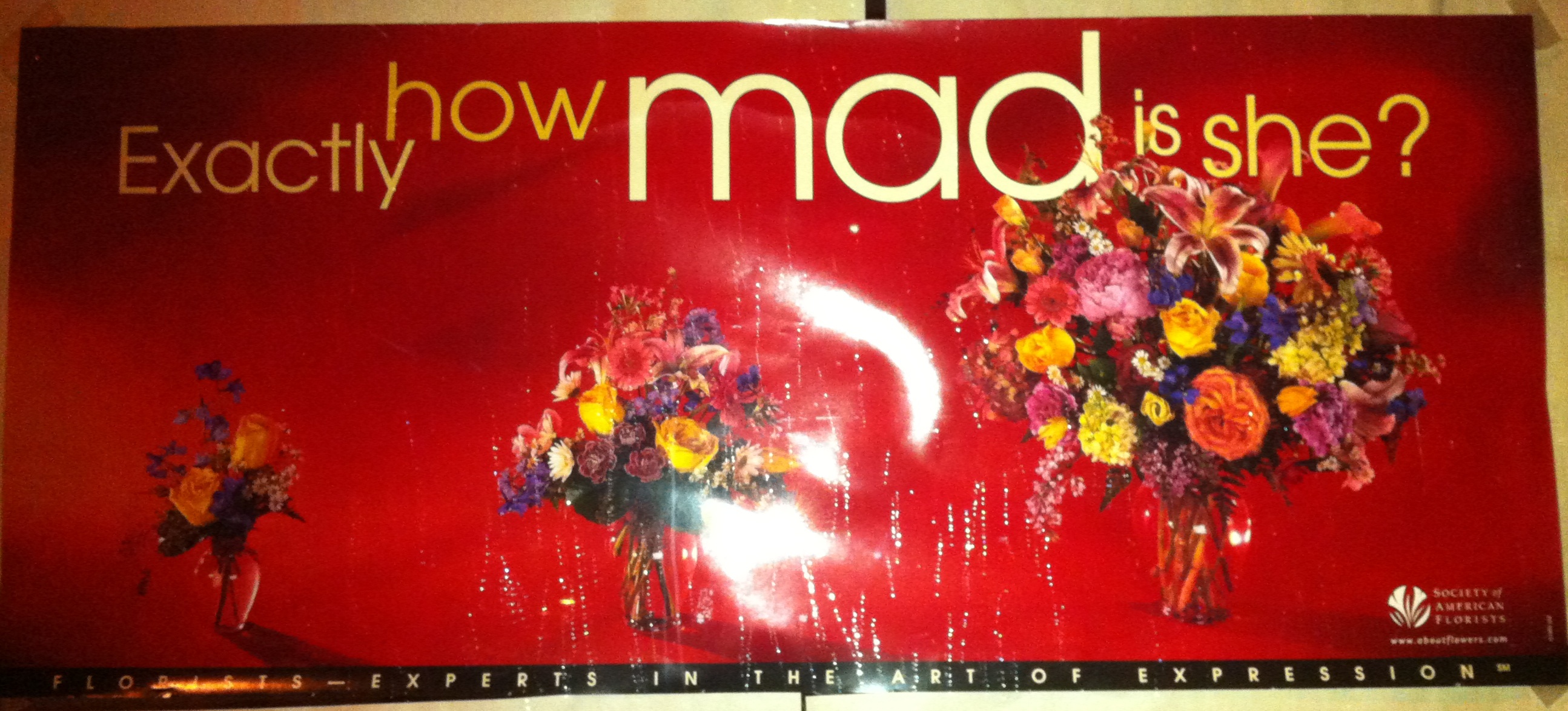
In addition to selling stuff, advertising tell us something about what “normal” relationships between people look like, such as the case below, submitted by Kyra M.

What’s it saying? When a woman’s upset, you can fix it with flowers.

In equating “she’s upset” with “get her flowers,” we’re discouraged from considering whether she might have a good reason to be upset.

Women have long been considered irrational creatures (it’s one of the justifications for denying them the vote — they didn’t have sufficient reason to make good choices in government) — much like children. When a child’s upset, you don’t reason with them, or think about whether you need to change your behaviour, you assume it’s because the child is immature. This ad encourages us to treat women the same way, as if they’ve just had their feelings hurt and a little consideration and then everything will be fine.  This undermines women’s status in a variety of contexts, communicating that women’s complaints do not need to be taken seriously. This kind of attitude makes women less able to structure their social environments to meet their needs.

More, this trope suggest that whatever a woman’s concerns are, she’ll abandon those positions and principles if you spend enough money. This construes women as corruptible — another construction justifying the lack of women in positions of authority. After all, would you want someone’s who’s irrational, materialistic, and corruptible running your company? Or your government?

——————————

Anastasia Kulpa teaches Sociology at Grant MacEwan University in Edmonton, Alberta, Canada. Her research interests include the sociology of post-secondary classrooms, and cultural vehicles for transmitting ideology (class, music, television, etc.).

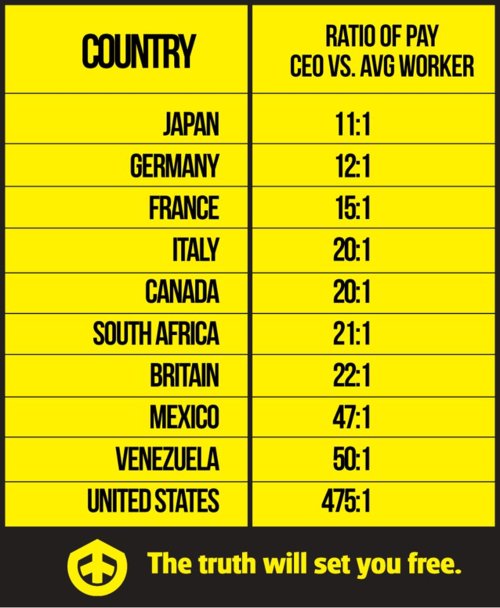
UPDATE:  Since posting this, I’ve discovered that the numbers do not accurately reflect the ratio of CEO vs. worker pay.  Writes PolitiFact:

We don’t doubt the chart’s underlying point that the ratio of CEO pay to worker pay is high in the United States, and is likely higher in our free-wheeling economy than it is in the historically more egalitarian nations of Europe.

But in its claim that the U.S. ratio is 475 to 1, the chart conveys a sense of certitude and statistical precision that simply isn’t warranted — and which is contradicted by the facts. The latest number for the U.S. is 185 to 1 in one study and 325 to 1 in another [though in previous years, those ratios have reached as high as 525 to 1] — and those numbers were not generated by groups that might have an ideological interest in downplaying the gaps between rich and poor. We rate the claim on the U.S. ratio False.

I apologize for not vetting this more carefully.

H/T KeepYourHopesUpHigh via GlobalSociologyBlog.

Lisa Wade, PhD is an Associate Professor at Tulane University. She is the author of American Hookup, a book about college sexual culture; a textbook about gender; and a forthcoming introductory text: Terrible Magnificent Sociology. You can follow her on Twitter and Instagram.