Cross-posted at Racialicious.

Race as biology has largely been discredited, yet beliefs about one race being biologically superior to another still seem to pervade one social arena: sports.  Claims that different races have genetic advantages to play particular sports persists both because individual athletic ability obviously has some basis in biology (even though that does not mean it is racial biology at play) and athletics appears to be one social arena where racial minorities succeed over whites in certain sports.

For example, according to the Institute for Diversity and Ethics in Sports’ 2011 Racial and Gender Report Card on The National Football League (http://www.tidesport.org), over 2/3rds of players in the NFL are African American — far higher than the proportion of Blacks in the general population of the United States.  This report also shows that all other racial groups are under-represented in the NFL relative to their proportion in the general population, including Asians who make up only 2% of the players in the league.
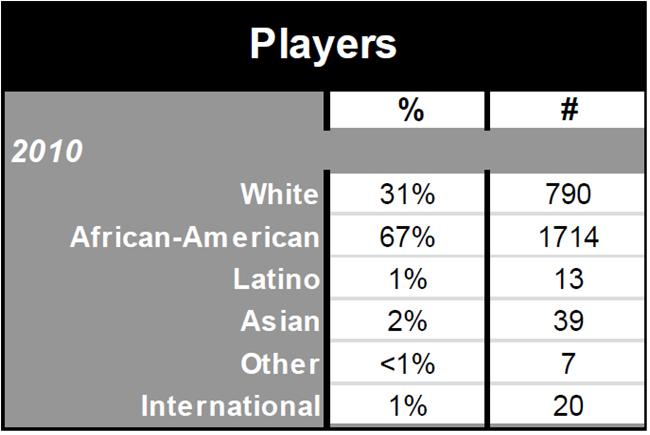
These statistics compel many to assume that racial biology plays a large part in athletic success.  However, the 60 Minutes investigation Football Island debunks this assumption during a trip to the place where most of the Asian players in the NFL come from: American Samoa.   This small island is a U.S. Territory in the Pacific and has a population small enough to seat comfortably in most professional football stadiums.  Yet the average Samoan child “is 56 times more likely to get into the NFL than any other kid in America.”

60 Minutes finds Samoans succeed at football only in small part because of their size and strength.  Rather, their success grows mostly out of a “warrior culture” that instills a strong work ethic in young men.  Also, on the island the daily chores that are a necessary part of survival provide a lifetime of athletic conditioning.  In short, many of the Asian players in the NFL are successful because of their nurturing, and not their nature.

[vimeo]https://vimeo.com/60688464[/vimeo]

Samoans are also driven to succeed at football because they come from a place plagued by poverty and often their only chance at a better life is through athletics (that, or follow another Samoan tradition and join the Armed Forces).  In the video, the most famous Samoan player, Troy Palamalu of the Pittsburgh Steelers, explains “football is a ‘meal ticket.’  Just like any marginalized ethnic group, you know, if you don’t make it to the NFL, what do you have to go back to?”

—————————-

Jason Eastman is an Assistant Professor of Sociology at Coastal Carolina University who researches how culture and identity influence social inequalities.

Lisa Wade, PhD is an Associate Professor at Tulane University. She is the author of American Hookup, a book about college sexual culture; a textbook about gender; and a forthcoming introductory text: Terrible Magnificent Sociology. You can follow her on Twitter and Instagram.

This little annotated image is a humorous contrast to the call to help an Africa that is portrayed as corrupt, miserable, or pitiful.  Thanks to Amy H. for submitting it!

See also challenging stereotypes of African men, the “single story” of Africa, how not to write about Africa, and portraying poverty in Africa.  Found at themetapicture.

Lisa Wade, PhD is an Associate Professor at Tulane University. She is the author of American Hookup, a book about college sexual culture; a textbook about gender; and a forthcoming introductory text: Terrible Magnificent Sociology. You can follow her on Twitter and Instagram.
Dolores R. sent in a cartoon by rampaige.  It seems unlikely that a man would randomly criticize a woman in a scoop neck t-shirt for the existence of her breasts, but it happens more often than you think.

I’m a bit busty, and a girl, and strangers have occasionally given me “advice” about my breasts.  Once I was told by a man I had just been introduced to that I shouldn’t wear sweaters.  Stumped — and living in Wisconsin — I asked why.  He explained that sweaters have “pile,” by which he meant that the fabric was thick.  The thickness of the fabric, he said, made my boobs look even bigger.  Since that was a bad thing, apparently, he advised me to avoid sweaters.  Weird, I know.  But I’m just saying, this stuff happens.

Lisa Wade, PhD is an Associate Professor at Tulane University. She is the author of American Hookup, a book about college sexual culture; a textbook about gender; and a forthcoming introductory text: Terrible Magnificent Sociology. You can follow her on Twitter and Instagram.

A new submission from Rucha S. inspires me to bring back our 4-year-old boob products post.  Hers is added last, so enjoy the scroll!

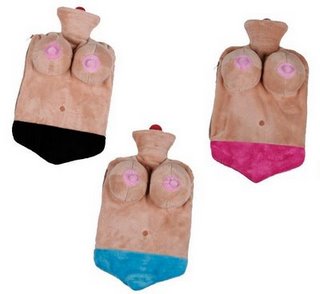
Sent in by Jessica F. and found at Trend de la Creme. Boob hot water bottles:

boobhotwaterbottle

Boob ice cubes:

boobicecubes

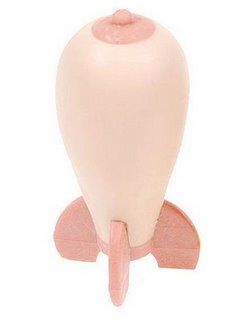
A boob/rocket-shaped “stress toy”:

boobrocket

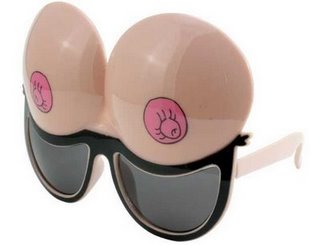
The boob glasses don’t even make sense:

boobglassesblackframegreylens

Taylor S. sent us this picture of “boob stress relievers” sold at a flea market:

dscn0778

Pitseleh S. found these boob clogs at boinkology.  You can also get these clogs with piercings or tattoos.

In comments to another post, Tim pointed us to this ad:

Many, many more after the jump.

more...

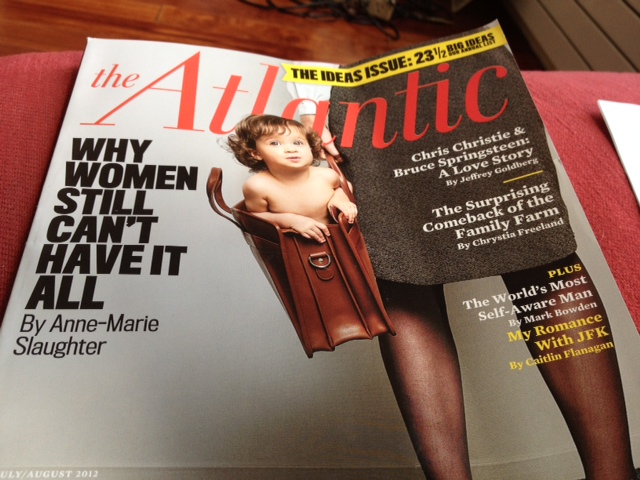
In a stroke of brilliance, Jessica Valenti has named a new trope: Sad White Babies with Mean Feminist Mommies.   The trope offers a visual “no” to the question that won’t die, “Can women have it all?”  It serves as a cautionary tale to all the ambitious feminist ladies out there: go right ahead, get a good job, but don’t think for a second that you’re doing the right thing for your (future) child.  Thanks to Larry H. and Zeynep A. for sending it in!


TIME has an alternative image of the working mom that I thought was quite cute.

Lisa Wade, PhD is an Associate Professor at Tulane University. She is the author of American Hookup, a book about college sexual culture; a textbook about gender; and a forthcoming introductory text: Terrible Magnificent Sociology. You can follow her on Twitter and Instagram.
Cross-posted at Montclair SocioBlog.

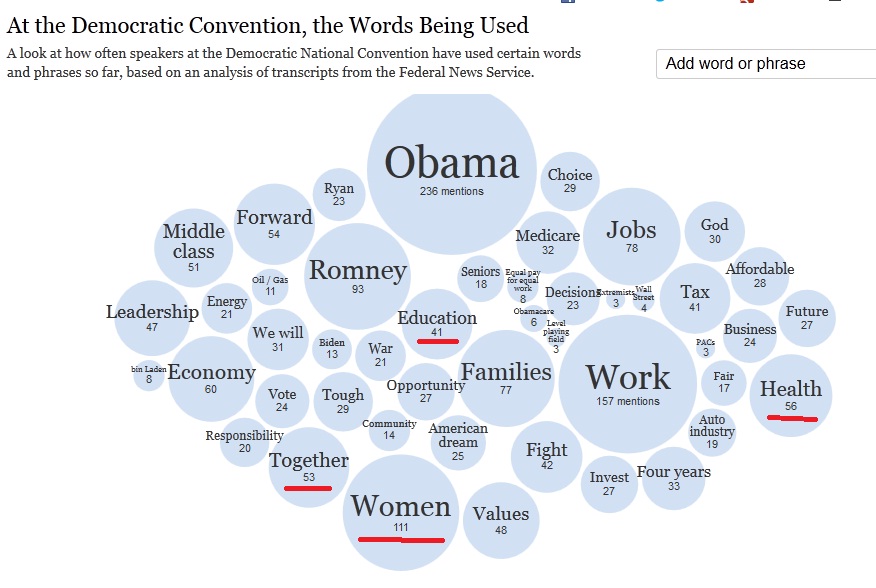
The New York Times ran these graphics showing the word frequencies of the Republican and Democratic conventions.  I’ve added underlining on the keywords that seem to differentiate the two conventions. (The data on the Democrats runs only through Sept. 4, but it looks like the themes announced early on will be the ones that are repeated.)

Both parties talked about leadership, the economy, jobs, and families.  More interesting are the differences.  Democrats talked a lot about Women, a word which seems to be absent from the Republican vocabulary.  The Democrats also talked about Health and Education.  I find it curious that Education does not appear in the Republican word cloud.

The Republican dictionary falls open to the page with Business – ten times as many mentions as in the Democrats’ concordance.  If you go to the interactive Times graphic, you can click on Business and see examples of the contexts for the word.  Many of these excerpts also contain the word Success.

You can put the large-bubble words in each graphic in a sentence that condenses the party’s message about government, though that word – Government – does not appear in either graphic.   For the Republicans, government should lower Taxes so that Business can Succeed, creating Jobs.

For the Democrats, government should protect the rights of Women and ensure that everyone has access to Health and Education.

Perhaps the most telling most interesting word in the Democratic cloud is Together.  The Republican story is one of individual success in business, summed up in their repeated phrase, “I built that.”  The Democrats apparently are emphasizing what people can accomplish together.  These different visions are not new.  They go back at least to the nineteenth century.  (Six years ago, I blogged here about these visions as NFL brands — Cowboys and Steelers — and their parallels in US politics.)

(HT: Neal Caren who has posted his own data about the different balance of emotional expression at the two conventions.)

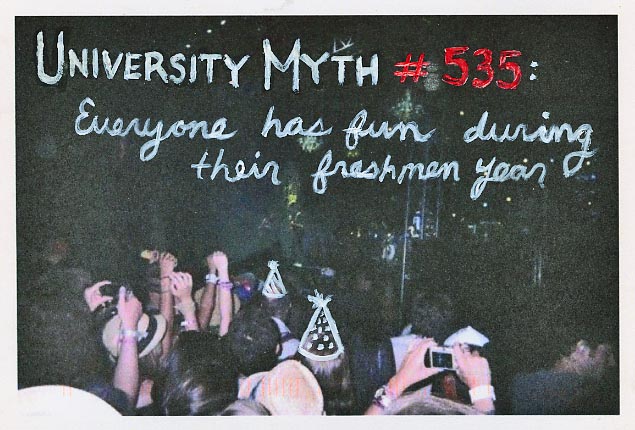
This week on PostSecret I stumbled across the following confession: 

The idea that certain beliefs about college may not be true reminded me of the concept of pluralistic ignorance.  The phrase refers to a phenomenon in which a large proportion of a population misunderstands reality.

For example, while many college students think that lots of people hook up a lot, 80% of college students hook up less than once a semester, on average.  About 40% of those hook ups involve intercourse, while a strong third just involve getting horizontal and making out.  Students, for what it’s worth, also tend to consistently overestimate how much drugs and alcohol other students are consuming.

So, while “everyone thinks” that “everyone has fun during their freshman year.”  In fact, the person who wrote this confession may be a lot less alone than s/he thinks, even if most people think that everyone does, in fact, have fun.

Lisa Wade, PhD is an Associate Professor at Tulane University. She is the author of American Hookup, a book about college sexual culture; a textbook about gender; and a forthcoming introductory text: Terrible Magnificent Sociology. You can follow her on Twitter and Instagram.
Earlier this month, Lisa posted about the objectification of female beach volleyball players at the Olympics, discussing the types of photos and poses that are used when reporting on different types of sports, including gendered differences.

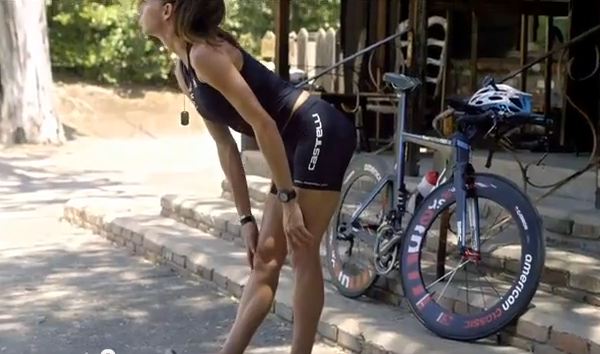
Autumn B. sent in another over-the-top example of the objectification of female athletes. The commercial is for RoadID, a company that sells “identification gear.” Autumn saw it while watching the Tour de France; she found this shortened version online, which she says actually features less objectification than the original did.

The main focus of the ad is a slow investigation of various aspects of cyclist Jenny Fletcher’s body. The camera travels slowly up her leg, then shows her full profile before zooming in on her breasts as she zips up her shirt:

Jenny Fletcher has no dialogue. She exists as a body to be broken down into eroticized parts for the consumption of the viewer. As Autumn put it, it’s frustrating that, a fan of the “the male-centric Tour de France,” that “when they do FINALLY feature a female cyclist, it is as a sexual object.”

For other posts on this topic, see Serena Williams’ patriarchal bargain, Sports Illustrated covers, feminizing female athletes, Serena Williams in ESPN magazine, and media portrayals of female athletes.