In light of Romney’s comments regarding those who depend on the government, we thought we’d re-post this great data showing that many people who are using government social programs don’t know they are doing so.  

————————

Dolores R. sent in a fascinating image posted at boingboing. It comes from a paper by Suzanne Mettler, a professor in the Department of Government at Cornell. Mettler first asked survey participants whether they had ever used a federal U.S. government program. Then later in the survey she specifically asked respondents whether they had ever benefited from or participated in specific federal programs. As it turns out, large number of people who have benefited from various federal programs or policies do not recognize themselves as having done so. This table shows what percent of people who said they had participated in or used these 19 federal programs had earlier in the surveys said they had never used any social program:
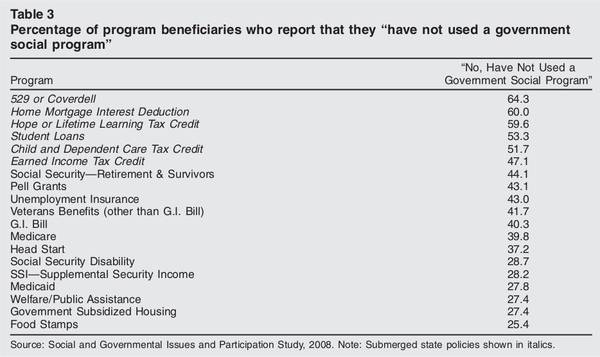
Mettler argues that recipients are less likely to recognize themselves as benefiting from programs that are part of what she calls the “submerged state” — programs and policies that provide incentives and motivations for particular behaviors in the private sector, rather than overtly directing behavior. If you receive food stamps, you interact directly with a government agency, are required to periodically meet with a government worker and reapply to re-establish eligibility, and can point to a specific thing that links you to the program (these days usually a debit-type card rather than the old style coupons/stamps).

On the other hand, if you participate in the government’s mortgage interest deduction program, which encourages home ownership by allowing people to deduct the cost of mortgage interest from their taxable income (which you can’t do with rent costs, for instance), it’s less noticeable that you are benefiting from a federal policy. You get a form from your mortgage company that provides the relevant number, and you transfer it over to the correct line when you’re filling out taxes.

Notably, the programs recipients seem least likely to recognize as a government program are among those the middle (and higher) classes are most likely to use, while those more common among the poor are more clearly recognizable to those using them as government programs. Yet allowing you to write off mortgage interest (but not rent), or charitable donations, or the money you put aside for a child’s education, are all forms of government programs, ones that benefit some more than others. But the “submerged” nature of these policies hides the degree to which the middle and upper classes use and benefit from federal programs.
One of our very first posts on SocImages was a Wrestle Mania billboard.  It featured a bunch of muscle-bound men without shirts, but their nipples were photoshopped out. They were too suggestive of women’s nipples (which are obscene, obviously) and possibly against the law.

Nipple-phobia is back with a particularly amusing example from Facebook.  Company policy requires deleting images of “female nipple bulges” (defined as “naked ‘private parts'”; male nipples, with or without bulges, are excluded from the ban).  This prompted Facebook to take down a New Yorker cartoon by Mick Stevens, see if you can figure why.

Robert Mankoff mocked the incident.

To be fair, and here I begin my own mockery, we are talking about Eve here.  And she had lost her innocence — and the innocence of the entire human race — with her “original” idea.  So… you know, she was a dirty, dirty gal who did a bad, bad thing and would realize the importance of covering up those “dirty pillows” sooner or later.  Facebook was just ahead of the curve. I guess.

Lisa Wade, PhD is an Associate Professor at Tulane University. She is the author of American Hookup, a book about college sexual culture; a textbook about gender; and a forthcoming introductory text: Terrible Magnificent Sociology. You can follow her on Twitter and Instagram.

In Wayward Puritans: A Study in the Sociology of Deviance, Kai Erikson states,

 …the agencies built by society for preventing deviance are often so poorly equipped for the task that we might well ask why this is regarded as their “real” function in the first place. (p. 14)

He notes that the amount of deviance and crime found in a society is largely related to how many resources we commit to looking for it. And once we’ve created institutions and industries to deal with particular types of deviance, we tend to continuously find enough deviance to continue to justify the system’s existence. If we’ve built a large criminal justice system, that system takes on a self-sustaining life of its own. Even if we eradicated all major crime as we know it, Erikson suggests, the agencies would turn their attention to behaviors we’ve previously ignored or treated as relatively unimportant, finding a new reason for the system’s existence and access to resources.

In the past several decades, fighting the War on Drugs has become an important role of the U.S. criminal justice system. Drug infractions are a major cause of the growth in imprisonment rates and, especially, the racial gap in incarceration.

I thought of Erikson’s insights when I recently saw the trailer for The House I Live In, an upcoming documentary about the impact of the War on Drugs. The trailer highlights the way that low-level drug dealers and addicts are fed as raw material into the criminal justice system. Law enforcement agencies often benefit directly from seizures of cash or property during drug busts, which then becomes property of the agency; additionally, agencies that design programs to target drug use/sales often get access to federal funds for training and equipment that they’d have no way to purchase otherwise:

The War on Drugs is an industry, one with vested interests with a powerful motivation to ensure its continued existence and expansion, regardless of any objective cost-benefit analysis of the consequences of incarcerating such a large proportion of the population or even of the effectiveness of our policies for actually decreasing drug use.

Cross-posted at Reports from the Economic Front.

Politicians always seem to be talking about the middle class.  They need some new focus groups.  According to the Pew Research Center, over the past four years the percentage of adult Americans that say they are in the lower class has risen significantly, from a quarter to almost one-third (see chart below).

Pew also found that the demographic profile of the self-defined lower class has also changed.  Young people, according to Pew, “are disproportionately swelling the ranks of the self-defined lower classes.”   More specifically some 40% of those between 18 to 29 years of age now identify as being in the lower classs compared to only 25% in 2008.

Strikingly, the percentage of whites and blacks that see themselves in the lower class is now basically equal.  The percentage of whites who consider themselves in the lower class rose from less than a quarter in 2008 to 31% in 2012.  This brought them in line with blacks, whose percentage remained at a third.  The percentage of Latinos describing themselves as lower class rose to 40%, a ten percentage point increase from 2008.

And not surprisingly, as the chart below shows, many who self-identify as being in the lower class are experiencing great hardships.   In fact, 1 in 3 faced four or all five of the problems addressed in the survey.

In short, there is a lot of hurting in our economy.

Jarrah Hodge, the woman behind the Canadian feminist blog Gender Focus, has started a new video series called Feminism F.A.Q.s.  They’re short videos aimed at addressing myths about gender inequality and the people who care about it.  She’s already got 10 videos up, but here are a couple of my favs.

What Have Women Been Told They Can’t Do?

Ride bicycles (’cause of “bicycle face”), get a credit card, run marathons, and much more.

Did Feminists Burn Bras?

Answer: Nope!

Lisa Wade, PhD is an Associate Professor at Tulane University. She is the author of American Hookup, a book about college sexual culture; a textbook about gender; and a forthcoming introductory text: Terrible Magnificent Sociology. You can follow her on Twitter and Instagram.

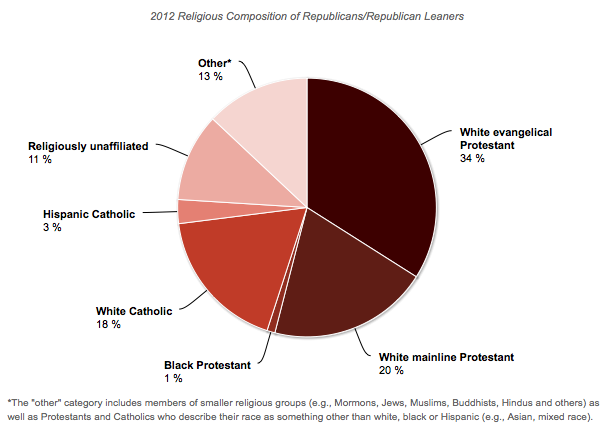
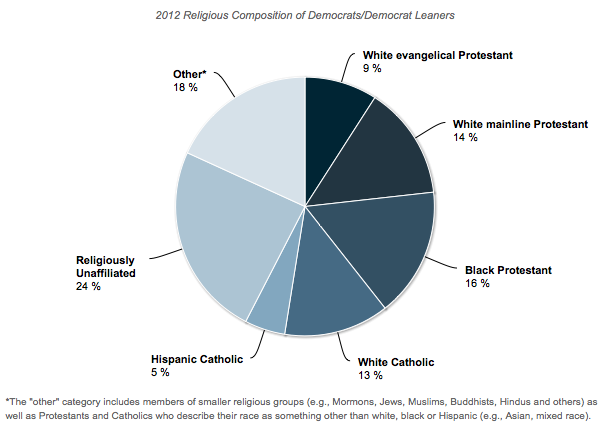
Peter N. sent in some data compiled by Chris Cillizza of the Washington Post.  It reveals the intersection of race and religion among Democrats and Republicans.   As Cillizza concludes, it’s “overblown” to say that the Republican party is made up of White Protestants and the Democratic of minorities and atheists, but there is definitely an argument to be made that each party is disproportionately so.

This first pie chart shows the racial and religious affiliation of people who identify with or lean towards the Republican party.  More than half are White Protestants, another 18% are White Catholics.  Only a small percentage of party faithfuls are religious Blacks and Hispanics (the two racial groups featured in in these data).

This second chart shows the same data for Democrats and Democratic-leaning individuals.  Almost a quarter of Democrats are White Protestants, but a slightly larger percentage of Democrats are religiously unaffiliated.  One in five Democrats identifies as either Black or Hispanic and religious.  The larger “other” category conceals smaller blocs that nonetheless add diversity to the party.

This is just one way to slice the pie, so to speak, but these are the kinds of data that both the Obama and the Romney campaigns are working with.  When they aim to bring out their “base,” this is what they’re talking about.  These numbers may give us a clue as to why they pick the strategies they do, such as the sudden spike in the inclusion of the word “God” in the Republican party platform.

Lisa Wade, PhD is an Associate Professor at Tulane University. She is the author of American Hookup, a book about college sexual culture; a textbook about gender; and a forthcoming introductory text: Terrible Magnificent Sociology. You can follow her on Twitter and Instagram.

Confirmation bias is the tendency to search for or interpret information in a way that reaffirms our pre-existing beliefs. We may selectively notice information; for instance, if we think the full moon makes people act weird, we’re likely to notice and remember strange things we see people doing during a full moon better than strange things we observe at other times (or than all the people we see acting perfectly normally during a full moon). We tend to perceive what we expect to see, our brains struggling to come up with reasons that justify what we already think.

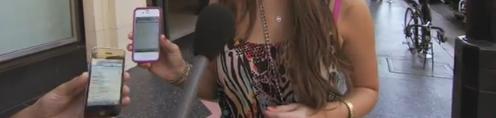
Dmitriy T.C. sent in a video that illustrates this particular type of selective thinking. Jimmy Kimmel gave people on the street an exclusive look at the iPhone 5 and asked what they thought of it. Except, of course, the iPhone 5 isn’t available yet. What he actually gave them was an iPhone 4S. But when told they’re looking at a new version of the iPhone, everyone immediately perceives clear improvements that make it better than the iPhone 4.

You might expect this from people who don’t have much knowledge of iPhones; they don’t have a clear basis for comparison, so whatever features seem neat, they assume are new. But even people holding their own iPhone 4 up for direct comparison perceive the “iPhone 5” Kimmel hands them to be superior, noting a range of details — it’s lighter, faster, just clearly better. They think a new version of a gadget must be way more awesome than the previous version, and Apple has an aura of coolness that leads people to expect their new products should be extra amazing. Since people expect a new iPhone to be awesome, they notice, or invent, features that confirm that it is, indeed, awesome.

It’s a really fun demonstration of this cognitive bias:

I’m supervising senior theses this semester and so I have to be a super stickler about something that makes most students’ eyes roll back in their heads: operationalization.  Wait!  Keep reading!

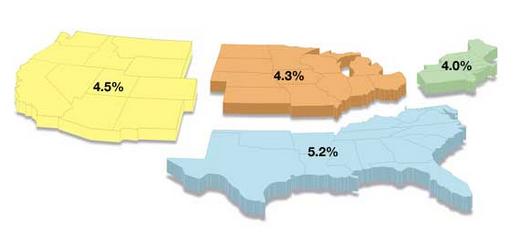
The term refers to a careful definition of the variable you’re measuring and it can have dramatic influences on what you find.  Dmitriy T.C. sent in a great example.  It involves whether you include church donations in your definition of “charity.”   Friendly Atheist breaks it down.

If you include church donations, the South appears to be the most generous U.S. region:

But if you don’t, everyone looks a whole lot stingier and the Northeast comes out on top:

All you budding sociologists out there remember!  Think long and hard about how to define what you’re measuring.  It can make a huge difference in your results.

Lisa Wade, PhD is an Associate Professor at Tulane University. She is the author of American Hookup, a book about college sexual culture; a textbook about gender; and a forthcoming introductory text: Terrible Magnificent Sociology. You can follow her on Twitter and Instagram.