Well, first, they’re not baby carrots.  The two-inch carrots marketed as juveniles are actually pieces of regular sized carrots that are cut off and shaved into a “baby carrot” shape.  So, there’s no reason to expect the babies to be fresher, more tender, or sweeter. (Sorry, baby carrot lovers.)

But revealing how baby carrots are made is only Part I of the answer to the question of where they come from.  Who had the idea to make “baby carrots” and for what reason?

It turns out the idea came from a grower named Mike Yurosek.  According to Douglas McGray at Fast Company, it was grocery stores that pushed Yurosek to invent the baby carrot.  McGray writes:

…Yurosek had become frustrated with all the waste in the carrot business. Supermarkets expected carrots to be a particular size, shape, and color. Anything else had to be sold for juice or processing or animal feed, or just thrown away. Yurosek wondered what would happen if he peeled the skin off the gnarly carrots, cut them into pieces, and sold them in bags.

He whipped up two prototypes: the baby carrot with which we’re all familiar and “bunny balls,” 1-inch round carrot bites.  Somehow the latter didn’t catch on.  The rest is history.

Thanks to Annie C. for sending in the link!

Lisa Wade, PhD is an Associate Professor at Tulane University. She is the author of American Hookup, a book about college sexual culture; a textbook about gender; and a forthcoming introductory text: Terrible Magnificent Sociology. You can follow her on Twitter and Instagram.
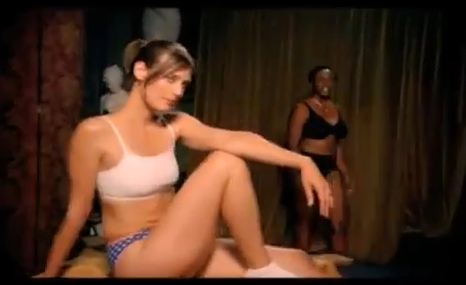
Tricia Mc.T. sent in a video that illustrates the tendency to associate non-White women’s bodies with curves. Fruit of the Loom’s “Flawless” commercial celebrates women’s bodies, offering the message that they’re flawless at any size. But as Tricia points out, though there is variety in the bodies of the women in the commercial, “women of color are the only ones with ‘curves’,” and the woman whose body is farthest from the thinness ideal is an African American woman:

It’s a small example of a larger pattern in which non-White women are associated with curviness and we’re comfortable depicting women of color as larger — think of all the TV shows you’ve seen where the only plump female character is the African American woman.

For more on this pattern, see our post on who has curves in a Levi’s ad, an ad for shapewear to get “Latino curves,” Vogue emphasizes Beyonce’s body, fetishizing African American women’s butts, and conflating “ethnic” with “curvy.“

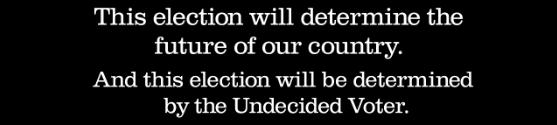
The political humor of Saturday Night Live (SNL) has become a mainstay of modern elections in the United States. The show is especially well known for its impersonations of candidates. However, so far this season SNL’s spoof political advertisement from a fictitious group called Low Information Voters of America is generating the greatest amount of political discussion.

The mock advertisement depicts undecided voters as lacking basic civic knowledge as they ask questions about when the election is held, who is running and whether or not they are an incumbent, how long the president serves, who succeeds the president, and whether or not both sexes can legally vote. SNL presents these few remaining swing voters in a way that implies they might have a problematic amount of influence in a close election.

However, is low information an issue only with just late deciding swing voters, or are they much more prevalent in the United States? A little known Zogby poll conducted in 2006 on a representative sample of adults (+/- 2.9%) in the United States provides some insight about how uniformed voters are by comparing political knowledge to awareness of popular culture.

Whereas 73.8% of respondents correctly named the three stooges; only 42.3% of knew the three branches of the U.S. government. Fifty-six percent knew the name of J.K. Rowling’s Fictional boy wizard; yet only 49.5% correctly identified the Prime Minister of England—and this was during the fallout of Iraq war and Downing Street Memo. Sixty-three percent of those polled could not name one Supreme Court justice; 85% were able to identify at least two of the seven dwarfs. Twice as many respondents (22.6%) knew the last American Idol than the last justice confirmed to the Supreme Court (11.3%).

Democracy needs an informed electorate, although the level of information necessary to maintain an effective republic is open for debate. This poll (which does need to be redone because it is becoming quite dated) finds that many adults in the United States — both the decided and undecided — are more informed about popular culture than politics. Thus, while voters may be “informed enough,” it is still difficult to subjectively claim it is healthy for a democracy to have a populace more knowledgeable about reality television, children’s books and fairy tales than civics.

—————————

Jason Eastman is an Assistant Professor of Sociology at Coastal Carolina University who researches how culture and identity influence social inequalities.

“Today,” Mother Jones‘s James Ridgeway reports, “roughly 1 in 12 state and federal prison inmates is 55 or older.”  Prisoners sentenced to life without parole will die in prison, so that means they’ll convalesce there too.  In other words, prisons are part nursing home and, according to a report from the ACLU, the number of elderly prisoners is expected to skyrocket:


Imprisonment is already expensive, but aging patients cost twice what a younger prisoner costs.  Today, we spent $16 billion a year to house elderly prisoners,  Soon we’ll have to start renovating our prisons.

Unless states start releasing them, [former warden Bob] Hood says, we will need to “retrofit every prison in America to put assisted living-units in it, wheelchair accessibility, handicapped toilets, grab bars — the whole nine yards.”

Prisons increasingly feature assisted-living cells and hospice units.

Some argue for “compassionate release.”  After all, elderly prisoners have a very low recidivism rate.  But the ACLU cautions us to remember that release shouldn’t mean abdicating responsibility.  “For many elderly prisoners,” the director of the ACLU’s National Prison Project explains, “particularly those with serious medical needs, simply pushing them out the prison door will be tantamount to a death sentence.”

Lisa Wade, PhD is an Associate Professor at Tulane University. She is the author of American Hookup, a book about college sexual culture; a textbook about gender; and a forthcoming introductory text: Terrible Magnificent Sociology. You can follow her on Twitter and Instagram.
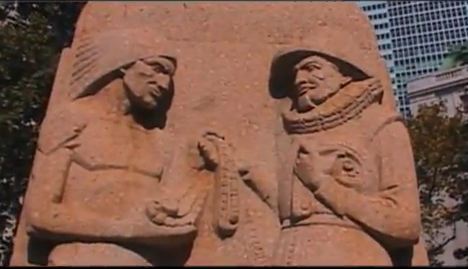
In Lies Across America: What Our Historic Sites Get Wrong, James Loewen looks at monuments, highway markers, historic museums, and other physical sites that commemorate elements of U.S. history. Loewen argues that the information that is included or ignored, and the language used to describe the people or events such sites are dedicated to, often distort or even actively rewrite history, reaffirming or justifying current beliefs in the process.

Sometimes these distortions are amusing. As we’ve posted about before, the sculptor of a statue of Civil War general John H. Morgan sitting on his favorite horse, Bess, added testicles to her because he felt that a female horse just wasn’t a sufficiently heroic mount, though she carried Morgan safely through the war well enough. In other cases, museums and monuments actively obscure the extent of racial oppression or largely ignore the voices of non-Whites. For instance, Almo, Idaho, features a monument to 295 immigrants who supposedly “lost their lives in a most horrible Indian massacre” in 1861 (p. 89). Loewen points out that this event was likely entirely invented, but fit discourses about savage Indians who simply could not live peacefully alongside vulnerable, civilized Whites that were still quite resonant when the monument was erected in 1938.

The documentary Monumental Myths takes a close look at some sites of this type It features Loewen, Howard Zinn, and others discussing the stories our historical monuments tell us and the consequences of the often very distorted narratives they construct about U.S. history:

Also check out our post on whose history monuments tell.

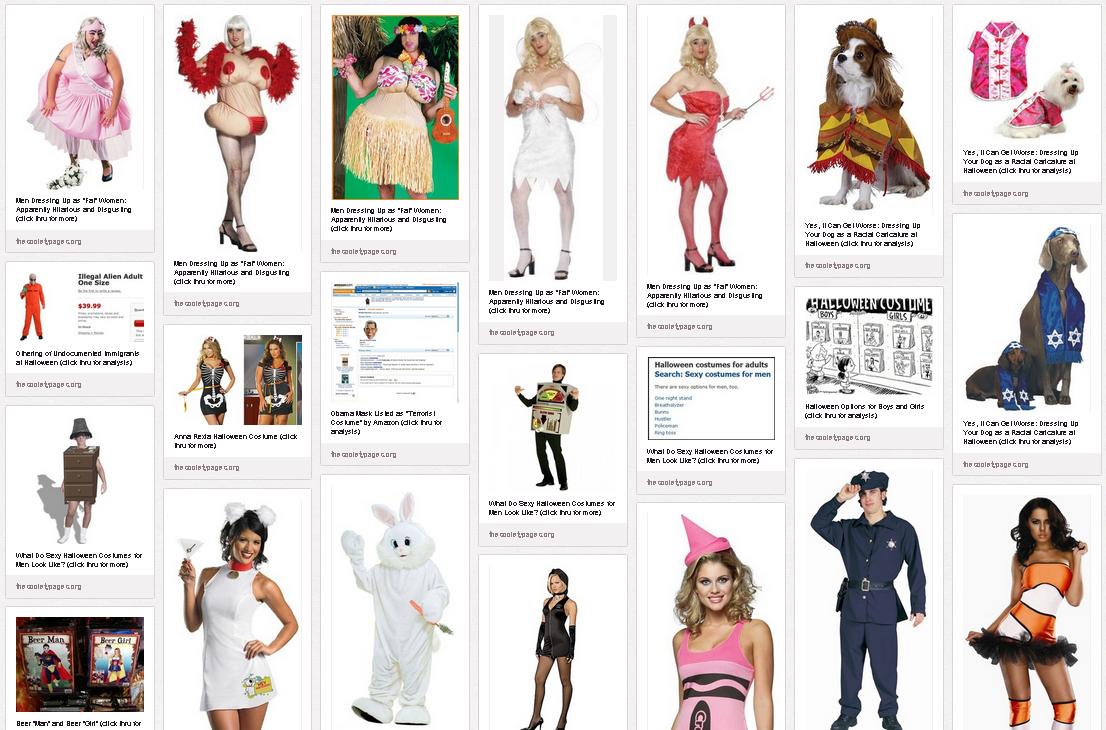
Hello all!  In honor of the upcoming holiday, we put together a Pinterest page featuring all of the images from our Halloween-related archives.

There you’ll see the a sexy body bag costume, an “Anna Rexia” costume, a dog dressed up like a geisha, a “little black dress” costume for a little girl, and an Obama mask labeled “terrorist.”

You will love to hate it!  Here’s a taste:

A while back we featured a guest post by Geoffrey Arnold about discrimination against short men.  He collects examples of heightism at his blog, The Social Complex, and has agreed to let us feature some of his examples here.

Think heightism doesn’t exist? Think again.

Bridesmaids include “Getting put with an usher who is not shorter than you” among good things in life (at 15secs):

Anne Hathaway takes her shoes off when standing next to a shorter guy (just the first 30secs):

Bravo TV executive Andy Cohen talks about being heckled backstage the 2011 Miss Universe pageant by Miss Montenegro and Miss Sri Lanka (unfortunately the clip ends with the host affirming Cohen that he’s not short instead of just condemning the contestants’ behavior):

Better to be tall: “Why be average, when you can XL”?

Short men are ridiculous and laughable, internationally.

American DirectTV commercial:

Chilean (I think) Doritos commercial:

Korean commercial:

American CRV commercial:

This ad, Arnold observes, actually “uses a statistic about heightism in order to justify and encourage the prejudice itself”:

See also Arnold’s guest posts introducing the concept of heightism as a gendered prejudice and discussing heightism (and other icky stuff) at Hooters.

Lisa Wade, PhD is an Associate Professor at Tulane University. She is the author of American Hookup, a book about college sexual culture; a textbook about gender; and a forthcoming introductory text: Terrible Magnificent Sociology. You can follow her on Twitter and Instagram.

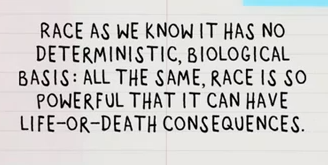
Dalton Conley’s newest animated video provides an overview of the social construction of race: the categories we define as race aren’t based in biology, yet they’re incredibly important factors that influence our opportunities, constraints, and life outcomes.