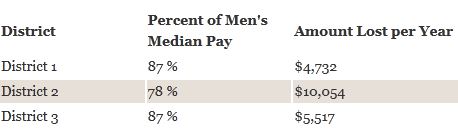
The National Partnership for Women & Families has posted an interactive map that displays the gender pay gap in each state and in the Congressional districts within the state. It uses Census Bureau data comparing full-time, year-round workers (that is, the scenario in which we’d expect women’s income to be closest to men’s). When you click on any state, it brings up information about it. For instance, in Nevada, women make 85% of what men do. Women working full-time have a median income of $35,484, while men’s median income is $41,803. The gap is smallest in the 1st and 3rd districts (both including parts of the greater Vegas metro area), but significantly larger in District 2, which covers the rest of the state, much of it rural:

Here are the 10 U.S. Congressional districts with the largest gender gap in median pay:

They don’t list the state or districts with the smallest gap. Just from casually and non-systematically clicking around, the state with the most parity that I found was in Washington D.C., where women make 90% as much as men. Let us know in the comments if you find anywhere with an even smaller gap.

In the 3-minute video below we see 100 people, filmed by Jeroen Wolf, from ages one to one hundred.  The one-year-old mostly just stares, the remainder look into the camera and state their age.

What I find interesting is the uneven way that people age.  As you watch the clip, people’s ages become increasingly difficult to pin down.  You know that each person is about one year older than the last, but their appearance betrays this knowledge.  One might look significantly older than the one before, or quite a bit younger.  How old we look doesn’t ascend nicely in a linear fashion,  but varies tremendously.  No doubt this is based, in part, on genetics and life choices, but it is also dependent on opportunities and expectations related to ascribed identities and social structures.

Enjoy:

Lisa Wade, PhD is an Associate Professor at Tulane University. She is the author of American Hookup, a book about college sexual culture; a textbook about gender; and a forthcoming introductory text: Terrible Magnificent Sociology. You can follow her on Twitter and Instagram.

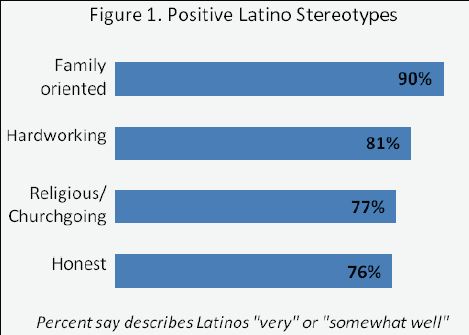
The National Hispanic Media Coalition recently released a report, “The Impact of Media Stereotypes on Opinions and Attitudes towards Latinos,” that looked at perceptions of Latinos in the U.S. A survey about views on Latinos, as well as media representations of them, was administered by phone to a national sample of 900 non-Latinos in March 2012.

The study found that the overwhelming majority of respondents agreed with a number of positive stereotypes of Latinos, such as the idea that they are hardworking and family-oriented:

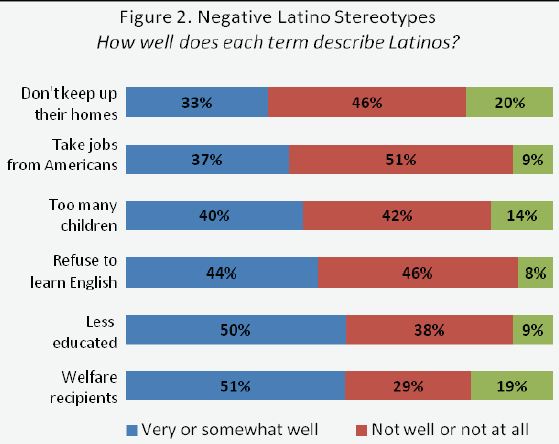
A range of negative stereotypes were persistent as well. Participants were asked how well a number of negative views described Latinos. Fully half agreed that Latinos can generally be described as welfare recipients and poorly educated, while significant minorities agreed with a number of other negative views:

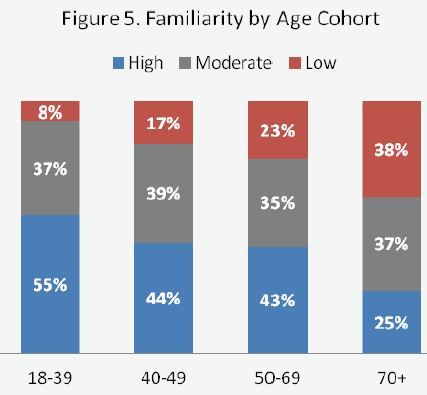
The researchers created a familiarity index based on personal contact with Latinos, frequency of such interactions, and general cultural awareness. Overall familiarity varied significantly by age, with younger adults reporting higher levels than older adults:

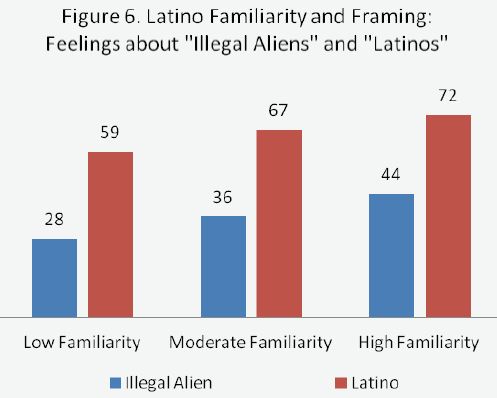
All groups, regardless of level of familiarity, felt generally positively about Latinos. However, when asked about “illegal aliens,” feelings were much more negative. Feelings were based on a scale from 0 (worst possible opinion) to 100 (highest possible opinion). The more familiar a group was with Latinos, the higher their average rating of both “Latinos” and “illegal aliens,” but every group had distinctly more negative opinions when asked about illegal aliens:

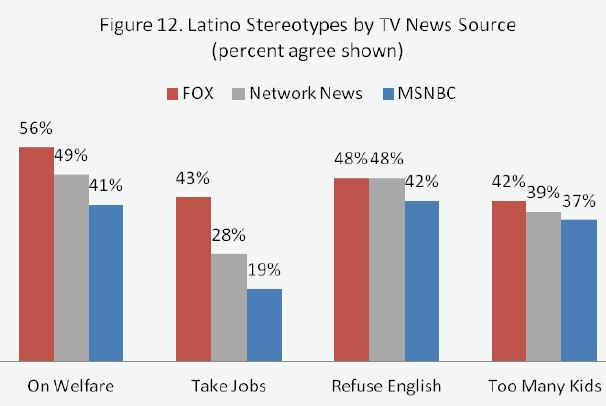
Which news source a person favored affected their perceptions of Latinos, with those who listed FOX News and conservative talk radio reporting more belief in negative stereotypes than those who rely on other TV sources or NPR for their news. However, though the gap was significant, it often wasn’t as large as you might expect given common perceptions of the wide divergence among, say, MSNBC and FOX News fans:

The researchers also conducted an online experiment on the impacts of negative media images on individual’s perceptions of Latinos. You can read the results of that aspect of the study in the full report (and read more about the research firm’s methods here).

Generally speaking, gender equality in the U.S. and other Western countries has involved women moving into men’s spheres.  We have not seen an equivalent migration of men into women’s spheres.  Accordingly, while women have integrated many male occupations (they are now, for example, 50% or more of law and medical students), many female-dominated ones remain heavily female.

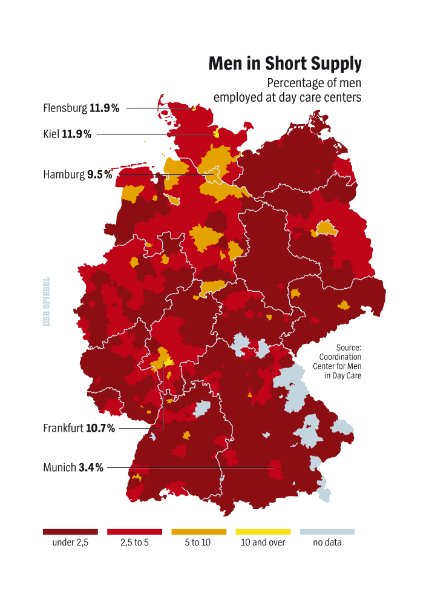
This is perhaps nowhere more true than in early childhood education.  In a story about male childcare workers at Organizations, Occupations and Work, Lata Murti reports that only 5% of child care workers and 3% of pre-school teachers are male.  Numbers are also low in other Western countries.  In Germany, the average is 3.5% (and this includes all employees of child care centers, including custodians).

So, Spiegel Online reports, Germany has decided to try to do something about it.  Aiming to increase the percentage of men in child care to 20%, the government is spending 13 million Euros on a “More Men in Early Childhood Education and Care” program.

The state isn’t doing this, though, solely out of a passion for gender equality or a soft place in their heart for men holding babies.  They’re doing it because Germany has promised that there will be a spot in a day care center for all children when they turn one year old.  To fulfill this promise, they need more day care workers badly; recruiting men means that that other half of the population might fill out the profession.

Lisa Wade, PhD is an Associate Professor at Tulane University. She is the author of American Hookup, a book about college sexual culture; a textbook about gender; and a forthcoming introductory text: Terrible Magnificent Sociology. You can follow her on Twitter and Instagram.
Cross-posted at Jezebel.

Sara sent in an example of a phenomenon that I always find somewhat funny: the socially constructed life trajectory.

Never fear!  If you don’t know what to do next in life, the answer is out there.  When I filled my taxes out with Turbo Tax, it happily pointed a strong finger towards marriage, buying a house, and having children.  In that order of course.  A slide show about birth control options laid out my best choice depending on what it told me I was to be doing in each decade of my life.

Sara’s example is on the Weight Watchers website.  Under the phrase “Life Stages,” it nicely lays out a trajectory.  First you go to college, then you get married, then you have a child, and then you are old. (At every stage of life, though, you’re too fat!)

Get in line, ladies!  College, husband, babies, old person!  Oh, and make sure you’re losing weight every step of the way.

Lisa Wade, PhD is an Associate Professor at Tulane University. She is the author of American Hookup, a book about college sexual culture; a textbook about gender; and a forthcoming introductory text: Terrible Magnificent Sociology. You can follow her on Twitter and Instagram.

Last week a secretly-taped video of Romney made headlines. In it, he said that 47% of America believes that they are “victims,” is “dependent” on the government, and likes it that way.  SocImages, like many places around the web, did some talking about who the 47% of people who pay no income taxes really are.

In this post, however, I’d like to make a different kind of point about framing and the sociological imagination, inspired by Ill Doctrine‘s Jay Smooth and Slate’s William Saletan.

Reacting to the release of the video, the media returned to a similarly clandestine video of Obama that had made the rounds during his first run for the presidency.  In it, Obama refers to Americans who are “bitter” and “cling to guns or religion, or antipathy toward people who aren’t like them, or anti-immigrant sentiment…”  So, six-of-one, half-dozen-of-the-other right?  Both statements are equally tone deaf and biased right?

No. In fact, one is embedded in a deep empathy and an understanding that circumstance (i.e., that thing that sociologists study) can shape one’s outlook, sometimes in negative ways.  The other is a straightforward criticism of a group’s character, with a lack of empathy and understanding.

Let’s take a closer look at how Obama introduced his (fairly criticized) comment about the bitter clinging to guns (transcript).  He begins by saying that people have a good reason to be unhappy with politicians:

In a lot of these communities in big industrial states like Ohio and Pennsylvania, people have been beaten down so long, they feel so betrayed by government, that when they hear a pitch that is premised on not being cynical about government, there’s a part of them that just doesn’t buy it…

Then, instead of writing off these people as bad people who will never vote for the right guy, Obama argues that he wants to reach them (calling it a “challenge”), further validating how they might feel given the circumstances of their lives:

…our challenge is to get people persuaded that we can make progress when there’s no evidence of that in their daily lives. You go into some of these small towns in Pennsylvania, Ohio — like a lot of small towns in the Midwest, the jobs have been gone now for 25 years, and nothing’s replaced them. And they fell through the Clinton administration and the Bush administration. And each successive administration has said that somehow these communities are going to regenerate. And they have not. So it’s not surprising then that they get bitter, and they cling to guns or religion, or antipathy toward people who aren’t like them, or anti-immigrant sentiment, or, you know, anti-trade sentiment [as] a way to explain their frustrations.

In contrast, Romney’s comments are dismissive and accusing (transcript).   His targets — the 47% of people who are exempt from paying income taxes — aren’t embattled, fighting for a decent life despite political neglect, they’re “entitled” to something they haven’t earned.  They’re happy to be dependent on the government and don’t want it any other way.  They’re leeches, parasites, freeloaders, bums.

And, instead of saying that its his job to help those people see life a different way, Romney dismisses them entirely:

 [They’ll] vote for the [current] president no matter what… my job is not to worry about those people — I’ll never convince them that they should take personal responsibility and care for their lives…

So, while some are arguing that Romney’s comments are just a politically-right version of Obama’s — equally biased and cynical — nothing could be farther from the truth.   Obama looks at Americans who will not likely vote for him and sees social structural reasons that their negative emotions are valid (even when they’re aimed at him), he expresses empathy for their plight, and seeks to connect with them.  Romney does nothing of the sort.  Instead, he condemns them as individuals and blows them off as potential constituents; and he encourages others to do the same.

In short, Obama has a sociological imagination that enables, even presses him to see the bigger picture.  He sees both individuals and the circumstances they live in.  Romney, for whatever reason, does not exercise a similar imagination.

Wanna hear it straight from Jay? I would too:

Lisa Wade, PhD is an Associate Professor at Tulane University. She is the author of American Hookup, a book about college sexual culture; a textbook about gender; and a forthcoming introductory text: Terrible Magnificent Sociology. You can follow her on Twitter and Instagram.

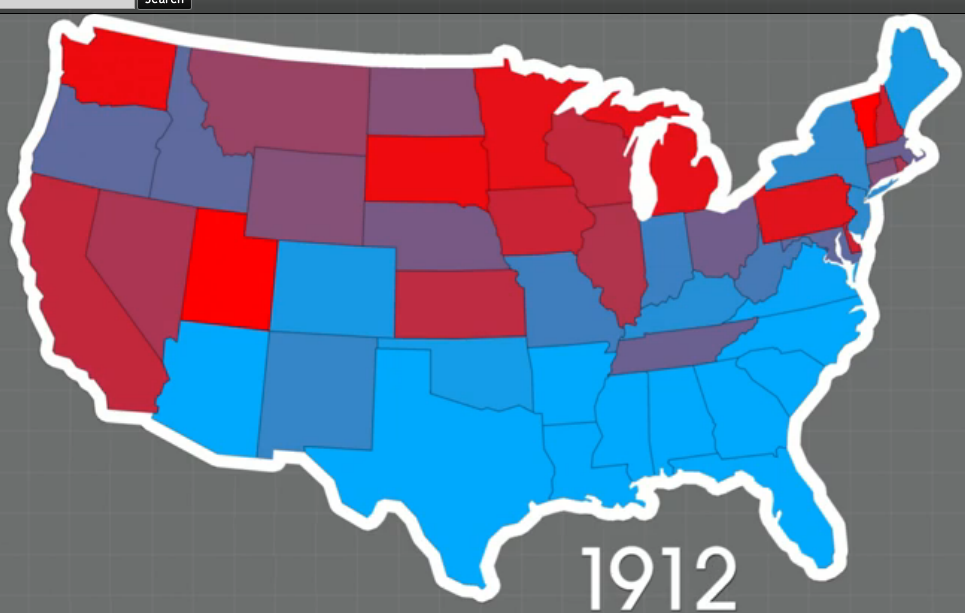
Salon posted a video by Benjamin Wheelock that illustrates changing voting patterns in the U.S. over the last century. He assigned each state a color based on voting for presidents, governors, and Congress for each year there were elections. Red indicates Republican, blue is Democratic; the darker the color, the more overwhelming the vote was for that party.

The video starts with 2011 and moves backward to 1912. What’s perhaps most striking today is that through the late 1970s, the South was a swath of Democratic blue. In the 1980s much of it turns purple, as presidential elections increasingly go Republican but Dems remain competitive in state elections. By the 2000s, it becomes much more solidly, and brightly, red as Republicans consolidate their popularity in the region.

It’s a quick way to highlight many major trends and turning points in U.S. political history, including changing stances on racial issues within the parties, the Democrats’ overwhelming dominance during the late ’30s as the country struggled to emerge from the Great Depression, and the clear shifts in the South and on the coasts over time.

Thanks to my colleague Pete for pointing it out!

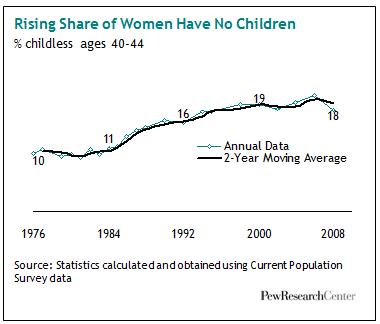
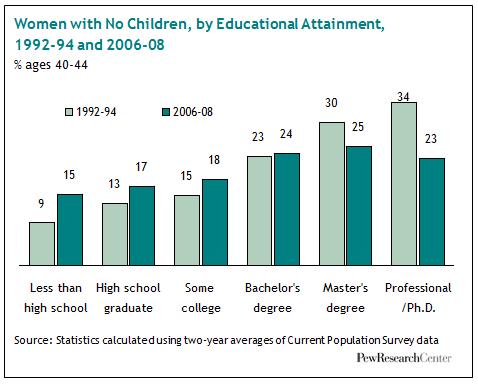
In doing research for a book I may write about voluntary childnessness, I came across a telling graphic from the Pew Research Center.  First, note that the percent of women age 40-44 without a biological child has almost doubled since the late ’70s.  Today about one-in-five such women (18%) have never given birth:

The percent of women is even higher among women with professional degrees (a master’s or equivalent and higher).  One-in-four women with a master’s degree, and nearly that many women with PhDs, have no biological children by ages 40-44.

Here’s where the really telling graph comes in.  Though women with higher levels of education are less likely to have biological children than other types of women, the trend  of increasing childlessness shown above doesn’t apply to them.  In fact, women with master’s and PhDs in the most recent data are more likely to have children than their counterparts 14 years ago.  In the first half of the 1990s, nearly one-in-three women with professional degrees did not have biological children; today it’s one-in-four. Childbearing among the most educated women, then, bucks the trend. It has gone up.

The data probably reflect greater endorsement of the idea that a woman can, or should be able to, balance both a career and a family, as well as the rise of policies that make that possible.  University of Florida sociologist Tanya Koropeckyj-Cox, who’s studied this stuff, says as much.  It may be hard to imagine now, but there was a time when having children would destroy a woman’s always-already fragile career; as much as we may love or hate the “mommy track,” at least today there is one.  Koropeckyj-Cox also suggests that women with higher incomes may have greater access to infertility treatments, making overcoming health problems or delayed childbearing more possible for them than it is among women with less education.

In any case, the data suggests an interesting story about gender, childbearing, educational achievement, and historical change.  I’d be happy to hear more interpretation in the comments.

Lisa Wade, PhD is an Associate Professor at Tulane University. She is the author of American Hookup, a book about college sexual culture; a textbook about gender; and a forthcoming introductory text: Terrible Magnificent Sociology. You can follow her on Twitter and Instagram.