Cross-posted at Racialicious and Family Inequality.

Trying to summarize a few historical trends for the last half century, I thought of framing them in terms of diversity.

Diversity is often an unsatisfying concept, used to describe hierarchical inequality as mere difference. But inequality is a form of diversity — a kind of difference. And further, not all social diversity is inequality. When people belong to categories and the categories are not ranked hierarchically (or you’re not interested in the ranking for whatever reason), the concept of diversity is useful.

There are various ways of constructing a diversity index, but I use the one sometimes called the Blau index, which is easy to calculate and has a nice interpretation: the probability that two randomly selected individuals are from different groups.

Example: Religion

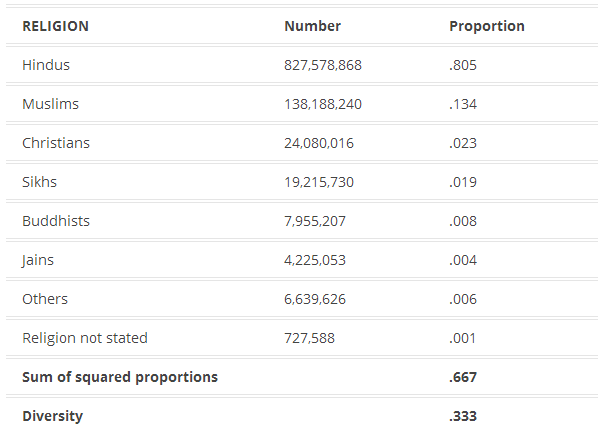
Take religion. According to the 2001 census of India, this was the religious breakdown of the population:
1.jpg

Diversity is calculated by summing the squares of the proportions in each category, and subtracting the sum from 1. So in India in 2001, if you picked two people at random, you had a 1/3 chance of getting people with different religions (as measured by the census).

Is .33 a lot of religious diversity? Not really, it turns out. I was surprised to read on the cover of this book by a Harvard professor that the United States is “the world’s most religiously diverse nation.” When I flipped through the book, though, I was disappointed to see it doesn’t actually talk much about other countries, and does not seem to offer the systematic comparison necessary to make such a claim.

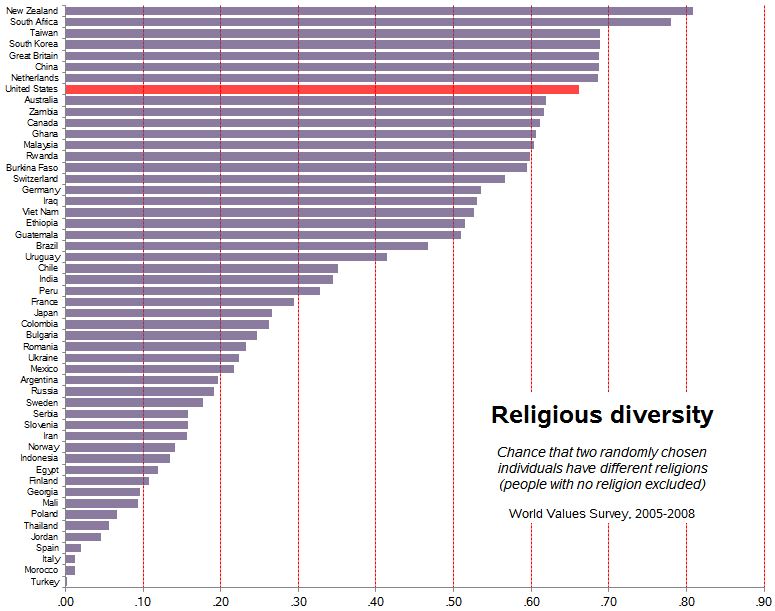
With our diversity index, it’s not hard to compare religious diversity across 52 countries using data from World Values Survey, with this result:
2

The U.S. is quite diverse — .66 — but a number of countries rank higher.


Increasing U.S. Diversity

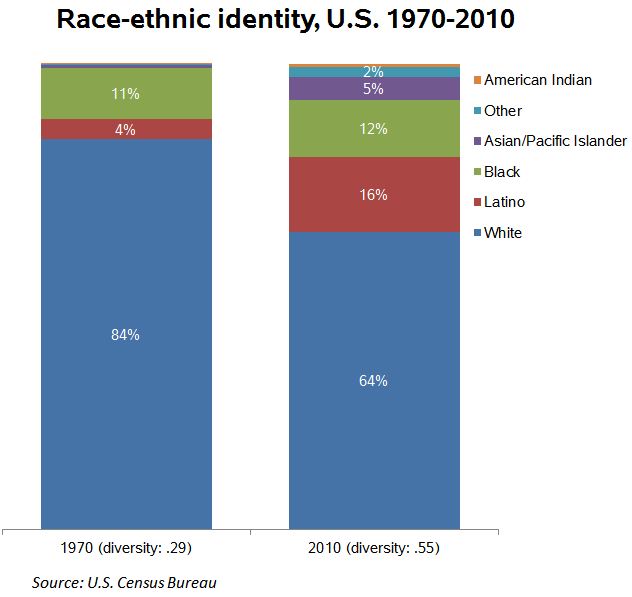
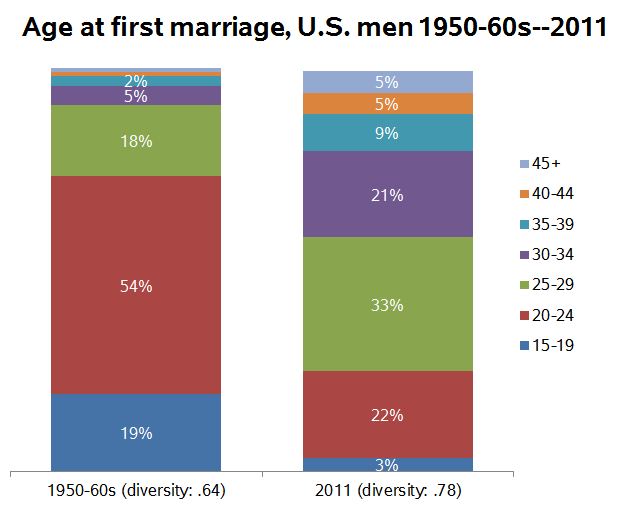
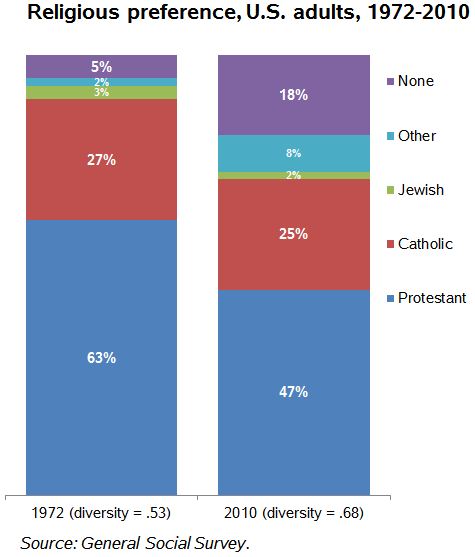
Anyway, back to describing the last half century in the U.S. On four important measures I’ve got easy-to-identify increasing diversity:
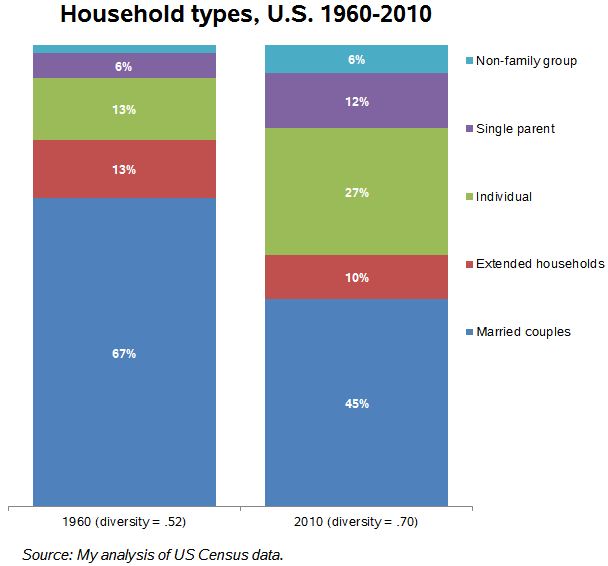
3

5

4

6

The last one is a little tricky. It’s common to report that the median age at marriage has increased since the 1950s (having fallen before the 1950s). But I realized it’s not just the average increasing, but the dispersion: More people marrying at different ages. So the experience of marriage is not just shifting rightward on the age distribution, but spreading out. Here’s another view of the same data:
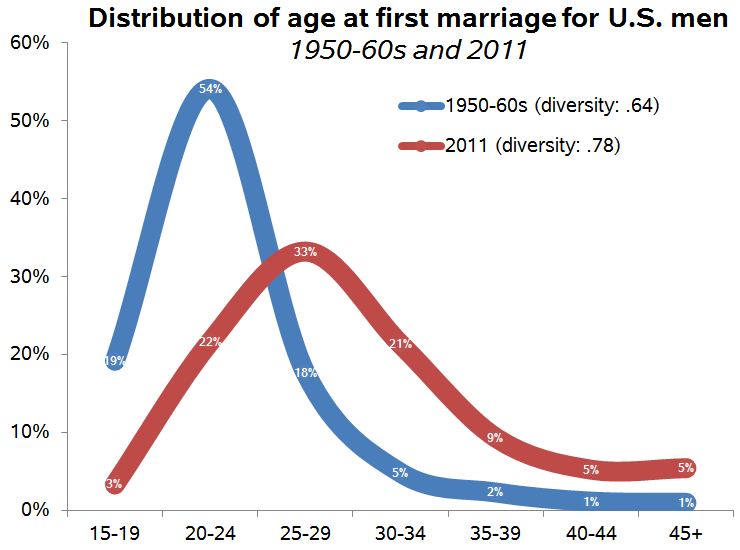
7

I calculated these using the Panel Study of Income Dynamics from 1968 (for those married in the years 1950-1968) and comparing it with the 2011 American Community Survey for those married in the previous year. There might be a better way, of course.

I have complained before that using the 1950s or thereabouts as a benchmark is misleading because it was an unusual period, marked by high conformity, especially with regard to family matters. But it is still the case that since then diversity on a number of important measures has increased. Over the period of several generations, in important ways the people we randomly encounter are more likely to be different from ourselves (and each other).

Philip N. Cohen is a professor of sociology at the University of Maryland, College Park, and writes the blog Family Inequality. You can follow him on Twitter or Facebook.

Readers have submitted some great examples of gendered items in the last few months, so I’ve collected just a few here. This includes “the first gender-based wholefood,” certainly a milestone worth commemorating, so let’s get to it!

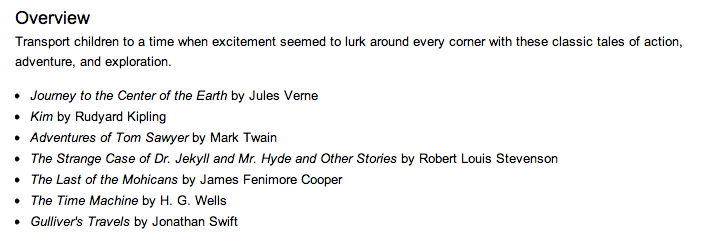
An anonymous reader pointed out that Barnes & Noble has book collections for boys and girls:

1

Screen Shot 2013-02-16 at 7.18.31 AM

The summaries of the books reinforce ideas about gender and especially the association of boys with action and girls with relationships. The description of the boys’ collection mentions “excitement” and “tales of action, adventure, and exploration”:

Screen Shot 2013-02-16 at 7.19.14 AM

The girls’ collection, on the other hand, includes “heartwarming tales” that teach us that “friendship is the most priceless and enduring gift of all”:

Screen Shot 2013-02-16 at 7.21.32 AM

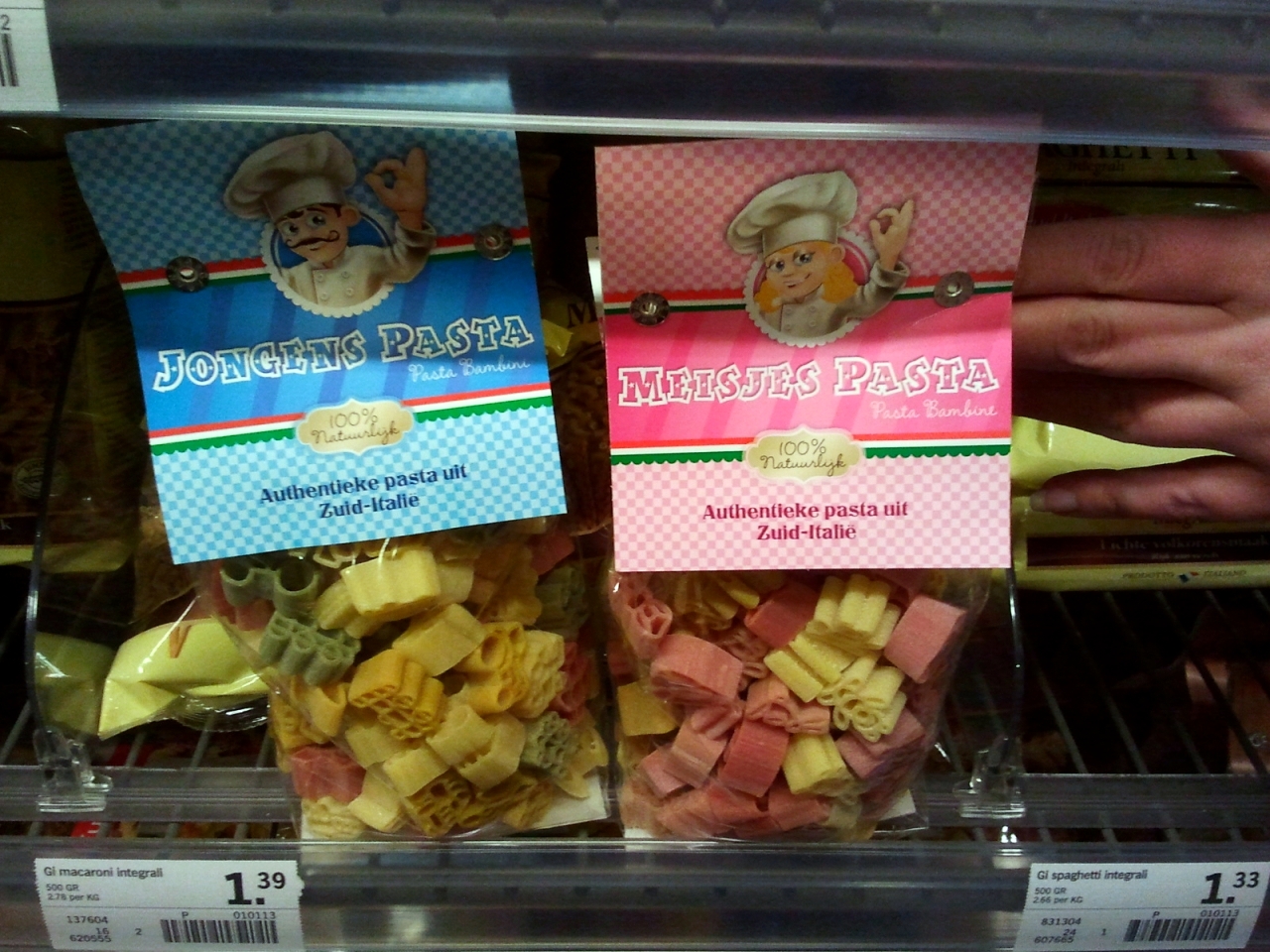
Nora Goerne sent in girls’ and boys’ pasta she saw in Dutch supermarket Albert Heijn:

20130202185512150

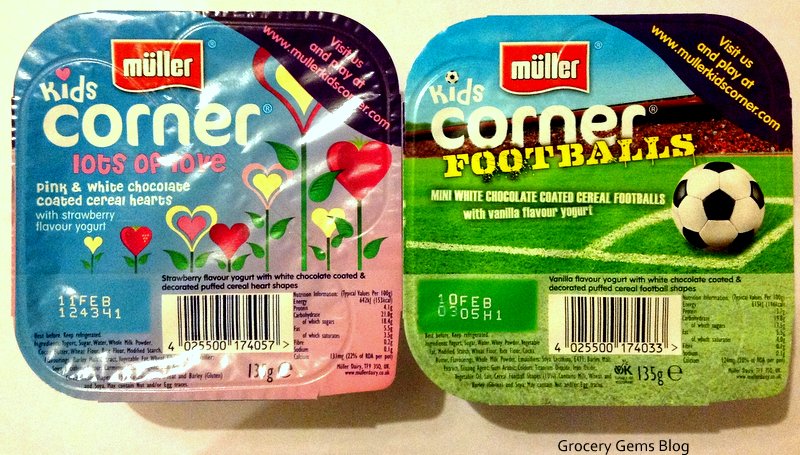
And Emily discovered you can get gender-specific yogurt for kids:

yoghurts

Nick O. noticed these bottle-opener rings, one of which is marketed to women by putting it on a pink background with the word “woman” on it but otherwise seemed the same to Nick:

Screen Shot 2013-02-16 at 7.26.35 AM

Carrie J. sent in this ad for gendered kids computers from 1999:

Screen Shot 2013-02-16 at 7.32.43 AM

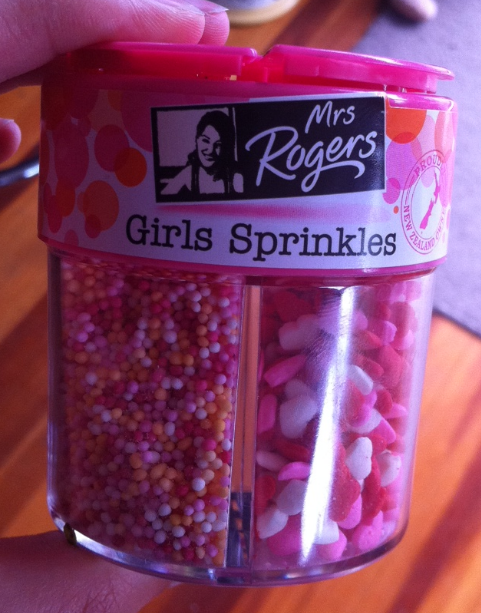
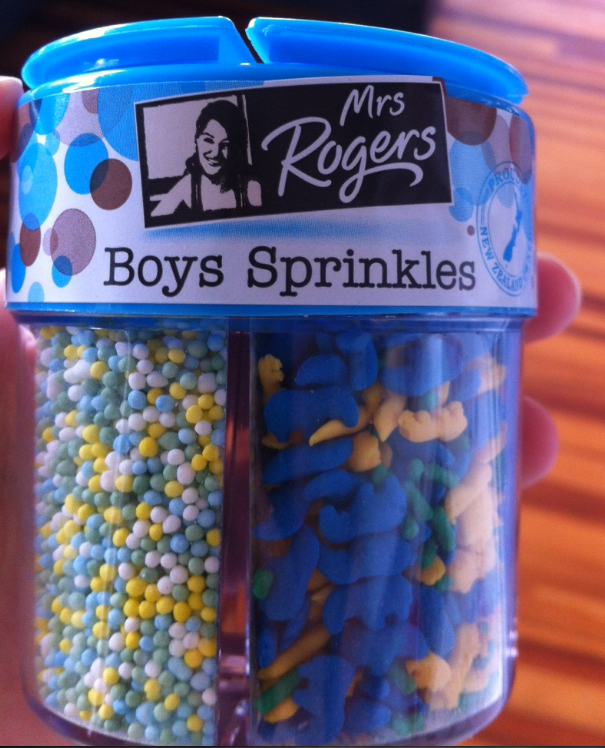
Shara found boys’ and girls’ cake sprinkles in New Zealand:

Screen Shot 2013-02-16 at 7.35.06 AM

Screen Shot 2013-02-16 at 7.35.18 AM

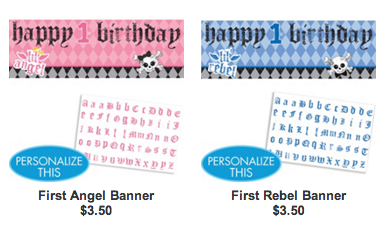
CBH was looking for birthday supplies on the Party City website and noticed that according to the decorations, by their first birthday girls are already “angels” and boys are “rebels”:

Screen Shot 2012-10-12 at 9.51.55 PM

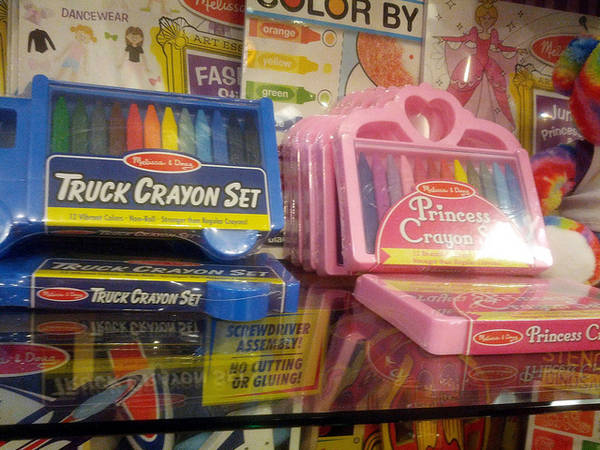
Helen S. sent us this image posted at Boing Boing of crayon sets that are implicitly gendered through the use of the colors and terms (especially “princess”) that have become codes for boys and girls:

7961433594_f2f52a0aa6_z

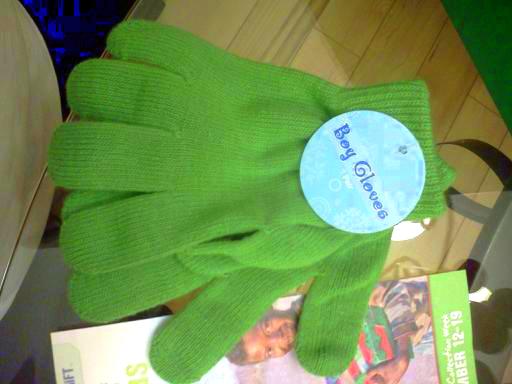
Green gloves are apparently for boys now (thanks, Michelle):

gloves

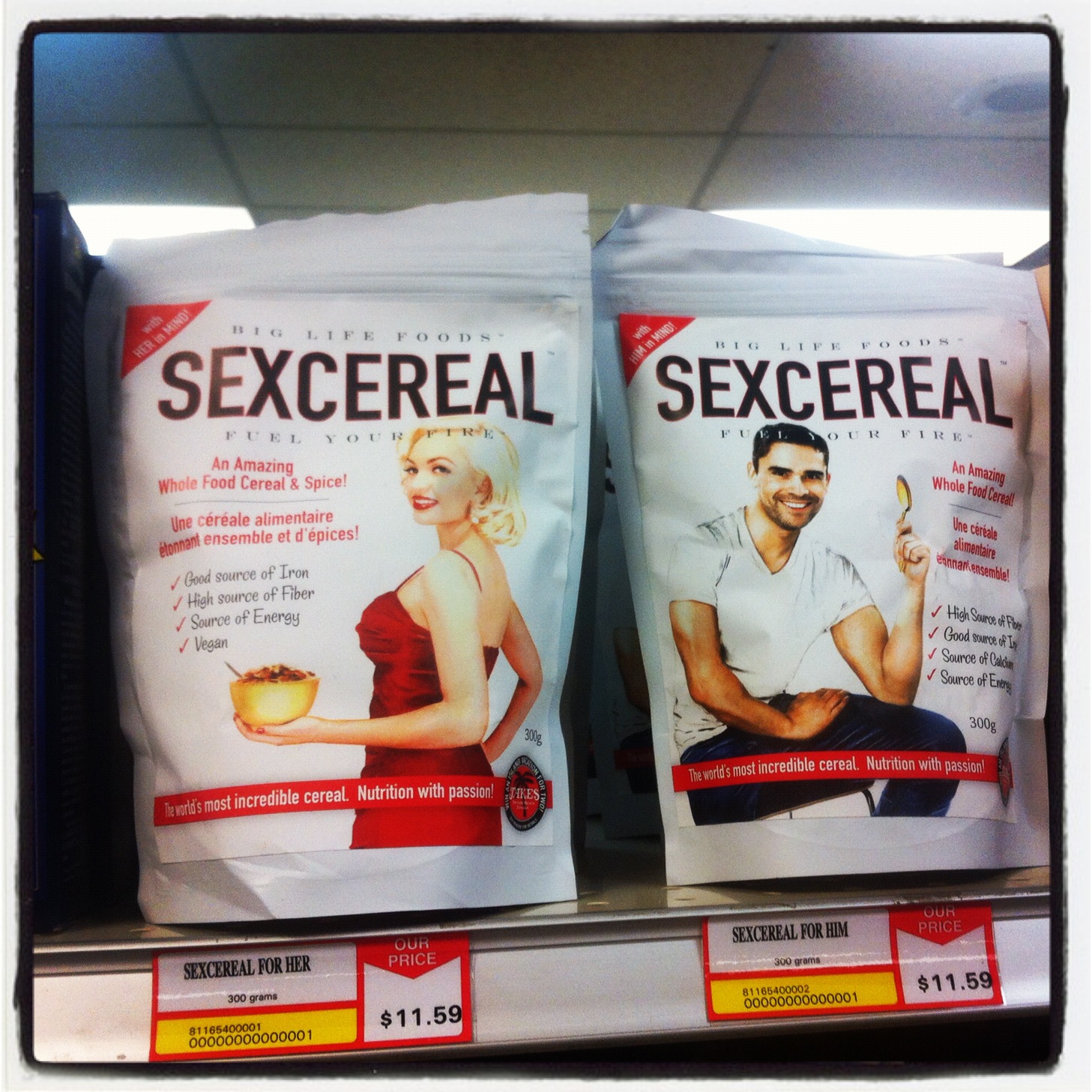
And finally, as promised: You will be relieved to know that “the first gender-based wholefood” is here, and not a moment too soon. According to the website for Sexcereal — no, stop laughing, this is serious — the female version supports “hormonal balance” while the male version has ingredients that “support testosterone and then some,” which actually makes me afraid this product might cause ‘roid rage if eaten too often:

image

Their website (sent in by Vanessa K.) is an absolute delight, and provides many a hearty laugh. It’s just too bad Sexcereal is only available in Canada. All of us non-Canadians are stuck eating our stupid unisex cereals, leaving our hormones unbalanced and our testosterone feeling sadly unsupported, and then some.

Gwen Sharp is an associate professor of sociology at Nevada State College. You can follow her on Twitter at @gwensharpnv.

Cross-posted at The Huffington Post.

Justin J.W. Powell and Liat Ben-Moshe have written a great short history of the icon signifying accessibility for people who use wheelchairs for the magazine Stimulus Respond.  The story, they argue, is one of “exclusion to inclusion.”

For most of American history, they begin, there was no icon at all.  This is because people in wheelchairs were largely excluded from public life.  There were no efforts to ensure accessibility, so no signs of accessibility were needed.

In the late ’60s, however, Rehabilitation International partnered with the United Nations and the International Standards Organisation to sponsor an international competition for an icon.  The winner, a Danish design student named Susanne Koefoed, had submitted the icon on the left.  In committee, they noted that Koefoed’s design erased the person in the wheelchair.  They added a head, creating what people around the world recognize as a symbol of accessibility.

1

The symbol is still evolving. Powell and Ben-Moshe note that recent revisions have been aimed at emphasizing that people in wheelchairs are active users, not passive ones.  Accordingly, some organizations have shifted to using a symbol that captures the fact that people in wheelchairs get themselves around.  I’ve snapped pictures of the icons used by the Huntington Gardens and a T.J. Maxx (both in CA): the former has the users’ arms bent behind them to signify pushing their chair forward, while the latter leans the figure forward and adds motion lines.

2

Another trend involves trying to break down the categorical binary between abled and disabled people, instead recognizing that there is a spectrum of ability. For example, this icon (source):

3

Ultimately, Powell and Ben-Moshe hope that access will be so universally designed into public buildings that it will eliminate the need for an icon at all: architecture would no longer be designed around a specific type of person considered “normal,” but instead would be designed for the range of people who will use the spaces.  This full integration would mean that differently-abled people would be considered just “people” and we wouldn’t need an icon at all.

Lisa Wade, PhD is an Associate Professor at Tulane University. She is the author of American Hookup, a book about college sexual culture; a textbook about gender; and a forthcoming introductory text: Terrible Magnificent Sociology. You can follow her on Twitter and Instagram.

Cross-posted at Policy Mic and The Huffington Post.

The gap between the household wealth of Black and White families is massive.  Today the median wealth held by White households is 20 times that of Black households.  There are lots of reasons for this difference and a new study offers great data on one of them: the need to assist poor relatives.

Kevin Hartnett, at Braniac, writes:

Middle-income blacks are more than twice as likely as middle-income whites to have a poor sibling and more than four times as likely to have parents below the poverty line. And because of these relationships, they’re called upon more often to provide financial assistance.

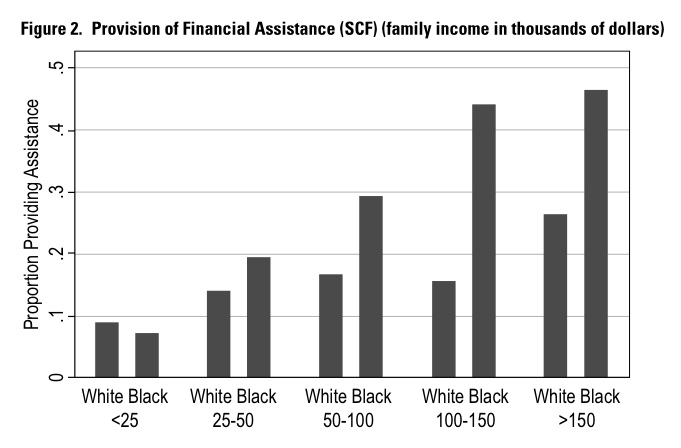
Sociology graduate student Rourke O’Brien used data on spending and other financial patterns among Americans to test whether this is a significant source of the wealth gap (link).  He found that, at all but the most low income level, Black households are more likely than White households to give money to struggling relatives.  And the wealthier the Black household, the more likely they were to help others.

The graph below illustrates this.  The vertical axis represents the proportion of households offering assistance and the horizontal axis represents increasing income levels (in thousands of dollars).

blackwhitewealth

The lesson is simple, but all too often unnoticed.  Due to hundreds of years of enslavement and discrimination, African Americans are more likely to be poor than Whites. If you grow up poor then most of the people in your family are poor.  Accordingly, even if you “make it out” and arrive in the middle class (income-wise), you will likely be less financially secure than a person that earns the same income but came from a middle class family.  That person can put all of their extra money towards buying a home (and earning equity), retirement, additional degrees, starting a business, and sending their kids to college.

But the poor person who earns a middle-class income might use a significant portion of their income keeping their parents’ heat on, helping their little brother go to college, or buying back-to-school clothes for their nieces and nephews.  This makes it much harder for poor and working class people who become middle class to stay that way.  And the cycle continues.

Via Citings and Sightings.

Lisa Wade, PhD is an Associate Professor at Tulane University. She is the author of American Hookup, a book about college sexual culture; a textbook about gender; and a forthcoming introductory text: Terrible Magnificent Sociology. You can follow her on Twitter and Instagram.

Cross-posted at Montclair SocioBlog.

You’re not going to persuade a conservative by appealing to liberal moral principles.  Tell a Tea Party type that industrial waste harms the environment and should be regulated, you won’t get very far.  But if you appeal to conservative moral principles, the story goes, you might have more luck.

I’ve been skeptical about Jonathan Haidt’s conservative moral principles — group loyalty, purity, and authority — mostly because they are used to justify practices I find wrong or immoral.  Things like anti-gay legislation, torture, assassination, terrorism, etc.

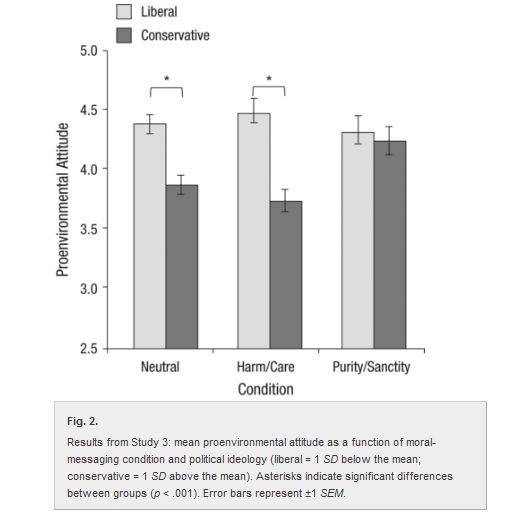
But a recent experimental study by UC Berkeley’s Robb Willer shows that the right kind of persuasion can make conservatives a bit more leftist on the environment.  In his study, participants read a pro-environmental message that was based either on “Harm/Care” (liberal logic) or on “Purity/Sanctity”(conservative logic) along with photos that matched the appeal.

  • Harm/Care: A destroyed forest of tree stumps, a barren coral reef, and cracked land suffering from drought.
  • Purity/Sanctity: A cloud of pollution looming over a city, a person drinking contaminated water, and a forest covered in garbage.

1

There was also a Neutral condition: “an apolitical message on the history of neckties.” (Willer has a fine sense of humor.)

Participants were then asked questions to determine their support for pro-environmental legislation.

2

For people who identified themselves as liberal, the type of material they saw — Harm, Purity, or Necktie — made no difference in their environmental position.  Conservatives, as expected, were generally cooler to environmental legislation, but only in the Neutral and Harm conditions.  Once they were shown the Purity materials, conservatives were as pro-environment as the liberals.

Other aspects of the conservative mind-set seem to go along with this emphasis on purity:  simplicity rather than complexity and a lower tolerance of ambiguity.  It’s a view that sees the need for clearly marked and rigidly enforced boundaries — the boundaries of the nation, the boundaries of the individual, the boundaries of cognitive categories.

Ultimately, the findings suggest that common ground between liberals and conservatives may not be as impossible to find as it may seem.

Jay Livingston is the chair of the Sociology Department at Montclair State University. You can follow him at Montclair SocioBlog or on Twitter.

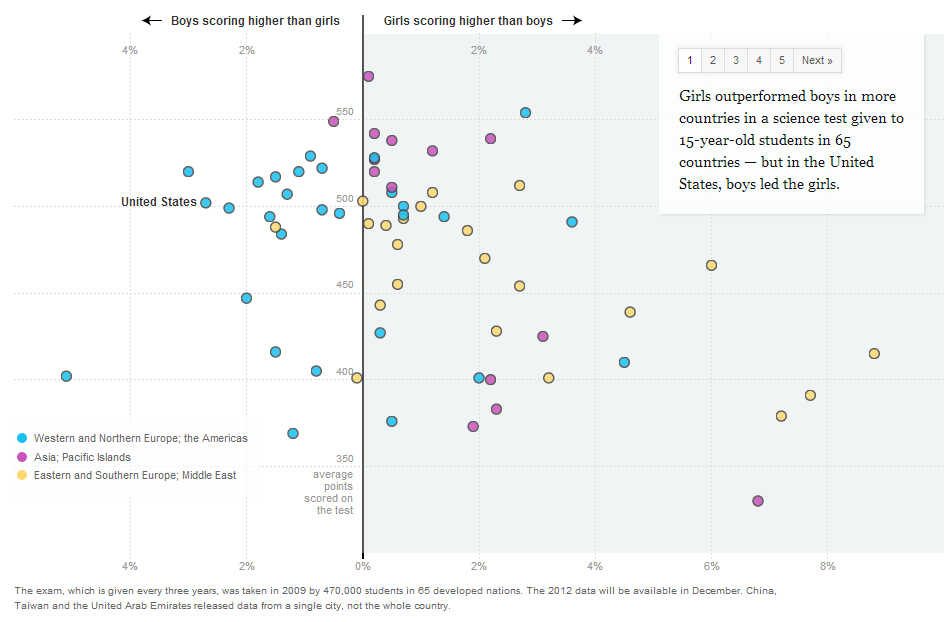
In 2009, 470,000 15-year-olds in 65 developed nations took a science test.  Boys in the U.S. outperformed girls by 14 points: 509 to 495.  How does the U.S. compare to other countries?

The figure below — from the New York Times — features Western and Northern Europe and the Americas (in turquoise), Asia and the Pacific Islands (in pink), and the Middle East and Eastern and Southern Europe (in yellow).  The line down the middle separates societies in which boys scored higher than girls (left) and vice versa (right).

Notice that the countries in which boys outscore girls are overwhelmingly Western and Northern Europe and the Americas.

This data tells a similar story to the data on gender and math aptitude.  Boys used to outperform girls in math in the U.S., but no longer.  And if you look transnationally, cultural variation swamps gender differences.  Analyses have shown that boys outperforming girls in math is strongly correlated with the degree of inequality in any given society.

One lesson to take is this: any given society is just one data point and can’t be counted on to tell the whole story.

Via The Global Sociology Blog.

Lisa Wade, PhD is an Associate Professor at Tulane University. She is the author of American Hookup, a book about college sexual culture; a textbook about gender; and a forthcoming introductory text: Terrible Magnificent Sociology. You can follow her on Twitter and Instagram.

A new example prompts us to re-post this fun one from 2010.

We’ve posted in the past about the way in which “male” is often taken to be the default or neutral category, with “female” a notable, marked, non-default one. For instance, the Body Worlds exhibit, “regular” t-shirts are men’s, Best Buy assumes customers are male, stick figures on signs are generally male, and default avatars tend to be male.

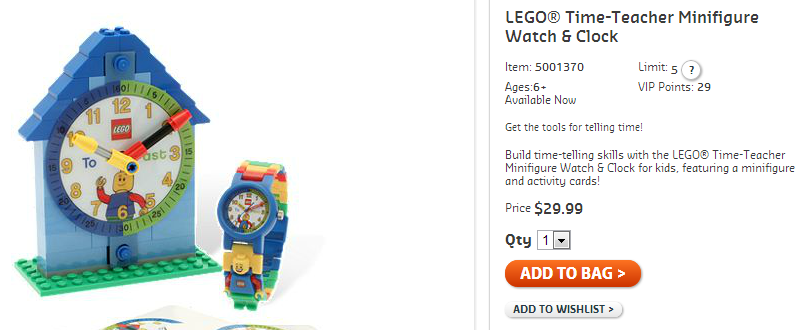
We’ve collected several more examples of the tendency to present men as the norm, while women are a marked, non-default category. @LydNicholas tweeted us this example of a LEGO product advertised on their website.  Notice that the blue version is a LEGO Time-Teach Minifigure Watch and Clock, while the pink version specifies that it’s for girls:


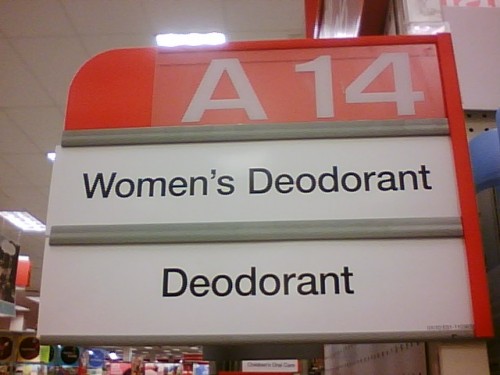
Jessica J. noticed that Wal-Mart Target helpfully lets you know where to find both neutral, plain old deodorant and women’s deodorant:

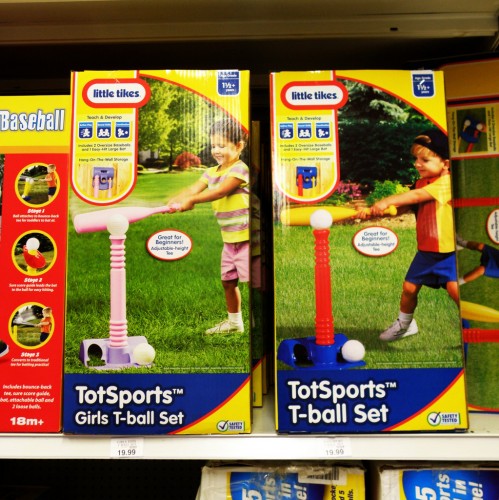
Jane G. sent us this photo of t-ball sets, one for girls and the other with no sex specified:

Aline, in Brazil, found these two wall painting kits.  One is just a painting kit and the other is specifically “for women” (“para mulheres”).  The latter, she said, claims to be a special offer, but is actually about $2 U.S. dollars more.

1

Eric Stoller pointed out that ESPN differentiates between college basketball and “women’s” basketball:

Lindsay H. pointed out that when you go to the U.S. Post Office’s website to forward your mail, it offers you the chance to subscribe to magazines. Those aimed at women (Cosmopolitan, First for Women, etc.) are in the category “Women,” while equivalent magazines for men (Esquire, Maxim) are not in a category titled “Men” but, rather, “Lifestyle”:

And Jane V.S. noticed that REI has various types of marked, “non-standard” sleeping bags, including those for tall people and women:

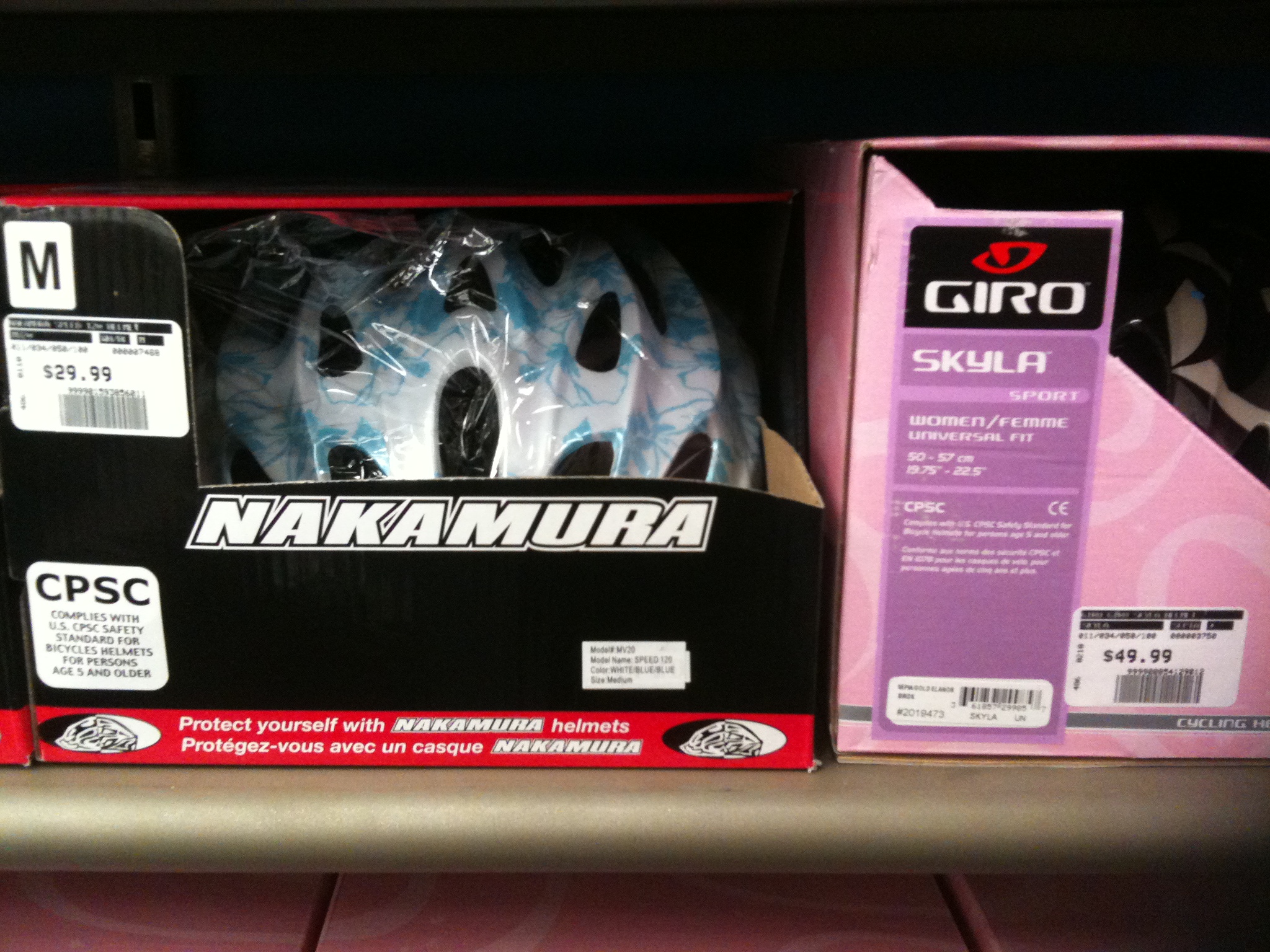
Renée Y. sent along another example, bike helmets:

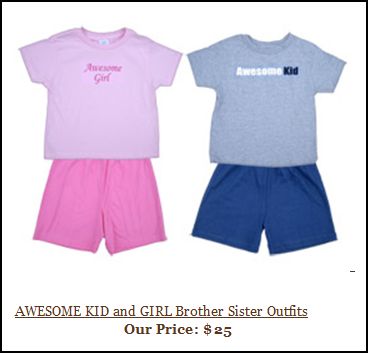
 Jessica B. spotted this pair of sibling outfits, coming in “Awesome Girl” and “Awesome Kid”:

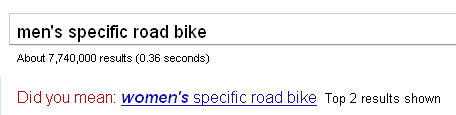
E.W. searched Google for men’s specific road bikes and Google asked, “Don’t you mean women’s specific road bikes”?  Because there are road bikes for people and road bikes for women.

Ann C. sent a screenshot of bubblebox, a site for children’s games.  Notice that along the top there are seven options.  The last is “girls,” suggesting that all the rest are for boys.

So, there you have it.  In this world, all too often, there are people and there are women and girls.

Gwen Sharp is an associate professor of sociology at Nevada State College. You can follow her on Twitter at @gwensharpnv.

CollegeHumor posted a set of fake Puritan-themed Valentine’s Day cards.  They’re a humorous way of reminding us that our intensive focus on romantic love as a driving force for sex and marriage is, in fact, quite new.

1

When the Puritans landed on the rocky east coast of America in the 1600s, they brought with them the belief that sex should be restricted to intercourse in marriage, hence the sentiment on the left. All non-marital and non-reproductive sexual activities were forbidden, including pre- and extra-marital sex, homosexual sex, masturbation, and oral or anal sex (even if married).   Violations of the rules were punished by fines, whipping, public shaming (yes, with “scarlet letters”), ostracism, or even death.

Alongside religion, there were practical reasons why the Puritans were so darn puritanical.  Colonizing the U.S. was a dangerous job; lots of people were dying from exposure, starvation, illness, and war.  Babies replenished the labor supply, motivating the Puritans to channel the sex drive towards the one sexual activity that made babies: intercourse. Accordingly, having intercourse with your spouse wasn’t only allowed, it was essential; women could divorce men who had proven impotent.  

The Puritans also married primarily to form practical partnerships for bearing children and mutual survival, hence the sentiment in the card on the right.

The idea that love should be the basis for marriage didn’t take hold until the Victorian era, when industrialization was changing the value of children.  Useful on the farm, children were suddenly became a burden in expensive and overcrowded lodgings.  This gave couples a new reason to limit the number of children they had and, because industrial production had made condoms increasingly cheap and effective, they could.  Marital fertility rates dropped precipitously between 1800 and 1900: from 6+ children/woman to 3 1/2 in the U.S., England, and Wales.

In this context, a Puritan sexual ethic that restricted sex to efforts to make babies just didn’t make sense. People needed a new logic to guide sexual activity: the answer was love. Over the course of the 1800s, Victorians slowly abandoned the Puritan idea that sex was only for reproduction, embracing instead the now familiar idea that sex could be an expression of love and a source of pleasure, an idea that still resonates strongly today.

That’s at least part of the story anyway.

Sources:

Bremer, Francis J., and Tom Webster.  2006. Puritans and Puritanism in Europe and America: A Comprehensive Encyclopedia. SantaBarbara: ABC-CLIO, Inc.

D’Emilio, John & Estelle Freedman. 1997. Intimate Matters: A History of Sexuality in America. Chicago: University of Chicago Press.

Freedman, Estelle. 1982. Sexuality in Nineteenth Century America: Behavior, Ideology, and Politics. Reviews in American History 10, 4: 196-215.

Lisa Wade, PhD is an Associate Professor at Tulane University. She is the author of American Hookup, a book about college sexual culture; a textbook about gender; and a forthcoming introductory text: Terrible Magnificent Sociology. You can follow her on Twitter and Instagram.