Cross-posted at Tim Wise’s website.

It’s one of those stories that can leave even the most jaded and cynical critic of racist thinking scratching their head; the kind that manages to shock even those of us for whom acts of bigotry and intolerance seem all-too-typical, and who have, sadly, come to expect them in a culture such as this.

And so it was that in Flint, Michigan recently, a new father — and this is a term he has earned in only the most narrow, biological sense — demanded that when his recently arrived child was sent to the Neonatal Intensive Care Unit of the hospital where she had been born, no African American nurses were to attend to her needs, to care for her, to do what neonatal ICU nurses do, which is to say keep sick babies alive. White hands only for this white, fresh as snow child, whose father, sporting a shiny new swastika tattoo (a Christmas present no doubt from his pathetic skinhead bride) prioritized his own hatreds above and beyond the needs of his precious little girl.  That the future does not bode well for her seems hardly worth saying. To be delivered from an ICU into the arms of one as unhinged as this can only, by reasonable people, be seen as a turn for the worse. Incubators and breathing machines might be preferable to having parents such as she has, through no fault of her own, inherited.

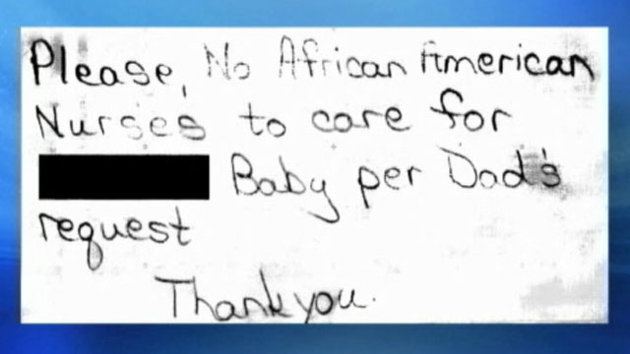
But what is worse, perhaps, than the bigotry of this one neo-Nazi — which is at least to be expected and so, can, despite its irrationality in a case such as this, remain somewhat within the realm of the banal — is that the hospital in question, Hurley Medical Center, actually capitulated to his psychotically racist demands, posting a sign on the little girl’s chart instructing the unit to disallow any black nurses from as much as touching this baby.
1

Presumably, were Tonya Battle, a black Hurley neonatal nurse since 1988 the only nurse within arms reach of the girl as she entered cardiac arrest or as her kidneys began to shut down — both of which have been known to happen to those in a NIC-U — Battle was to scream loudly for a white nurse to come and save the child’s life. Because God forbid a black woman with 25 years experience do the job. And if she dies, well, at least her precious white skin wouldn’t have been sullied by black hands.

Hurley’s acquiescence to this insanity, in contravention of all ethical responsibility, not to mention legal obligations to treat their employees in a non-discriminatory fashion, is going to cost them no doubt, as they are apt to discover once the lawsuit currently brought against their witless administrators plays out. They are going to pay, and pay big, as they should, for their enabling of overt white supremacy. But that is hardly the most important part of this story. Just as it was not the most important part of the story back in 2000 when a heart specialist at St. Thomas Hospital in Nashville did a similar thing, agreeing to the lunatic ravings of another racist white man, who demanded that his wife, who needed open heart surgery to save her life, not be attended to by any black doctor, because he didn’t want a black man to see his wife naked.

More interesting, I think, is what this story (and the earlier one from Nashville) says about racism in America, and not just of the sort evinced by one bottom-feeder, troglodytic fan of Adolf Hitler. For while we are too quick to presume racism to be merely an individual pathology manifested by individually bad people, much like the father in the story from Flint, the fact is, an incident like this illustrates as well as anything can, the way that racism continues to operate as a systemic force in the United States, civil rights laws and all our vaunted post-raciality notwithstanding.

To understand what I mean by this, consider something I am often asked as I travel the country, speaking about racism, or in reply to one or another column or book that I’ve written: namely, it is queried, why don’t I ever talk about black racism, or, just generally, racism against white people? Why, it is wondered, do I focus on racism only when it’s deployed by whites?

There are many things I could say, and do, when asked something like this. But for now, let it suffice to say that this story, from Michigan, involving a white institution as respected as a hospital bending to the whims of a fucking Nazi, is more than enough of a reason for my selective attention. And this is true for multiple reasons.

First, what the story demonstrates is how much more potent white racism is than any potentially parallel version practiced by peoples of color. Simply put, there is no way that any bigoted black person, or Latino, or Asian American, or indigenous person, could possibly have made a similar demand in the reverse direction — that no white nurses attend to their newborn — and expect to have that insistence met with approval and acquiescence. Anyone who thinks a hospital would have agreed to such a thing — to actually deny opportunity to white nurses or doctors, and to limit the care of such a child to same-race caregivers because of the expressed bigotry of a patient — is either so overly medicated or mentally damaged as to make further discussion impossible. In other words, even when a white racist who is likely not of substantial economic means makes a racist demand, his desires can get ratified, and in ways that not even the wealthiest person of color could expect to have happen.*

And this is because — and this is what is especially pertinent to the matter of institutional racism — even if a hospital was willing to go along with the ridiculous and bigoted demands of a hateful person of color, that no whites be allowed to touch their black or brown baby, it would be virtually impossible to fulfill such a request. And why? Simple. Because given the history of unequal opportunity in medical professions, from doctoring to nursing — and also just given the demographic and power dynamics within pretty much any institution you can name — to work around white professionals, even if one wanted to, is almost impossible.

Bottom line: the hospital in this case went along with the demand to exclude blacks from attending to this child because they could. Given the history of discrimination in access to the medical profession, including nursing, and the barriers to professional practice faced by too many people of color, there exists today a more limited number of such professionals from which to draw. As such, excluding them from a particular hospital unit or assignment is hardly a huge burden for the institution in question.

But imagine what would happen if the situation were reversed, and a racist black man had demanded the exclusion of whites from caring for his child. Even if there were a doctor willing to agree to such conditions, it would be virtually impossible for him or her to follow through, because whites — having received the opportunities needed to enter the nursing profession in larger numbers — are hard to work around. “No whites” policies would result in a lot of empty NIC-Us, whereas “No blacks” policies require only a small administrative headache at best, so fewer are such professionals in the first place. And so, given the history of racial inequity, the consequences of which we still experience, white bigotry of the individual type is operationalized and activated if you will, by the institutional injustices that have resulted in the over-represantaion of whites and under-representation of black and brown folks in certain jobs to begin with.

In other words, institutional racism is akin to the gasoline, allowing the otherwise stationary combustion engine of individual racism to function: the former gives the latter life, and the ability to impact others in a meaningful and detrimental way. Without the power to enforce one’s racism, or expect it to be enforced or enforceable by others, that racism is largely sterile. Which is why white racism is simply more worthy of our attention and concern than any other form.

Much the same would be true in other realms of life, beyond medical and hospital settings. Blacks who wish to avoid whites in their neighborhoods will typically find themselves limited to the poorest, most crowded areas of town — places whites long ago abandoned — since finding Caucasian-free zones in more prosperous suburbs can be a tough task. Whites can more or less live wherever we wish. If we are not to be found in a particular census tract you can bet it’s because we’ve chosen to be absent. Such cannot be said for why blacks are often absent from more affluent areas, however. Money or no money, good credit or bad, millions face discriminatory barriers in residential opportunity every year.

Once again, even if people of color despise whites and seek to avoid us, their ability to do so will be directly constrained by the larger opportunity structure that has skewed power and resources in our direction. Whites seeking to avoid blacks and Latinos on the other hand, can do so readily, with the help of mortgage discrimination, redlining, zoning laws and so-called “market forces” pricing many blacks out of the better housing markets (even though we only got into those markets because of government subsidies and preferences, both private and public).

So for those seeking to understand what racism is — and the difference between the merely individual as opposed to institutional forms of it — and why white racism is more potent and problematic than any other potential form, you need look no further than the recent headlines. When institutions can and will collaborate with and directly empower the racism of even the most deranged of bigots, you know that we have yet to arrive at that place of racial ecumenism claimed for us by those who would rather gloss over the ongoing injustices we face, and pretend to have attained, as a people, a perch to which we have no ethical right to lay claim.

————————–

*Please note, I wish to differentiate here between those patients whose desire for same-race/ethnic nurses or doctors is motivated by apparent bigotry, on the one hand, and those whose desire for such a thing might be motivated by such things as linguistic familiarity, on the other. So, for instance, a Spanish-speaking, or for that matter, German or Russian-speaking mother-to-be might request a nurse, or anesthesiologist who speaks their language, for reasons of comfort and communication. Additionally, it is possible that given the history of difficulties in cross-cultural communication between authority figures who are white and patients/clients who are persons of color (which has been studied and documented for years), a black patient might prefer, if possible, to have a black nurse or anesthesiologist to wait on them. Although even these cases are likely rare, they would not be remotely comparable to a blatant bigot demanding same-race care for reasons comparable to the facts in this story, or the 2000 story from Nashville.

————————–

Tim Wise is among the most prominent anti-racist writers and educators in the United States.  The author of six books on race in America, he has spoken on over 800 college and high school campuses and to community groups across the nation.  His new book, The Culture of Cruelty, will be released in the Fall of 2013.
Cross-posted at AlterNet, Jezebel, and VitaminW.

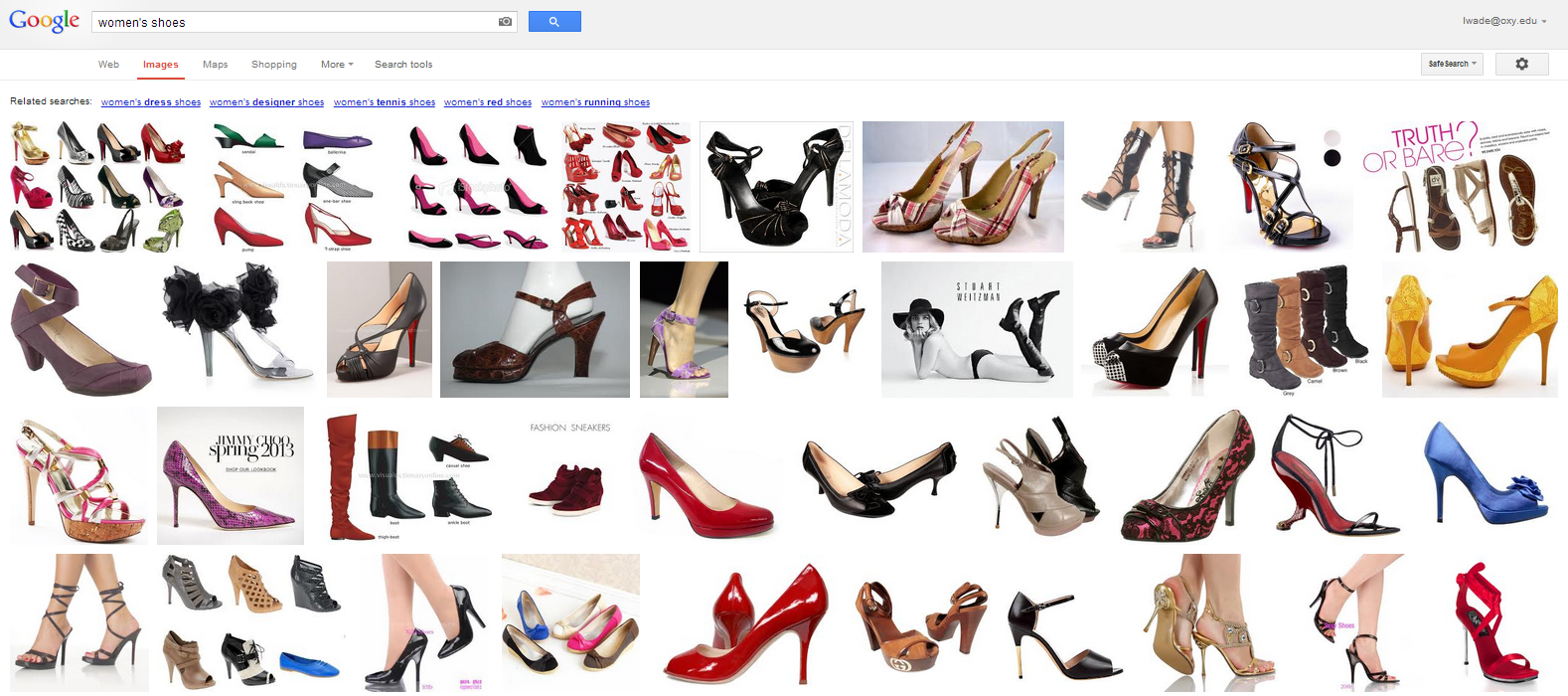
I don’t know about you, but whenever I go shopping for shoes, I’m always stunned by the incredible disproportion of high heels.  I’m just gonna guestimate here, but I’ll bet 85% of the shoes at the average store are high heels so impractical that most women only wear them on special occasions that involve a lot of sitting down.  These shoes, moreover, seem to be pushed to the front of the display.  Women’s shoe stores beckon shoppers by putting their most outrageous shoes out front.  You have to go digging for a practical pump. A quick Google image search for “women’s shoes” reveals the same bias in favor of the four-inch or higher, spindly heeled shoe:

How is it that a shoe that gets 1% of feet time takes up 85% of retail space?  I’m gonna take a shot at offering an answer.

In a previous post I reviewed the history of the high heel.  Originally a shoe for high-status men, it was adopted by the lower classes.  Elites responded by heightening the heel.  The higher the heel, the more impractical the shoe.  Eventually the working classes couldn’t keep up with the escalation because they had to, you know, work.  Sociologically, this is an example of what Pierre Bourdieu famously called “distinction.”  The rich work to preserve certain cultural arenas and products for themselves.  This allows them to signify their status; you know, keep them from getting confused with the masses.

I think something similar is going on today among women. Certain class advantages make it easier for upper middle class and wealthy women to don high heels.  High heels can really only be worn routinely by women who don’t work on their feet all day (I’ll grant there are dedicated exceptions).  Valet parking makes it a whole lot easier to wear shoes that hurt to walk in, so does not having to take the bus.* Having money, in itself, means that nothing stands between you and buying things that are impractical. So, high heels function to differentiate women who can afford to be impractical with their footwear — both monetarily and in practice — from women who can’t. This, I think, is why the highest, spikiest heels are are the front of the shoe store.  In a certain way, they signify status.  Wearing those shoes promises to differentiate you from other “lesser” women, women who can’t invest in their appearance and get lots of practice looking elegant on their tip toes.

Women of all classes desire such shoes because of the signals they send and they often buy them aspirationally, hoping to be the type of woman who wears them.  It’s primarily women at the top of the class hierarchy that will be able wear them routinely, though, feeding the supply of barely worn spike heels that populate every thrift store in America. So, that’s my theory.

But let’s complicate it just a bit more.  Since working class people do, ultimately, have access to high-heeled shoes, the upper classes have to go to extra lengths to effectively use high heels as a marker of distinction.  This can be accomplished by sub-dividing high heels into “classy” and “trashy”: I got the ones on the left by Googling “stripper shoes” and the ones on the right are courtesy of Louis Vuitton, $890 and $1,450 respectively. Now I know that you can get “classy” heels for much cheaper, but the point is to identify this as an arms race.  The rich have the power to control the discourse and can always access the high-status objects.  The poor can copy, but they are often playing catch up because the rich are always changing the rules.  So, as soon as the poor are doing it right, the rules change, otherwise the activity doesn’t function to distinguish the rich from the poor.  And so on.

* Men, if you’re reading, high heels really do hurt to walk in.  Yes, pretty much all the time.  Most women are used to it and mild pain may not even register consciously.  Sometimes the pain is quite significant, but women wear them anyway.  You’ve probably seen women in your life kicking off their high heels as soon as they walk in the door, or rubbing their feet and wincing; there’s a reason for that.

Lisa Wade, PhD is an Associate Professor at Tulane University. She is the author of American Hookup, a book about college sexual culture; a textbook about gender; and a forthcoming introductory text: Terrible Magnificent Sociology. You can follow her on Twitter and Instagram.

Screenshot_1In this charming minute-and-a-half, Walter Cronkite demos the home office of 2001, as envisioned in 1967.  Amazingly, reality seems to have far outpaced their imagination!

I love the first line, by the way: “This is where a man might spend most of his time in the home of the 21st century.”  Apparently professional futurists in 1967 couldn’t imagine women working!

Via Cyborgology.

Lisa Wade, PhD is an Associate Professor at Tulane University. She is the author of American Hookup, a book about college sexual culture; a textbook about gender; and a forthcoming introductory text: Terrible Magnificent Sociology. You can follow her on Twitter and Instagram.

Screenshot_15Naama Nagar tweeted us an interesting video commentary about hipsters.  In it, Mike Rugnetta uses Pierre Bourdieu’s idea of cultural capital to describe the difference between nerds and hipsters.

This is a topic I’ve enjoyed thinking about myself (on CNN and here at SocImages).  I think Rugnetta makes an interesting argument that resonates with the observations of sociologists: being a hipster is about borrowing other people’s authentic cultural signifiers as their main or only consistent cultural practice.  Check it out:

Lisa Wade, PhD is an Associate Professor at Tulane University. She is the author of American Hookup, a book about college sexual culture; a textbook about gender; and a forthcoming introductory text: Terrible Magnificent Sociology. You can follow her on Twitter and Instagram.

This week Neil DeGrasse Tyson tweeted the following, along with a photograph of suspiciously gendered AP exam study guide covers:

1

I’m going to take this to mean that Tyson is as big a fan of sociology as I am of astrophysics.  Made my day.

Thanks to Jay Livingston for the tip!

Lisa Wade, PhD is an Associate Professor at Tulane University. She is the author of American Hookup, a book about college sexual culture; a textbook about gender; and a forthcoming introductory text: Terrible Magnificent Sociology. You can follow her on Twitter and Instagram.

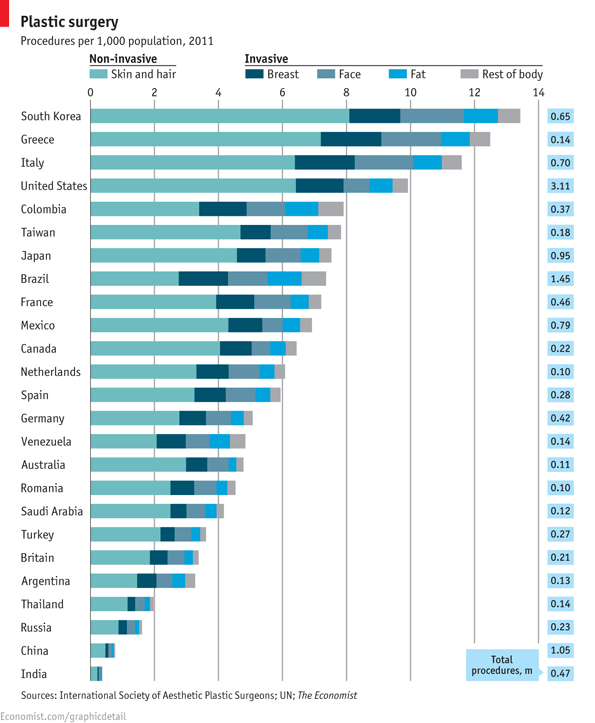
The  International Society of Aesthetic Plastic Surgeons has released new data on the incidence of invasive and non-invasive cosmetic procedures.  The U.S. leads in sheer numbers of procedures but, accounting for population, we fall into 4th place.  South Korea leads for the number of procedures per person, followed by Greece and Italy.

1

By far the most common kinds of surgical cosmetic procedures are lipoplasty and breast augmentation.  Along with fat, breasts seem to be a particular concern: breast lifts and breast reductions for both men and women are also in the top ten.  Abdominoplasty, nose jobs, eyelid surgeries, and facelifts are as well.

2

The incidence of these surgeries is strongly related to everything from the gender binary to global power dynamics.  In 2008 we reported that male breast reductions were the most common cosmetic surgery for 13-19 year olds (boys and girls combined). You would be shocked at what counts as excess breast tissue and how little the before and after photos look.  Boys and men getting breast reductions, alongside women getting augmentations, is obviously about our desire for men and women to be different, not naturally-occurring difference.  See The Story of My Man-Boobs for more.

Likewise, we’ve posted about surgeries that create an epithelial fold, a fold of skin in the eyelid more common in people with White than Asian ethnic backgrounds.  This surgery is a trend among Asians and Asian-Americans, as colonization has left us with an association between Whiteness, attractiveness, and power.

The Economist summarizes some other trends:

Breast augmentation, the second biggest surgical procedure, is most commonly performed in America and Brazil. Buttock implants are also a Brazilian specialty, as is vaginal rejuvenation. Asia is keen on nose jobs: China, Japan and South Korea are among the top five nations for rhinoplasty.

More on where and how many procedures are being performed, but nothing on why, at the ISAPS report.

Image at The Economist; via Global Sociology.

Lisa Wade, PhD is an Associate Professor at Tulane University. She is the author of American Hookup, a book about college sexual culture; a textbook about gender; and a forthcoming introductory text: Terrible Magnificent Sociology. You can follow her on Twitter and Instagram.

How many Americans think about the war in Afghanistan regularly? The daily realities of war are inescapable for military members and their families, but the rest are largely able to stay disconnected from it. The issues of foreign policy and war dropped off the radar entirely for most Americans before the 2012 election.

About 68,000 U.S. troops are still deployed in Afghanistan, down from the peak of 101,000 (not to mention the those who were in Iraq). Without a draft, WWII-style war bond campaigns, or highly visible war industry, most Americans need to be reminded that we’re at war.  Unlike veterans and military families, civilians not directly connected to the military have a kind of privilege to forget the conflict in their daily lives. The result is a growing chasm between U.S. civilians and the Armed Forces.

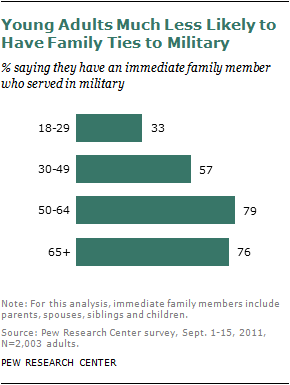
In 2011, the Pew Research Center surveyed Americans about their connections to the military and found a considerable gap: “Never has the U.S. public been so separate, so removed, so isolated from the people it pays to protect it.” The vast majority of those over 50 had an immediate family member who had served (mostly due to WWII and Vietnam). Of those 30-49 years old, 57%  had someone in their immediate family serve. Those between 18-29 are the most disconnected from war; only 33% have a close family member with military experience:

2011-family-connections-01

picture2

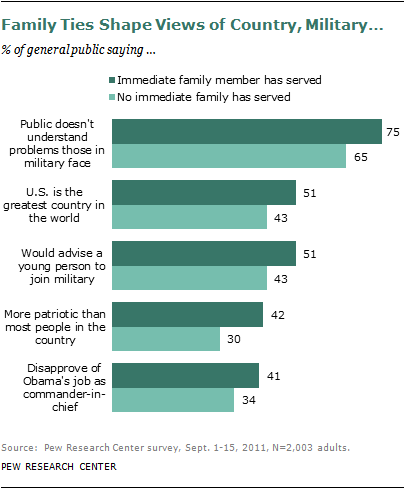
This leads to differences in views about the military. Those from military families are more likely to believe that civilians do not understand what they go through, that the U.S. “is the greatest country in the world,” and that they are “more patriotic than most people in the country.” They’re also more likely to recommend the armed forces to a young person — though only about half would do so:

picture3

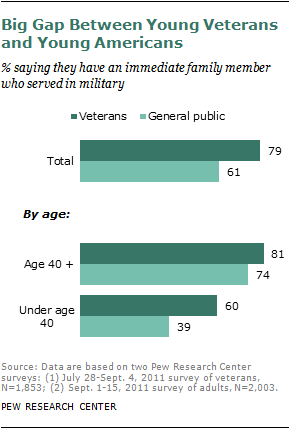
My own research on the experiences of military families during deployment supports the Pew findings. And patterns in who joins the armed forces may lead to an increased gap. Those with veterans in their family are more likely to join the military; 79% of young veterans, compared to 61% of the public, have family members who served. As fewer Americans have relatives who were in the military, making them less likely to join themselves, insulation from the military grows.

This bumper sticker reflects this gap between military families and everyone else. It draws a distinction between “my” service member and “your” freedom, while seeming to assume a lack of support from non-military Americans:

bumper sticker

Military families believe that others don’t understand what they go through during deployment. As one mother told me, “We understand why we try to be strong but automatically cry when we see the foot powder display at Wal-Mart.” Or as an Iraq war veteran explained to Time,

The gap between the military and everybody else is getting worse because people don’t know–and don’t want to know–what you’ve been through…There are no bond drives. There are no tax hikes. There are no food drives or rubber drives … It’s hard not to think of my war as a bizarre camping trip that no one else went on.

Veterans return to a country where very few understand what they have been through, which makes reentry into civilian life more difficult — just one of the consequences of having a small segment of the country assume the burdens of war.

——————–

Wendy Christensen is an Assistant Professor at William Paterson University whose specialty includes the intersection of gender, war, and the media.

Screenshot_5One of the few genuinely large observed differences between men and women involves throwing ability.  Men, on average, are much stronger throwers than women.  Hence the phrase “throws like a girl.”

That we observe a difference, however, tells us nothing about where that difference comes from.  Figuring that out is much more difficult than simply measuring difference and sameness.  We know that the difference emerges at puberty, suggesting that sheer size might have something to do with it.  But the fact that boys and men, on average, get much more practice throwing than women might also play a role.  How to test this?

Well, here’s one way: compare men and women throwing with their non-dominant hand.  Muscle memory doesn’t transfer from one side of the body to the other.  Accordingly, since most people have a lot of practice throwing only with one hand, comparing the throws of men and women using their non-dominant hand might tell us something interesting.

I don’t know that that study has been done, but an enterprising videographer has captured video of a set of men throwing with the “wrong” hand. What I like most about the video is the men’s facial expressions.  You can see them laughing at themselves, suddenly reduced to a beginner thrower.  Though we still don’t know how much of it is biological and how much social — though, this is the wrong question anyway — it reveals that, no matter what the answer, men’s throwing ability is strongly related to practice:

A big thanks to Reynaldo C. for sending in the video!

Cross-posted at BlogHer.

Lisa Wade, PhD is an Associate Professor at Tulane University. She is the author of American Hookup, a book about college sexual culture; a textbook about gender; and a forthcoming introductory text: Terrible Magnificent Sociology. You can follow her on Twitter and Instagram.