In a previous post, Gwen explained that sugar consumption rose in Britain during the late 1800s because more nutritious foods were scarce and saved for men. Women and girls, then, consumed sugar because it offered energy, even if less nutrition. This led to an association of sugar with women that remains to this day (think of who supposedly LOVES chocolate, binges on ice cream after a break up, etc.).
While having tea with my friend Marie in Ireland, I spotted her bag of sugar and snapped a photo for the blog:
Notice that not only do we see a giant, lipsticked kiss on the bag, but their slogan, “spread a little sweetness” (plus heart and arrow!), is a statement with a double meaning invoking both sugar and a quality associated with/required of women.
NEW! Sarah D. snapped this photo of a sugar packet, also in Ireland:
Jean Piaget, a psychologist who published his most influential works from the late 1920s through the 1950s, is most known for his theory of stages of cognitive development. He suggested a four-stage model that children go through as they develop more complex reasoning skills.
Children start out in the sensorimotor stage, which lasts until they’re roughly 2. They have no sense of themselves as individuals, obviously, and wouldn’t recognize their hand as “theirs.” They aren’t afraid of heights or touching something hot because they can’t grasp the idea of falling or something being hot–those ideas are too abstract.
Here’s a video that illustrates some of the limits of reasoning at this age:
In the preoperational stage (Piaget said it lasted from around age 2 until about 7), kids start being able to grasp symbols. For instance, they can draw a series of squares with a triangle on top to represent a house. They also start to learn the alphabet, which is, of course, the set of symbols we use to read and write.
On the other hand, they don’t understand abstract concepts like amounts, speed, or weight. In one of Piaget’s most famous experiments, he showed that children at this stage can’t comprehend that if you pour liquid from a short, wide glass into a tall, narrow glass, it’s still the same amount:
By the concrete operational stage (roughly 7-12 years old) kids comprehend ideas like weight, amount, and speed, and can understand that the amount of liquid in the two glasses is the same:
They can also understand causal relationships, though not necessarily explain the reasoning behind them. Here, the younger kid says what would happen if you hit a glass with a feather based on what he knows about feathers, whereas the older child reasons from the previous statement and answers according to the logic proposed (despite it being obviously inaccurate):
Finally, Piaget said that in the formal operational stage (after about age 12) kids can understand abstract concepts and reason logically. If you ask them what “justice” means, they can explain it. The girl in the last video, who reasoned from the previous statement (which had been presented as true), illustrates formal operational thinking.
Of course, there are questions about Piaget’s model (described in Kimmel and Aronson, 2009, Sociology Now). Do we really only go through each stage once? Might we have to go through some of them again when we hit new life challenges or milestones? Do we have to completely master one stage before we can progress, or is it possible to have some overlap? Are these stages universal? Would we expect childhood mental development to occur in the same way in a society where people are middle-aged by 20 as they would in one where they aren’t middle aged until 35 or 40? Might the fact that kids in some societies are given more “adult” tasks at a young age affect their mental development?
Of course, another issue comes up about the formal operational stage…Kohlberg and Gilligan (1971, “The Adolescent as Philosopher,” Daedalus, p. 1051-1086) estimated that about 30% of people in the U.S. never actually develop advanced abstract reasoning skills. I will make no further comment on that.
Gwen Sharp is an associate professor of sociology at Nevada State College. You can follow her on Twitter at @gwensharpnv.

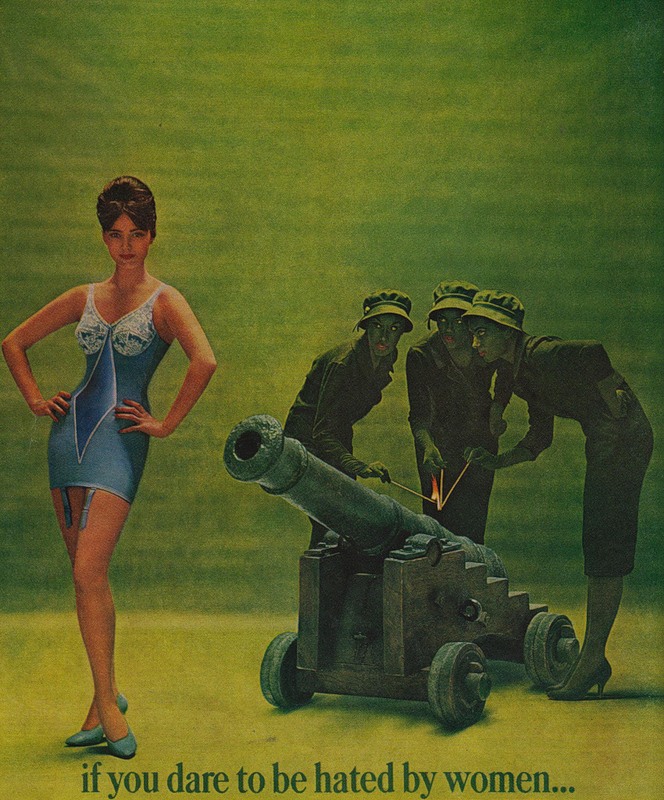
From Vintage Ads, another great example of the propagation of the stereotype that women are jealous of and hateful towards one another:
The ad reminded me of the Pantene commercials from the 1980s with the slogan “Don’t hate me because I’m beautiful…” The real message not being “Don’t hate me because I’m beautiful…” but, “Don’t hate me because you could be beautiful too, and if you can’t, well then I suppose you’re going to have to hate me”:
When high schools and sports teams recruit a type of person as a mascot, it objectifies and caricatures them. It also encourages opposing teams to say things like “Kill the Orientals.” This can only be okay when we aren’t really thinking about these kinds of people as real humans beings.
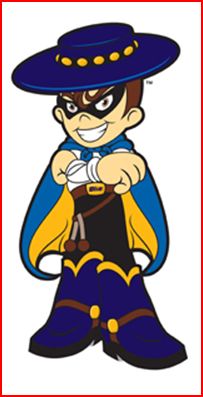
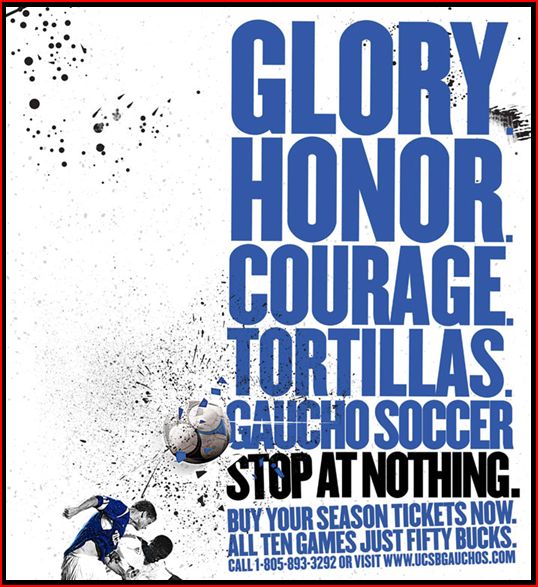
This reminded me: As an undergraduate, I went to the University of California, Santa Barbara. Our mascot was the Gaucho, which I remember being described as a Mexican cowboy (though South American cowboy may be more descriptive). I went by the UCSB website and found these two logos. There is a story about the first identifying it as a brand new logo; the second is for kids:
I am troubled by the Gaucho mascot for the same reasons that I don’t like the Orientals mascot, but at least authentic gauchos are not likely to enroll at UCSB the way that “Orientals” are likely students of the East High Schools.
It does indeed read: “GLORY. HONOR. COURAGE. TORTILLAS.” This seems to invalidate any argument that the use of the Gaucho mascot is “respectful.”
Thinking about the Orientals and the Gauchos, alongside the many American Indian mascots still found in the U.S., Notre Dame’s Fighting Irish, and the soccer team in the Netherlands who call themselves the Jews, may give us some perspective on this mascot phenomenon that thinking about one at a time doesn’t. If we feel that one of these mascots is less discriminatory than another, what drives that feeling? And is it logical? Or does it stem from a trained sensibility that isn’t applied to all marginalized groups across the board? Or is it in response to different characteristics of these different groups? Or different contexts?
Maybe all five mascots are equally offensive and offensive for the same reasons. But thinking about them together may also be useful for teasing out how, exactly, they are offensive. What do you think?
A clothing-optional resort, Paradise Lakes in Land O’Lakes, is sponsoring a “g-string pageant.” It is advertising its event with the following ad:
In response, the American Association for Nude Recreation (AANR) has suspended the resort’s membership. They claim that the contest “sexualized the nudist experience.” Instead, the AANR promotes “social, family nude recreation” (story here, via).
What a fantastic example of the different ways in which we can interpret nudity.
Once again Larry at The Daily Mirror dug up something interesting from the L.A. Times archives. It’s a 1969 article about–gasp!–a female ranch hand. What’s fascinating is the way that, while discussing how she does things that aren’t traditionally considered female, the reporter describes her in ways that emphasize her femininity so we know she’s not completely un-womanly.
She’s as cute as all get-out and as strong as a heifer. She’s the only female ranch-hand (“don’t call me a cowgirl, it’s a dude term”)…
…”I was never quite like all the other little girls.” Beverly always wanted to be a cowboy–always wore bluejeans to school…
But she also succeeded in remaining ultrafeminine in an impish sort of way…She bemoans the fact that she has to keep her hair trimmed to a maximum of two inchles all over her head…
And:
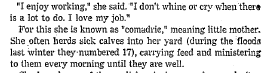
Text:
“I enjoy working,” she said. “I don’t whine or cry when there is a lot to do. I love my job.” For this she is known as “comadrie,” meaning little mother…”
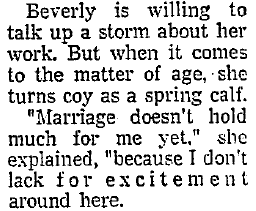
She’s also described as “coy”:
But to the likely relief of many readers, she goes on to say that probably she eventually will get married. Reading the entire article, I can’t help but suspect that’s more out of a sense that you have to than a real desire on her part. She kind of reminds me of my grandma, who I think got married and had kids mostly because what else could a woman do? I suspect if she’d been able to get a job as a ranch hand, she would have happily done that instead.
And while they don’t call her a “cowgirl,” this title from the second page of the article might not be what she was hoping for instead:
Now, if this was just an historical curiosity, I wouldn’t have posted it. But the thing is, we still see this type of emphasis on the femininity of women who succeed at things we consider “men’s work.” For instance, see this post on WNBA player Candace Parker, or Lisa’s post about Caster Semenya. Or even just compare the uniforms of male and female athletes. We’re more comfortable with women who break some gender rules as long as they maintain their femininity by following other rules.
Gwen Sharp is an associate professor of sociology at Nevada State College. You can follow her on Twitter at @gwensharpnv.

Amber W. let us know about the “Consuming Kids” video, which looks at how marketers target kids, both for their own spending power and for their influence over parents’ spending.
Gwen Sharp is an associate professor of sociology at Nevada State College. You can follow her on Twitter at @gwensharpnv.
About Sociological Images
Sociological Images encourages people to exercise and develop their sociological imaginations with discussions of compelling visuals that span the breadth of sociological inquiry. Read more…