Archive: Jan 2015

In statistics, a little star next to a coefficient generally means that the result is statistically significant at the p<.05 level. In English, this means that there is only a 1 in 20 chance that the finding just popped up by pure random chance. In sociology, that’s generally considered good enough to conclude that the finding is “real.”

If one investigates a lot of relationships, however, this way of deciding which ones to claim as real has an obvious pitfall.  If you look at 20 possible but false relationships, chances are that one of them will be statistically significant by chance alone. Do enough fishing in a dead lake, in other words, and you’ll inevitably pull up some garbage.

Thanks xkcd, for making this funny.

Lisa Wade, PhD is an Associate Professor at Tulane University. She is the author of American Hookup, a book about college sexual culture; a textbook about gender; and a forthcoming introductory text: Terrible Magnificent Sociology. You can follow her on Twitter and Instagram.
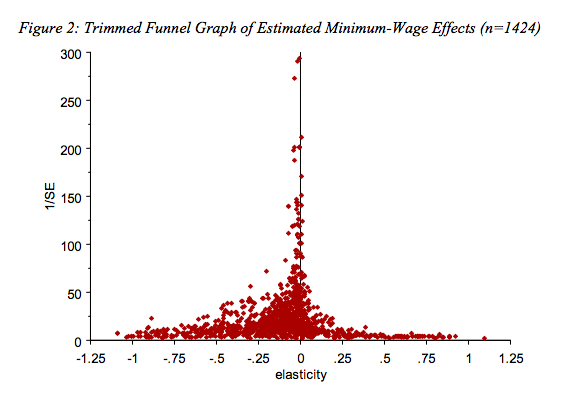
One of the arguments against an increase in the minimum wage is that it will lead to higher unemployment.  One can make theoretical arguments for and against this proposition.  And, of course, the income gains from an increase in the minimum wage are likely to produce overall benefits for both low wage workers and the economy as a whole even if there is a rise in unemployment.

Economists have tried to estimate the employment effects of a rise in the minimum wage.  As a Vox article describes, two of them, Hristos Doucouliagos and T.D Stanley, looked at almost 1,500 estimates of the effects of minimum wage increases on employment and found that the estimates “clustered right around zero effect, but with more of those estimates showing a slight downward pressure on employment.”

3

They concluded, “with sixty-four studies containing approximately fifteen hundred estimates, we have reason to believe that if there is some adverse employment effect from minimum wage rises, it must be of a small and policy-irrelevant magnitude.”

Originally posted at Reports from the Economic Front.

Martin Hart-Landsberg is a professor of economics at Lewis and Clark College. You can follow him at Reports from the Economic Front.

Flashback Friday.

When it comes to forming an opinion on poverty, some Americans just can’t seem to understand why poor people can’t just stop being poor. One of the things that gets harped on is the idea that poor people spend money on frivolous things; somehow some people believe that, if the poor just gave up their cell phone and Nikes, they would pop up into the middle class.

What these people don’t realize is the extent to which being poor is living a life of self-denial.  To be poor is to be forced to deny oneself constantly. The poor must deny themselves most trappings of:

  • an adult life (their own apartment, framed pictures on the walls, matching dishes);
  • a comfortable life (a newish mattress, a comfy couch, good shoes that aren’t worn out);
  • a convenient life (your own car, eating out);
  • a self-directed life (a job you care for, leisure time, hobbies, money for babysitters);
  • a life full of small pleasures (lattes, dessert, fresh cut flowers, hot baths, wine);
  • a healthy life (fresh fruits and vegetables, health care, time for exercise);
  • and so, so many more things that don’t fit into those categories (technological gadgets, organic food, travel, expensive clothes and accessories).

They have to actively deny themselves these things every day. And, since most poor people remain poor their whole lives, they must be prepared to deny themselves (and members of their families) these things, perhaps, for the rest of their lives.

So when someone sees someone (they think is) poor walking down the street with a brand new pair of Nikes, perhaps what they are seeing is someone who decided (whether out of a moment of weakness or not) to NOT deny themselves at least one thing; perhaps they are seeing someone who is trying to hold on to some feeling of normalcy; perhaps what they are seeing is a perfectly normal person who just wants what they want for once.

I was thinking about this today when I saw a postcard at Post Secret (which, to be fair, may or may not have been submitted by someone who struggles financially).  The postcard, featuring a PowerBall receipt, reads “It’s the only time I feel hopeful”:

picture12

For many poor people, hope and the absence of fear and worry are also luxuries they live without.

Originally posted in 2009.

Lisa Wade, PhD is an Associate Professor at Tulane University. She is the author of American Hookup, a book about college sexual culture; a textbook about gender; and a forthcoming introductory text: Terrible Magnificent Sociology. You can follow her on Twitter and Instagram.

Thank you all for a truly fantastic year!

We rounded it out with more than six and a half million page views.  We almost doubled our Facebook followers — from 35,000 last December to more than 68,000 today. We are honored to enjoy over 21,000 Twitter followers, 13,000 on Pinterest and 20,000 on our one-year-old Tumblr page.  Much gratitude to everyone for your enthusiasm and support!

Highlights:

Two of us published textbooks!

2What else!

I’ve also signed contracts to write two more books, one on hookup culture and a Introduction to Sociology text. I’m excited to keep writing!

Best of 2014!

1 (3)

Over the last week I’ve highlighted my favorite and your most loved posts from 2014.  Here’s are the lists in case you missed it last week!

Reader’s Choice (plus # of likes/shares before we re-posted)

Most loved humor!

Editor’s picks

Happy New Year everyone!  Here’s to wonderful things in 2015!

Lisa Wade, PhD is an Associate Professor at Tulane University. She is the author of American Hookup, a book about college sexual culture; a textbook about gender; and a forthcoming introductory text: Terrible Magnificent Sociology. You can follow her on Twitter and Instagram.