Archive: 2010

A few days ago, a mini-controversy erupted when this vidcap from the sports network RDS started making the rounds. Here’s the Deadspin article. Two Montréal Canadiens fans {nicknamed Habitants or Habs} donned the jersey of a hot prospect, P. K. Subban, who happens to be Jamaican Canadian. They also painted their faces black and wore afro wigs.

Toronto Mike blogged about the incident and one of the Habs fans came on to comment. The words got pretty heated, but in the end, the fan apologized and Habs and Leafs fans once again could resume their hockey-based hatred of one another.

What struck me as interesting was how this drama played out. The French language cable network covering the 11 March game against the Edmonton Oilers chose to air 10 seconds of the two friends. Was the intent to be controversial? Was the intent to be a facepalm moment?  The back-and-forth on Toronto Mike’s blog was interesting, as the polarizing effect of race brought up assumptions about the Habs fan and his intent by commenters. In the end, I thought the Habs fan handled himself well, given how people were responding and what was being said. Toronto Mike did a good job of not divulging the fan’s name. This was one of those rare moments where Web 2.0 seemed to actually foster a dialogue and didn’t degenerate into a protracted flame war. That said, it wasn’t always pretty, but a lot prettier than what one typically sees on news article comments on issues of race, which are often tantamount to text equivalent strangers yelling at each other at the top of their lungs in an open hall.

Here on ThickCulture, we have examined race in the post-racial era. Racism isn’t dead, it’s just gotten to a late stage where there is a consciousness about what is offensive and debates of this now enter into the public discourse space. I get a sense that race gets so intertwined with speech and knowledge structures that it often becomes a confusing and convoluted morass for many. This impinging upon liberties of speech, in terms of what one can and cannot say or should and should not say, creates a tension, which may result in a backlash.

Where are the lines in the post-racial era? Here in Toronto, last fall there was a party where a group of guys dressed up as the Jamaican bobsled team, depicted in the film, Cool Runnings {1993}. This story caused a stir and points were argued through social media comments on whether or not this was racist.

Four guys darkened their skin and one guy lightened his. The Torontoist chronicles how the story unfolded and offers a tutorial on what blackface is and its cultural significance. The students offered their explanation for their choice of costume:

First and foremost we would like to apologize if anyone was offended…Throughout our childhood, Cool Runnings was something we reflected on with fond memories and therefore in the process [of] choosing Halloween costumes, seemed to be a promising candidate. With this idea in mind, we took notice of how the primary cast, consisting of four black characters and one white character, coincided with our group ratio of four white and one black member. This sparked the idea to add another comedic element to the costume, and have the black student go as John Candy and the white students going as the four bobsledders. At this point, several of us was already of aware of what blackfacing was and therefore took out various means of investigation to further our knowledge of the topic and ensure that what we were doing be doing may not be considered similar in anyway. The conclusion that we came to that simply painting our faces dark brown would not be a portrayal of blackface….understand that we did not act in a negative or stereotypical manner [at the party]. We acted ourselves the whole night, and did not internalize the characters.

Here’s the theatrical trailer for Cool Runnings:

University of Toronto Sociology professor Rinaldo Walcott offered a different take:

I think that in particular [Cool Runnings] became a part of the popular culture imagination of [white] Canadians in a way that [they] took responsibility for that film as though it was somehow an extension of them. And one of the reasons that I think Canadians identified with that film so deeply is because that film weathered something that many white Canadians come to believe strongly—that black people don’t actually belong here. That we are an insertion into a landscape that is not actually an landscape where we naturally fit.

For black people who understand this history [of blackface], Cool Runnings was never a funny film; it in fact replicated all of the techniques of blackface. It is in fact one of the ways that we have come to see that blackface does not require painting of blackface anymore. Just look at the work of Marlon Riggs. We know that in North America there is a deep resonance around producing images of black people that make black people look disgusting. Cool Runnings is a milder version of that. So we should ask… why do they remember Cool Runnings so fondly?

Post-racial means navigating these choppy waters where intent collides head-on with history and its interpretations. Not to get all postmodern here, but while the metanarrative is dead, social media is a site where clashing mini-narratives that structure perceptions of the world, culture, society, etc. battle it out. I think the fellow Contexts blog Sociological Images is a social media site where clashing mini-narratives are de rigueur. I’m wondering if we will ever “get over” issues of race. I’m beginning to think we won’t, given globalization, etc., but perhaps it’s due to the fact that what this is really all about is identity.

What troubles me more than this is when the “right” language is used by individuals doing so strategically. The talk is talked, but the walk isn’t walked. That’s a topic for another blog.

—————————

Kenneth M. Kambara interests and expertise include social media, innovation strategy, environmental sustainability, business and marketing, sociology, urbanism, critical theory and economic sociology.  His insights (and unexpected pop culture segues) can be found on the fellow Contexts blog, ThickCulture, and on his own blog at rhizomicon. Like every good social media guru, he also tweets.

If you would like to write a post for Sociological Images, please see our Guidelines for Guest Bloggers.

Lisa Wade, PhD is an Associate Professor at Tulane University. She is the author of American Hookup, a book about college sexual culture; a textbook about gender; and a forthcoming introductory text: Terrible Magnificent Sociology. You can follow her on Twitter and Instagram.
Elle, at Shakesville, writes:

…sometimes I am struck by how many times, in so many little ways, people of color are reminded that “white,” in terms of race, is presumed to be the default or that white people are presumed not to “have” race in the same ways that we are.

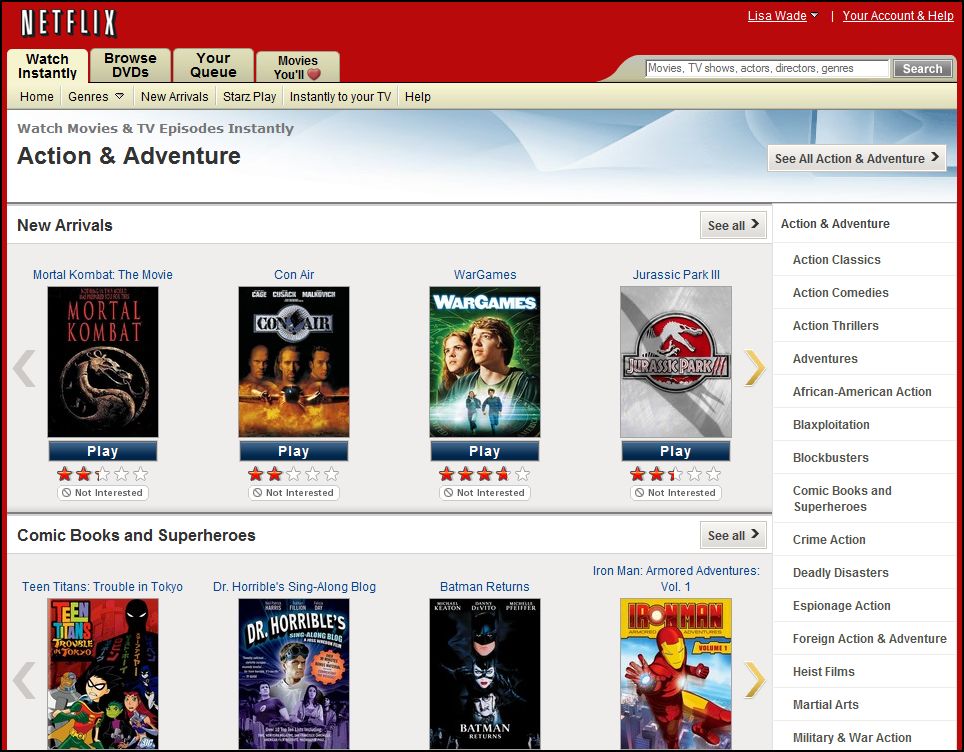
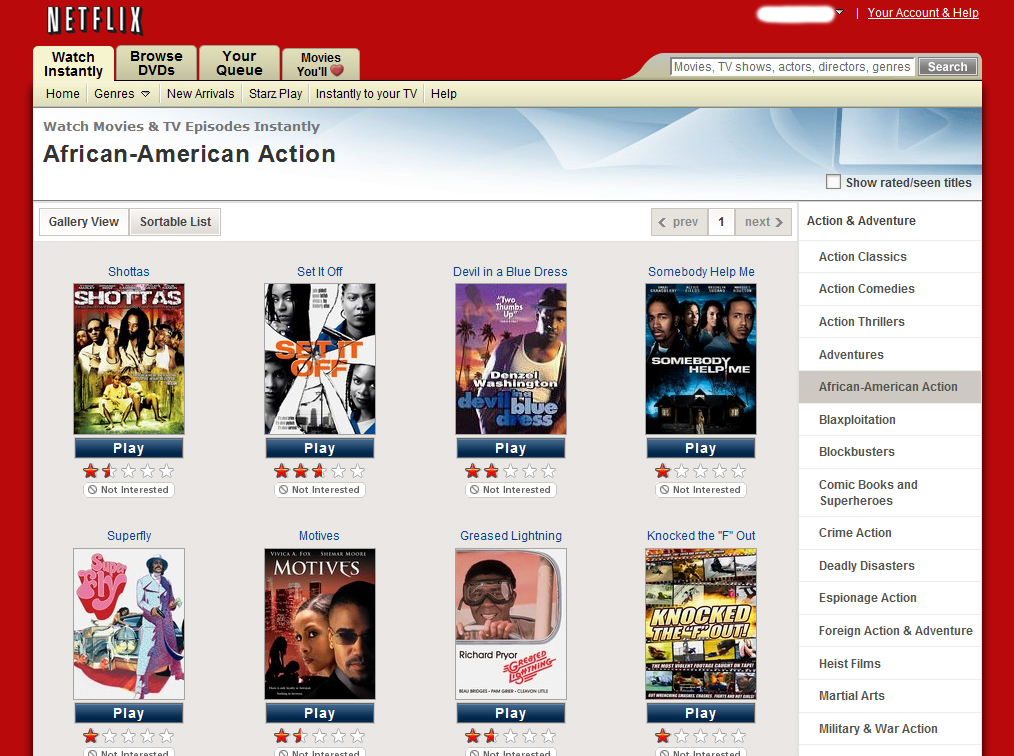
Skada sent us another great example of this phenomenon: Netflix genres include “Action and Adventure” and “African-American Action” (“and Adventure” would be too many As I guess).

For more examples of the neutrality of whiteness and the marked nature of blackness, see our two posts on recent descriptions of beige as “flesh-colored” (featuring Michelle Obama and Beyonce et al.) and our posts on bandaids and other “flesh-colored” items and lotion for “normal to darker skin.”

Lisa Wade, PhD is an Associate Professor at Tulane University. She is the author of American Hookup, a book about college sexual culture; a textbook about gender; and a forthcoming introductory text: Terrible Magnificent Sociology. You can follow her on Twitter and Instagram.
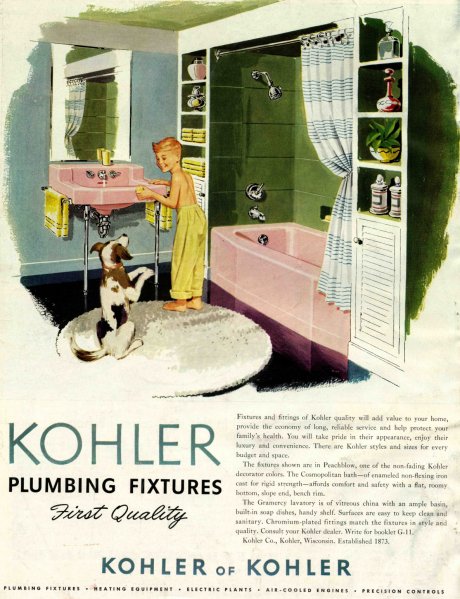
Though it’s certainly here now, pink didn’t stabilize as a girls-only color until sometime in the 1950s.  During that decade, pink was the in-style color for bathrooms in residential homes.  Notice that this ad, sent in by Penny R., features a boy in a pink bathroom with no threat of emasculation:

Pam Kueber, at Retro Renovation, estimates that:

…some 5 million pink bathrooms went into the 20 million+ homes built in the United States from 1946-1966… 1 in 4 — at minimum — mid-century homes had a pink bathroom.

She quotes a 1958 Electrical Merchandising that said: “If forced to pick one color as leading this year, most industry men say pink is tops.”

Pink is so strongly associated with women now that it hardly seems appropriate for a family bathroom.  Kueber bemoans that home owners are taking sledge hammers to pink tiles and encourages us to preserve the bathrooms because we all look excellent in pink-tinted light.

See men in pink (then, now, and now).

Lisa Wade, PhD is an Associate Professor at Tulane University. She is the author of American Hookup, a book about college sexual culture; a textbook about gender; and a forthcoming introductory text: Terrible Magnificent Sociology. You can follow her on Twitter and Instagram.
Crossposted at Racialicious.

—————————

After presenting lots of statistics about racial disparities in criminal justice, I showed my class the videos from ABC News What Would You Do? in which first White and than Black youths vandalize a car in a public parking lot. [See the videos at ABC: Part I and Part II.]

There is only one 911 call on the White boys, but ten on the Black boys. Plus, while the White boys are vandalizing, someone calls 911 to report people who are suspected of planning a robbery — Black kids asleep in a nearby car! Well, most of the class, as expected, saw this the way I did, as evidence of a racial problem. I was trying to emphasize that not arresting Whites when they commit crimes is just as important in racial disparities as arresting Blacks. Some students pointed out (correctly) that it was a demonstration, not a controlled experiment and wondered (fairly) whether the producers selected cases for their strong differences. But a few very vocally insisted that the difference was not about race at all, but that the Black kids were wearing “gang clothing.” They got somewhat offended when I said, “yeah, Black styles” and then cut off that line of argument, saying “OK we disagree on that, but I don’t want to spend the rest of the class arguing about clothing.”

Today I went back to the video and took screen shots of the kids. They are all wearing hooded sweatshirts and jeans, as I said. (One student had insisted that the White kids wore tucked in shirts! Not so.)

There are subtle differences in how they wear the clothes, though. The Black kids’ clothes are bigger on them (and the kids themselves appear to me to be smaller). The White kids’ shirts have words on them which I assume are school names (the resolution isn’t good enough for me to read them) while one Black kid has some sort of design on it that you could construe as edgy — it is definitely not preppy. One Black kid is wearing a cap which (as can be seen elsewhere in the video) is a gold weave thing that I cannot imagine a White kid wearing, but he’s wearing it in the same way as lots of White kids wear baseball caps. In my view the only difference between the clothing was subtle differences in style sensibilities between Blacks and Whites, and that calling the Black kids’ clothing “gang attire” is ridiculous. These few students think that if the Black kids had been in “non-gang” (i.e. “White”) clothing, the result would have been different. (They did not even suggest dressing the White kids in “gang” styles.) I think they are just exhibiting extreme resistance to the obvious. (The same students criticized me for failing to show examples of Black crime.) Opinions?

Edit: I decided to add shots of the kid with the most distinctively Black hat. In these shots you can see that he’s also wearing a do-rag. Just to be fair. I can find no evidence that this is “gang attire.” But it is certainly distinctively Black.

Do you think it’s the do-rag and not the skin color that matters here?

—————————

This Anonymous Guest Post is borrowed from Sociological Confessions. The blogger is a Sociology professor who teaches courses on race relations and does public sociology work on racial disparities in criminal justice. In this post, she poses a question based on an interaction with students who questioned her interpretation of an incident as racial.


Dmitriy T.M. sent in this video about the production and marketing of bottled water. It’s a little over-the-top at the beginning, but it brings up a lot of really interesting issues surrounding the selling of a product that is, in the U.S., available to the vast majority of people at a much cheaper price in their kitchen. And yes, I know, some people’s water tastes terrible, etc. etc. The point, in general, still stands that we are spending a lot of money and resources carting water around, and I find the advertising for bottled water fascinating.

Also see The Story of Stuff.


Mary, writer of the fabulous blog Cooking with the Junior League, sent in an episode of the PBS series Faces of America. The episode, titled “Becoming American,” looks at the immigrant origins of various celebrities (Meryl Streep, Stephen Colbert) in the period of massive immigration to the U.S. from about 1820 until 1924.

The segment Mary found interesting is about the grandfather of Queen Noor. An immigrant from Syria, he became a naturalized citizen, which Mary says “was unusual because at the time, only ‘white’ and ‘black’ people could be naturalized…but during this time, Syrians started taking their cases to court to prove that they were white, and could, as a result, become naturalized citizens.” It’s a great example of the social construction of race and the way groups have actively resisted the ways they were categorized.

The segment on Queen Noor’s grandfather starts at 36:23.

Also see our post on suing for whiteness.

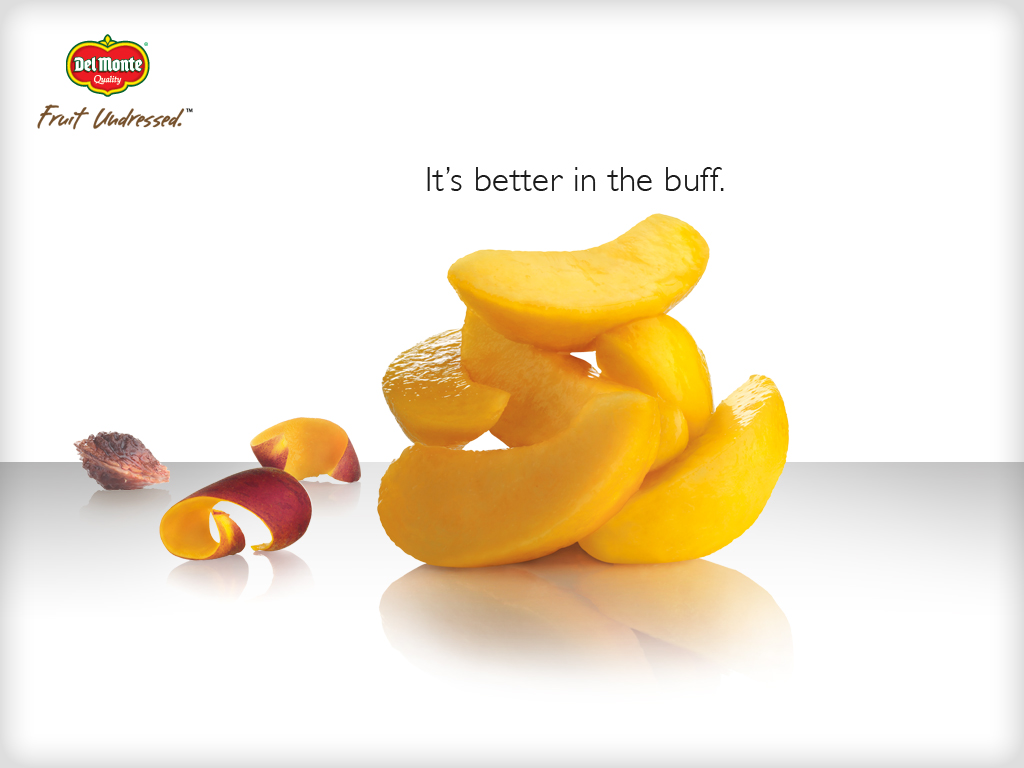
In the theme of selling everything with sex, I present Del Monte’s “fruit undressed” campaign.  First I saw this along the side of a webpage I was perusing (for you, readers, for you):

Damn it; I clicked.  The product is, like, a reinvented fruit cocktail:

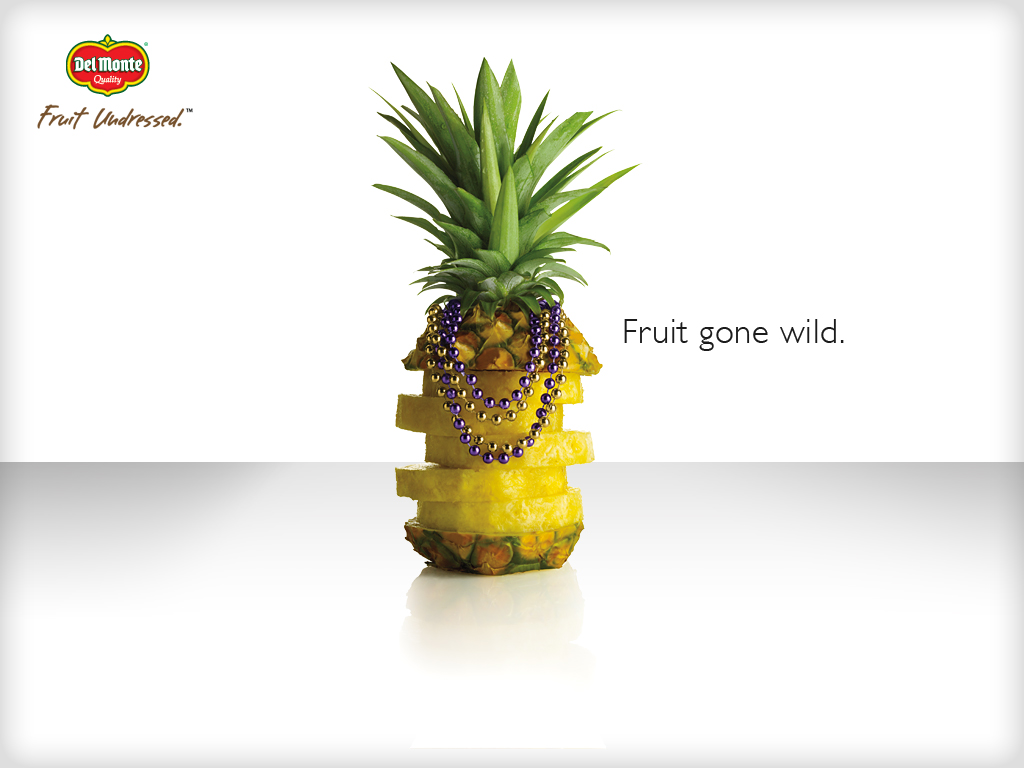
It’s being marketed with these ads suggestively suggesting that the fruit is nude:

Notice that that last one is referencing Mardi Gras.  Flash those pineapples, baby!

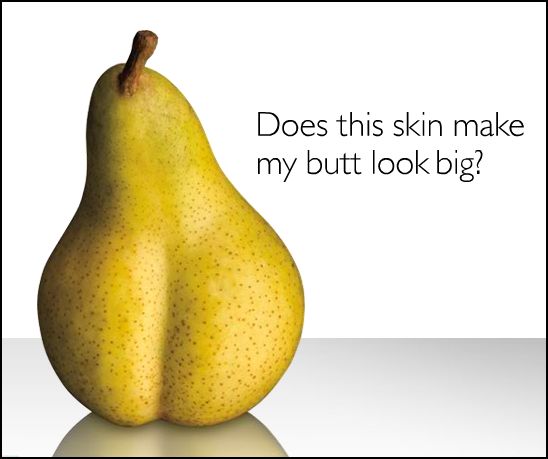
But don’t get too cocky, the ad campaign reminds us, you still look fat in clothes and should be horribly insecure about it:

Yeah, so sexual objectification and hatred of women’s bodies all in one!  Just to sell fruit cocktail!

Lisa Wade, PhD is an Associate Professor at Tulane University. She is the author of American Hookup, a book about college sexual culture; a textbook about gender; and a forthcoming introductory text: Terrible Magnificent Sociology. You can follow her on Twitter and Instagram.

Charlotte alerted us to a make-up brand called Primitive that makes and sells natural lips sticks, glosses, and pencils.

The company is drawing on familiar associations of primitiveness with naturalness.  We were natural “for centuries,” but have now somehow graduated from naturalness, such that we need to make a special effort to recapture the simple, intelligent, real, and honest beauty of our foremothers.

So, Primitive romanticizes our primitive past while making a questionable assertion about the relationship between time and naturalness.  In addition, the names of their products locate primitiveness in some parts of the (modern) globe and not others.

The products are named after places that are, almost exclusively, in Africa, Latin America, Asia, and the South Pacific.  In a previous post I introduced the idea of “anachronistic space.”  I wrote: “Catherine MacKinnon coined the term ‘anachronistic space’ to refer to the idea that different parts of the globe represent different historical periods.”  In this case, Primitive is counting on our associating a (romanticized) primitiveness with only some places and not others.  It’s 2010 in Mali and Morocco.  They don’t represent our own past, they represent unique modernities.  And the places left out of these product names — largely North America and Europe — don’t represent the future.  They are not wholly modern societies that have shed their primitive past; they, just like all societies, are a mixture of old and new stitched together to form the present.

For more instances in which anachronistic space appears, see our posts on representing the fashion of the Surma and Mursi tribes and Wild African Cream.

And for more on the social construction of the modern and the primitive, see these posts: “Africans” as props for white femininity, Union Carbide brings modernity to the world, primitive Australia cures modern ills, women as carries of tradition and progress, representing the Middle East, equating modernity with permissiveness, and civilizing the Pueblos.

Lisa Wade, PhD is an Associate Professor at Tulane University. She is the author of American Hookup, a book about college sexual culture; a textbook about gender; and a forthcoming introductory text: Terrible Magnificent Sociology. You can follow her on Twitter and Instagram.