Archive: 2010

Crossposted at Jezebel.

All my life my Grandfather has used the phrase “cotton pickin'” as a slur, as in “wait a cotton pickin’ minute!” and, if he was mad at you (or the dog), “You cotton pickin’…!”

It is debated as to whether the phrase refers to the act of cotton picking, which is tedious and painful work (because the edges of cotton bolls are prickly and sharp), or the people who picked cotton (highly disadvantaged groups, especially black slaves in the American south).

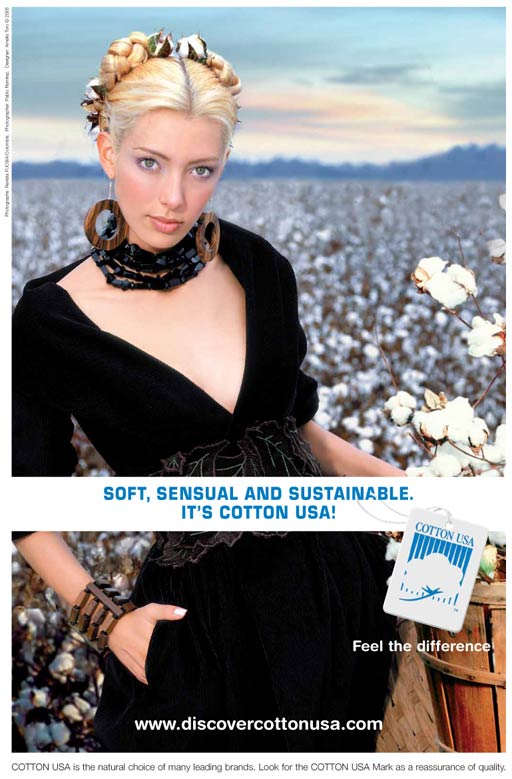
In light of this, it is fascinating that the cotton industry has decided to try and revamp its image by focusing on the act of cotton picking (as opposed to trying to make it invisible).  In this recent Cotton USA ad campaign, sent in by Katrin, cotton picking is full-on romanticized: beautiful people in beautiful clothes decorated in cotton pick cotton in cottony cotton fields:

The image suggests that cotton is beautiful, natural, relaxing, comforting, and comfortable. Indeed, the new tagline for the campaign was: “Soft, sensual, and sustainable.  It’s Cotton USA!” (source).
Interestingly, the U.K. has banned the language of this campaign, arguing that cotton is a highly destructive crop because it is both insecticide- and pesticide-intensive (i.e., not sustainable at all).

In any case, it’s interesting for me, as an American, to see a company try to romanticize an activity so closely linked with slavery.  The Great Grandmother of my co-blogger, Gwen, picked cotton and she said that it was an absolutely miserable job.  The cotton boll itself was prickly and sharp and she had to put her hand inside of the boll and pull the cotton out, such that it would leave both her hands ripped up.  The harvested cotton was carried on her back under a beating sun.  Agricultural labor is punishing, not pastoral.

Today, of course, most cotton in the U.S. is picked by machine, not beautiful 20-somethings (or Great Grandmas).  Most of us would have no knowledge with which to challenge this images so, I suppose, that’s how Cotton USA gets away with such a ludicrous campaign.

See also romanticizing colonialism and our post on how mommies and daddies are baking Goldfish crackers in their comfy kitchens just for you!

Lisa Wade, PhD is an Associate Professor at Tulane University. She is the author of American Hookup, a book about college sexual culture; a textbook about gender; and a forthcoming introductory text: Terrible Magnificent Sociology. You can follow her on Twitter and Instagram.

The American Anthropological Association website on race has a great collection of the racial and ethnic categories included on Censuses throughout the world, showing how different countries formalize different racial categories.  They illustrate just how diverse ideas about race are and challenge the notion that there is one “correct” question or set of questions.

Lisa Wade, PhD is an Associate Professor at Tulane University. She is the author of American Hookup, a book about college sexual culture; a textbook about gender; and a forthcoming introductory text: Terrible Magnificent Sociology. You can follow her on Twitter and Instagram.

Rob D. sent along a commercial, made by the non-profit organization Iranians Be Counted, aimed at encouraging Iranian Americans filling out the U.S. Census to check “Other” and write in “Iranian.” It features a famous Iranian commedian doing a bunch of outrageous personalities, but in between the schtick is an argument that there is power in numbers and, therefore, a benefit to being identified as specifically Iranian:

This type of effort is really interesting and taps into a larger debate about Census categories.  How do we divide up the categories that we count?  Iranians are a much smaller group than, say, Arab American Persian (which is currently not an option on the U.S. Census).  If there is power in numbers, then wouldn’t it be better to write in “Arab American” “Persian”?  But, if you write in Arab Persian instead of Iranian, the resources to be gained from being counted may not benefit your community specifically. [As two commenters have pointed out, Iranian Americans are not Arab, except for a small minority. Iranians are Persian and most speak Farsi, not Arabic.  My mistake.]

The Asian American community in the U.S. is a good example of this conundrum.  “Asian” is a social construction; it is an umbrella label that includes very, very different groups.  There is great power in the social construction because it gives “Asians” a presence in American politics that, for example, the Hmong or the Vietnamese alone could never have.  But counting Asians as a group also means obscuring some very important differences among them.

For example, Asians outearn Whites in income surveys, suggesting that Asians should be excluded from programs trying to help groups escape poverty.  But, in reality, the groups we categorize as Asian vary tremendously in their average socioeconomic status.  Some Asian groups (e.g., the Japanese) outearn Whites; other Asian groups (e.g., the Hmong) have very high poverty rates.  When we look at the data broken out by smaller groups, we see more need, but the group itself is small enough that it can be ignored by politicians.

UPDATE: Roshan, in the comments, corrects me further:

Not all Iranians are Persians… Persians compose only 51 percent of the population. Other groups include the Azeris (24 percent), Gilaki and Mazandaranis (eight percent), Kurds (seven percent), Arabs (three percent), Lurs (two percent), Baluchs (two percent), and Turkmens (two percent) (Hakimzadeh, 2006).

Lisa Wade, PhD is an Associate Professor at Tulane University. She is the author of American Hookup, a book about college sexual culture; a textbook about gender; and a forthcoming introductory text: Terrible Magnificent Sociology. You can follow her on Twitter and Instagram.

Christina W. sent in this 1969 video imagining, basically, the internet:

I found it hysterical. I mean, they were sort of bizarrely accurate in their general predictions. The gender roles also cracked me up.

And since we’re on the topic of the internet, the BBC recently conducted an international poll about the internet and David F. sent us a link to it. The methodology:

Photobucket

The finding that has gotten the most attention is that half of people strongly agree, and another 29% somewhat agree, that internet access should be a “fundamental right of all people”:

Photobucket

Concerns about the internet:

PhotobucketOf those who use the internet, beliefs about several topics:

Photobucket

The fact that 45% of respondents said they couldn’t cope without the internet has also gotten quite a bit of attention. However, it turns out that answers vary quite a bit by country; 79% of respondents in the Philippines and Pakistan said they could cope without it, while on the other end, 84% of Japanese respondents said they couldn’t:

Photobucket

Photobucket

I have to say, I find that question and the responses to it odd. You couldn’t cope without access to the internet? What does that mean, exactly? You’d be depressed and miserable without it? Suffer a mental breakdown? Become suicidal? I am a very heavy internet user–my computer is open with email displayed most of the time, even if I’m doing something else, and I spend enormous amounts of time every day actively using the internet. I get anxious when I can’t get access to it. But would I say I couldn’t cope without it? I would be very unhappy, but I wouldn’t, you know, become entirely incapable of functioning and give up the will to live, I don’t think. So I don’t know what to make of that.

Anyway. Hours spent online per week:

Photobucket

And finally, Michael C. sent us this video of a “skeptic’s take” on Google, including consolidation and privacy issues:

It’s interesting given Google’s recent decision to stop censoring internet access in China due to concerns that human rights activists’ emails were being tracked, as well as accusations of privacy issues with Buzz. A friend and I were talking recently about how normally we’re concerned about corporate concentration and control, and yet we both have entirely enmeshed ourselves with Google–using gmail, storing things on Google Docs and Notebook, tracking websites through Google Reader, using YouTube, getting directions from Google Maps…basically my entire online life is routed through Google services (I tried Chrome but didn’t like it, but if I had, even my browser would have been a Google product).

We’re not sure what to make of this — that it’s easier to lull people into a sense of complacency about corporate control if you provide them really nifty stuff they like using? That we aren’t yet really taking concerns about internet privacy seriously? The way these services are set up, it’s simply easier to use all of them than to insist on using a cloud server, reader, email, and so on separately just so we wouldn’t be supporting the concentration of internet services, and this undoubtedly plays a role in reducing our resistance. And our reliance on Google slowly grew over time so that neither of us really noticed how much we used the company’s products until we were actively talking about it (which we were only doing because of the events in China).

What do you think? Do you worry a lot about control over the internet, and particularly Google’s reach into so many aspects of internet usage? Do you really worry about how internet privacy issues affect you personally?

College admissions is a competitive business with colleges competing for the smartest, richest, and otherwise most desirable frosh each year.  Administrators have come to realize that “extras” —  e.g., the quality of the gym, the luxuriousness of the living quarters, and the availability of extra-curriculars — now heavily influence the decision making of prospective students.  Among academics and administrators, this is called the “amenities arms race.”  A set of representative images can be found at a slide show about college dorms sent in by Dmitriy T.M. They nicely illustrate the proliferation.

Lisa Wade, PhD is an Associate Professor at Tulane University. She is the author of American Hookup, a book about college sexual culture; a textbook about gender; and a forthcoming introductory text: Terrible Magnificent Sociology. You can follow her on Twitter and Instagram.

Liz C. sent in the video for the song “A Kiss with a Fist (Is Better Than None)” by Florence and the Machine. She analyzes it nicely:

The lyrics seem to condone domestic violence, and the video seems to trivialize it, in the sense that the lead singer prances and jumps around while singing about getting punched in the face, having her leg broken, and having plates broken over her head by her partner, while she, in turn, hits and slaps him, breaks his jaw, and refers to “The Burning Bed” by setting fire to their bed.

The lyrics:

You hit me once
I hit you back
You gave a kick
I gave a slap
You smashed a plate over my head
Then I set fire to our bed

You hit me once
I hit you back
You gave a kick
I gave a slap
You smashed a plate over my head
Then I set fire to our bed

My black eye casts no shadow
Your red eye sees nothing
Your slap don’t stick
Your kicks don’t hit
So we remain the same
Love sticks
Sweat drips
Break the lock if it don’t fit

A kick to the teeth is good for some
A kiss with a fist is better then none

A kiss with a fist is better then none

I broke your jaw once before
I spilled your blood upon the floor
You broke my leg in return
So sit back and watch the bed burn
Love sticks
Sweat drips
Break the lock if it don’t fit

A kick to the teeth is good for some
A kiss with a fist is better then none

A kiss with a fist is better then none

You hit me once
I hit you back
You gave a kick
I gave a slap
You smashed a plate over my head
Then I set fire to our bed

You hit me once
I hit you back
You gave a kick
I gave a slap
You smashed a plate over my head
Then I set fire to our bed

UPDATE: Reader Kyle pointed out another example, Chester French’s video for the song “She Loves Everybody.” He asks whether we can imagine seeing this video if the gender roles were reversed:

And commenter Dave gave us a link to a recent discussion of this topic at Jezebel.
Also see our post on sexualized violence in Lady Gaga’s “Paparazzi” video.

Dmitriy T.M. sent us a report from the Nielsen company of time spent watching TV and using the internet.

We do, of course, want to take into account possible sample bias–the data are based on answers from Nielsen TV and internet panel participants and a survey of cell phone users, and there’s likely some self-selection bias there, with some groups being more likely to participate than others. I know I’ve read about concerns with Nielsen’s data within the entertainment industry.

That said, while I would be cautious about reporting the data as representative of the U.S. overall, the general trends are interesting. People 65+ watched over 47 hours of traditional (non-recorded) TV per week? Can that be possible? The only 65+-year-old whose TV-watching habits I know is my grandma, and she does tend to have the TV on at all times, even when she’s in the kitchen and is just listening, not watching.

According to these data, among those of retirement age, TV watching is basically more than a full-time job. Kids aged 2-11, on the other hand, only have a part-time job watching TV, at about 25 hours per week.

I, of course, had to sit down and calculate my own TV watching, which came out at a little over 6 hours per week when my friends and I have our Friday night TV watching get-together, 3 hours when we don’t. Less than I thought, overall. I am, however, that advertising nightmare, the person who watches 100% of TV online or DVRd, thus reducing the number of commercials I’m exposed to. You can blame me and others like me for the increasing number of product placements you see in TV shows, a way to try to incorporate sponsorship directly into the content rather than in separate commercials that people are finding more ways to skip.

Gwen Sharp is an associate professor of sociology at Nevada State College. You can follow her on Twitter at @gwensharpnv.

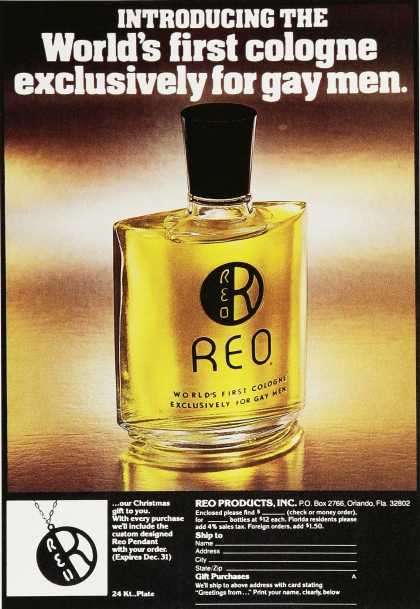
I don’t even quite know what to say about this; it just… surprises me.  Tell me why.

Source: Vintage Ads.

Lisa Wade, PhD is an Associate Professor at Tulane University. She is the author of American Hookup, a book about college sexual culture; a textbook about gender; and a forthcoming introductory text: Terrible Magnificent Sociology. You can follow her on Twitter and Instagram.