Archive: 2008

One thing I do in my classes is show my students evidence that things that seem very individualistic and unique are often influenced by social patterns to a much higher degree than they’d think. I often bring up the example of baby names. On one level, it’s an extremely personal and individual-(family)-level decision: people pick names they like and that are meaningful to them, and many would deny that larger social influences had anything to do with what they named their child. And yet names come into and out of fashion quite abruptly among lots of people at the same time, indicating that either a whole lot of people somehow independently make the same decision or that there’s a social aspect to baby naming–so naming your baby “Isabel” might not be the totally unique, personal decision you thought.

Well, now I can quantify this. It turns out the Social Security Administration has this nifty little website where you can put in any year since 1880 and find out the most popular names (from the top 20 up to the top 1000) boys’ and girls’ names for that year, including percentages of babies born that year given each name.

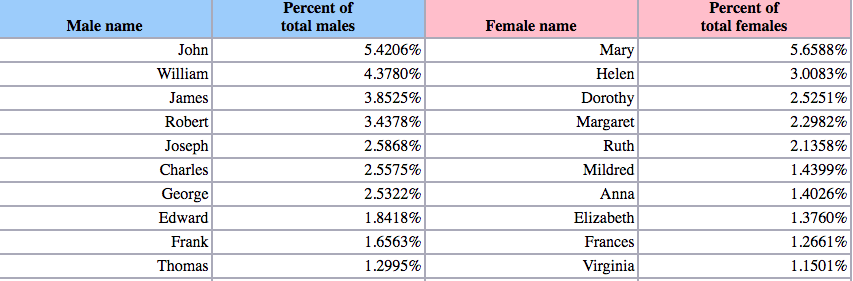
Here are the top 10 names for boys and girls in 1916 and 2016.

From 1916:
From 2016:
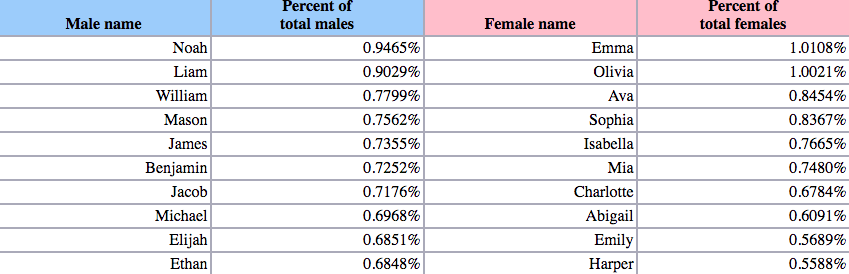
Only 1 name (William) that was most popular in 1916 was still in the top 10 in 2016. There was also a lot more concentration in 1916 than in 2016. For boys, the top name in 1916 made up 5.4% of names, while in 2016 the most popular name was only 0.9% of all names. For girls it went from 5.7% to 1.0% (I rounded all percentages to the nearest tenth of a percent). Also, in the past there was more clumping in boys’ names than girls’ names, though this is no longer the case. So in addition to just pointing out that preference for names has changed over time, it might be interesting to discuss the increasing emphasis in our culture on trying to have a “unique” name for kids that express their personality, so that there is more diversity in kids’ names today than in the past, and why until recently this was more true for girls than boys.

Jay L. provided a link to this neato site where you can type in any name and get an immediate graphic of its frequency per million babies. Totally addicting!

NEW: Abby sent in a link to Freakonomics Watch with the following explanation:

The other day a friend of mine said he was reading Freakonomics and there is a chapter on baby naming…the chapter presents a theory for how baby names become popular. People of higher education and socioeconomic status tend to seek out unusual names for their babies, which are then increasingly adopted by the masses.  Once the names become popular, cultural elites seek out a new batch of unusual names, and so on.  Based on this theory, the book gives a list of names that they predict will be popular by 2015.

You can find a table tracking the popularity of the Freakonomics predictions here. Abby was embarrassed to see that her 3-month-old son’s name is on the list.

Gwen Sharp is an associate professor of sociology at Nevada State College. You can follow her on Twitter at @gwensharpnv.
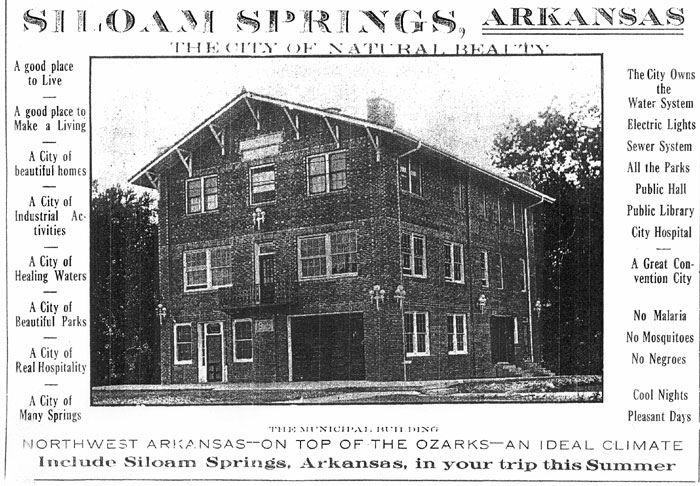
In his book Sundown Towns: A Hidden Dimension of American Racism (2005; New York: Touchstone), James Loewen discusses cities that had a “no Blacks after dark” policy. They were called “sundown towns” because African Americans were actively informed that they should be out of town by sundown; if not, they were subject to arrest or violence. Of course, the purpose of these regulations was to keep Blacks from settling permanently in these towns. If they couldn’t be in town limits after dark, they clearly couldn’t live there. Here is an example of a sundown town: this ad encouraging people to move to Siloam Springs, Arkansas, says, over in the lower right corner, “No Malaria, No Mosquitoes, No Negroes.”

Found here.

NOTE: As Mr. Loewen pointed out in a comment, I had originally said he discussed “cities in the South,” as though that was all his book concentrated on. That was poor wording on my part, as I had been reading the sections of the book that covered some areas in the South I was specifically interested in (particularly Oklahoma). I did not mean to imply that sundown towns existed only in the South or that Mr. Loewen only discusses the South.


Thanks to Thorsten S. for the link!

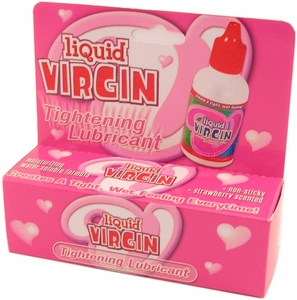
Bob K. sent in this image of Liquid Virgin Tightening Lubricant (found here):

According to the website,

This product is called a Vaginal Contracting Lubricant. It is Similar to the age-old China Shrink cream. These drops work to temporarily tighten the walls of the vagina. I have never tried it but our sales representative says they work. I didn’t ask how she knew.

This could be used in a discussion of how women’s bodies are perceived, and particularly stereotypes of sexually active women’s bodies. After all, the word “loose” implies that a woman is slutty and therefore her vagina is all, you know, stretched out and stuff. Because that’s totally how that works.
The implication is that sex with such women will be less pleasurable for men than sex with women who have had less sex…such as virgins. You might also want to talk about vaginal rejuvenation surgery as part of this topic.

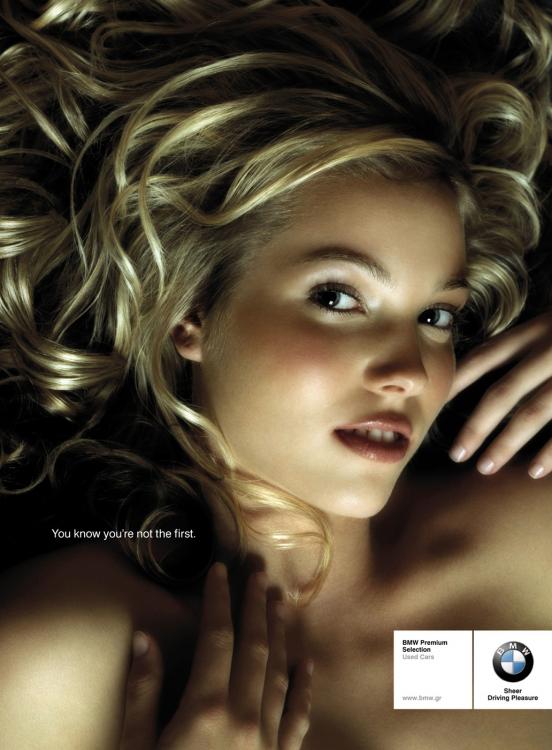
Since we’re on the topic of images of sexually experienced women, Jenelle and Marcello both sent in this ad for BMW used cars (found here):

“You know you’re not the first.”

Here’s an example of another ad (found here) from the Polish used BMW campaign that doesn’t use a woman to sell cars. So apparently it can be done.

Thanks, Bob, Marcello, and Jenelle!

As we’re sure you’ve noticed, one thing we’re really interested in is the social construction of gender and the way the world is divided into things that are ok for men to do and things that are ok for women to do. This dividing of the world by gender includes everything from food (salad vs. steak), pets (cats vs. dogs), and even colors (pink vs. blue). Generally, people are punished for not following these rules, though men are often punished more harshly for crossing into “feminine” or “girly” territory. At the same time, because these rules are socially constructed, they get fiddled with and sometimes people can get away with crossing the gender line–or even make it cool to do so.

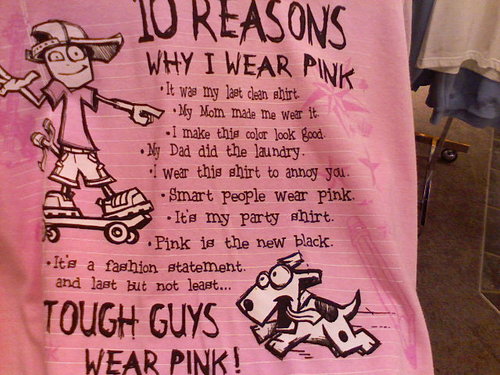
Abby sent in this photo of a t-shirt (found here) similar to one she saw a boy wearing at a school picnic recently. Another boy was also wearing a pink shirt, though without the explanation for why.

Abby says,

I think it is interesting the way the shirt challenges some dominant ideas about gender (pink = smart) while reinforcing others (e.g. men don’t know how to do laundry).

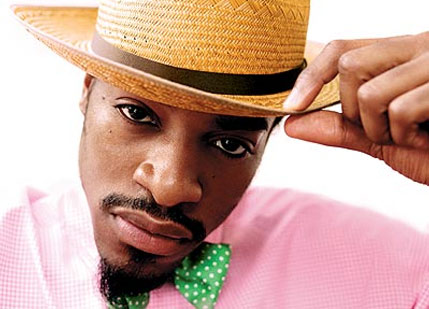
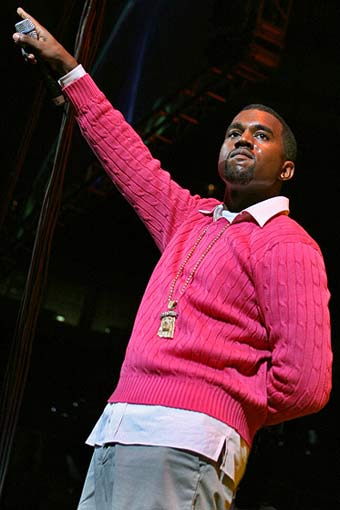
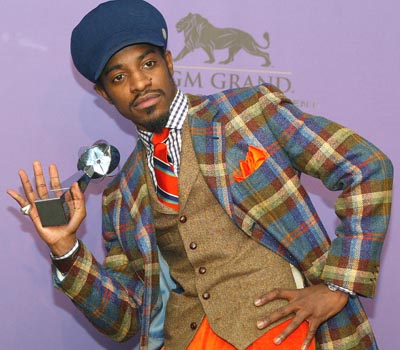
Another example of pink being redefined as an appropriate color for men to wear (other than Don Johnson in the 1980s) is Andre 3000 from Outcast (image found here):

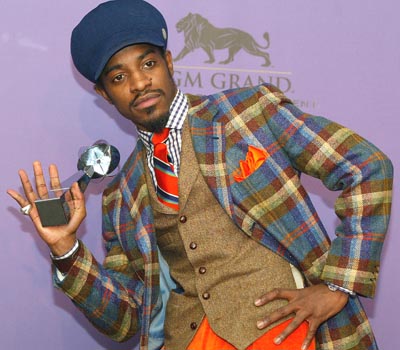
In fact, Andre 3000 was one of several hip-hop stars in the last few years who have clearly cared about fashion and re-popularized what has been described as a “dandy” fashion sense (see next photo, found here). So something that we generally associated with women (caring intensely about fashion) has become an acceptable, or even hip, part of a masculine image.

Here’s Kanye West in pink (found here):

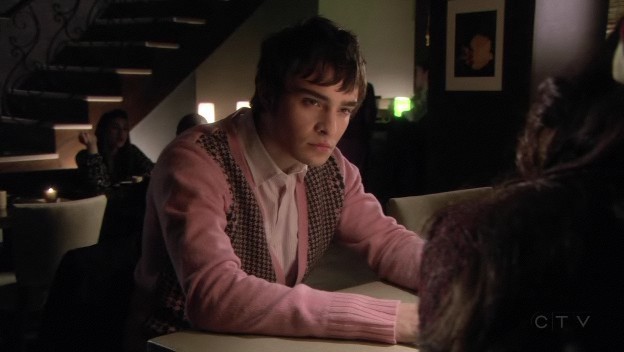
Here is a picture (found here) of the character Chuck Bass from the TV show “Gossip Girl”:

Huh. While looking for other examples for this post I came upon The Charming Dandy, which has the tagline “a feminine eye for every guy.” It gives advice about fashion, manners, decorating, and tips for grooms (I did not previously know the names for shawl, peak, and notch lapels). The things you discover.

Anyway, these pics could be useful for showing how our gender dichotomy (pink = girls, blue = boys) is actually a lot more contradictory, that there is nothing “natural” about associating pink with girls, and that we often change gender rules while failing to acknowledge this has any bigger implications for our entire system of dividing the world by gender.

Thanks to Abby for the image and post title!

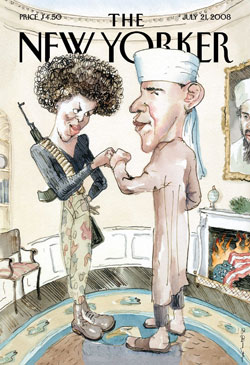
Breck sent in a link to this post about the controversial New Yorker front cover depicting Barack and Michelle Obama as Muslim extremists (I found the full-size image here):

As you may guess, there have been some quite negative reactions to this cartoon. The Obama campaign did not particularly like having him portrayed as an American flag-burning Muslim, oddly enough. And apparently this has gotten wide enough press coverage that even my mom had heard about it and was distressed, and my mom doesn’t follow politics too closely.

I’m kind of fascinated by this entire situation. When I went to Oklahoma last month to visit my family, my uncle informed me that Obama is a Muslim with some secret evil motive for wanting to be president that the rest of us can’t even imagine because we aren’t diabolical enough to think of it. When I pointed out that Obama is not a Muslim, my uncle said he used to be, which is the same thing, and that if Obama really loved America he would change his middle name from Hussein. I gave up on the conversation at that point and returned to pulling ticks off the dog, since that was a lot more pleasant.

What I’m saying is, I have first-hand knowledge of the people out there who honestly believe Obama is some type of Muslim extremist with an evil plot for when he gets into office. Fox News reported on the “fist bump” as a possible terrorist gesture. This distrust of Obama is out there. So this cartoon could spark a really interesting discussion of political humor/satire and the boundaries between “appropriate” and “inappropriate.” I assume–and I’m just assuming here–that this cover was supposed to be a commentary on the fact that some people (and Fox News) are convinced Obama has a connection to Muslims and/or terrorists and, as a result, has evil plans for the future of America. But the cover could also simply reinforce those ideas–I really hope my uncle doesn’t suddenly take up reading and pass by a magazine rack in the near future, because this cover will prove to him that he’s been right all along. So what’s the line between social commentary that points out and/or ridicules issues such as these and just reinforcing the misconceptions or stereotypes that you claim to be undermining?

It could also be used for a discussion of how we read things into images based on our own assumptions. I mean, I have no evidence this cover is supposed to be a commentary (however misguided, dumb, or inappropriate it might be) on misconceptions about Obama; I’m just presuming based on what I know about The New Yorker, its liberal slant, and my recent experience with my uncle. If you showed me the exact same image and told me it came from Fox News, I am certain my reaction would be different because of my assumptions about what Fox News would be trying to say with the image. I can check that tendency to make assumptions about the intention of the creators of an image, and I try to, but I think it’s always good to point out to students that we don’t just passively see an image; our own experiences, assumptions, and so on influence how we interpret them. This is part of the reason that, once an image is put out there, the intention of the creator doesn’t necessarily have much to do with how people interpret or use it.

Thanks, Breck!

On an unrelated note: If you’ve noticed my absence from posting the last few days, I can only say that the first 2 seasons of “Buffy the Vampire Slayer” turned out to be way more compelling than I was expecting and watching them can be quite the time sucker.

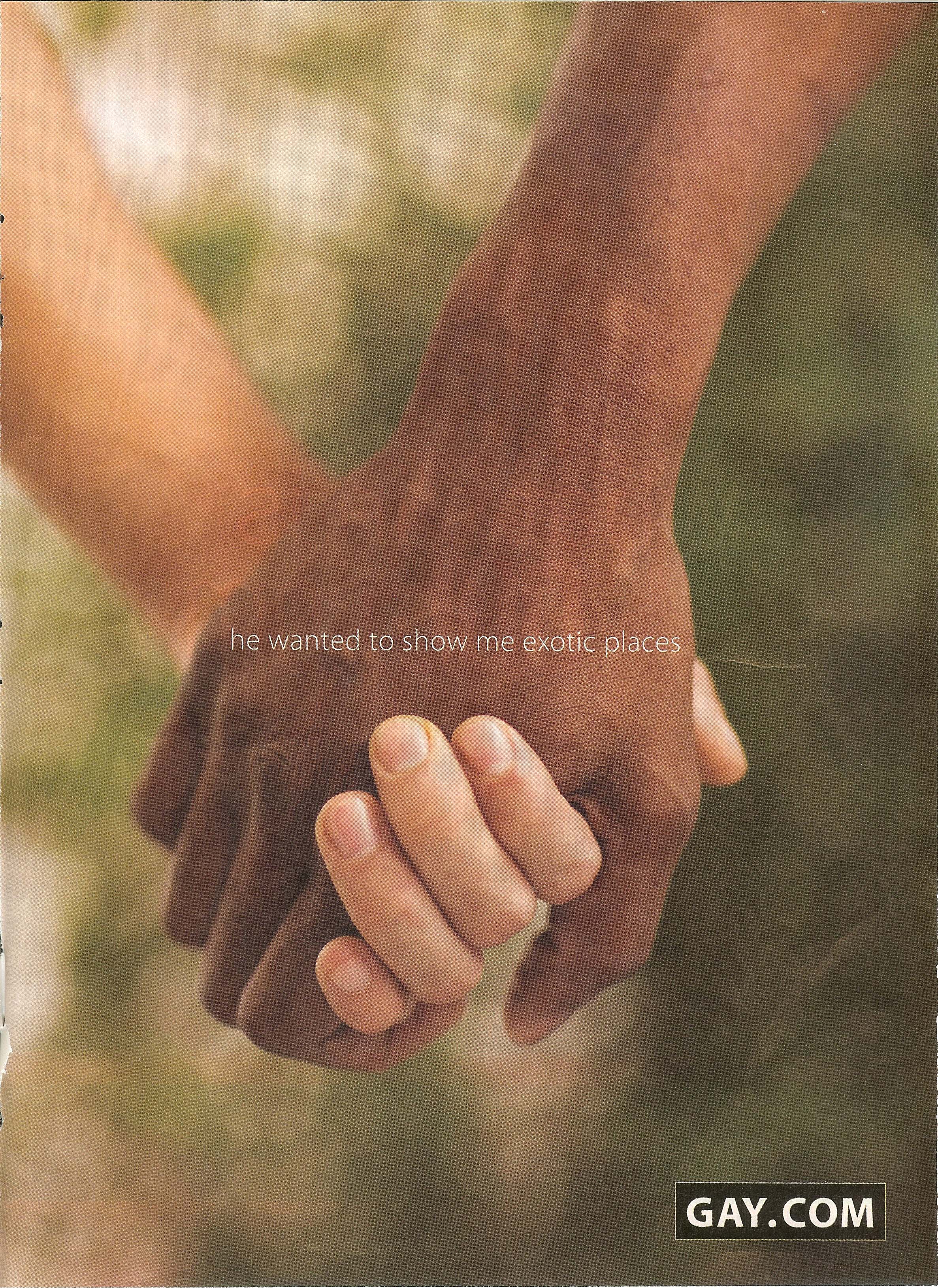
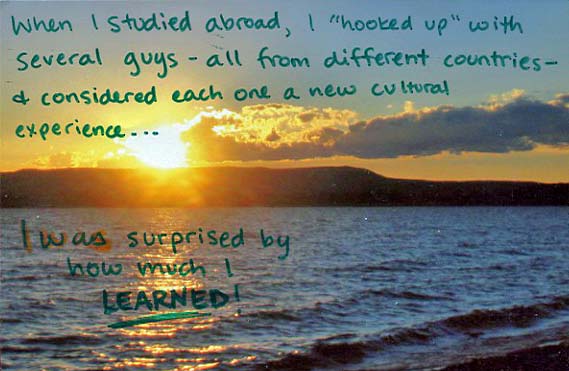
I have posted previously on the exoticization of the Other through tourism (see especially this post on hula girls in Hawaii).  This is part of an exoticization of the Other that occurs within state borders as well as across.   bell hooks talks about about how some white people see having sex with a person of color as an exciting adventure, like a trip to an exotic location, in her essay “Eating the Other.”   See also Race, Ethnicity and Sexuality by Joane Nagel and Black Sexual Politics by Patricia Hill Collins.  You can see visual representations of it here and here.

Jacob G. sent us this amazing ad suggesting that dating a person of another race is like going to an exotic location. 

Text:

he wanted to show me exotic places.

Um. Wow.

NEW!  From Postsecret:


According to Melissa, the dialogue/voice-over in this Czech commercial roughly goes like this:

…basically the woman complaining about stuff, followed by the deflation, then a voiceover with a play on words about blowing off your wife to have a beer with the lads.