Archive: 2008

Remember that Trojan ad where men were pigs? Daniel G. sent us another ad portraying men as animals. In this one, men in a bar grow antlers so as to head-butt over a cute girl. Guess which one she goes for? Thanks Daniel!

We consolidated our products-shaped-like-boobs posts and added 17 (yes, 17) new boob-shaped products. Thanks to Stumblng Tumblr and Shakesville.

On a similar theme, we added some additional images of things shaped like women, generally, including a cigarette extinguisher. See them here.

And, still on this theme, we added one more urinal shaped like a woman. We added a second example of a non-American Indian appropriating an American Indian identity and doing conservation work. Click here for Archibald, I mean, Grey Owl.

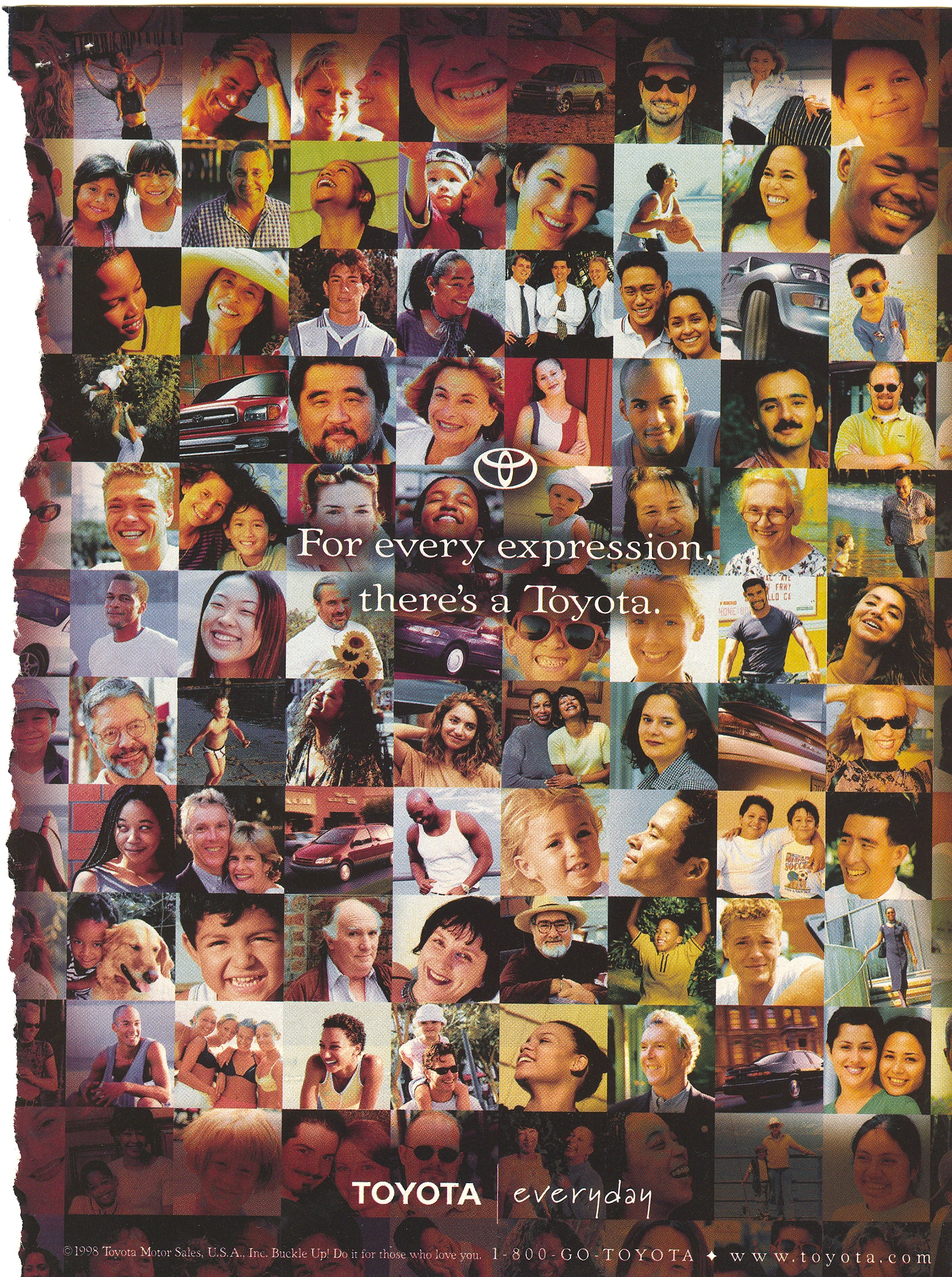
We added another example of people of color being associated with “spice” and, thus, spicing up the bland world of white people. And this one in a truly misguided pro-diversity ad!

We added to our ad using the idea that Latinas are “hot” and “spicy,” some ads for Rio Casino in which a black woman is used to communicate “passion.” Both demonstrate how women of color are stereotyped as more highly sexual than white women. See it here.

We added a description of a chapter in the book Freakonomics that presents a theory on how baby names become popular to this post about historical trends in baby names, including a link to a website that tracks the popularity of names the Freakonomics authors predict will be most popular by 2015.

We updated this post about an Israeli air conditioner ad that let viewers manipulate a thermostat to make a woman’s nipples get more or less visible. We added a comment from the CEO of the company that he released after protests in Israel forced the company to take the ad down in which he calls people out for being hypocrites for targeting some sexist material but not others. And also says that if they can’t use sexist ads, products would have to actually have a competitive advantage. We thought it was awesome that a CEO would admit they need media images to sell their products because or they’d have to actually make something better or cheaper than what’s already out there.

Eva Longoria was recently accused of being “fat.” We added a pic of her offending body to this post on the scandal over Czech model Karolina Kurkova’s scandalous appearance on the runway and Ali Michael’s fall from grace. Thanks to Elizabeth A. for the tip!

We added an ad for I Can’t Believe It’s Not Butter and one for Skyy vodka to this post about the sexualization of food. Scroll way down.

We added a Snickers commercial in which Mr. T. attacks a man for acting like a sissy (i.e., gay and/or feminine) to our other commecial demonstrating the policing of masculinity. Thanks to Penny R. for alerting us to the commercial!
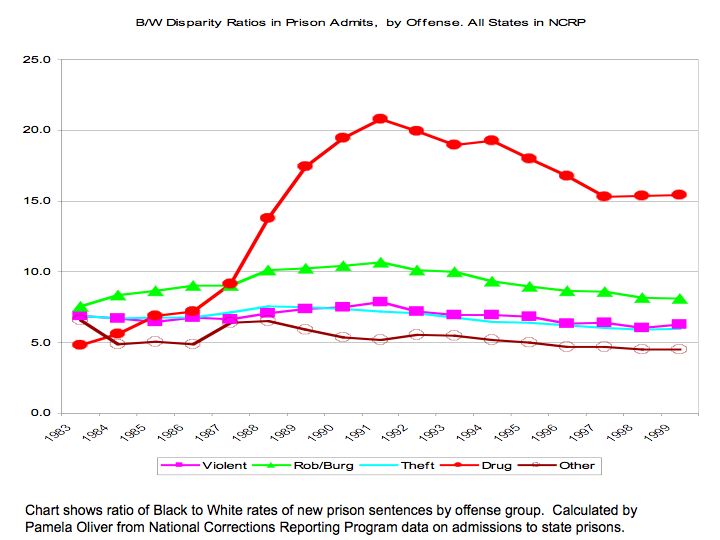
Pam Oliver sent in this graph that shows disparities in Blacks’ and Whites’ new prison sentences:

While blacks are more likely to be sentenced for all the offenses shown, clearly drug offenses stand out as the area with the biggest racial disparity in prison sentences. The other thing that stands out is the huge jump that occurred in the late 1980s and how much higher the disparity was by the 1990s than in the 1980s. Either African Americans suddenly started doing a whole lot more drugs, Whites stopped doing them altogether…or Blacks started getting arrested and sentenced at a much higher rate than Whites for drug offenses.

From an article by Oliver:

…the rise in imprisonment since the 1970s is not explained by crime rates, but by changes in policies related to crime…Determinate sentencing, which eliminates judicial discretion, longer sentences for drug offenses, increases in funding for police departments and large increases in prison capacity, the exacerbation of racial tensions and fears following the civil rights movement and the riots of the 1970s, and the politicization of crime as an election issue all seem to have played some role.

In Focus 21 (3) pp. 28-31 Spring 2001.

Other sociologists have pointed out that Whites tend to sell drugs inside buildings (houses, dorm rooms, workplaces) to people they know, while Blacks are more likely to engage in open-air sales to strangers. It’s much easier for police to see and arrest people engaged in open-air sales because they’re visible and, being out in public, can often be stopped and frisked without a warrant. Clearly it would be more difficult to know about drug sales taking place in private residences, and there would be more procedural hurdles to searching for them. And when you’re selling to strangers, you’re more likely to see to an undercover cop or to sell to people who don’t really have a problem saying who they bought their drugs from. So the very manner in which they sell makes it much more likely that Blacks will be caught and arrested, even though enormous amounts of drugs are bought and sold by Whites.

You can find a lot more graphs and articles on this topic (including disparities broken down by state) at Pam Oliver’s website. Also see this post about international imprisonment rates. Thanks, Pam!

Oh, and Lisa’s at the American Sociological Association meetings, which is why you’re stuck with just me this week.

Here is an ad put out by the McCain campaign that associates Obama with Britney Spears and Paris Hilton:

What struck me about it is that associating Obama with some young women is a way to imply he’s not a serious candidate (see this post from yesterday on a similar theme). I mean, they could have used, say, Tom Cruise of one of the examples of overwhelming celebrity, but part of the image of the Obama campaign is that many of his followers are sexy but vapid young women. (Also, as far as I’m aware neither Britney Spears nor Paris Hilton have actually been connected to Obama, unlike Scarlett Johansson, who sent him emails; the media frenzy over the idea that he was her “email buddy” eventually forced him to distance himself from any association with her. Why this was such a big deal, I do not know, since there was no indication that the emails were inappropriate in any way.)

Also: Paris Hilton has now become part of our political discourse? Really?

NEW: Marc S. sent in a link to the humorous response from Paris Hilton. It might be a humorous intro to a discussion of the way that we assume that certain types of femininity (particularly the type associated with tanning and liking the color pink) are incompatible with being intelligent or politically aware.

Thanks, Marc!

Gwen Sharp is an associate professor of sociology at Nevada State College. You can follow her on Twitter at @gwensharpnv.

Today I saw an interesting talk about public reaction to the Humane Society (HSUS) video of cruel treatment of cattle at the Westland/Hallmark slaughterhouse in Chino, California. As you may recall, someone from the Humane Society took a job at the plant and secretly videotaped the practices there for about four months. In late January, 2008, HSUS released the video. Here is a video from the HSUS website that shows images from the original video footage (and yes, it’s a disturbing video, even by my Oklahoma-ranch-raised standards):

The talk I saw today, titled “Westland/Hallmark: When You Don’t Care Enough to Send the Very Best,” by David Holt and Michelle R. Worosz (presented at the 71st Annual Meeting of the Rural Sociological Society in Manchester, NH) provided an interesting analysis of how issues get framed in the public. The HSUS undertook this investigation, and released the video, primarily because of concerns about animal cruelty and the mistreatment of cattle, particularly those that could not stand or move on their own.

But as sociologists studying framing and social movements have often noted, once an issue gets out there, organizations can’t control what the public, lawmakers, or the media will make of it, and this case is a good example. Once the news broke, what came to the forefront were food safety issues, particularly the idea that so-called “downer cows” (that is, cows that can’t stand or walk on their own) might have made it into the food supply. Downer cows are a concern because of the (very small) risk that they might be suffering neurological damage from BSE, or Mad Cow disease. After an outcry several years ago downer cows were barred from human consumption, but back in 2007 the USDA quietly relaxed the standards so that downer cows can be slaughtered for human consumption if a Food Safety and Inspection Service (FSIS) veterinarian inspects and passes them.

Anyway, it turns out that this particular meat processor was a major supplier of beef to the nation’s school lunch program. This exacerbated concerns about the (remote) possibility of BSE-infected meat getting into the food supply. And that quickly overwhelmed the animal-cruelty concerns that had motivated the HSUS investigation in the first place. The Congressional hearings and (superficial) changes to processing practices that occurred as a result of the video focused primarily on improving food safety, with little discussion of how animals bound for slaughter are, or should be, treated.

It reminded me of how Upton Sinclair said that, when he wrote The Jungle, that he “aimed for the public’s heart, and by accident I hit it in the stomach,” meaning that he’d meant to bring attention to the horrific conditions immigrant workers faced at work but what the public outcry centered on was the idea of rats in their meat.

I thought this might be a good example of how activists try to frame issues but have incomplete control of the framing process once it enters the public domain and may find that media depictions and public discussions of the issue take a very different path than they would have liked.

When I think “sexy,” I tend to think of three things:

1. Soft candlelight

2. The music of Barry White

3. Automobile crash test research

Apparently, the people over at DSQUARED2 (which, by the way, comes out to D4 ) agree with me on the last one:

Good for discussions about objectification, driving safety, or that fashion photographers are finally starting to run out of ideas.

My friend at Trucker Bomb alerted me to this clip from the 1956 film “Indestructible Man.” I’m saving it until one of my students waxes nostalgic about the “good old days” in which gender roles were clearer, and people didn’t have to be so confused all of the time about, say, whether it’s okay to open a door for a “lady”. This sort of comment often comes up when we discuss the difference between courtesy (which can apply to everyone) and chivalry (which is predicated on the notion that women are weaker than men). It could also be useful in discussions about gender as it relates to marriage, careers, or golly, just about anything!

[youtube]http://www.youtube.com/watch?v=jgGFzUS4tkg[/youtube]

Man, the good old days were awesome, in a pause-while-laughing-to-barf-a-little kind of way.

The presence of lead paint on toys made in China this year brought the threat of lead poisoning to the forefront of the American mind. Parents, pundits, and politicians called on the U.S. government to DO SOMETHING. But lead poisoning was a problem for low-income families long before the China toy scandal and there was little to no outcry in the popular press.

Lead poisoning in children can increase the risk of cognitive delay, hyperactivity, and antisocial behavior. Many older homes and apartments available for rental in low-income neighborhoods still have lead paint and ingesting paint dust and paint chips is the most common way to get lead poisoning. Blood tests show that children living in poverty show much higher exposure to lead than other children.

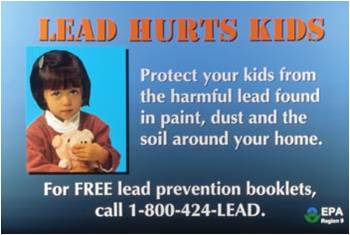
According to William Ryan, if you are a landlord, renting out a residence with lead paint without making tenants aware of it is a crime. But, instead of enforcing compliance among landlords, the most common response to the threat of lead poisoning has been to warn mothers. Here is a representative poster:

Ryan writes that, while lead poisoning is often described as a problem involving negligent or ignorant mothers, it:

…is more accurately analyzed as the result of a systematic program of lawbreaking by one interest group in the community [landlords], with the toleration and encouragement of the public authority charged with enforcing that law.

So as long as the threat of lead poisoning was more-or-less restricted to the poor in the U.S., it was considered the problem of individuals (mothers) and the state refrained from doing much more than promoting individual responsibility. But, as soon as the lead poisoning threat affected middle class children through the toys from China, state intervention seemed appropriate.

Ryan again:

To ignore these continued and repeated law violations [by landlords who rent residences with lead paint], to ignore the fact that the supposed law enforcer actually cooperates in lawbreaking [by ignoring landlord infractions], and then to load a burden of guilt on the mother of a dead or dangerously ill child is an egregious distortion of reality. And to do so under the guise of public-spirited and humanitarian service to the community is intolerable.

CITATION: Ryan, William. 1998. Blaming the Victim. In Race, Class, and Gender in the United States. See also his book.

Did you know that the U.S. has a higher imprisonment rate than even Russia?  And the U.S. imprisonment rate is about six times that of many European countries. 

(This first figure was made by Kieran Healy.)

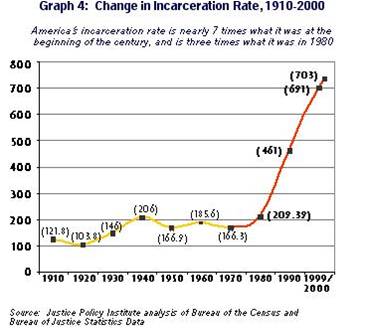
When and how did this happen?  It started in the 1980s with Reagan’s “war on drugs.”  The figure below shows the increase in the incarceration rate beginning in the 1980s (# of people out of 100,000).

So our imprisonment rate is the result of imprisoning people who break drug laws, NOT violent criminals or even people who commit property crimes.  The increase is largely due to more aggressive policing of drug law violations. 

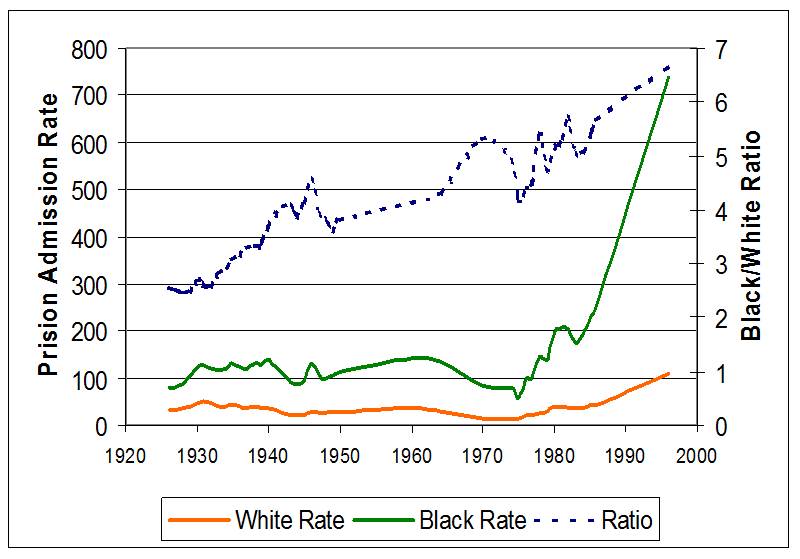
And, as you can see in the figure below, the aggressive policing of drug law violations can be found disproportionately in black neighborhoods.  (White and black people take drugs at a very similar rate, but black neighborhoods are more heavily policing and drugs more common among blacks than white have carried heavier sentences — i.e., crack versus cocaine until recently).  This figure shows that the increase in the incarceration rate is mostly an increase in the black incarceration rate. 

Thanks to the amazing Pam Oliver for reminding me that this last graph comes from her work on the incarceration rate (found here).