Archive: 2008

As Melissa at Shakesville writes:

…Subway reminds women that the only reason they have to feel good about themselves is being thin, that their self-worth is predicated on their looks, that psychological health is evidently dependent on being pretty, that fat axiomatically equals ugly, and that no man would ever love a fat girl.


English First is an organization advocating the adoption of English-only laws in the U.S., which would mean government agencies and officials would not be allowed to conduct any type of business in a language other than English. They also oppose bilingual education and bilingual ballots. Here is a screenshot of their homepage’s banner; perhaps you will note a small irony, coming from an organization concerned about people being unable to use the English language:

There is a very clear anti-immigrant stance, which in some cases bleeds over into a general anti-Latino perspective. For instance, the website has a link to a letter sent to Attorney General Mukasey, expressing concern over Department of Justice statements about plans to crack down on voter intimidation:

Yet under the new DOJ policies as we understand them, anyone who dares complain when they see a busload of illegal aliens pulling up to a polling place could be arrested on the spot by agents of their own government.

What’s interesting here is the idea that you could immediately spot “a busload of illegal aliens.” I could be wrong here, but I’m guessing that to at least some members of the organization, any vehicle with Latinos (or other brown-skinned people) in it might be targeted as full of “illegal aliens.”

The organization also blames Hispanic legislators for the failure of the original financial bailout bill.

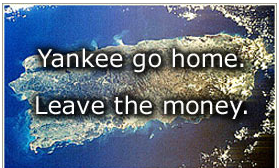
One of English First’s projects is No Statehood for Puerto Rico. Technically speaking, the population of Puerto Rico has the right to become a state, should a majority ever vote to do so. All Puerto Ricans are U.S. citizens and can travel freely between the island and the mainland, with no need for a passport or visa. Here are some images from the homepage:

I think the hand at the bottom of that last image is supposed to be begging for a handout.

All of these images portray Puerto Rico as a money-sucking burden on the rest of the U.S. The website questions Puerto Ricans’ patriotism (because they protest military training at Vieques, unlike the good people of Oklahoma, who do not protest military training at Ft. Sill), links Puerto Rico to terrorism, and argues that Puerto Rico is a “proud, Spanish-speaking nation” and thus wouldn’t want to be a state anyway (leading to questions of why any of this is an issue, since the population would presumably never vote for statehood anyway). I am unclear whether English First advocates total Puerto Rican independence from the U.S., or just keeping it from becoming a state.

English First has a handy list of states that have English-Only laws, as well as which ones have been overturned.

You might also check out Lisa’s recent post on an organization that linked anti-immigration and pro-environment stances.

First, the commercial (found here):

I love and hate this commercial because of androcentrism.  Androcentrism is the idea that we value masculinity over femininity such that we admire both men and women for performing masculinity.  Androcentrism explains why we tend to like it when women drink beer, play sports, and become lawyers, but do not typically think it’s equally awesome when men cry, wear skirts, learn to knit, or become interior designers.   Here is my crash course on androcentrism.

In any case, I kinda love the fact that the hot chick in this commercial represents strength and we’re obviously supposed to think she’s awesome.  But the guy in the commercial, who is supposed to represent sissy hippy environmentalism, doesn’t exactly come off as awesome.  He is funny, stupid, ridiculous.  And I kind of hate that.  In a perfect world, men would be allowed to do things associated with femininity without being considered uncool.


Click here to watch a segment on Good Morning America about the upcoming movie, Tinkerbell.

The rather barf-tastic segment comes to you thanks to media consolidation.  Good Morning America is on ABC which is owned by Disney which, of course, produced TinkerBell.  So there you have it.

One of the preview ads for the Blackberry Storm is shot from the point of view of a guy approaching a Blackberry on a table. We hear his internal monologue, then see his hand reach for the Blackberry. As music wells up and the scene disappears, we’re supposed to assume that he’s been impressed or sucked into an alternate reality or something.

The framing of the ad puts the viewers in the man’s place. assuming that the viewers are heteronormative white bourgeois men and, if they aren’t, imposing this status upon them. It’s a nice example of how modern US middle-class society continues to assume that hetero white men are the default type of people.

[youtube]http://www.youtube.com/watch?v=gbWsQCbqcE0[/youtube]

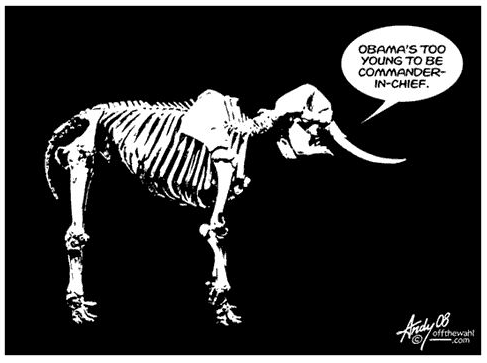
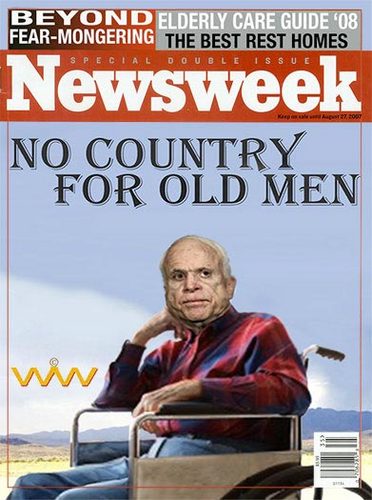
Last week, John Kerry made a joke about John McCain’s age, implying that he wears Depends (that is, adult diapers). I have searched everywhere and haven’t been able to find any video of Kerry telling the joke; all the discussions I’ve been able to find of it seem to lead back to an original story at PolitickerMA.com. It brought up something that has bugged me throughout this campaign: the cheap shots about McCain’s age. For example (thanks to Burk for finding me all these images):

Found here.

Found here.

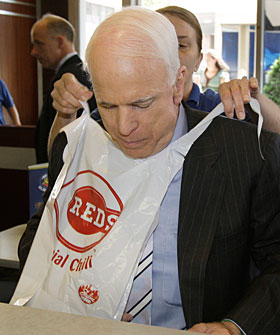
The Baltimore Sun posted this photo and asked readers to provide captions for it:

Suggested captions included jabs about Ensure, reaching out to senior citizens, nursing homes, forgetfulness, and so on.

While I’ve heard a lot of people talking about racism in depictions of Barack Obama, and sexism in portrayals of Sarah Palin and Hillary Clinton, I have heard very few people discuss the very negative depictions of the the “old” being used to ridicule McCain. Depictions of older people range from out-of-touch, doddering fools to crazed racists to pathetic invalids. Although Kerry’s joke drew some criticism, jokes or comments about McCain’s age have generally been given a pass–they’ve been declared fair game. You might get in trouble in our culture for being sexist or racist, but apparently ridiculing people for being old is fine.

I don’t know about you, but I know some old people, and they are healthy, coherent, mentally competent people who appear to have complete control of their bladders and bowels. My grandmother is 70 and runs a 110-cow ranch on her own in Oklahoma, doing all of the labor herself (except that she hires someone to come in and bale the hay each year). Just as I thought it must be awful to be an Arab American and hear accusations that Obama is secretly Arab or Muslim used as a slur against him, I’ve wondered how my grandma feels, hearing McCain’s age ridiculed. My guess is that she finds it mortifying, but I haven’t gotten up the courage to ask.

I have also on more than one occasion heard people mock John McCain’s physical appearance, particularly the fact that one side of his face is swollen because he had a patch of skin removed due to skin cancer. The times I overheard this, they weren’t expressing concern that he might have a serious form of cancer that could kill him or force him to leave office; they were just laughing at how he looked.

If McCain showed evidence of dementia or osteoporosis or some other condition that you could maybe directly relate to his age, then ok, fine, I could see people commenting on it. But that’s not what’s going on here. This is just making fun of his age for the sake of it–it’s funny that he’s old, because old people are laughable. It’s an interesting statement about the value we place on older people in this culture.


The video “The Great Schlep,” featuring Sarah Silverman, is part of The Great Schlep campaign, which, according to the website,

…aims to have Jewish grandchildren visit their grandparents in Florida, educate them about Obama, and therefore swing the crucial Florida vote in his favor. Don’t have grandparents in Florida? Not Jewish? No problem! You can still become a schlepper and make change happen in 2008, simply by talking to your relatives about Obama.

(Go here if the video isn’t working.)

The Great Schlep’s Facebook page has a link to talking points (titled “Obama Talking Points for Jews”), including,

*He is a Christian and has never been a Muslim.
*Obama ran the business side of his primary campaign significantly better than any other candidate of either party…
*His love for the United States is similar to that of generations of Jewish immigrants, who loved America for giving them an opportunity to succeed if they worked hard enough…
*Obama represents a different kind of black leadership, less interested in the confrontational tactics favored by many who came of age in the 1960s and 1970s…
*Biden’s knowledge of Middle Eastern affairs and his decades of strong support for Israel (he identifies himself as a Zionist) are well documented.

It’s an interesting list, drawing on the “up by your bootstraps” immigrant ideal (“…an opportunity to succeed if they worked hard enough”), the idea of Obama as a non-threatening Black leader, and that Jewish voters would be particularly impressed by Obama being able to manage the “business side” of his campaign.

Now watch this clip of Dave Chappelle’s “Reparations” skit:

(Go here if the video isn’t working.)

These would be great videos for discussing humor and the way that in-group members may be allowed to make jokes that others would be criticized for. Both of these videos are full of images and statements that, should a non-Jew or non-African American say them, would almost certainly be considered incredibly offensive. Are they necessarily not offensive simply because the person presenting them is a member of the stereotyped group? How can we distinguish between humor that pokes fun at stereotypes and humor that just uses them for a cheap laugh?

On the one hand, Whites often use the “it’s just a joke” disclaimer to deny responsibility for racist content in jokes; on the other hand, minorities may use the “I’m a member of the group I’m making fun of; how could the jokes be racist?” argument to deflect criticism. And of course, we may legitimately feel differently about a joke depending on who said it (the whole “are you laughing with us, or at us?” phenomenon). But at the same time, I think it’s sort of fascinating that we’re often allowed, or encouraged, to laugh at racist stereotypes, as long as the person saying them is a member of the stereotyped group–and in fact, we often wouldn’t really know how to go about criticizing them if we felt it was warranted.

Gwen Sharp is an associate professor of sociology at Nevada State College. You can follow her on Twitter at @gwensharpnv.

In this excellently-made 55-minute video, Michael Wesch talks about the way in which YouTube, especially, functions to create community in the post-community era (via Wicked Anomie).  It’s a bit too heavy on the feel-good for me, but quite informative and, well hell, it did make me feel good!