Archive: 2008

When a member of a regularly-excluded group gains entry into what was previously a homogeneous club–say, a Black man is elected President of the United States–that person is sometimes used as “proof” that there are, in fact, no barriers to entry after all. Thus, some of us worry that Obama’s election will be used against those fighting for racial justice. Well, it began before it began. In this clip on CNN, aired before Obama was confirmed the winner, former Secretary of Education Bill Bennet, when asked what his election would mean, remarks:

Well, I’ll tell you one thing it means… You don’t take any excuses anymore from anybody who says, ‘The deck is stacked, I can’t do anything, there’s so much in-built this and that.’

Yes, there’s no more “this and that” and Bill doesn’t want to hear about it anymore.

Scroll forward to about 45 seconds:

[youtube]http://www.youtube.com/watch?v=SvpB-MnM8I8[/youtube]

Clip via Macon D. at Stuff White People Do, who has a nice analysis.

Jason S. sent us this picture of a T-shirt he saw for sale in Berkeley, California. The T-shirt says:

Wingman Services: Don’t Be Sent Out On A Dangerous SOLO Mission!  Let Us BANG Her Fat Friends For You!

A “wingman” is a guy who helps his buddy get laid.  Here the suggestion is that the “wingman” will take the fall and have sex with the fat one so that his buddy can have the desirable, skinny one.  Notice also the violent language used to describe sex.

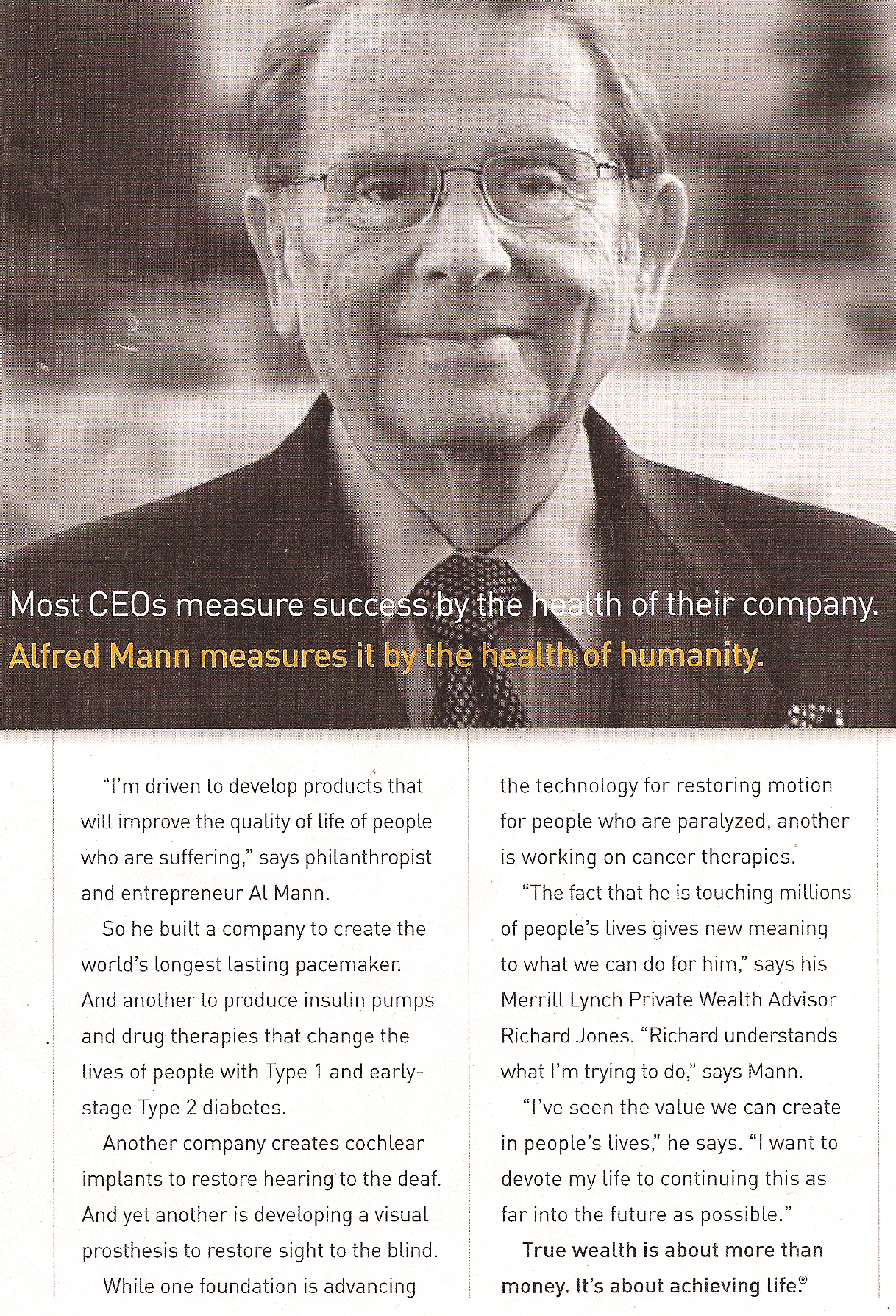
I found this Merrill Lynch ad in The New Yorker last week:

What I found interesting about it was the text, which is talking about how the guy in the photo is a philanthropist. Examples of his products to “…improve the quality of life of people who are suffering” include better pacemakers, insulin pumps, a visual prosthesis for the blind (who knew?), and cochlear implants for the deaf. The reason it drew my attention is that while (to my knowledge, anyway) pacemakers and insulin are generally accepted as useful technologies that improve people’s lives, cochlear implants have been the subject of controversy. Many people in the deaf community argue deafness is not a “disease” or a “disability,” but simply a state of being (or a subculture), and that efforts to “correct” deafness are offensive and even culturally oppressive (for an example of this perspective, see this discussion from the Drury University website). Thus, while most people would see efforts to treat diabetes as an unequivocal good, and few diabetics would oppose them, opinions about cochlear implants are much more divided, and those who would presumably be seen as the beneficiaries of this technology are not necessarily convinced they need it or that there is anything “wrong” with them that requires intervention. In fact, within the deaf community individuals may face peer pressure to reject implants and those who get them are sometimes stigmatized as sell-outs, basically.

It might be a useful image for sparking a discussion about the social construction and definition of medical problems. Who gets to decide whether a condition is a disease or is just a human characteristic (that is, perhaps uncommon but not automatically problematic)? What if the individuals who have the characteristic disagree with the wider public (or among themselves) about its interpretation? You might use it to spark a discussion about medical interventions and ethics–what are the implications of the increasing ability to use medical innovations to alter a wide variety of characteristics? Are innovations such as cochlear implants helping improve the lives of those who cannot hear, or are they simply reinforcing the idea that deafness isn’t “normal” and thus should be treated as a medical problem? And why does resistance to medical intervention arise surrounding some issues, such as deafness, but not others (for instance, as far as I know, there isn’t the same level of controversy surrounding blindness)?

No longer just for the lovely, Unilever’s “Fair and Lovely” is being marketed to men (see here and here for ads for “Fair and Lovely”).  The marketing is interesting on at least three levels:

(1) The ads exploits men’s insecurity about their appearance, just as they do for women.

(2) However, they masculinize the product with the “Fair and Handsome” name and, in the second commercial, by emphasizing the sporty-fighty-ness of the men using the product (see also our posts on make-up for menmasculinizing hair product, and selling hair dye to men).

(3) Though I don’t understand the language, the imagery of the arrows representing “Fair and Lovely” bouncing off of men’s skin seems to affirm the idea that men are inherently and biologically different from women… so much so that there would need to be a totally different product (kind of like the old “P.H. balanced for a woman” argument). Do correct me if I’m mistaken.

[youtube]http://www.youtube.com/watch?v=MgBevCTBTJw&feature=related[/youtube]

Via MultiCultClassics.

Lisa Wade, PhD is an Associate Professor at Tulane University. She is the author of American Hookup, a book about college sexual culture; a textbook about gender; and a forthcoming introductory text: Terrible Magnificent Sociology. You can follow her on Twitter and Instagram.


Andrew Sullivan suggests that this commercial for Pearl Cream that fetishizes (upper class) “Oriental” women is from the 1970s, but a commenter of his makes a good argument that it was on cable television in the ’80s and ’90s. Do you remember this commercial?

[youtube]http://www.youtube.com/watch?v=JaD_fvehAaU[/youtube]

Mary K. took this picture of two magazines covers side-by-side in a magazine holder in an acupuncturist’s office.  The one on the right is for parents and the one on the left is for women going through menopause.

Mary writes:

The cover of both is donned with females at very different points in their life trajectories with the exact same pose. I couldn’t help but think the woman on the left was socialized just as the baby on the right is currently being. My first reaction was definitely not “Aww how cute. Look at the baby pretend to model.”

Neat find, Mary!

The Pink Patch is similar to nicotine patches, except it’s a diet product aimed at young women. Here’s a photo from the website of a woman wearing it:

The website for this product clearly targets young women; it warns young women that they are at the time in their lives when their metabolism is highest, and refers to college weight-gain.

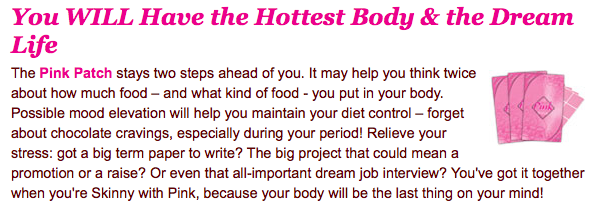
The product promises women a solution to their negative body image. Of course, the solution isn’t to think differently about their bodies; the solution is to use the Pink Patch to get skinny:

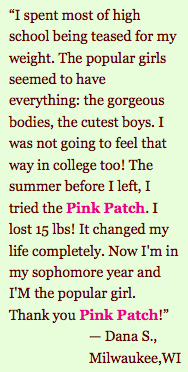
This quote from a supposed customer makes it clear that losing weight brings boys and popularity:

It also encourages competition and envy among girls:

And apparently, it’s an upper. You might experience “possible mood elevation” and can “relieve your stress,” allowing you to get everything done:

So use the Pink Patch and you will lose weight, which will bring popularity and male attention. Girls will envy you. You’ll be happier, you’ll get a lot done, and that will help you graduate with that great job you always wanted.

It’s the overall message of the diet industry, condensed in one website: the answer to all your problems in a product that will help you melt the pounds away, thus transforming your life. And it’s pink! So feminine!

Via Big Fat Deal.

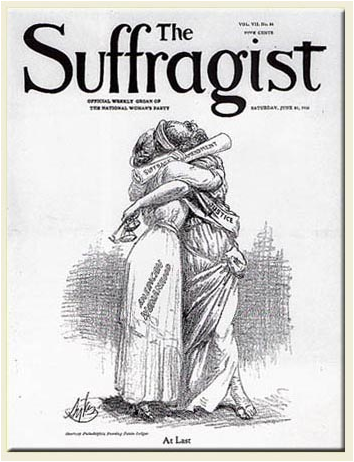
Penny R. sent in this image (found here via Pennamite) of a 1919 magazine cover.  The image is of two women embracing.  One represents “Justice” and the other “American Womanhood.”  It is captioned “At Last.”