Archive: 2011

Here, in this prelude panel discussion to the Internet as Playground and Factory conference, Tiziana Terranova presents a brief and excellent summery of how contemporary Marxist theory—particularly, Italian Marxist theories of socially-produced value—is useful in understanding the social and economic conditions of the Web.  It’s a bit dense, but, in brief, she argues that much of the value produced in modern capitalist societies now comes from outside the workplace.  Markets have learned to capture value from our everyday social activities.  The ideology of neo-liberalism has moved society even further away from the traditional wage-for-labor relationships that used to characterize the workplace by convincing people to view their individual labor-power as a (sometimes risky) investment that may or may not result in satisfying returns.

Terranova was an early advocate of viewing cyberspace and the material world as co-determining (what we describe, on this blog, as “augmented reality”).  Consider her (2000) statement:

I am concerned with how the “outernet” – the network of social, cultural, and economic relationships that criss-crosses and exceeds the Internet – surrounds and connects the latter to larger flows of labor, culture, and power. It is fundamental to move beyond the notion that cyberspace is about escaping reality in order to understand how the reality of the Internet is deeply connected to the development of late postindustrial societies as a whole.

The intrinsic materialism of Marxism proves quite productive in this case insofar as it draws Internet theorists toward viewing the material implications of digital politics. more...

As the 2012 presidential race ever so slowly gains momentum it remains clear that social media will be influencing elections for a long time to come. In the long run, does the shift towards social media campaigning change who is perceived to be a legitimate candidate? If so, social media might change who wins elections and therefore changes how we are governed. Avoiding [for now] the issue of whether social media has inherent tendencies towards the left or right, what I want to ask is: opposed to old media, does new media benefit political underdogs and outsiders?

As Republicans announce presidential bids on Twitter and Obama gets friendly with Zuckerberg and Facebook, it seems that the presidential campaign has found itself augmented by and reliant upon social media tools; some of the very same tools many of us use, like Facebook, Twitter, YouTube and so on. Part of their popularity is that one can view and be viewed by people from all over the world in an instant and for no cost. It does not cost money to publish this post or to tweet about it later on. Social media campaigning is also relatively cheap; indeed, often times free. Alternatively, print advertising is expensive because space is scarce and the scarcity of broadcast time makes television and radio too costly for underdogs and outsiders to fairly compete. However, when we exchange atoms for bits we enter into a world of abundance, a world where broadcasting a message quickly and globally becomes cheap and easy.

This cheaper social-media campaign style may remove or at least lesson more...

Already, we are being inundated with stories about the how social media will shape the 2012 campaigns (and how Facebook may, or may not, transform the Presidency itself).  Two facts, however, limit the potential role social media will, ultimately, play in the 2012 election:

1.) Young people are heavy users of social media, but are unlikely to vote.

2.) Older folks are likely to vote, but are much less involved in social media.

Thus, the reality is that social media is best at reaching those least likely votes. In its 2008 post-election analysis, Pew found that while 72% of Americans 18-29 year of age were using the Internet for political activities or information gathering (and 49% used social-networking sites for these purposes), only 22% of Americans 65+ years of age engaged in such activities on the Internet (and a mere 2% did so on social media).

From: Aaron Smith, "The Internet's Role in Campaign 2008," Pew Internet & American Life Project, 15 April 2009

At the same time, young adults are roughly 33% less likely to vote than their grandparents. more...

Costas K is a graphic designer who used Cyborgology Editor Nathan Jurgenson‘s post on digital dualism as part of a design project. The physical book explores the intersection of atoms and bits. The creator was invited to write a short essay about the project.

As kids, we were told to stop ‘wasting’ our time with electronic devices and that we should be outside, engaging with the ‘real’ world. Early on, the idea was planted into us that what we do using a computer is an alternative false state that bears no value. To still believe this is naive. Personally, I have met some of my best friends online. I make transactions, articulate opinions, receive feedback and get commissioned professional projects. How is this not real?

Still, when approaching the topic the first expressions that came to mind were ‘physical world’ and ‘digital world’ – the cornerstones of digital dualism. Nathan Jurgenson’s text ‘Digital dualism versus augmented reality’ helped me put things into perspective, before exploring them visually.

It is my belief that online activity is a continuation of what we do physically, more...

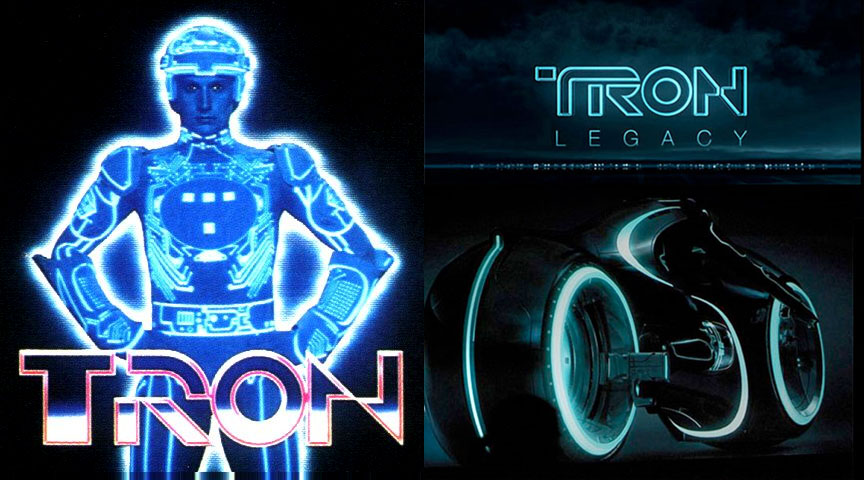
Cyborgology is sponsoring a local meetup event at PJ’s place on Wednesday, June 1st.  We’ll be enjoying a Tron Double Feature.  Use this link to contact PJ for details: http://is.gd/n5WwyE.

YouTube Preview Image

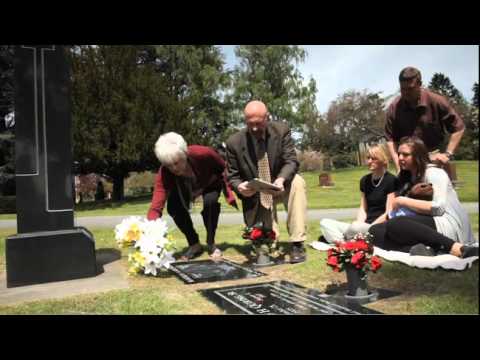
A company called Quiring Monuments has recently begun marketing augmented tombstones that are designed to assist smartphone-carrying visitors in accessing digital information about the deceased.  On these tombstones, qr codes are given the kind of prominence once exclusively reserved for a person’s name, dates, and epitaph.  The qr codes link users to individualized sites that contain information about the person being memorialized.  This means that part of the memorializing process now includes constructing an enduring Web presence for the deceased.

This raises a few questions.  How important to the memorializing process is being in the physical presence of a the body?  Will crystallized bits of memory in cyberspace deepen, or even eclipse, the memorial experience found in physical graveyards?  Facebook has already adopted a policy for memorializing accounts (also discussed in the official blog).  Are graveyards becoming redundant?

For more, see Bellamy Pailthorp’s NPR story, “Technology Brings Digital Memories To Grave Sites.”

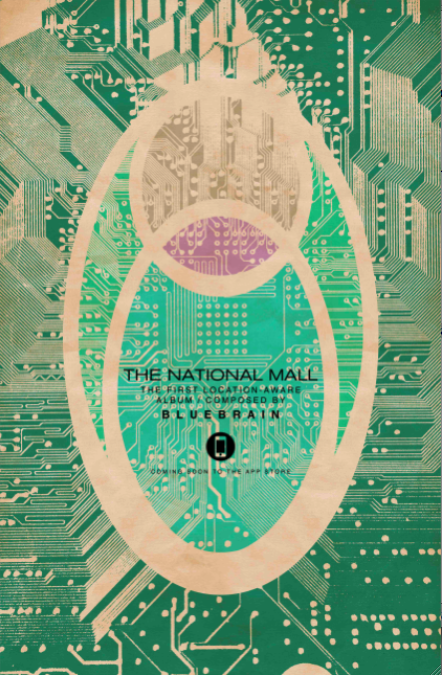
Washington D.C.-based musicians Bluebrain created an album that is actually a location-aware iPhone app called The National Mall (out today via Lujo records). Open the app while on the National Mall in Washington, DC and the music reacts to how you move about your surroundings. As reported on Wired UK,

approach a lake and a piano piece changes into a harp. Or, as you get close to the children’s merry-go-round, the wooden horses come to life and you hear sounds of real horses getting steadily louder based on your proximity.

We have previously looked at augmented reality art on this blog, such as Jon Rafman’s compelling Street View images,  Google’s Street Art View and Clement Valla’s “Postcards from Google Earth, Bridges” project. The National Mall is an augmented album, imploding digital media with your specific movements within physical space. The listener-turned-cyborg’s experience of the album comes in the form of the codetermining interaction of media and physical space.

The artists will release their next location-aware augmented albums for Brooklyn’s Prospect Park followed by another set to the length of Rt1 in California.

The Cyborgology Editors Nathan Jurgenson and PJ Rey are the guests on the latest Office Hours podcast. We chat about the Theorizing the Web 2011 conference we put on, as well as the Cyborgology blog. Listen here.

This post originally appeared on OWNI, 7 March, 2011.

“Robert, I am leaving you.” In the initial moments after, all Robert could do was replay those words in his head until all the tears he could muster had spilled from his broken heart. Once the shock settled, he could throw himself into the comfort of a bottle of beer – or harder alcohol depending on the situation – to drown out his sorrows. Yet the inevitable form of cleansing was obvious, as we’ve all been Robert –  he needed to burn (or at least return to the original owner) the knick-knacks, photos, love letters, and the memories that were attached to those objects. He needed to reject the one who no longer wanted him. This is not an easy step to make, but once this purging has been accomplished then the relationship is truly over.

That was before…and like everything else, yes, it was better before. Now, Robert must also mange his failed love-life in the digital world.  It is nothing groundbreaking that our lives are not just physical, but also virtual. So if we raise the question whether our digital accounts will affect the grieving process of friends and family after out death, the same inquiry can be applied to breakups. Social networks have permanently changed the situation, making breakups more painful. A US marketing agency tried to create “break up with your ex day” on the same day as Valentine’s Day: time to turn the page, unfollow, untag, block, and move on! Wise decision, but breaking digital connections are not the same as breaking ties in real life. The digital world constantly reminds the most desperate and nostalgic of their misfortunes.

Facebook: the heroine for breakups

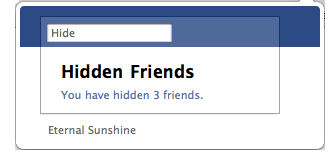
Lucy* had been dumped, and was too quick to take the decision to cut off her torturer from her Facebook profile. “I blocked him to avoid being tempted to contact him on his status updates. I knew I would post something or send him a message. It’s childish, I know!” Skip to the hater category, a well-known classic in the breakup realm. more...

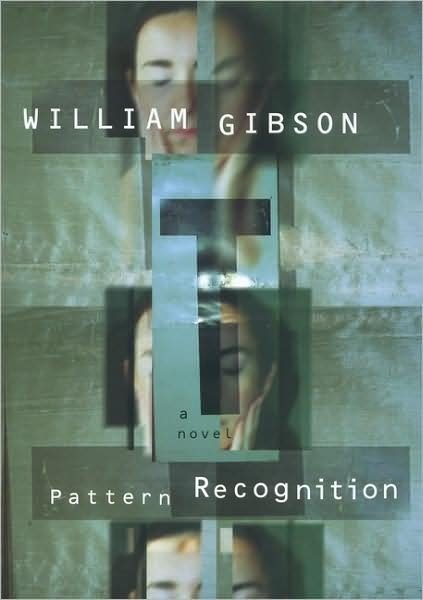
“The future is there,” Cayce hears herself say, “looking back at us. Trying to make sense of the fiction we will have become. And from where they are, the past behind us will look nothing at all like the past we imagine behind us now.”
–William Gibson, Pattern Recognition

“This is a kind of writing which simply makes you feel very strange; the way that living in the late twentieth century makes you feel, if you are a person of a certain sensibility.”
–Bruce Sterling, “Slipstream”, SF Eye #5, July 1989

I first read William Gibson’s Pattern Recognition almost a year ago, after a long hiatus from his work. I’ve long loved his books, but went through the kind of distance that time and life just sometimes put between a reader and an author. Pattern Recognition was the return, and I went into it cold, knowing nothing about it except for the author–an experience that I always find somewhat refreshingly like exploring a dark, richly appointed room with a small flashlight.

And then something rather interesting happened. The book contains a description of the memories that the protagonist retains of the events of September 11, 2001, and as I read, I experienced a curious kind of vertigo–something that I have since come to understand as the mirror-hallway perception of reading a fictionalized account of a real event in my own memory, remembered as past in a near-future context. In that moment, what I experienced as vertigo was the collapsing of a number of categories–past, present, and future, fiction and non-fiction, myself and other.

Vertigo, a really common illness seen in many of us may be a sort of dizziness that makes balance disorder. Vertigo gives one a sense of swaying while the body is stationary with reference to the world or its surroundings. Vertigo is commonest when an individual goes up some height. it’s going to produce to a false sensation of movement. Vertigo often results in nausea and vomiting.

Vertigo is said to the internal ear balance mechanism that relates to the brain or the nerves connecting the ear and therefore the brain. The disease creates a loss in equilibrium and wooziness. However, vertigo and dizziness aren’t synonymous. While dizziness is one symptom of Vertigo, not all dizziness are often termed as Vertigo. Vertigo is commonest in elderly people, but can affect both sexes at any age.

Vertigo is a treatable disease and handled through medicines, but only if treated from well qualified doctors like vertigo la. As vertigo is more a symbol of other diseases, it are often treated by treating the particular disease that causes this. If Vertigo has been caused by a tympanic cavity infection, then it requires antibiotic treatment. Home remedy is additionally an option for vertigo.

more...