
Archive: 2011

Since 2007, the US federal minimum wage has been set at $7.15 an hour, yet workers on Amazon’s Mechanical Turk—many of whom live in the US—make an average of $2 (according to the estimates of Mechanical Turk researcher Alex Quinn).  As illustrated in the above image, Amazon, itself, encourages businesses (at least implicitly) to pay workers (or “turkers” as they are called) less-than-minimum wages.  Moreover, to even qualify for these low-paying tasks called HITs (Human Intelligence Tasks), turkers are often expected to complete unpaid training sessions that can last for up to an hour.  Also, because turkers receive micro-payments for each task and because the time to completion for each task is rationalized to the second, turkers receive no pay during normal periods of rest during the workday.

Mechanical Turk is a crowdsourcing platform that allow anyone to recruit laborers for short online tasks, which cannot be effectively completed by computers.  For examples, turkers might compile contact information for various businesses, sort through images and tag offensive ones, or participate in university research experiments.  Because of the piecemeal and spatially-disembedded nature of the work, it is virtually unregulated.

Can we simply dismiss this subversion of labor laws—as some commentators have—on the grounds that “$2 an hour is a decent wage in India?”  Even if we are angered by this exploitation of turkers, is it even possible to regulate an international platform of this sort?


Just came across the personal blog of Nick Pearce, a scholar at Durham University’s Foundation Centre, who is doing some very interesting research on higher education, technology, and zombies. I discovered his website while researching existing work on zombies and higher education, and I discovered that he is one of the scholars putting together the much-awaited anthology “Zombies in the Academy: Living Death in Higher Education” (to be published in 2012).

I was particularly drawn to an old post on “Zombies, Technology, and Capitalism,” because of Pearce’s use of the zombie metaphor in depicting some of the recent trends in higher education. He states rather eloquently:

The very general thrust is that VLEs (such as Black(magic)board, and VOODLE) replace face-to-face ‘human’ learning with undead digital teaching. These VLEs have rapidly spread across the sector (virally?) without being explicitly demanded by either teachers or students. The embedded pedagogy of these VLEs is restrictive and they offer a level of social control and conformity not possible with more traditional teaching practices.

In Pearce’s words, the Virtual Learning Environments (VLEs) of today’s academy sap the human element out of the classroom (or computer screen in this case). more...

Google Maps has a new tool to help the consumers of its popular maps also be producers. Users-generated improvements will be a benifit to many, but probably most to Google itself. While the Google video below paints all of this in light of personal or civic empowerment (“leave your mark”), we should also understand that this move towards us becoming “prosumers” of these maps is also about the company taking advantage of our free labor in hopes of earning greater profits. Does that bother anyone?

YouTube Preview Image

“We’re not computers, […] we’re physical,” explains the Blade Runner‘s chief antagonist, a replicant named Roy Batty.  In this moment of dialogue, Blade Runner engages a frequent themes of the Cyborgology blog—the implosion of atoms and bits, which we term “augemented reality.”  In this statement, Roy unpacks the assumption that digitality and physicality are mutually exclusive, while, simultaneously, transcending the boundary between the two.  Put simply, Roy is contending that computers cease to be mere computers when they become embodied.  In contrast to the familiar theme of cyborganic trans-humanism, Roy is articulating (and embodying) the obverse theory: trans-digitalism.

This Copernican turn—de-centering humans’ role in understanding of the universe—is, undoubtedly, one of the great contributions  of the cyberpunk genre (and science fiction, more broadly).  Quite provocatively, it points to the possibility of a sociology, or even anthropology, where humans are no longer the direct object of inquiry.  The question, here, shifts, from how we are shaped by and interact with our tools, to how technology itself becomes an actors (or even agents!) in a particular social milieu. more...

YouTube Preview Image

Greetings cyborgs,

I came across this interesting video last week on BME Modblog. If you are unaware, the Nintendo 3DS now offers augmented reality video games. One gamer was so excited by this new technology, he got the AR card tattooed on his forearm to allow himself to become part of the game experience itself.

This exemplifies what Nathan and others have discussed on this blog many times. That is, the merging of the digital and the material and the creation of an augmented reality. So is the man in this video truly a “cyborg?” I believe so. In fact, we all are to a certain extent. Heck, you are reading this blog right now, engaging in a dialogue with me from far away through the help of internet technology. In this sense, the Nintendo DS AR card tattoo serves as an exemplary case of modification and the new cyborg body that I have spoken about before in this blog. more...

Lately I have been trying to list all of the spaces, places, moments in time, story telling techniques, life courses, and jobs that are not popularly considered “the real world.” Here is the not-so-comprehensive list I came up wtih:

  1. The Internet
  2. Video Games
  3. Books
  4. Graphic novels
  5. Reality television
  6. Movies
  7. School
  8. College
  9. “Theory”
  10. Fiction

A note about number 3 (and 4). I say “books” as a whole, to capture two sentiments. The first, is an aversion to the nerdy bookworm that is exemplified in The Twilight Zone’s “Time Enough At Last” (SPOILER). The second is a sort of anti-intellectualism more...

In his Beyond the Beyond blog (hosted by WIRED magazine),  cyberpunk author Bruce Sterling recently made some comments on my post, “Cyborgs and the Augmented Reality they Inhabit.”

Here’s how he describes the piece:
[…] an argument about the definition of Augmented Reality and the definition of Cyborgs, until you can get ‘em to click together like puzzle pieces. But so much debris is left on the floor when they’re done with the theory tin-shears, that the debris looks more interesting than the remainder.
Though it may appear quite critical, I actually agree with Sterling on this point—authors on this blog have rendered augmented reality (and the cyborgs that inhabit it) quite banal.  Or, rather, the techno-saturated world that has emerged in the 21st Century appears to us far more mundane than the exotic dystopian imagery that enveloped the famous cyberpunk novels of yesteryear.  The fantasy of ocular implants and digital immersion have given way to the seemingly unremarkable reality of smartphones and Facebook. Through the “theory tin-shears” futurist art of the past becomes the sociology of the present.  But, the study of present realities will never be as exciting as the imagining of future possibilities. more...

Orcs, Trolls, Elves and more. With such fantastical races and landscapes, online gaming is an area where people can seemingly escape reality and all the expectations of society. For newcomers to the world of online gaming, it seems like anything can happen. You can be whomever you want to be, your race, gender, sexuality or physical limitations no longer matter. Games without avatars provide an even deeper layer of anonymity for players; for all you know, you could be playing against a faceless being behind a computer.

However as most people will quickly realize, the online gaming world is very similar to the “real life” world and strong assumptions and stereotypes regarding players still exist. Players can largely avoid racial stereotypes as it’s hard to tell the race of the person behind the screen, however, gender stereotypes are harder to escape.
After a short period of time, more...

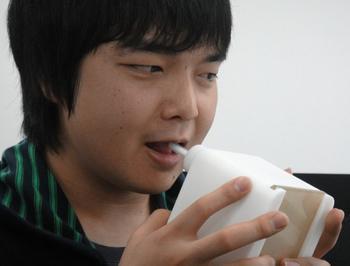
The Kiss Transmission Device was recently created in a lab in Japan. This is essentially an internet connected French kissing machine. Yes, you read that correctly. It is a machine that allows you to share actual French kisses via the internet. Okay, they are not actual French kisses…but kind of.

A user of the device caresses an internet connected straw-like mechanism with their tongue, causing the device to transfer the motion to a second straw-like mechanism, ostensibly located in the mouth of a romantic partner. Developers hope eventually to make the device more “tongue like” by adding personalized flavor, moisture and breathing patterns.

The developers view this as a device that will aid in the maintenance of long-distance romantic relationships, allowing geographically separate partners to connect on a physical level. They also talk about marketing celebrity kisses—allowing users to swap spit (er, swap straw movements) with the likes of Justin Bieber or any other celebrity willing to sell a physical piece of hir sexuality. more...

Shepard Fairey, that designer most famous for creating (stealing?) the iconic Obama image, has designed the cover for the new edition of Marshall McLuhan’s famous book, The Medium is the Massage. Fairey is known for creating art that often makes reference to the way propaganda is used by the powerful to control the masses into obeying. In fact, Fairey’s famous “OBEY” graphic is a reference to John Carpenter’s brilliant 1988 film about consumer culture, They Live (plot: with the help of special sunglasses, advertisements are revealed as actually reading, “obey,” “consume” and so on). Be it advertising, print, television or social media, McLuhan’s points remain important.

“Electrical Information Devices for universal, tyrannical womb-to-tomb surveillance are causing a very serious dilemma between our claim to privacy and the community’s need to know”. more...