race

  • Arlie Russell Hochschild (Professor Emerita of Sociology at the University of California, Berkeley) appeared on Next Question with Katie Couric, discussing her book Stolen Pride: Loss, Shame, and the Rise of the Right. The book describes how residents of Pikeville, KY, a small city where 80% of 2016 voters supported Donald Trump, felt a pervasive sense of economic loss and why Trump’s messages resonated with them. In response to the 2024 election, Hochschild comments: “I feel like America is now living with two denials. There’s the denial of the Democratic side of America that is [] really denying what a big sector of America that has faced tremendous loss and has lost faith in the government’s response to that… But there’s a denial on the Right side of the aisle. Republicans that may have voted for a man for one reason—the border, the price of gas. But we are facing, I think, a danger to democracy and I think there is a discounting and a denial of that on the Right side of America.” Stolen Pride was recently recognized by the New York Times as one of the 100 Notable Books of 2024.
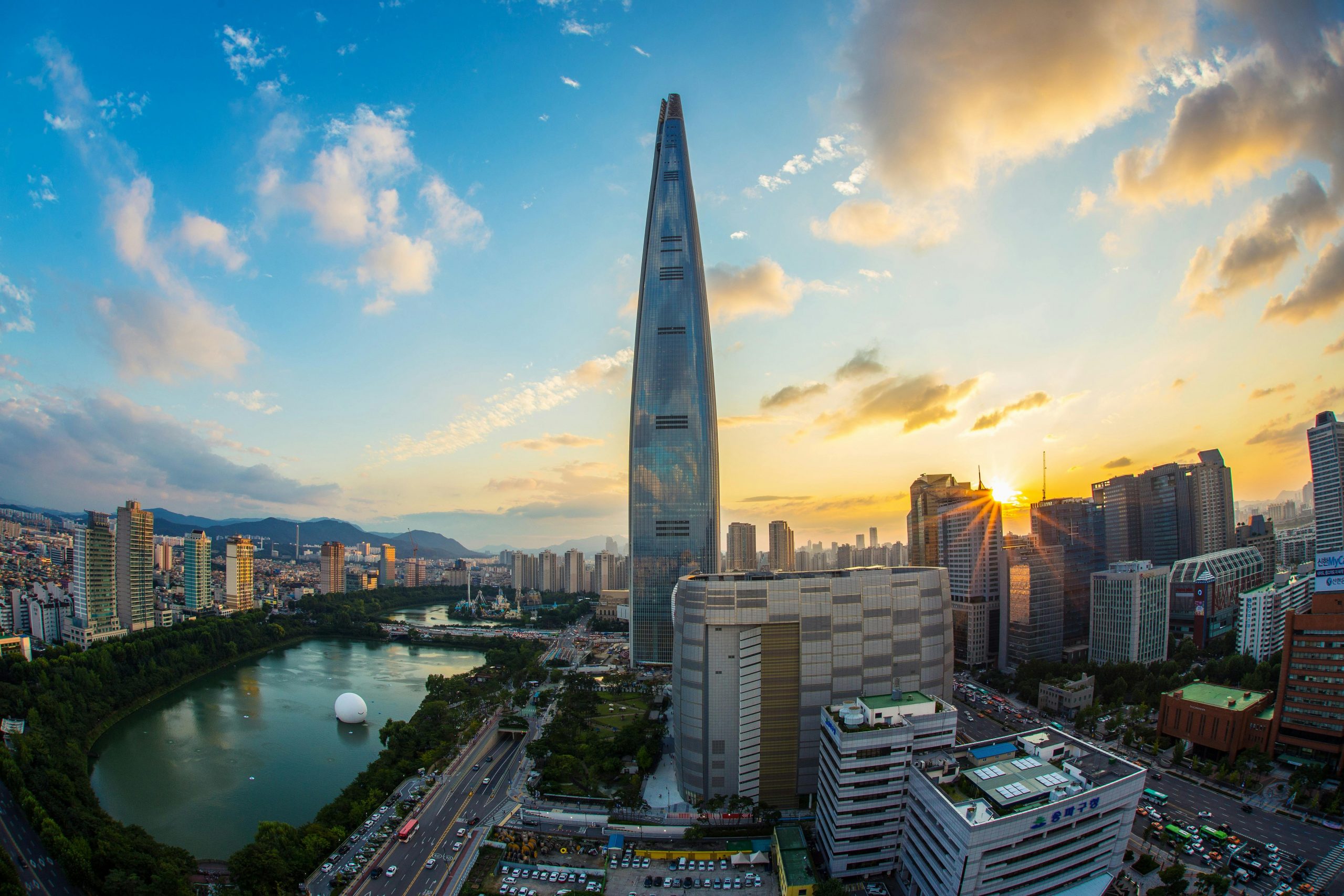
  • On Dec. 3rd, South Korean President Yoon Suk Yeol declared martial law, prompting widespread protests. He rescinded the decision six hours later. Gi-Wook Shin (Professor of Sociology and Director of the Asia-Pacific Research Center and Korean Studies Program at Stanford University) described the decision as a “surprising last-ditch move by Yoon to grab political power” amid low approval ratings. Shin appeared on NPR’s All Things Considered, discussing the future of democracy in Korea: “I think for a short term, there will be a lot of uncertainties and maybe instability in politics and society, maybe even in the economy. But in the long run, I think Korea has strong democratic institutions… And I remain optimistic, especially that such a move like martial law, you know, failed, you know, quite badly and very quickly.”

  • The New York Times ran an opinion piece featuring Allison Pugh’s (Professor of Sociology at John Hopkins University) new book The Last Human Job: The Work of Connecting in a Disconnected World. Pugh’s work reveals how technology––particularly artificial intelligence–has permeated work that requires “connective labor” and how “being able to have a human attend to your needs has become a luxury good.” However, Pugh commented that a dystopian future is not inevitable despite advances in interactive AI, because “humans lose interest in interacting with machines after a while, partly because of machine predictability.”

  • The Ink ran an article featuring Musa Al-Gharbi’s (Assistant Professor in the School of Communication and Journalism at Stony Brook University) new book We Have Never Been Woke: The Cultural Contradictions of a New Elite. “One of the key arguments of the book,” Al-Gharbi explains, “is that in many respects — and somewhat troublingly, from my perspective – social justice discourse is increasingly used by symbolic capitalists [elites who are committed to social justice], by the winners and the prevailing order of people who have been succeeding and flourishing, to justify inequalities. People who are losing, and suffering, and getting left behind, who feel like their values and interests are not reflected in our institutions, we [symbolic capitalists] point to those people and say, Good. They deserve to be marginalized. They deserve to be ignored. And we do this in the name of social justice. We use social justice, in many cases, to legitimize inequalities.”

  • Danielle Lindemann (Professor of Sociology at Lehigh University) was quoted in an Epic Stream article about what reality television reveals about our culture. Lindemann argues that reality TV provides a reflection of real-life people and social problems (like inequalities based on race, class, gender, or sexuality): “For all of its extreme personalities and outlandish premises, reality TV reflects how regressive we truly are.”
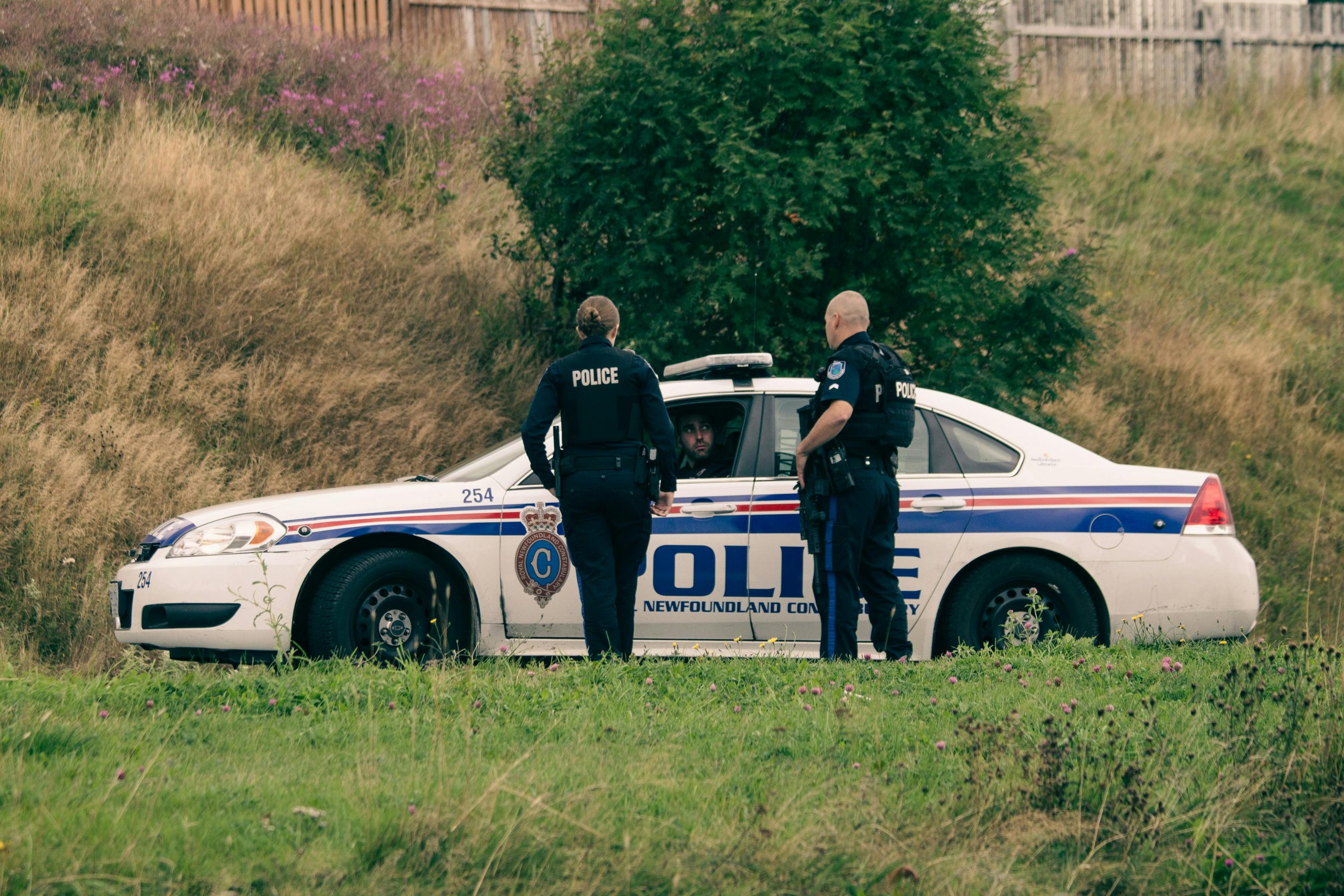
  • The Minneapolis Reckoning: Race, Violence and the Politics of Policing in America, a new book by Michelle S. Phelps (Associate Professor of Sociology at the University of Minnesota), argues that Minneapolis is a “secret bellwether city for understanding race and policing in America” and “a test case for both the possibilities and limits of liberal police reform.” Phelps appeared on MPR News, discussing the origin of her research, interviews with Minneapolis residents, and the potential impact of court-imposed reform measures. Reason Magazine called the book “a valuable piece of research on how fights for police reform are won and lost, and what reform means to the people who need it most.”
  • The U.S. Department of Justice recently filed an antitrust lawsuit against Live Nation Entertainment (the parent company of Ticketmaster) for monopolization of the concert industry. In an interview with The Conversation, David Arditi (Associate Professor of Sociology at the University of Texas – Arlington) discussed how musicians are now more dependent on tour revenues to make a living and how Live Nation and Ticketmaster changed the ticket purchasing experience for consumers.
  • In a new book, Between Us: Healing Ourselves and Changing the World Through Sociology, forty-five sociologists share personal stories of the impact of sociology. “I’ve always believed that sociology helped save my life and can do the same for others,” said co-editor Elizabeth Anne Wood (Professor of Sociology at Nassau Community College). “Instead of feeling hopeless and helpless, I found strength in understanding the social structures that constrain and hurt us,” co-editor Marika Lindholm (sociologist and founder of Empowering Solo Moms Everywhere) explained. This story was covered by PR Newswire.
  • Benjamin Shestakofsky (Assistant Professor of Sociology at the University of Pennsylvania) wrote an article for Zócalo Public Square describing how venture capital business models “help create products that succeed in short-term disruption—with questionable or even dangerous long-term effects” and the various alternatives to the venture capital model. “By promoting and investing in businesses with alternative ownership structures,” Shestakofsky argues, “consumers, workers, activists, and governments can challenge venture capital’s winner-take-all model, creating ecosystems of smaller, more localized and specialized platforms that are more responsive to the people who use them and to the communities in which they are embedded.”
  • The Telegraph ran a story on the rise of the ‘work from home’ husband, describing the post-pandemic phenomena of U.K. men working from home while their wives return to the office. Heejung Chung (Professor of Sociology and Social Policy at the University of Kent) commented that there is more opportunity to work remotely in male-dominated jobs. “The three big occupations or sectors where remote work is still limited are healthcare, education, not all education but mainly primary and secondary, and then the third is retail. Those are very female-centric occupations, where remote working is not possible,” Chung said.
  • In response to excerpts from Britney Spears’ upcoming memoir that revealed she had an abortion, USA Today ran a story on how access to abortion care benefits male partners. The article quotes Bethany Everett (Associate Professor of Sociology at the University of Utah): “Abortion is a highly stigmatized form of healthcare, and women almost always bear the brunt of the stigma and shame around abortion. Yet, there are likely many people, including male partners, who don’t want to become parents or have another child, who also benefit from abortion access — benefits that are rarely recognized by the broader public or policymakers.” 
  • Daniel Jaffee (Associate Professor of Sociology at Portland State University) wrote an article for The Conversation discussing the role of bottled water as a stopgap solution to natural or human-made drinking-water crises. Jaffee notes that “communities can end up relying on bottled water – often at great expense – for years after a crisis” and that existing inequalities are worsened by placing the costs on individuals. Jaffee recently published Unbottled: The Fight against Plastic Water and for Water Justice.
  • LeanIn.org and McKinsey released the annual Women in the Workplace report, which claimed that the “broken rung” – rather than the “glass ceiling” – is the biggest barrier to women’s advancement. Within the metaphor of careers as ladder, the “broken rung” occurs at the beginning of corporate careers, between entry level positions and managerial positions. “The thing that’s important to understand about the broken rung is that those people at that stage of career are earlier in their career, so they don’t have a really big track record,” explained sociologist Marianne Cooper (co-author of the report and Senior Research Scholar at Stanford University’s VMware Women’s Leadership Innovation Lab). “Men are getting it on potential, whereas women are held to a higher standard of performance[.]” This story was covered by Human Resources Director.
  • A recent study by Katie Spoon (PhD student in Computer Science at the University of Colorado, Boulder) and colleagues revealed that “workplace climate/atmosphere” was the most common reason that women leave academic positions (over both professional reasons and work-life balance). Compared to men, women were 44% more likely to feel pushed out of academia. Kimberlee Shauman (Professor of Sociology at the University of California, Davis) commented that the study provides a rare picture of trends in the overall academic field, rather than focusing on individual institutions. This story was covered by Nature.
  • ABC’s new season of The Bachelor centers around a 72-year-old “Golden Bachelor.” Deborah Carr (Professor of Sociology at Boston University) wrote an opinion piece for CNN on what dynamics we may see unfold over the season based on her expertise on aging. Carr anticipates that: 1) discussions of health will be important bonding moments, as managing health is salient in older adults’ lives; 2) family approval of the relationship will be crucial, as older adults are often merging two families in romantic relationships; and 3) marriage may be less of a focus, as increasing numbers of older adults are cohabitating or “living apart together.” To learn more on this subject, read a recent TSP Discovery on Older Adults on the Dating Market.
  • The New York Times featured new research from Nick Graetz (Postdoctoral Research Associate at the Princeton University Eviction Lab), Carl Gershenson (Project Director at the Princeton University Eviction Lab), Peter Hepburn (Assistant Professor at Rutgers University), Matthew Desmond (Professor of Sociology at Princeton University), and additional colleagues from the Census Bureau. The study found that children – particularly children under 5 – are disproportionately affected by eviction filings. The article suggests that both the financial effect of having young children and discrimination from landlords (who often see children as an unwanted risk) contribute to this trend.  “When I started writing about these issues, I kind of thought kids would shield families from eviction,” Desmond commented. “But they expose families to eviction.”
  • David Roediger (Historian and Professor of American Studies at the University of Kansas) wrote a piece for Mother Jones on the “mirage of the middle class.” Referencing C. Wright Mills’ work on the new middle classes of the 1950s, Roediger discusses how the imprecision of the term “middle class” is mobilized by politicians in election seasons.
  • For Hispanic Heritage Month, Mark Hugo Lopez (Director of Race and Ethnicity at the Pew Research Center) and Christina Mora (Associate Professor of Sociology at Berkeley) appeared on PBS News to discuss the terms “Hispanic” and “Latino” and how identity language has shifted over time. Mora discussed the push from Mexican, Puerto Rican, and Cuban populations in the 1960s/70s to get the United States to establish a panethnic census category. Lopez discussed how Latino adults use country of origin terms in discussing their identities.
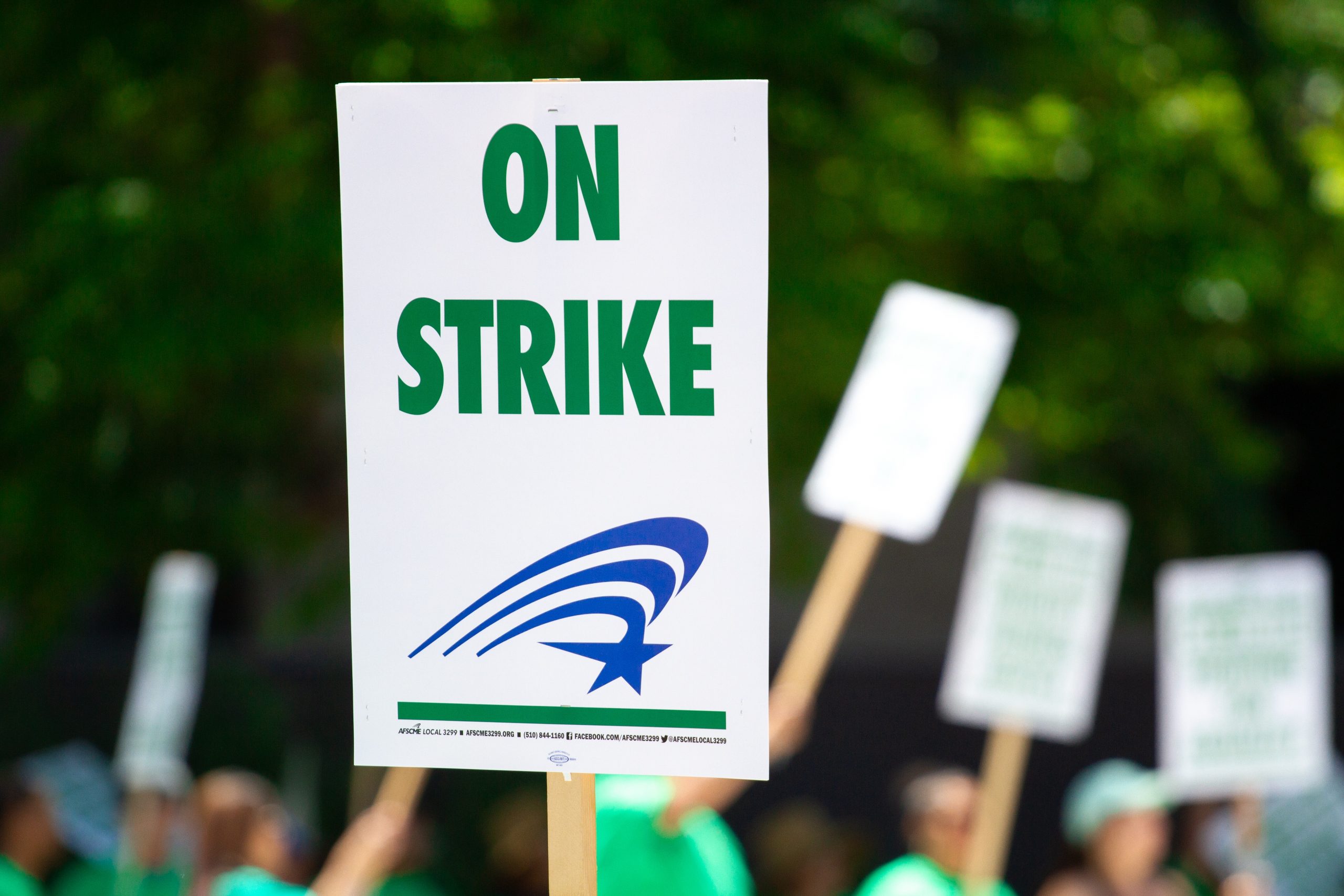
  • Aarushi Bhandari (Assistant Professor of Sociology at Davidson College) wrote an article for The Conversation, reflecting on how news of the strike-ending deal between the Writers Guild of America and the Alliance of Motion Picture and Television Producers was eclipsed by celebrity headlines. Six conglomerates own 90% of media outlets, giving them significant power over media narratives. Bhandari argues that the limited coverage of the WGA deal “fits into a longer historical pattern of tension between labor movements and corporate media” in which “corporate media has framed disproportionately negative narratives about strikes and union activities.”
  • Janet Vertesi (Associate Professor of Sociology at Princeton University) wrote an article for The Conversation discussing how NASA’s robotics can provide an example of an ethical future for AI. Vertesi notes three aspects of “strong human-robot teams”: technology that augments or extends human capabilities instead of replacing human work, respectful data harvesting and use, and a sense of care for the technology.
  • Matthew Desmond (Professor of Sociology at Princeton University) appeared on the ACLU’s At Liberty podcast. In conversation with Sandra Park (Senior Staff Attorney of the ACLU Women’s Rights Project), Desmond discussed the complexities of American poverty. “There’s a lot of propaganda out there about poverty, and […] it organizes us. It shapes our conversation, right, or kills the conversation. […] And so I think that means for me, shifting the aperture away from-from poor families and poor communities to us, to a lot of us who are living our lives, often unwittingly, in a way that contributes to poverty in our midst.”
  • Juliet Schor (Professor of Sociology at Boston College and lead researcher on the 4 Day Week Global trial studies) appeared on NPR’s TED Radio Hour to discuss the four-day workweek. Schor described how a four-day workweek can have positive well-being and climate outcomes without lowering worker productivity. 
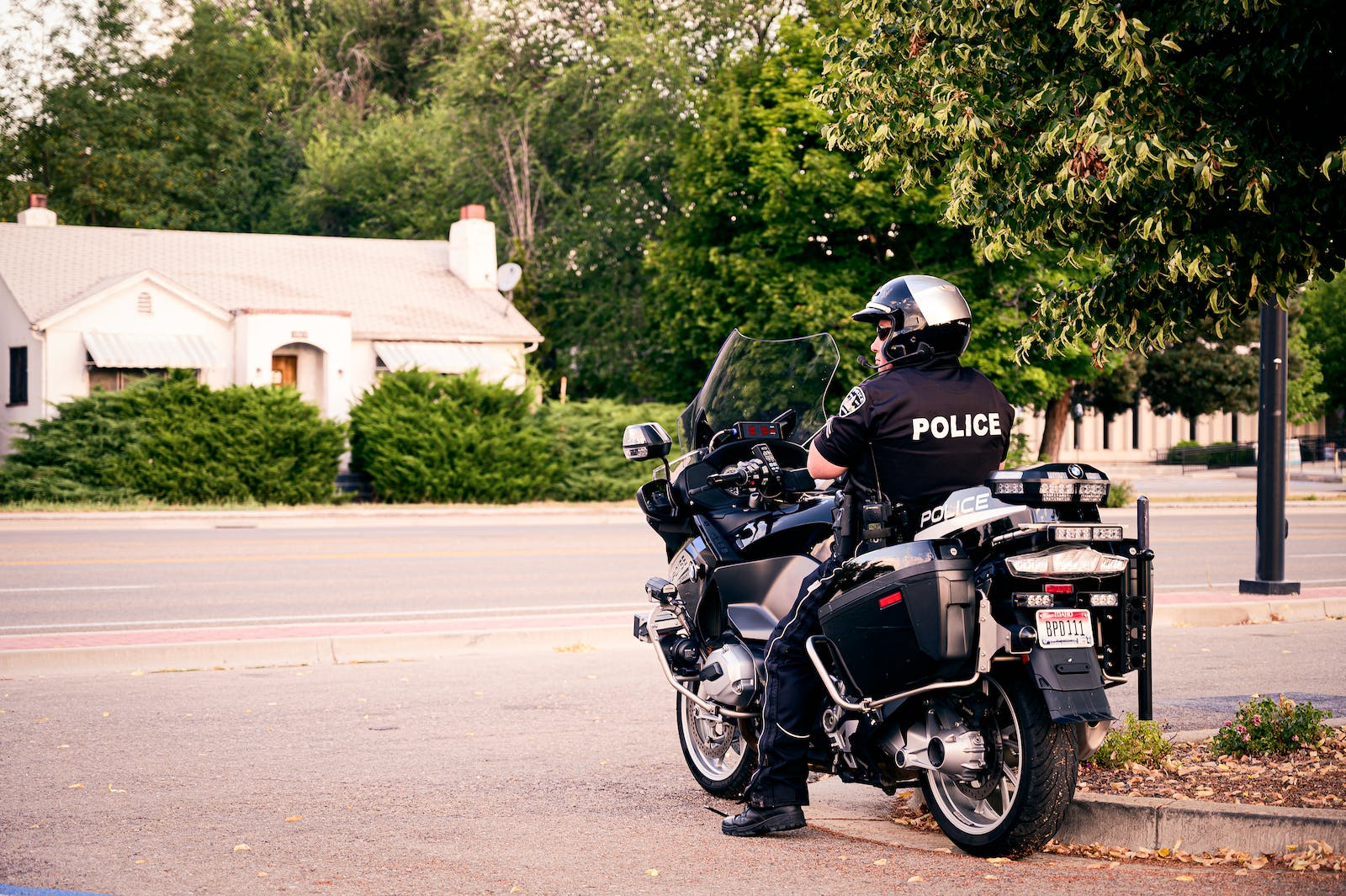
  • Neil Gross (Professor of Sociology at Colby College) wrote an article for Time, arguing that three “myths” about police reform are limiting productive conversation and policymaking: 1) the police can’t prevent crime; 2) police reform compromises public safety; and 3) because of policing’s racist origins, there is nothing we can do to improve it. Gross discusses how policing in combination with poverty reduction efforts can reduce crime, the complex connections between police defunding and crime, and his belief that “institutions can evolve beyond their origins.”
  • In Philadelphia, a former police officer is facing trial for over 200 sex crimes. While on the force, the officer was the subject of 12 citizen complaints. Nicole Gonzalez Van Cleve (Associate Professor of Sociology at Brown University), commented on the difficulty of creating accountability for police officers: “This officer, while he looks like ‘one bad apple’, a whole lot of players had to participate in emboldening such an egregious criminal activity that went on for years. That shows the flagrant nature. He knew there were no levers of accountability.” This story was covered by WHYY.

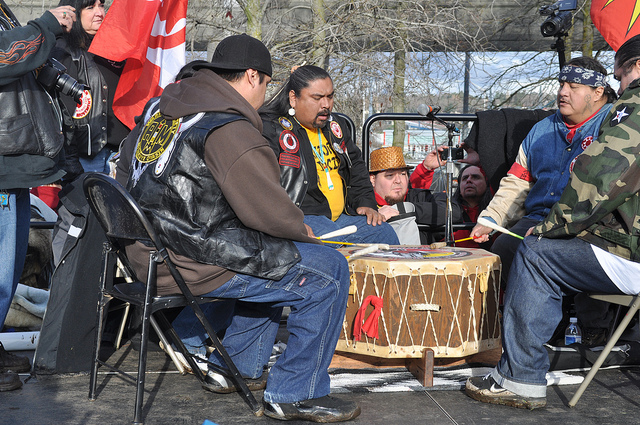
Three members of Warrior Society Mitakuye Oyasin sitting in chairs around a drum, drumming and singing.
Photo by Joe Mabel, Flickr CC

Following taunts from President Trump and other Republican officials, Democratic Senator Elizabeth Warren took a DNA test to “prove” her American Indian ancestry last fall. However, the political spectacle did not involve the Cherokee Nation’s determinations of who can rightfully claim their heritage, and for many American Indians, DNA tests have no bearing on deciding tribal heritage. The weight placed on these tests today harkens back to antiquated concepts of race, ethnicity, or tribal status as genetics — stripping the historical, cultural, and social meanings that shape them. Outsider attacks on tribal sovereignty are also an example where American Indian identity has been defined and controlled in the United States. In a recent Weekend Edition on NPR, social scientists weigh in on how determinations of American Indian identity have changed over time, and how who is “counted” as American Indian often depends on the method used for evaluating this identity.  

Throughout the latter half of the twentieth century, the U.S. Census has been key in tracking shifts for—and perhaps even influencing—the likelihood for one to identify as American Indian. According to census statistics, the American Indian population tripled from 1960 to 1990. Sociologist Carolyn Liebler argues that this shift is due to changes in the way the Census measured racial identity; instead of relying a census worker’s determination of someone’s race, participants were allowed to choose their own race starting in 1960. According to Liebler, before 1960 census workers

“[were] not necessarily going to see a person who’s American Indian as American Indian. And it was fairly rude, as kind of it is now, to ask someone what race they are. So the [census worker] would just write it down.”

The ability for one to self-classify, therefore, is likely part of the change in population. Anthropologist Russell Thornton, a member of the Cherokee Nation of Oklahoma, believes that the change may also be due to American Indian activism. He argues that the Civil Rights Movement empowered American Indians to be activists and lay claim to American Indian identity. According to Thornton,

“People that didn’t want to admit any Indian ancestry now thought it was kind of OK to be, quote, ‘Indian’ – even fashionable.”

Even the process to legitimate one’s claim as American Indian—and a citizen of a particular tribe—is debated in some tribal nations. Sociologist and member of the Cheyenne Nation, Desi Rodriguez-Lonebear states,

“[This process] has broken up families. It influences who individuals choose to partner with and have children with. It really permeates every part of our existence, in reality, as native peoples.”

Serving as an advisor for the Census Bureau, she urges policy makers and researchers to listen to American Indian communities as identities continue to shift and change.

Photo of old and young hands holding piggy bank by rawpixels, Pexels CC

Since the turn of the millennium, Americans over 55 have been giving more financial help to their adult children than ever before, with much of this assistance going to support things like their grandchildren’s education, living expenses, and medical bills. However, this growth in intergenerational giving has forced many grandparents to tap into their own savings to pay it forward.

In an interview for The Atlantic, sociologist Kathleen Gerson explains that sometimes grandparents provide help to the younger generations, even if doing so comes at a cost to themselves.

“Financial managers advise the elderly to hold on to the money they’ve saved, to use it to care for themselves in old age, to avoid becoming the responsibility of their children”… But many grandparents have a hard time listening to this advice, she said, because they can see that their children and grandchildren are even more financially insecure than they are.”

Robust social programs benefiting senior citizens, like Social Security, likely provide a sense of economic security that makes them feel capable of giving. Yet, while the social safety net has all but eliminated poverty among the elderly, dwindling support for social programs supporting children and families has left children in a more precarious position than their elders. As a result, Gerson explains, grandparents across the United States are “stepping into the void” to provide for the younger generations.

Giving money serves two functions, Gerson said—it’s “a way of expressing love,” and a way to help ensure “that your children’s children will have a decent spot in the world.”

But not all grandparents bear an equal burden in supporting the youngest generation. African American and Latino grandparents are more likely than white grandparents to spend money on schooling, to help out with living expenses, and to indulge their grandchildren when they ask for things. And, working and middle class Baby Boomers are more likely than wealthier peers to tap into their own savings or delay retirement.

Because grandparents are unequally equipped to provide financial support, doing so takes a greater personal toll on some than on others. Paradoxically, if we want to improve seniors’ quality of life in their golden years, an effective way to do it is by bolstering social programs to prevent poverty among the young.

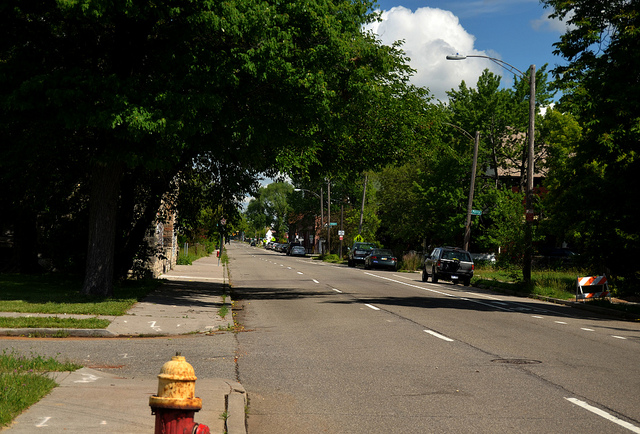
Photo of a street lined with trees in Detroit. Photo by Nic Redhead, Flickr CCi

Evidence shows that trees and green spaces in urban areas offer a number of benefits, such as reducing stress and improving air quality. Despite these benefits, many residents of Detroit refused to allow the city to plant trees in front of their houses during a recent city “greening” initiative. An article appearing in CityLab draws from sociological research to demonstrate how a history of government abuses and lack of inclusivity of communities of color in key decisions explains why many Detroiters had this reaction.

Sociologist Dorceta Taylor published a report in 2014, arguing that white environmentalists make environmental justice projects less effective when they assume they know what is good for a neighborhood. By leaving communities of color out of the planning process, they are not able to anticipate or overcome challenges along the way. This proved true in Detroit. A recent article by Christine Carmichael and Maureen McDonough examined the reasons why Black residents resisted the city’s trees. CityLab reports: “It’s not that they didn’t trust the trees; they didn’t trust the city.”

Carmichael and McDonough found that Black residents were aware of the many benefits of living near trees. However, to some, the trees were a symbol of the city’s unwanted intervention in their lives. Amidst racial tension in the 1960s, the city began clearing trees from Black neighborhoods — ostensibly to combat Dutch elm disease, but some interviewees. Yet, some people believed the city cut down trees to increase police surveillance. This memory triggered their reaction to the modern tree-planting. Carmichael says:

“In this case, the women felt that [after the race rebellion] the city just came in and cut down their trees, and now they want to just come in planting trees. … But they felt they should have a choice in this since they’ll be the ones caring for the trees and raking up the leaves when the planters leave. They felt that the decisions regarding whether to cut down trees or plant new ones were being made by someone else, and they were going to have to deal with the consequences.”

This failed initiative in Detroit highlights the social forces that environmental organizations must consider when working in marginalized neighborhoods. Recruiting volunteers and administrators who come from the communities they are serving (something Detroit did not do) could help improve the process. As CityLab reports:

“[E]nvironmental justice is not just about the distribution of bad stuff, like pollution, or good stuff, like forestry projects across disadvantaged communities. It’s also about the distribution of power among communities that have historically only been the subjects and experiments of power structures.”

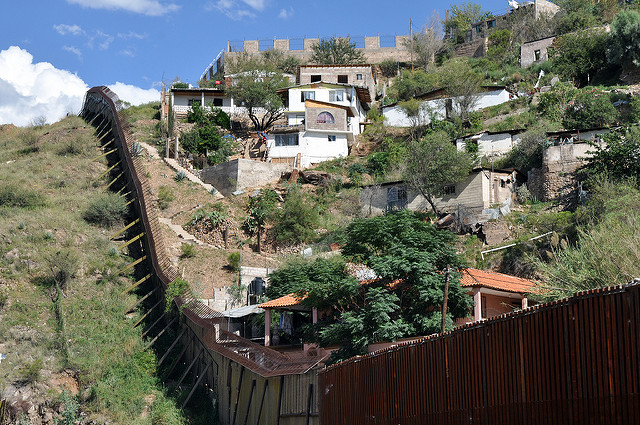
Photo of the wall in Nogales that divides Mexico and the United States. Photo by Jonathan McIntosh, Flickr CC

Current pressure for a wall on the United States’ southern border has been a centerpiece in politics and the media, but push for a wall is one recent development in a complex history of border politics. For centuries, the border has been a site for war, conflict, immigration, and trade. A recent article in The Washington Post highlights how these historic events have contributed to defining what the border means today, and how — especially in recent decades — this has led to calls for heightened security and enforcement.

The border itself is a powerful political symbol. According to sociologist Douglas Massey, it is not just

a border but the border, and its enforcement has become a central means by which politicians signal their concern for citizens’ safety and security in a hostile world.”

Recent work by Massey highlights how throughout history this “hostile” world has been defined and composed of dissident actors — drug traffickers, terrorists, communists, or criminals — with politicians using them as political chips to peddle and spin different narratives on how and why we should protect the border.  

This research demonstrates that whether the southern border is an invisible line, physical fence, or wall, it continues to be a symbolic boundary for people who hold a profound fear of those who are non-white or of different cultural backgrounds. For example, recent political positions towards Central American migration to the United States seem to echo historic anti-immigrant attitudes. During the late 19th century, Chinese laborers were banned for decades from immigrating to the U.S. for their perceived cultural and economic threat to American society.

As debates continue over the construction of a southern wall, it is worthwhile to question if anti-immigrant attitudes and fears are haunting reverberations of the past. Recognition of the complex history of the U.S.-Mexico border and its connection to fear of crime and xenophobic attitudes may be a useful starting point so that today’s politics do not become “another brick in the wall” in the history of the border.

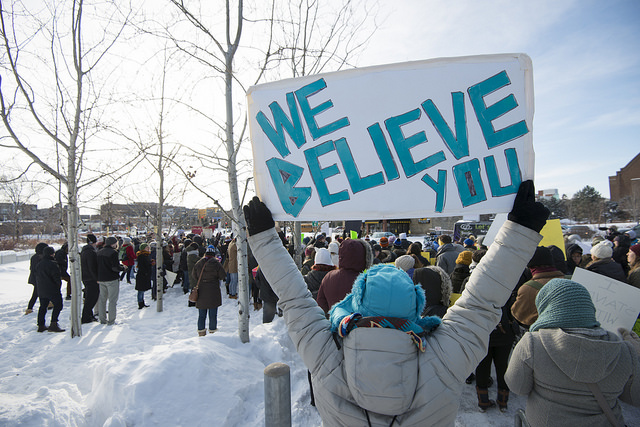
A marcher holding a sign that says, “we believe you.” Photo by Fibonacci Blue, Flickr CC

Since Surviving R. Kelly aired on Lifetime, we’ve seen a rise of activists led by Black women calling for the #MuteRKelly campaign, which dissuades music labels, radio stations, and other music platforms from selling, distributing, and promoting R. Kelly’s music. But despite the recent backlash, fans across the country continue to show their support for the R&B star. While some attempt to separate their feelings about the art from the artist, others dismiss Black women’s claims of R. Kelly’s abusive behaviors altogether. Much of this support comes from other Black R. Kelly fans. The documentary and the subsequent controversy also shed important light on an issue that is often missing from the public sphere: the plight of Black women and girls who experience sexual violence. Saida Grundy’s recent piece in The Atlantic helps us break down how Black support for R. Kelly remains despite the shocking revelations from Black women.

Rape myths have long obscured sexual victimization by suggesting that “real rape” occurs by strangers in a dark alley, women who dress “proactively” and show signs of intoxication “ask for it,” and men are not responsible for assault because they are unable to control their sexual impulses. According to Grundy, Black survivors and victims encounter a distinct set of racialized rape myths both from the broader public and from members of their own racial/ethnic community.

“With racialized rape myths, people compound untrue narratives about sexual assault with their own self-interests. For example, some African Americans might think defending Kelly is a way to push back against the history of false rape allegations from white women against black men — allegations that functioned as assaults on black communities, as they were commonly used by whites to justify the lynching of African American men during the Jim Crow era.”

Grundy echoes work by Black feminist scholars, such as Beth Richie, who argue that Black women and girls experience a “trap of loyalty,” where they are expected to resist racism against Black men by excusing or altogether denying abusive behaviors, even at the risk of concealing and enduring their own abuse. Furthermore, recent reports illustrate how Black girls are viewed as more adult and consequently less innocent than white girls. These myths surrounding innocence create interlocking gendered and racialized messages about Black girls’ and women’s sexuality that suggest they are “fast,” hypersexual, and deserving of men’s and boys’ unwanted advances towards them. In the age of #MeToo, disrupting racialized rape myths and the broader rape culture allows us to understand the race- and gender-specific mechanisms that damage Black girls’ and women’s credibility and impede disclosure and reporting on their experiences with sexual violence.