race

Photo by Ray_LAC, Flickr CC

With the current presidential administration’s promises to build border walls and increase deportations, it may be surprising that Latinx immigrants report experiencing less discrimination than those born in the United States. According to a recent survey featured in NPR’s Code Switchonly 23% of Latinx immigrants report experiencing discrimination, while 44% of Latinx born in the United States report discrimination. 

Sociologist Emilio Parrado told NPR that perceptions and experiences of discrimination are related to an individual’s level of participation in and adaption into United States culture. Research suggests that Latinx born in the United States may face more direct discrimination than immigrants, because they are more likely to engage in competitive workforce and social settings. 

“Discrimination is a strategy of the dominant group to protect itself, to protect the benefits that they have, so discrimination is something that emerges not when people are culturally different, but that emerges when people compete.”

Parrado also argues that many immigrants come to the United States without knowing the contextual “rules” of interactions with others, which makes it harder to  immediately identify instances of discrimination or racism.

“For immigrants, there is a process of learning that you are being discriminated against…Immigrants tend to think that it’s their own fault, that it’s because they don’t know the rules, or they don’t know English.”

Thus, past research may not fully capture how much discrimination is occurring simply because people may not recognize it as such. In response, some children of Latinx immigrants who were born in the United States are trying to educate their families on what discrimination looks like.
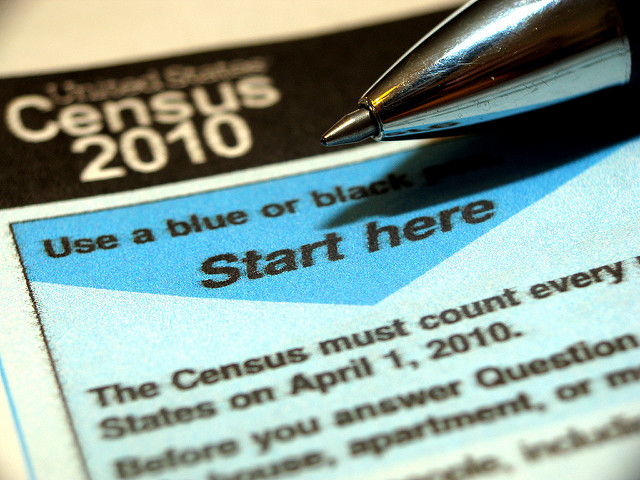
Photo by frankieleon, Flickr CC

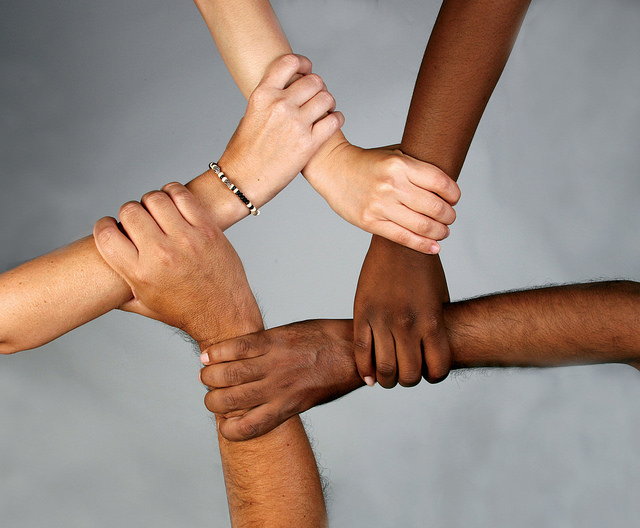
The multiracial population in the United States has grown at a significant rate since 2000 — three times faster than the general population. For the first time, the 2000 national census enabled individuals to choose multiple racial categories. However, racial identities are subjective, contextual, and fluid, making the categorization of racial identity an extremely difficult task. In a recent article in The Atlantic, sociologist Robyn Autry discusses the Census Bureau’s data cleaning process, which attempts to reconcile these ambiguities in racial identity, often at the expense of an accurate representation of people of color in the United States.

In the 2010 census, the Pew Research Center found that 9.8 million people reported a different racial or ethnic background than they had previously in 2000. To account for this, previous data is “cleaned” by changing or deleting responses from these individuals. Even with over 60 different options capturing racial descent in the 2010 census, individuals’ racial identities may be more nuanced than the census can account for.  According to Autry,

“Some people bristle at being asked to reduce the complexity of their self-perceptions into a singular choice. The ‘check-this-box’ mentality of the census is at odds with the more fluid and ambiguous self-perceptions of the population: people originating from outside the country, for example, or those habituated to customizable digital profiles, like those on Facebook, which appear to revel in the uncertainty of multitudinous identity. If anything, these digital tools have helped accelerate citizens’ willingness to self-identify in categories broader than those provided by the government — and even to demand to be able to do so.”

It seems the census has been slow to reflect the changing and dynamic atmosphere of racial identity in the United States over the last few decades. According to Autry, the census is more than just numbers and categories: 

“A simple count of the population remains ideologically loaded. These data are not neutral or objective information about the population. Instead they reflect changing political priorities and techniques to grasp how the country’s population is seen — and how resources are made available to them.”

Photo by Philip Cohen, Flickr CC

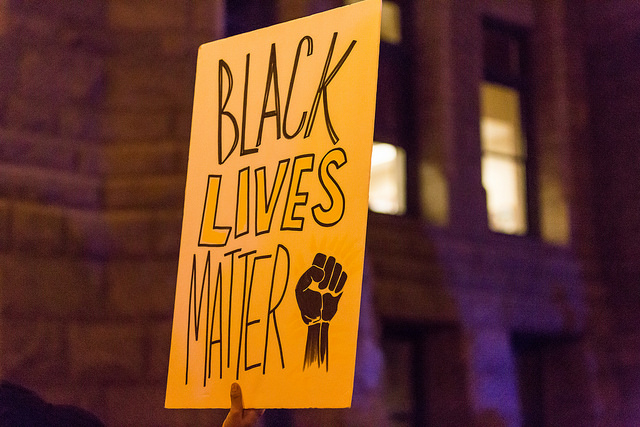
Recent social movements in the United States, like Black Lives Matter and Occupy Wall Street, have sought to challenge the status quo. While such movements often make the news, less attention is paid to how they achieve success. A recent article in the New York Times by sociologist Kenneth T. Andrews argues that social movements bring about change through exercising different types of power — cultural, disruptive, or organizational.

We are used to seeing cultural or disruptive power from movements in the media, but organizational power is also important. Organizational power is reflected in a movement’s ability to sustain its agenda through ties to other groups. Recent research suggests that after the Tea Party built upon disruptive power gained from initial protests, it established local organizations and supported political candidates that shared its ideas, ultimately transforming the Republican Party. However, as with each mechanism of power, organizational power also has constraints. Andrews explains,

“Staging the occasional protest and raising money are one thing; developing leaders and building constituencies are another. Despite substantial resources and hundreds of organizations, the environmental movement, for example, has not generated the sort of participation sufficient to meet the environmental challenges we face.”

In short, the pathways to power that different social movements utilize are very important to the movement’s success in encouraging change. A movement may have the most success when it combines all three types of power, which helped movements like the Civil Rights Movement. And even if a movement itself is short-lived, the cultural effects may remain long after a movement has fizzled out, and even small-scale changes can still have the cultural power to affect the status quo well into the future.

Over the past few years, Hollywood has come under fire for its continued exclusion of women and racial minorities, both in front of and behind the camera. With controversies surrounding the perpetual whiteness of Oscars nominees to disappointing statistics coming out of the annual Hollywood Diversity Report, there is a renewed conversation about the lack of diversity in the media we consume. However, a new report finds that television showrunners and writers are still mostly white, which has important consequences for the ways people of color are represented in the shows we watch.

The report finds that less than 10% of the 234 major series studied were led by minority showrunners, and only 14% of writers for these shows were members of a minority group. The Washington Post talked to Darnell Hunt, author of the report and co-author of the annual Hollywood Diversity Report, who explained that this lack of diversity in the writers’ room leads to unequal and inaccurate representations of racial minorities on the screen. Hunt said,

“White men dominate the major positions, and people of color and women have a long way to go to attain any type of equity … We need to change that because television is not just entertainment. Media images do matter, particularly for people who don’t have a lot of face-to-face encounters with people who are not like them. A lot of what they learn about people is what they see in these images.”

Hunt explains that shows led by black showrunners, like FX’s “Atlanta,” and shows with a diverse writing room are more likely to acknowledge racial inequality, whereas predominantly white writers’ rooms more often portray minority characters as one-dimensional “sidekicks.” An especially troubling example from the report concerns depictions of the criminal justice system. The article explains,

“None of the [crime-drama] episodes acknowledged the systemic racial profiling of black Americans, that black people are more likely to be pressured into plea bargaining for crimes they did not commit, or that they routinely face harsher penalties than whites for committing the same crimes … [These] depictions of policing and the court and prison systems, combined with viewers’ existing biases, undermine public support for policies that could help advance racial equity in American society.”

In short, when people of color are left out of the writers room, their stories are left out too.

U.S. Census, 2010. Photo by Joe Wolf, Flickr CC

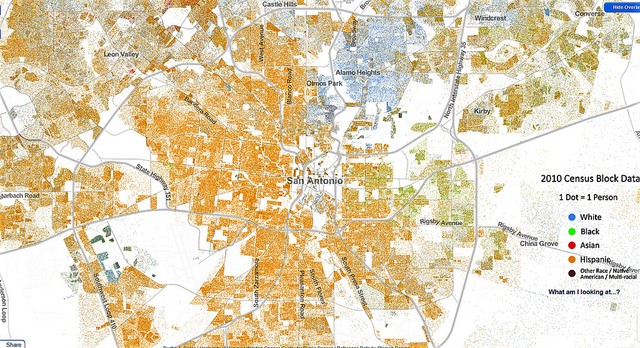
Recent celebrations of National Hispanic Heritage Month call our attention to the growing importance of Hispanic culture, histories, and contributions in the United States. As the Hispanic population has grown, so too has the interest in defining what exactly it means to be “Hispanic.”  Research suggests that administrative agencies, particularly the U.S. Census Bureau, played a significant role in unifying different identities under this single pan-ethnic umbrella category. In a conversation with sociologist Cristina Mora, NPR’s Code Switch uncovers the complicated history behind the term “Hispanics.”

Prior to the 1960 census, Latin communities did not have an identifiable option or category matching their ethnic identity. Initial attempts in the 1960 and 1970 census resulted in a massive undercount. Following these largely unsuccessful efforts, Mexican and Puerto Rican communities mobilized to come up with a sufficient term for the 1980 census. Terms were heavily contested, agencies and experts debated various phrasings, and, with reservations, they eventually decided on Hispanic. And the importance of finding a proper category cannot be underestimated — having “Hispanics” as a category in the census enabled communities to address pressing political issues. Mora told NPR,

“Once the category was made, everything from political groups to civic organizations to every other media group that would emerge, would draw on census data. As soon as the census numbers came out, Latino lobby groups could then run the numbers and say, ‘Look, this is what Latino poverty looks like; this is what Latino educational attainment looks like.’ They could go up to the Department of Education, for example, and say, ‘Latinos are the second-largest minority group. And yet, our educational attainment pales to that of whites. Send money to our schools.’”

Despite its contested nature, the use of the ethnic category of Hispanic and its incorporation into administrative counts has proven to be an effective tool for mobilization of Latinx populations. Mora’s research indicates that defining ethnic categories in this way may create opportunities to increase political representation and power among minorities in the U.S.

Photo by Wonder woman0731, Flickr CC

The goal of increasing “diversity” has become a common focus in university admissions, meaning strengthening the presence of underrepresented minorities within the student body. This kind of rationale also appears in businesses and government, with rhetoric that emphasizes how diverse groups can be more productive and innovative. In essence, most see pursuing diversity as a good thing because of the benefits of diversity.

That said, researchers question whether “diversity” policies and programs really overcome existing racial inequalities, and some argue that organizations are more interested in boasting about their diversity than they are in actually increasing minority representation. Ellen Berrey has researched the meaning and use of the word “diversity” in a variety of sites. Her research, as described in The New Yorker, suggests that touting the benefits of diversity can have an unintended consequence: glossing over issues of inequality, exclusion, and discrimination. As an example, Berrey describes an investigation of diversity in a Fortune 500 company,

“The diversity-management program functioned mainly as a surreal exercise in internal branding, entirely separate from the legal department (which handled claims of discrimination). So-called diversity managers worked to foster an “inclusive” environment, but they seemed to spend much of their time “reiterating the good that would come from diversity,” as a way of justifying their own positions.”

The New Yorker article also discusses research by Natasha Warikoo, who examines the ways that white students at Ivy League colleges describe diversity on campus. Their accounts point to what Warikoo calls “the diversity bargain” — white students accept the existence of racialized admissions programs with the expectation that students from different racial and ethnic backgrounds will expose them to new ideas, cultures, and experiences. In general, these researchers find that “diversity” rhetoric often misses the bigger picture of continued racial inequality in the United States.

Photo by Tony Webster, Flickr CC

Over a year after 49ers quarterback Colin Kaepernick first knelt during the national anthem in protest of police brutality, protests in the NFL spiked dramatically after President Trump attacked players who followed Kaepernick’s example. In recent weeks many more players knelt, locked arms, or stayed in the locker room during the anthem in response to Trump’s speech and series of tweets. During the flurry of media attention on the NFL, scholars Rashawn Ray and Nicole Gonzalez Van Cleve wrote an Op-ed for NBC News about not losing sight of the original purpose of the protests.

Instead of focusing on the political implications of the president’s tweets or changes in protests over the past week (such as owners joining their players on the field), Ray and Van Cleve reiterate research on the violent repercussions of racial bias in policing. They emphasize that black athletes, even NFL stars, are subject to the same dangers of racial profiling as all other African Americans. In an MSNBC spot discussing the Op-ed, Ray told the panel,

“We really have to reorient the narrative. This isn’t about someone standing or sitting, this is about the fact that black lives matter. This is about the fact that football players, basketball players, baseball players, once they leave those stadiums they are black and brown men. And unfortunately in our society it doesn’t matter if you are affluent or less affluent, unfortunately you might be actually profiled by the police, and unfortunately that particular profiling can turn deadly.”

Photo by blogtrepreneur.com/tech, Flickr CC

Surveillance technology dominates policing in many major cities, and software companies continue to develop tools that allow law enforcement to collect and analyze data on traffic violations, citizen complaints, and even license plate photographs. A recent CNN Tech article highlighted sociologist Sarah Brayne’s research on the Los Angeles Police Department’s use of one such data collection software, Palantir.  Brayne’s findings suggest that while the utilization of big data in policing facilitates communication, it also raises some major concerns of privacy and potential bias.

With the help of Palantir, LAPD officers use a point system to measure the risk of individuals with extensive criminal records, awarding points for a variety of law infractions and police interactions. However, Brayne found that individuals from low-income communities of color are more likely to have their risk measured — she cautions that such systems can be cyclic, with more points leading to more police contact, and vice versa.

Another potential problem is that of privacy. Palantir has improved location tracking abilities and allows law enforcement to gather and connect more information about individuals than ever before, but this often includes information on individuals without police contact. Certainly there are clear benefits; sharing data can help connect related crimes and more information helps police to work more efficiently and effectively. But challenges arise as technology develops. Brayne warns,

“I’d caution against the thinking that if you have nothing to hide, you have nothing to fear. That logic rests on the assumption of the infallible state. It rests on the assumption that actors are entering information without error, prejudice or discretion.”

For more on the biases behind surveillance technologies, check out this TROT on computer code as free speech.

Photo by Mark Dixon, Flickr CC

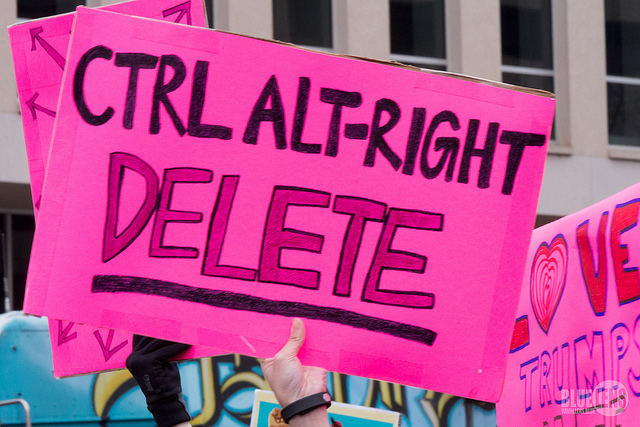
Americans’ views on race and racism have changed in many ways from those during the Civil Rights movement in the Jim Crow era. Today, most Americans agree that racism is not acceptable, and social norms have generally dictated that racist ideologies should not be part of the mainstream of American culture. Social norms are supported by institutions and leaders, however, and recent controversies over organized white supremacist groups call their stability into question. In The New York Times’ Upshot blog, sociologists Tina Fetner and Sarah Sobieraj describe how quickly these norms can change, especially amid criticism that the Trump administration has been slow to condemn white supremacist groups. From Fetner:

“It’s not because all of a sudden there is more racism now than there was a few weeks ago. It’s that the absolute condemnation of those most abhorrent views is crumbling away…”

And from the article:

“When norms of acceptable behavior and speech start to shift, it can disturb the shared beliefs, values and symbols that make up our culture.”

Leaders and institutions have the power to respond to controversy or to ignore it. Either way, their actions can change whether ideas appear to be part of the mainstream or the fringes of a society.

Photo by Nicki Dugan Pogue, Flickr CC

Companies like Ancestry.com use DNA samples to educate people about their genetic ancestry. This relatively new service is used by a growing number of people, and a recent article on STAT explains how has caused some uncomfortable moments for white supremacists who learn of their non-white ancestry. The article covers research by Aaron Panofsky  and Joan Donovan who studied posts on Stormfront, a white nationalist website, wherein users discuss their genetic ancestry results.

While one might assume that white nationalists would avoid posting their non-white ancestry online, Panofsky and Donovan found that members of Stormfront are quick to support each other in the face of genetic testing results which show non-white heritage.

“Instead of rejecting members who get contrary results, Donovan said, the conversations are ‘overwhelmingly’ focused on helping the person to rethink the validity of the genetic test. And some of those critiques — while emerging from deep-seated racism — are close to scientists’ own qualms about commercial genetic ancestry testing.”

Users discuss the potential failings of genetic testing, or posit that individual knowledge of one’s history is more useful than some findings in a remote laboratory. In other cases, individuals were told that they could remain in Stormfront so long as they didn’t “mate” and spread their non-white genes, and others even claimed that a sprinkling of non-white ancestry bolstered the community’s “diversity”. In sum, though genetic ancestry testing undermines the narratives that white supremacists utilize, users on Stormfront are negotiating their community boundaries with each new genetic test, and “rethinking who counts as white” in the process.