
inequality

Photo of a an overturned wheel barrow in front of a solid metal fence. Photo by Michael Coghlan, Flickr CC

Addressing gun violence in the United States is often a heated political issue — polarizing constituents around what solutions are best to address it. Reducing the thousands of firearm homicides and nonfatal shootings that occur each year will require some serious debate and complex solutions. But there is one surprising factor that may reduce gun violence — cleaning up neighborhoods. A recent study featured in Huffington Post shows that this simple strategy of “cleaning and greening” vacant lots may have some far-reaching impacts on reducing crime.

The researchers partnered with the Pennsylvania Horticultural Society’s LandCare program to randomly select lots in Philadelphia for either a full transformation (picking up trash, putting up a fence and grass seed, and maintenance), a partial makeover (trash removal and mowing only), or left untouched.The researchers then measured shootings in the area from 2011 to 2015.

They found that areas that received the full “cleaning and greening” saw a 7% reduction in shootings, and the partially treated areas a 9% reduction, when compared to areas with no cleaning or maintenance. John Macdonald, one of the study authors, notes that this cleaning strategy did not appear to displace shootings to other blocks, and that cleaned up lots could have other health and safety benefits. He also noted that the solution has its limitations and needs more research to understand the impacts of “cleaning and greening”:

“You couldn’t green a city and just eliminate the chronic problems of gun violence that are highly concentrated in city blocks just by doing remediation to places.” 

Sociologist Eric Klinenberg notes “broken windows” theory — the idea that visible signs of crime, like broken windows, creates an environment that encourages further crime —  is the main impetus behind this experiment. However, he also points out that broken windows theory has been used to justify policing of low-level crimes like public drinking — particularly against people of color and homeless people. These policing practices were not only severely misguided, but completely overlooked the environmental aspects of the original theory:

“What’s so striking is that the [original 1982 article The Atlantic] was actually much more about broken windows than it was about bad people…For decades now, we have fought crime by trying to crack down on people.”

Rather than reducing crime “by punishing people,” Klinenberg suggests that we need more resources and social infrastructure in communities that are heavily impacted by crime. As he concludes, “What we have not done is invest in places and rebuild places where crime is concentrated.”

Photo of flight attendant inside a plane. Photo by peter burge, Flickr CC

For many people, coining a term and having it become part of common conversations would be a huge achievement. But such popularity sometimes means that these terms lose their original meanings. This is what happened to Arlie Hochschild’s term, “emotional labor.” Initially coined to identify what is so exhausting about jobs such as flight attendants, nursing home attendants, and child-care workers, emotional labor is increasingly used as a catch-all term for mental work, care work, or any burdens that disproportionately fall on women.  

In a recent interview with The Atlantic, Arlie Hochschild reminds us of the core definition of emotional labor:

“Emotional labor, as I introduced the term in The Managed Heart, is the work, for which you’re paid, which centrally involves trying to feel the right feeling for the job. This involves evoking and suppressing feelings . . . The point is that while you may also be doing physical labor and mental labor, you are crucially being hired and monitored for your capacity to manage and produce a feeling.”

In addition to a lack of a social-class perspective in the recent usage of the concept — in one example, emotional labor was used to describe calling the maid — Hochschild contends that emotional labor may be overextended in ways that are unproductive, particularly during important conversations about alienated labor and household responsibilities. Some of her other books, including The Second Shift and The Time Bind, are more relevant to the uses of emotional labor that are fundamentally talking about household responsibilities and family dynamics. While Hochschild appreciates the attention to her work, she also believes maintaining analytic precision is essential — especially in mobilizing the concept of emotional labor to recognize inequality and alienation in the workplace.

“We’re trying to have an important conversation but having it in a very hazy way, working with [a] blunt concept. I think the answer is to be more precise and careful in our ideas and to bring this conversation into families and to the office in a helpful way…If you have an important conversation using muddy ideas, you cannot accomplish your purpose. You won’t be understood by others. And you won’t be clear to yourself.”

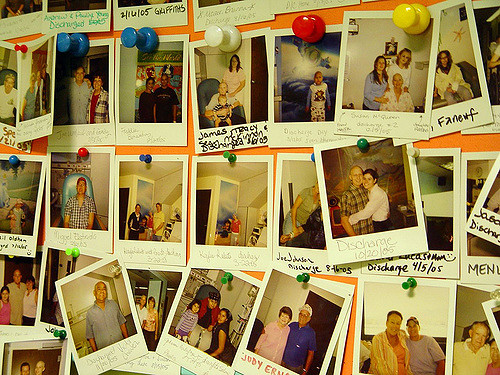
Photo of a wall of polaroid pictures representing discharged patients. Photo by midiman, Flickr CC

No, absolutely not. But married patients often receive more aggressive cancer treatment than those who are unmarried. Joan DelFattore, author of a recent article in The Washington Post, believes it might have something to do with doctors’ perceptions of unmarried people — specifically that unmarried people are less able to handle aggressive treatments than married people. DelFattore connected with sociological and medical experts to explore the potential importance of marital status in cancer treatments.

Some researchers speculate that overall unmarried patients may be starkly different than their married counterparts in terms of social support, depression, and social isolation. Sociologist Linda Waite, who co-wrote a book on the social benefits on marriage, concurs with these claims:

“In the U.S., where people have plenty of options for marriage, it’s likely to be those who are disabled or otherwise at a disadvantage who don’t marry….And so, they might indeed do worse in health care because of the underlying issues that caused them not to marry.

Others, like Susan Brown, point out that these perceptions are based on the assumption that social support comes primarily from spouses, rather than other family and friends. Instead, Brown argues that care providers should be open to patient support coming from people other than spouses or romantic partners. She says,

“Frame the discussion in terms of what the patient actually needs, rather than focusing on whether it’s provided by people in specific roles…Our whole system is built around traditional family roles, and that doesn’t work for many people.”

Good social support certainly matters for surviving cancer treatment, especially aggressive treatment. Where it comes from matters much less than the fact that it’s there.

Photo of a person with their back to the camera facing a train as it rushes past. Photo by Georgie Pauwels, Flickr CC

Despite growing research that people are having less sex in the United States, the perception that “everyone is doing it” persists, especially for young people. In a recent article, The Atlantic asked social scientists why young people aren’t having more sex.

Lisa Wade, author of the book, American Hookup Culture, says that one of the reasons for is that young people are more likely to have sex within relationships than in hookups, and always have been:

“Go back to the point in history where premarital sex became more of a thing, and the conditions that led to it…Young women, at that point — [the 1940s and 50s] — innovate ‘going steady.’ If you [go out with someone for] one night you might get up to a little bit of necking and petting, but what happens when you spend months with them? It turns out 1957 has the highest rate of teen births in American history.”

Part of the reason young people today are having sex more in relationships than in hookups — at least for women — might be that they are avoiding bad sex. According to Paula England, women report sex in hookups is less pleasurable than sex in relationships. Based on recent trends, it appears as though fewer young people are actually having relationships at all, marriage or otherwise. And the rise of online dating apps means that people meeting online are marrying more quickly, which might mean they are dating less overall, according to Michael Rosenfeld.

Despite a decline in sex overall for young people, this decline likely does not affect all young people equally. Since research shows that a good sex life appears to contribute to happiness and other health benefits, this also means that those who do not have a fulfilling sex life also do not reap those benefits. The article’s author, Kate Julian, concludes,

“Like economic recessions, the sex recession will probably play out in ways that are uneven and unfair. Those who have many things going for them already — looks, money, psychological resilience, strong social networks — continue to be well positioned to find love and have good sex and, if they so desire, become parents. But intimacy may grow more elusive to those who are on less steady footing.”

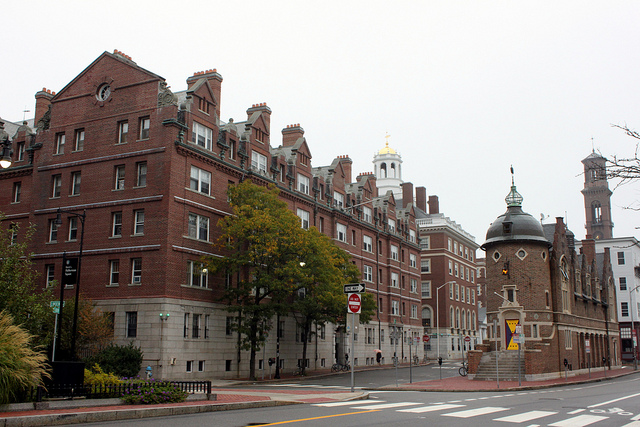
Photo of a large university building. Photo by Prayitno, Flickr CC

The high-profile lawsuit filed against Harvard University has reignited debates about race, college, and inequality. The plaintiffs claim that admission practices at Harvard have led to discrimination against Asian-Americans, but their arguments reflect a long line of litigation that claims such practices have led to discrimination against whites. A key point that gets lost in this debate is the pursuit of diversity in college student bodies, which colleges highlight as essential to their students being able to compete in the globalizing, modern world. In a recent article in The Washington Post, Anthony Chen and Lisa M. Stulberg discuss how the pursuit of diversity has a long history in higher education.

The use of race in admissions policies is often linked to the famous Supreme Court case Bakke v. University of California in 1978. There, the Court ruled in favor of universities’ right to consider applicants’ race in admissions as part of a holistic attempt to increase diversity at campuses. This case set the precedent for a diversity rationale in race and admissions, but Chen and Stulberg contend that such frameworks date back even further. They name several notable university figures in mid-20th century America who discussed diversity as an important part of a college experience, such as Harvard’s dean of admissions William J. Bender in 1961 and City College psychologist Kenneth B. Clark, who highlighted the benefits of diversity and multiracial environments in an era were several colleges still practiced racial segregation.

This discussion of the educational benefits of diversity — as well as corresponding changes in admissions practices at some colleges — dates back to at least the 1960s. Yet, Chen and Stulberg argue these ideas are still relevant for society today:

“The world is a big place full of people who are different from one another, and going to a school with a diverse study body is one of the best ways to prepare for it. That common-sense lesson from American history is still worth remembering today.”

Photo of a yacht. Photo by Ken Teegardin, Flickr CC

In our current era defined by financial crises and the Panama Papers, the ultra-rich have taken extra steps to keep their private lives off the radar. When sociologist Brooke Harrington began to inquire into their secrets — through interviews with wealth managers who specialize in protecting the fortunes of the world’s richest people — she discovered not only how the rich keep getting richer, but also how they spend their limitless fortunes. In a vivid account of her research in The Guardian, she explains that the rich not only rely on wealth managers to preserve and expand their fortunes, but also to cover up drug addictions, promiscuous behavior, secret love affairs, and laziness at work. Her interviews highlight how behaviors that are often associated as ‘pathologies’ of the poor are considered to be mere ‘eccentricities’ among the rich. Harrington expands further,

“Behaviors indulged in the rich are not just condemned in the poor, but used as a justification to punish them, denying them access to resources that keep them alive, such as healthcare and food assistance.”

Her findings also reveal how the ultra-rich take advantage of conditions that would mean life-threatening experiences for people in poverty. For instance, having no-fixed residence exposes the poor to a high risk of homelessness and forced migration. The ultra-rich, on the other hand, can acquire different residences and nationalities from varying countries with ease. And this ‘homeless’ status actually allows them to avoid the taxation of their fortunes. As one of Harrington’s interviewees, an extremely wealthy businessman, declares:

“I am not tax resident anywhere. The tax man says ‘show me a utility bill’, and the only utility bill I can present is for the house I own in Thailand, and it’s in a language that the European authorities aren’t familiar with. With all the mobility going on in the world, international marriages, governments can’t keep up with people.”

In sum, Harrington’s research shows that we often stigmatize and punish the poor for behaviors that the rich can easily get away with, and that this deception and lack of accountability may have long-lasting impacts for income inequality in the United States.

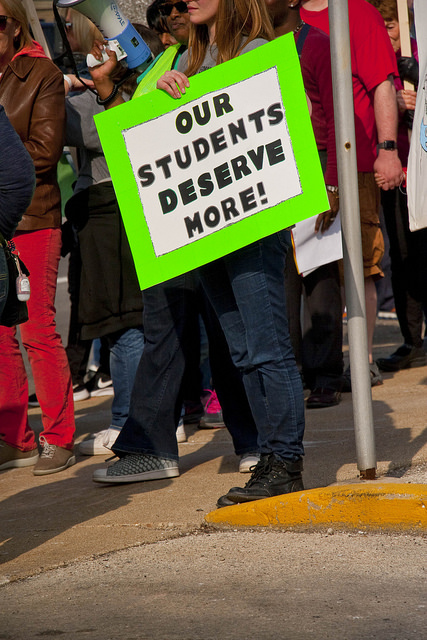
Photo of a protest sign that reads, “our students deserve more.” Photo by Charles Edward Miller, Flickr CC

In 2013, the abrupt closing of fifty Chicago public schools largely impacted people of color in West and South Side neighborhoods. Reasons for closures included under-enrollment and poor performance, but according to Chicago-based sociologist Eve Ewing, there is more to the story. In a recent interview with Morning Shift radio, Ewing describes systemic issues that contributed to under-enrollment, like the demolition of 22,000 public housing units across the city as part of the Chicago Housing Authority’s “Plan for Transformation.”

Subsequent school closings have disproportionality harmed students of color, and while these policies may not be intentionally racist, Ewing argues they reflect persistent structural racism in Chicago. For example, the school closings risk students’ safety, as many are now forced to trek through areas with perilous gang activity to reach their new schools. The emotional impact of school closings can also be devastating, comparable to family separations. Ewing observed close familial relationships between black students and their teachers and classmates, and thus the resulting separation can feel like losing a family member. And for “legacy” students, whose families have attended the same school for generations, the devastation is felt by entire families. To emphasize the severity of these school closings, Ewing makes a powerful connection between historical racism and policies today:

“A principal who was speaking at a school closure meeting, a black woman, stood up and said, ‘I feel like I’m at a slave auction right now.’… And I think that obviously there are many important distinctions between this kind of separation and chattel slavery, but I do think it’s important to think about, for black children, what it means to take them away from situations of stability, where they have deep, meaningful bonds with the adults and the other children in their lives.”

Photo by NCDOTcommunications, Flickr CC

Intersectionality is a term frequently used in many different contexts, from social movements to academic research to everyday speech. A recent article in The New York Times explores how intersectionality — defined as “the complex and cumulative way different forms of discrimination like racism, sexism and classism overlap and affect people” — influences men and women of color in the workplace.

The article draws from a recent non-profit study surveying 1,600 participants in workplaces ranging from corporations to higher education. Most respondents said they were “highly on guard at work,” which often meant they actively repressed traits others might perceive as frightening or intimidating. For example, they arrived early to meetings so they would be seated when others arrived in order to appear less threatening.

While the majority of workers in the study reported this need to be “on guard” to protect themselves against racial and gender bias, the types of stereotypes various groups face are not the same. For example, African-American women tend to face the stereotype of “the angry black woman,” while Latinas face stereotypes about being “too emotional or too wedded to their families.” Sociologist Yung-Yi Diana Pan notes that Asian-Americans are sometimes identified as “being workhorses without creativity” and “passive and acquiescent,” and this may lead to fewer promotions according to a recent report by the Ascend Foundation. 

Part of the problem, according to sociologist Lata Murti, is that women of color are constantly compared to professional white women — the “invisible norm.” So, what is the solution? Latasha Woods, brand manager at Proctor & Gamble argue it starts with leadership:

“We need leadership that truly cares about inclusion — a lot care about diversity, but how do you foster inclusion? People spend a lot of time on what they know the boss cares about. If they see the boss cares about inclusion they will too.”

Photo of a gate in front of a synagogue in Poland. Photo by Emmanuel DYAN, Flickr CC

On November 9th, 1938, thousands of Jewish stores, homes, and places of worship across Nazi Germany were destroyed by extremist mobs. During Kristallnacht, or “The Night of Broken Glass,” dozens of Jews were murdered and another 30,000 were sent to concentration camps in this crucial shift from anti-Semitic language to physical violence. This year’s commemoration of Kristallnacht comes in the aftermath of the shooting of 11 Jewish congregants in a Pittsburgh synagogue. In recent years, ideologically motivated violence has been increasing against religious minorities. Jewish and Muslim congregations have heightened their security measures in the face of such threats. In a new article in The Conversation, Christopher Scheitle and Jeffery Ulmer analyze these increased protections and the heightened fear among many religious minorities in their spaces of worship.

Using surveys and interviews, Scheitle and Ulmer conducted a study of over 1,300 congregations to examine crime and security in religious spaces. While many congregations experienced vandalism or theft regardless of religion,  synagogues and mosques experienced threats of violence at much higher rates:

“Crimes, most commonly vandalism and theft, were committed at about 40 percent of congregations in the year prior to the survey. This overall percentage was not significantly different across religious traditions. When we dug deeper, though, we found that synagogues and mosques deal with crime-related problems that are much different than the average church. Our survey found, for instance, that synagogues and mosques were three times more likely than congregations overall to have received an explicit threat in the prior year.”

Many synagogues and mosques have sought to respond to these threats through increased security. In comparison to other religions, Jewish and Muslim congregations have incorporated many more security cameras and guards. However, these implementations are not without cost:

“Our interviews found that most places of worship have a hard time implementing security. Some of this is simply not enough money. Larger and wealthier congregations tend to have more security in place. Beyond resources, our interviews consistently found that places of worship view security measures as a potential threat to their mission of creating a sacred space that is open to their communities.”

Scheitle and Ulmer suggest that congregations can better protect themselves through cost free measures, like limiting entrances to places of worship, and through community partnerships. A knowledge of the legacies of anti-Semitism and other forms of religious discrimination also emphasizes the need for compassion and concern in the wake of such tragedies.

Photo of Star of David on a Jewish Synagogue. Photo by Patrick Lentz, Flickr CC

The mass shooting at the Tree of Life Synagogue has been characterized as the deadliest attack on Jewish people in U.S. history, and mourning services continued last week and over the weekend for the shooting victims. In a recent article for The Conversation, Jeff Gruenewald and William Parkin discuss how the recent rise in violence against religious minority communities is often tied to far-right extremist conspiracies and ideological beliefs.

The authors argue that while violent crimes targeting religious minorities and institutions have been on the rise in recent years, it’s nothing new. Far-right extremism has existed in the United States for more than a century and motivated many of these crimes. Gruenewald and Parkin explain further:

“Unfortunately, it’s not new for far-right extremists to vilify non-white, non-Anglo-Saxon and non-Protestant religions. Judaism has endured most of their ideological rage and conspiratorial paranoia…Their dogma claims, falsely, that globalist Jews have infiltrated the government and other U.S. institutions, and that Jews and non-whites pose an existential threat to the white race.”

Using data from the U.S. Extremist Crime Database, they demonstrate that since 1990, far-right extremists have commited 217 ideologically motivated homicides, nineteen of which targeted religious institutions or individuals. While there are many examples of far-right extremist violence that have not been religiously motivated, such as the Oklahoma City bombing, the authors indicate that far-right extremist violence against religious minorities — especially places of worship — appears to be on the rise since 2010. And beyond these cases,there is evidence of over 100 failed or foiled plots against Jewish institutions or individuals between 1990 and 2014.

While mass shootings and extremist violence are rare events, Gruenewald and Parkin’s research demonstrates that there are some disturbing patterns in far-right extremism and its connections to mass violence. The authors conclude with the need to prevent far-right radicalization,

“We believe countering divisive narratives with different viewpoints informed by evidence on what works to prevent radicalization is more productive than aggravating wounds with politicized rhetoric. As Americans, we must speak openly about the perils of white supremacy, anti-Semitism and both the rhetorical and real dehumanization of those we perceive as unlike us. Those wielding political power and influence need to publicly and clearly condemn acts of violence by extreme far-rightists and the ideologies underpinning this form of domestic terrorism.”