inequality

Photo of a person sitting at a coffee shop table with a mug and a laptop. Photo by veganstraightedge, Flickr CC

Hate ordering a coffee and a scone, laptop in tow, only to find out that all the good tables next to the outlets are taken? Coworking spaces seem to be the affordable solution. Upscale urban restaurants –looking to make money during morning and afternoon off-hours — have started partnering with coworking startups to provide affordable workspaces with power strips, fast wifi, and bottomless coffee and tea. In a recent Vox article, Gaby DelValle calls upon the work of sociologist Dalton Conley to describe this latest trend in ‘weisure.’

“In his 2009 book Elsewhere, USA, Princeton University sociologist Dalton Conley referred to this as ‘weisure,’ or the merging of work and leisure. This breakdown of the boundary between labor and enjoyment, Conley wrote, is ultimately destructive, even if it’s disguised as a boon for both employee and employer.”

Coworking spaces, like Spacious in New York City, are expanding as more workers turn to freelancing or telecommuting. Having the freedom to work from anywhere may eliminate some of the role conflict experienced by people trying to juggle work, family, and their social life, but it also means they need a place to work from. Many workers find coworking spaces preferable to coffee shops because of the amenities and the camaraderie of working among other people. Yet, Conley explains, the shift to coworking also has less desirable consequences.

“This work-and-play blurring ends up enhancing [their] sense of alienation,” he wrote. “It’s not just that they feel like they need to be working when they are ostensibly supposed to be having fun or, conversely, that they should stop working and be there for their kids, spouse, or friends. It’s not just that [they] need to be everywhere at once. It’s that once disparate spheres have now collided and interpenetrated each other, creating a sense of ‘elsewhere’ at all time. … Home is more like work and work is more like home and the private and public spheres are indistinguishable from each other.”

As Conley explains, coworking is part of a larger trend of blurring distinctions in the social world: home–office, work–leisure, public–private, and even self–other. The result for many is a sense of alienation: No matter where we are, we’re always wondering where we should be and where we need to be. When we participate in ‘weisure,’ we feel that we should be ‘elsewhere.’

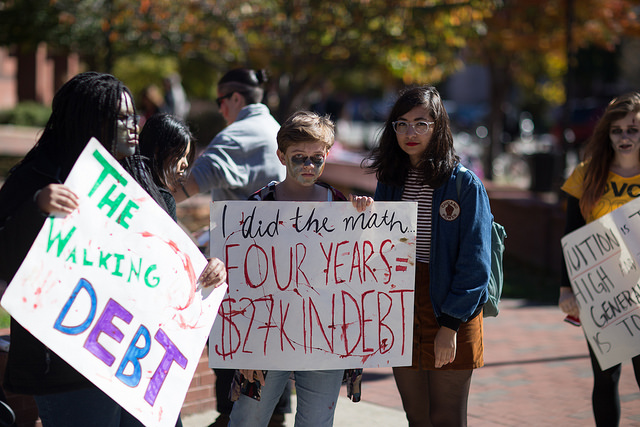
Photo of people protesting student debt. Photo by Tom Woodward, Flickr CC

While considerable media attention has been paid to the student debt crisis in the United States, few stories have detailed how this burden falls disproportionately on Black borrowers. Recently, CNBC interviewed Jason Houle about how student loans contribute to the racial wealth gap.

In their research, Houle and his co-author found that Black Americans accumulate nearly twice as much debt as their white counterparts by graduation. This disparity grows through adulthood as Black borrowers pay their loans at a slower rate than whites (4% per year vs. 10% per year). Fifteen years after college, Black borrowers hold 185% more student debt than whites. Houle contends that “the racial wealth gap is both the biggest and has grown the fastest among those with a college education,” and that student loans are a primary reason for this trend. In fact, student loans explain roughly 25% of the total racial wealth gap by age 30.

Houle offers several explanations for this gap. Black students on average have less financial capacity to pay for college than whites, causing them to pursue more loans. Additionally, Black students are more likely to attend expensive for-profit colleges and use private loans, both of which offer fewer protections to consumers. Houle uses the phrase “predatory inclusion” to describe this phenomenon, remarking that expanded access to higher education for Black Americans has also expanded opportunities for financial institutions to exploit them. These findings have made Houle rethink the metaphor of higher education as an engine of upward mobility: 

“In a world where we have rising college costs and rising student debt, it raises questions about whether or not that engine may be sputtering out.”

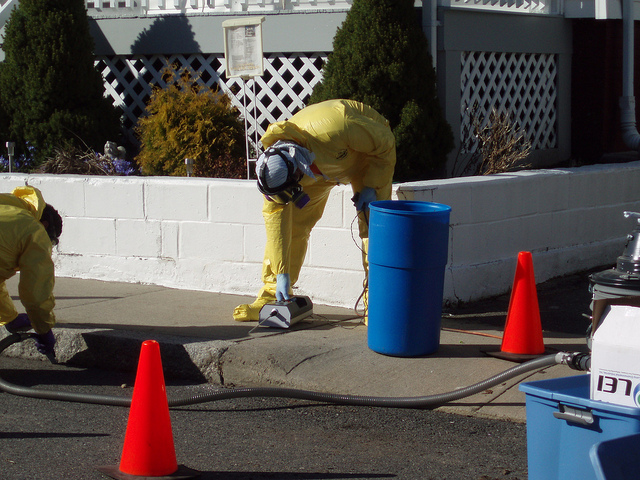
Photo of emergency worker on a street responding to a release of mercury. Photo by Massachusetts Dept. of Environmental Protection, Flickr CC

Gentrification is rapidly transforming once-industrial cities into trendy urban neighborhoods.  However, the dangers that lie below the surface – “hundreds of millions of pounds” of hazardous wastes released by small and large businesses each year – fail to be addressed at the same rate. In a recent interview in The Guardian, sociologists Scott Frickel and James R. Elliot discuss findings from their book about the limitations of current data on environmental hazards and how gentrification has diversified the types of people at risk of exposure to toxic waste.

Frickel and Elliot explain that government databases on hazardous sites only appeared in mid 1980s, and databases often exclude manufacturers that have few employees or release under a specified threshold of pollutants. Reporting is also completely voluntary, meaning the databases only contain the information facilities choose to report. In their research, Frickel and Elliot use old manufacturing directories to address these limitations by creating their own database. They found manufacturing to be heavily concentrated in certain “legacy sites,” or areas where you would expect to find heavy industry with large concentrations of factories or other facilities. However, these site boundaries also spread out slowly over time, and so too did the hazardous wastes. While disadvantaged social groups are more typically exposed to these pollutants, gentrification has disrupted this to some extent.  Elliot explains,

“We do also find things that we’ve come to unfortunately expect from the vast research on environmental injustices… These larger facilities are opening up and disproportionately concentrating in areas of ethnic minority and low-income settlement. But when we begin to consider the spread and the accumulation across cities as land uses change, that picture also changes. We begin to see, as one of our colleagues put it, that we’re all in this together. Many different types of neighborhoods are exposed.”

To remedy this exposure to hazardous materials, Frickel suggests that urban planners seriously consider the history of pollutants that exist below our cities when addressing sustainability. It remains to be seen how gentrification will impact citizens’ ability to hold businesses and government officials accountable for these environmental hazards, but recent events such as the water crisis in Flint should serve as a key example of how far we have left to go to address toxic hazards. 

Photo of two people walking through rows of large columns. Photo by Roman Boed, Flickr CC

Despite the longevity signified by the phrase, “till death do us part,” many American marriages are not so permanent. The statistic that half of marriages end in divorce has been cited for decades, but research by Philip Cohen shows that divorce rates have been falling for the last few years, even after accounting for demographic changes over that time. In a recent article in The Atlantic, Andrew Cherlin provides an unromantic explanation for the recent trend: “In order to get divorced, you have to get married first.”

In other words, declines in divorce are more driven by who is getting married than increased marital stability. Historically, divorce rates have been highest among Americans without a college degree. However, this group is now more likely to delay or forego marriage than they were 20 or 30 years ago. Victor Chen suggests that one factor responsible for marriage declines among people without a college degree is lack of jobs. Well-paying jobs for the less educated have become sparse as the American economy has transitioned away from manufacturing. Without stable employment, it is harder to maintain long-term romantic partnerships.

Another factor could be a rising acceptance of cohabitation, which has decreased the pressure for couples in their 20s to marry. Delaying marriage has benefits for marital quality. Cherlin explains:

“If you’re older, you’re more mature … you probably have a better job, and those things make it less likely that you’ll get into arguments with your spouse.”

However, declines in marriage do not necessarily mean that Americans are getting better at long-term partnership. Rather, relationship volatility is moving from the context of marriage to cohabitation, where it is harder to measure. These falling marriage rates among the less-educated parallel a growing gap between the richest Americans and everyone else. College graduates, who are more likely to marry, are better positioned to endure economic uncertainty and build wealth through their pooled incomes. This leads Cohen to conclude that marriage is “an increasingly central component of the structure of social inequality.” In other words, while declining divorce may look like a positive trend at first glance, it may speak more to growing inequality than it does enduring love.

Graffiti image of Angela Davis. Photo by mike krzeszak, Flickr CC

The contemporary Afro hairstyle has a particular history in the United States that signifies political, cultural, and social resistance. For one, it is a symbol of resistance against white cultural notions of what types of hairstyles and clothing are “aesthetically pleasing.” It also represents a global movement. However, the Afro’s use in popular culture and the media sometimes contradicts the goals of social resistance. A recent article in The Atlantic by Saida Grundy documents how modern uses of the hairstyle can both further ideas of resistance and reduce the Afro to merely a media commodity.

Grundy argues the use of the Afro by Colin Kaepernick in a recent Nike ad campaign has turned a symbol of resistance — made famous during the Black Power movement by people like Angela Davis and other revolutionaries — into a retail commodity. Davis also faced this issue. She was troubled by the way her activism and scholarly work was reduced to an iconic image sold on various merchandise. In a similar way, the branding of Kaepernick’s racial politics risks undermining his intention of highlighting egregious racial disparities in the United States. According to Grundy, Kaepernick has no control of how his message will be received by Nike consumers. Instead,

“He is a proxy—a window-dressing model for the larger project of packaging Black Power images, which is jarringly similar to the cultural reimagining that deemed Davis’s style and the black leather jackets and berets of her contemporaries irresistibly and undeniably cool.”

In short, using symbols of Black resistance in consumer culture can be a double-edged sword. While the use of these symbols can further the movement’s publicity and longevity (as represented by the longtime symbolism of the Afro), it also runs the risk of reducing its message to something that can be easily bought or sold.

Photo by USAG- Humphreys, Flickr CC

All parents want the best for their children, but what happens when the best for their own child means disadvantaging many more? In an article recently published in The Atlantic, sociologist Margaret Hagerman shares the story behind her new book, White Kids: Growing Up With Privilege in a Racially Divided America. She spent two years interviewing and observing upper-middle-class suburban white families in a midwestern city in the United States with one goal: to find out how white children learn about race. Hagerman spent a significant amount of time with 36 children between the ages of 10 and 13, and analyzed how homework, games, and conversations with friends and family members influenced their interpretations of race. Hagerman says,

“One of the things I was really struck by was how frequently some of these children used the phrase That’s racist or You’re racist. They were using this word in contexts that had nothing to do with race: They were playing chess, and they would talk about what color chess pieces they wanted to have, and then one of them would say, “Oh, that’s racist”—so things that had to do with colors, but also sometimes just out of the blue, instead of saying, “That’s stupid.” These kids have taken this phrase, That’s racist, and inverted it in a way such that it’s become meaningless.”

Hagerman also observed affluent parents calling schools to demand the best teachers in certain topics and pulling their students out of a public school to enroll them in a private one after a “racist incident.” These actions serve as reinforcing agents, propagating the idea that “your own child is the most important thing”a belief that Hagerman thinks should be reconsidered by all.

“When affluent white parents are making these decisions about parenting, they could consider in some way at least how their decisions will affect not only their kid, but other kids. This might mean a parent votes for policies that would lead to the best possible outcome for as many kids as possible, but might be less advantageous for their own child…I don’t have any grand answer, but I think people could think in bigger ways about what it means to care about one another and what it means to actually have a society that cares about kids.”

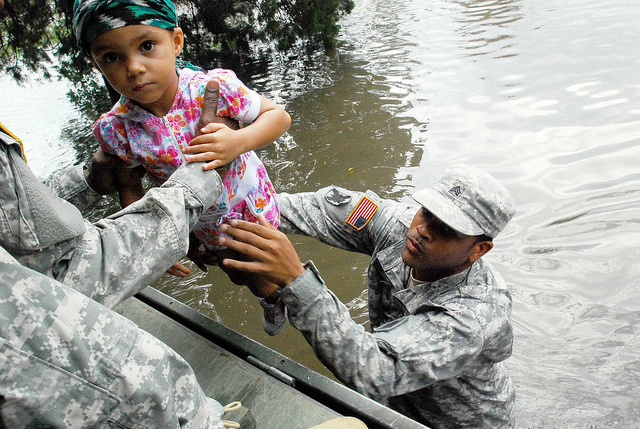
Lousiana National Guard evacuates a from the flood waters caused by Hurricane Isaac in 2012. Photo by The U.S. Army, Flickr CC

While the catastrophic flooding by Hurricane Florence made recent headlines, the emotional trauma it caused — particularly for children — may be overlooked. A growing approach to natural disasters as “social phenomena” with social consequences sheds light on how storms, earthquakes, and wildfires impact the emotional health of young survivors. In a recent article in The Atlantic, sociologist Alice Fothergill discusses her research on the emotional turmoil caused by Hurricane Katrina.

Fothergill finds that lack of communication with friends and family during a storm leads to tremendous anxiety for children. However, children who stay together with family in unsafe conditions also suffer. She explains,

“In a lot of studies, we find that kids who experience the intensity of the event do have a harder time coping. It really is important to evacuate and not be in it. Being with family is important, [but so is] not feeling like they’re in a life-threatening situation.”

The good news is, emergency responders are learning. Fothergill notes that during Hurricane Katrina, many kids in foster families and their biological parents completely lost contact and family records were destroyed in the storm. However, during Hurricane Sandy, the Department of Children and Families in New Jersey was able to learn from these mistakes.

Fothergill says one of the best things to do is to allow children to help prepare for the storm — for example, let them have a say in what comes in the car and what stays at home — so they feel like they have some control over the situation. While Fothergill notes that children are especially vulnerable to trauma, they are also very resilient; for this reason, showing them how to prepare and rebuild after a deadly storm can make all the difference.

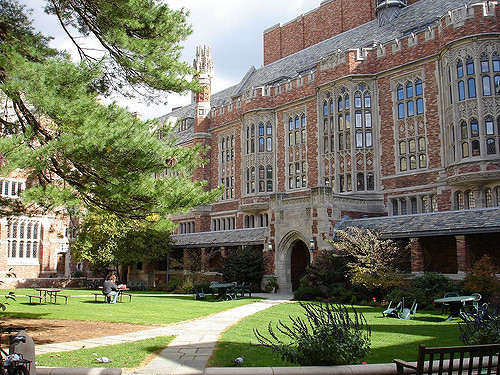
Photo of Yale Law School courtyard. Photo by stepnout, Flickr CC

More than 20 million people tuned in to the Ford-Kavanaugh hearing on Thursday. Many sociologists provided perspectives on the hearing, outlining everything from the myths about rape to the connections (and differences) with the Anita Hill and Clarence Thomas case. In an op-ed for The Washington Post, Shamus Khan provides his take on how class privilege shaped many of Brett Kavanaugh’s actions.

In his book Privilege, Khan followed students at St. Paul’s, an elite private school in New Hampshire. He describes how elite institutions, including the ones Kavanaugh attended, like Yale, foster privilege among their predominantly upper-class student bodies. This privilege includes ideas that students are “exceptional” and that the “rules don’t really apply to them.” As Khan explains in the article,

“What makes these schools elite is that so few can attend. In the mythologies they construct, only those who are truly exceptional are admitted — precisely because they are not like everyone else…Schools often quite openly affirm the idea that, because you are better, you are not governed by the same dynamics as everyone else. They celebrate their astonishingly low acceptance rates and broadcast lists of notable alumni who have earned their places within the nation’s highest institutions, such as the Supreme Court.”

These narratives of privilege among the elite can have some pretty nasty implications. Khan cites research by economist Raj Chetty demonstrating that admission to an Ivy League school is rarely the result of educational aptitude, but rather extreme family wealth. He asserts that this class privilege, masked by notions of “exceptional qualities,” is tied to beliefs about special treatment among the elite. For example, Kavanaugh’s supporters argue that he deserves the Supreme Court nomination and accountability for actions he committed years ago doesn’t really apply to him. Khan illustrates further how this privilege also shaped Kavanaugh’s actions on Thursday:

“This collective agreement that accountability doesn’t apply to Kavanaugh (and, by extension, anybody in a similar position who was a youthful delinquent) may help explain why he seems to believe he can lie with impunity — a trend he continued Thursday, when he informed senators that he hadn’t seen the testimony of his accuser, Christine Blasey Ford, even though a committee aide told the Wall Street Journal he’d been watching.”

In short, Khan’s research demonstrates how class privilege has shaped Kavanaugh’s actions from the outset, and how this privilege is cemented by the institutions and social circles around him.

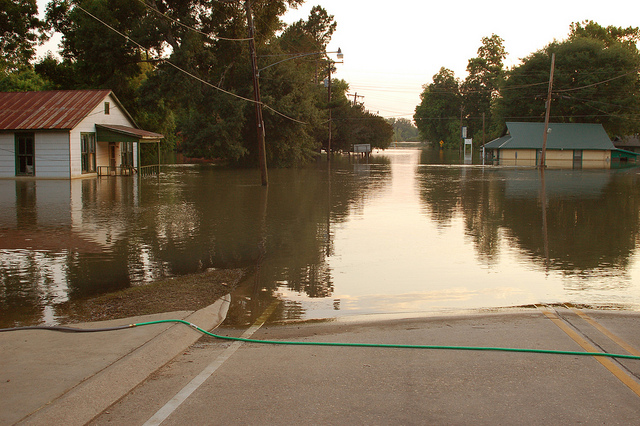
Photo of two houses in flooded area. Photo by Mary, Flickr CC

The National Weather Service estimates that Hurricane Florence dropped over 8 trillion gallons of rain across North Carolina, and the Federal Emergency Management Agency (FEMA) has just started evaluating how much damage was done. While Hurricane Florence and other natural disasters impact thousands of lives every year, not all groups recover equally. Recent research reported by Mic reveals that non-white households tend to lose wealth after a natural disaster, while white households often profit.

Tracking families from 1999 to 2013, sociologists Junia Howell and Jim Elliot found that white families in the most disaster-hit counties gained $126,000 in wealth on average over the 14 years of the study. By contrast, Back, Latinx, and Asian families in the same counties lost $27,000, $29,000 and $10,000 respectively. “Put another way, whites accumulate more wealth after natural disasters while residents of color accumulate less,” Elliot explained.

After a natural disaster, FEMA provides grants and low-interest loans to offset the cost of property damage. While it would make sense that federal disaster relief would mitigate racial disparity, Howell and Elliot’s research shows that it actually makes it worse. Counties receiving the most FEMA aid experienced the starkest widening of the racial wealth gap. Black families in counties that received the least FEMA aid accumulated $82,000 more wealth on average than Black families in counties that received the most aid. The researchers tried to explain this puzzling finding:

“Based on previous work on disasters such as hurricanes Katrina and Harvey, we know FEMA aid is not equitably distributed across communities … When certain areas receive more redevelopment aid and those neighborhoods also are primarily white, racial inequality is going to be amplified.”

In other words, one potential explanation for this trend is that white communities within counties receiving federal aid tend to receive more investment for rebuilding after a disaster than non-white communities in the same county. And with climate change increasing the frequency and intensity of natural disasters, this discovery implies worsening racial wealth gaps in the future. However, Howell and Elliot see reason to be hopeful,

“The good news is that if we develop more equitable approaches to disaster recover, we can not only better tackle that problem but also help build a more just and resilient society.”

Protester holding a sign that says “did your dinner lead a horrible life?” Photo by Alan & Pamela Rice, Flickr CC

The devastation of Hurricane Florence is not limited to the loss of human lives. It is estimated that millions of chickens and thousands of pigs died in North Carolina from the flooding. Vegan social movements have pointed to this major loss of animal life as one of the many reasons to reduce our reliance on meat and the consumption of other animal products. However, these groups face a difficult path ahead as factory farming is a massive U.S. industry. A recent article in The Atlantic highlights research by sociologists Corey Wrenn, Nina Gheihman, and Elizabeth Cherry on the many obstacles that can thwart veganism from blossoming into a large-scale social movement.

According to Wrenn, one of the main barriers to mobilization of any social movement is that they allow “free-riders”, or individuals who may identify with the movement but do not change their behavior. In the case of veganism, including “flexitarians” — people who are interested in vegetarianism or veganism but still eat meat and other animal products — waters down the cause’s overall message. Wrenn argues that including flexitarians “maintain[s] the illusion of mass support, [while] real power is reserved for core members.” Wrenn suggests that smoking cessation campaigns provide a key example of how an “all or nothing” approach can bring about meaningful change in consumption behaviors.

In the same article, Elizabeth Cherry and Nina Gheihman push back against Wrenn’s claims, advocating that incrementalism and inclusion of those who aren’t strictly vegan may lead to more success for vegan social movements. Cherry, who has a book comparing animal rights activism in France and the United States, argues that vegan social movements promoting meat reduction rather than complete elimination parallels the often incremental shift by many vegans into a plant-based diet. Gheihman agrees with Wrenn that flexitarianism may damage vegan social movements in the long-term, but also believes that including those at the margins of the movement accounts for the multiple motivations people may have for going vegan. Gheihman expands further,

“I do believe that flexitarianism as an initial approach is worthwhile, as there are many people who are not willing to adopt the ideological stance of the animal-rights movement within a society that does not yet embrace it. As well, they may have alternate motivations for following a plant-based diet, including health and environmentalism, and I believe these motivations are as valid as that of animal rights.”