
inequality

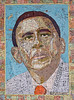
Obama MapThe San Francisco Chronicle recently published an article on how presumptive democratic presidential nominee Barack Obama has raised the profile of mixed-race Americans. When the social scientists weigh in, they add a level of complexity to Tyche Hendricks’ report on the issue:


The debate over what to call Obama – and the growing recognition of mixed-race Americans – is also a reminder that there’s no such thing as racial purity and, indeed, that “biologically, race is a fiction,” said sociologist Jorge Chapa, the director of the Center on Democracy in a Multiracial Society at the University of Illinois.

Still, prejudices based on conceptions about race continue, said Michael Omi, a professor of ethnic studies at UC Berkeley. “The prospect of having an African American presidential candidate has led some people to think we’re now in a post-racial society,” Omi said. “What’s disturbing are the ways in which that ignores the persistence of racial inequalities – in health care, home-mortgage loan rates – it shouldn’t make us think we’ve gotten beyond that.”

But the expanding conversation about race that has been prompted by Obama’s candidacy and his complex heritage could advance America’s understanding about race. “I want the history of miscegenation to be part of our discussion, and I think Barack Obama could catapult us there,” said Vest, the iPride co-director. “If these (mixed race) kids are able to normalize their difference by looking at Obama, then my work is done.”


ParisThe latest issue of Newsweek featured an article entitled, ‘The Future of Freedom: The Fate Of Liberty In The Next Century Is Fragile, In Part, Because The Very Notion Is Now So Ill-Defined.’

Newsweek reporter Robert J. Samuelson writes,

In a century scarred by the gulags, concentration camps and secret-police terror, freedom is now spreading to an expanding swath of humanity. It is not only growing but also changing–becoming more ambitious and ambiguous–in ways that might, perversely, spawn disappointment and disorder in the new century.

Undoubtedly, it was time for some sociologists to weigh in…

In 1900, this was unimaginable. “Freedom in the modern sense [then] existed only for the upper crust,” says political sociologist Seymour Martin Lipset of George Mason University. There were exceptions–America certainly, but even its freedom was conspicuously curtailed, particularly for women and blacks.

Traditional freedom historically meant liberation from oppression. But now freedom increasingly involves “self-realization.” People need, it’s argued, to be freed from whatever prevents them becoming whoever they want to be. There’s a drift toward “positive liberty” that emphasizes “the things that government ought to do for us,” says sociologist Alan Wolfe of Boston College. This newer freedom blends into individual “rights” (for women, minorities, the disabled) and “entitlements” (for health care, education and income support) deemed essential for self-realization.

Read more.

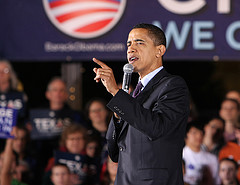
A recent article from the Christian Science Monitor, “How Clinton and Obama Boost Feminism, Civil Rights,”  seeks to understand how the primary season may have helped to advance these “historical causes.”

The Christian Science Monitor writes,

“The race between Barack Obama and Hillary Rodham Clinton may be over, but its effects on the broader movements for racial and sexual equality in America are likely to be felt – and debated – well past the fall.”

“Senator Obama’s victory roused blacks who never thought they would see an African-American this close to the presidency, not in a country with a shameful history of slavery. Senator Clinton embodied the aspirations of millions of women, many of whom saw in her defeat a culture still rife with sexism.”

But they did consult a sociologist…

“Some critics say it was less voters than the news media, obsessed with firsts, that reduced Obama to his race and Clinton to her gender. ‘It’s an element that got inflamed in the course of the campaign because of the premium on differentiation,’ says Todd Gitlin, a sociologist at Columbia University and an expert on social movements. ‘It didn’t start out that way. When this campaign started, Hillary was the favorite of black voters.'”

The Washington Post reports,

“The resonance of that long-ago predicament is still with us today, as a bitter Democratic presidential primary battle has caused many supporters of Sens. Barack Obama and Hillary Rodham Clinton to feel that the campaign has pitted race against gender. Many Clinton supporters, men included, cite openly sexist criticism targeting their candidate — conservative radio host Rush Limbaugh asked, ‘Will this country want to actually watch a woman get older before their eyes on a daily basis?’ — and feel that a political defeat would be an unconscionable victory for sexism itself. Obama’s supporters, the majority of whom are white, cite the racism their candidate has faced — large numbers of voters have openly told pollsters they would never vote for a black man. Should Democratic superdelegates hand the race to Clinton, many of these voters would feel racism has won.”

The sociologist weighs in:

“Patricia Hill Collins, a University of Maryland sociologist who is to be the next president of the American Sociological Association, said the error being made by many Clinton and Obama supporters is to see race and gender in unidimensional terms: ‘Obama represents race and Clinton represents gender — this is a flawed model,’ Collins said. ‘Why does Obama not represent gender? He has a race and a gender. Hillary has a race and a gender.’

The reason for our selective focus, the scholars said, is that people are keenly aware of unfair disadvantages but spend no time dwelling on unfair advantages.”

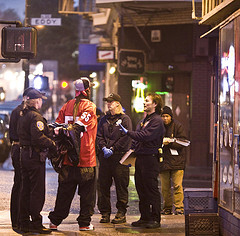
2201482197_3d7f34bbae_m.jpgThe New York Sun recently reported on the release of a new study from sociologist Harry Levin of Queens College titled, “Marijuana Arrest Crusade.” The report claims that police have singled-out minorities during the drug crackdown in New York beginning in 1997. The study makes use of data from the New York Division of Criminal Justice Services which shows that between 1997 and 2007, of those arrested on drugs charges, 52% of the suspects were black, 31% Hispanic, and only 15% white.

Some blame laws…

“Laws were revised in the late 1970s to largely decriminalize carrying small, concealed stashes of marijuana, Mr. Levin said. But he claimed police routinely ‘manufacture’ arrests for possession in public view — still a misdemeanor — by stopping young black men on the street and goading them into emptying their pockets.”

Others blame the administration…

“According to the study, arrests for marijuana possession began skyrocketing in the late 1990s during the Giuliani administration — a trend that continued under Mayor Bloomberg at an estimated cost of between $50 and $90 million a year. There were 39,700 arrests last year alone, according to the study. The 2007 total makes the city ‘the marijuana arrest capital of the world,’ Ms. Lieberman [the Executive Director of the New York Civil Liberties Union] said.”

via Brayden King at orgtheory:

It turns out Tom Wolfe, the realist American novelist most famous for his Bonfire of the Vanities, is a bit of an amateur sociologist. Check out this interview with the New York Times’s Sam Tanenhaus in which Tom admits to falling in love with sociology.   (You can begin listening about 1/4 of the way into the interview.) During graduate school Tom became attracted to Weber’s theorizing of status, a concept that later figured prominently in many of Wolfe’s novels, especially in Bonfire.  In the last half of the interview Wolfe describes how he carefully builds status markers into his novels.

In honor of the 40th anniversary of the Kerner Commission Report, academics and journalists have gathered for a symposium at the University of Pennsylvania to address issues of racial and socio-economic inequality in the United States.

The Kerner Report was commissioned in the 1960s in the wake of urban riots and concern over the growing racial gap in the U.S. The report’s conclusion that “our nation is moving toward two societies, one black, one white – separate and unequal” was shocking to much of its audience.

The Philadelphia Daily News reports:

“A lot of what we’ve learned since Kerner is that we find ourselves in a different moment, a different place,” said Darnell Hunt, a professor of sociology at UCLA. “We’re confronted with a lot of the same problems we were confronted with in 1968. We’ve seen some progress in certain spheres, but a lot of the underlying structure has remained largely unscathed.”

Miller-McCune reports on University of Texas sociologist, Arthur Sakamoto’s new report on paying top dollar for the best service providers. Sakamoto cites the example of a top-rated prostate surgeon in the country having a potentially negligible difference from his colleague ranked 50th, while the difference in cost could be staggering. This, Sakamoto argues, is an example of how individuals seeking services will pay top dollar for a formally or informally ranked provider because of a lack of expertise on the part of the consumer.

“‘The top people in their fields are getting much higher salaries than they used to get,’ he said. ‘That’s most obvious among lawyers and doctors. But it also applies to the person who gave John Edwards his $200 haircut.’
Sakamoto believes that star-power phenomenon is one important reason economic inequality is growing within occupations — the subject of the just-published paper he co-wrote with ChangHwan Kim of the University of Minnesota. Usually, the term “wage inequality” brings to mind headlines about chief executive officers — unions like the AFL-CIO ruefully note that the average S&P 500 CEO averaged $15 million in total compensation in 2006. Sakamoto agrees the disparity between white-collar and blue-collar salaries is very much a reality, citing a 2002 study that reports the wage gap between high school graduates and college graduates increased 15 percent from 1979 to 1999.”