culture

IMG_1579The Christian Science Monitor reported this morning on the enduring signs of US power despite the economic crisis. Many people seem panicked about America’s status as a superpower, so the Monitor investigated scholarly opinions as to whether ‘the American century’ is over. 

Sociologist Immanuel Wallerstein brings his take to this coverage…

Still, what seems clear is that the experience of the Bush years, now drawing to a close amid the worst economic calamity in eight decades, have bolstered those who long predicted a clipped American eagle. “What George Bush did was turn a slow decline into a precipitous one,” says the noted Yale University sociologist Immanuel Wallerstein, who has been predicting the end of the American empire since the 1980s.

“We’ve had two standout factors: the Iraq war, which not only demonstrated but actually accelerated this decline in power, and then the way this president put the American government in such deep debt,” Mr. Wallerstein says. “What we see playing out before us is the culmination of these actions.”

The Monitor concludes….

But for the moment, it’s the financial crisis that is providing a gauge of America’s enduring leadership capacity. With many economists citing international coordination as key to righting the global economic ship, one test will come Friday when finance ministers of the world’s seven major economies meet in Washington.

Read more.

L1030439

Eleanor Clift of Newsweek, has recently written about how vice-presidential candidate Sarah Palin is reigniting the culture war as her ‘everywoman’ act plays well with audiences. She suggests that this might indicate that the GOP will try to once again paint Barack Obama as an elitist.

In her article Clift included commentary from sociologist Todd Gitlin, who spoke at a Pew Forum discussion in Washington as to whether the cultural war will have an impact come November…

Todd Gitlin, a professor of journalism and sociology at Columbia University, speaking from the progressive side, said the culture war always matters, but that it may not be decisive, with economic issues making it harder for Republicans to get traction on lampooning Obama as an elitist, in the way they turned John Kerry into a windsurfing Frenchman. Gitlin described the presidential election as a “quadrennial plebiscite of who we are,” with Americans casting their vote for the candidate that best embodies who we are as a nation.

Newsweek’s commentary on the vice-presidential candidates in this culture war…

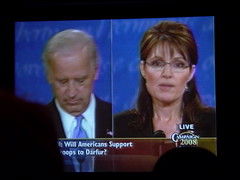
Nobody wants to be an elitist. In politics, it’s a deadly label. What we saw in Thursday night’s debate were two competing strains of populism. Biden, the Irish-Catholic kid from Scranton, represents Main Street populism, the people against the powerful, anti-corporatism, little guy kitchen-table values. Palin is wooing the same working-class constituency that could decide the election in battleground states like Ohio and Pennsylvania with her pro-gun, family and religious down-to-earth values.

Read more here.

Let's find a cure

This morning MSNBC ran a story on new research from San Francisco State sociologists, which suggests that when women receive a breast cancer diagnosis, they often assume a caretaking role in their own treatment and recovery. 

MSNBC reports:

 After conducting a series of interviews with 164 breast cancer survivors over two years, researchers from San Francisco State University found that women with cancer not only shoulder the emotional burden of disclosing their diagnosis to loved ones, they often end up being supportive of others at a time when they actually need support themselves.

“There’s been a lot of research on how women are emotional managers, how they take care of others,” says medical sociologist and lead researcher Dr. Grace Yoo, who recently presented the findings at the annual meeting of the American Sociological Association. “And when they’re diagnosed with breast cancer they’re still doing that. They’re worried about how others might react.”

Read the full story

Today the New Republic published a review of the new book, “The Politics of Truth: Selected Writings from C. Wright Mills,” edited by John Summers. 

An exerpt from the New Republic article:

C.Wright Mills published his sociological trilogy during the 1950s: White Collar in 1951,The Power Elite in 1956, The Sociological Imagination in 1959. Those were years of Republican ascendancy, and while the president, Dwight D. Eisenhower, was a moderate, the vice president, Richard Nixon, and a number of key senators, including Joe McCarthy, belonged to the conservative wing of the party. By decade’s end, the country was tiring of Republican rule and its accompanying scandals and foreign policy failures, and was harkening to the appeals of a young, ambitious, brash, Catholic politician who called for change. The times were perfect for a radical such as Mills to make his mark.

Almost a half-century later, the United States once again faces a choice between an incumbent conservative party with little public appeal and a young, dynamic politician whose race, rather than his religion, sets him apart from the usual run of presidential contenders. This time, though, there is no single social critic publishing books documenting the hold that powerful military and economic forces have over the country’s destiny, and lamenting the decline of a vibrant public sphere, and urging intellectuals to dissent as loudly as they can from the prevailing complacency. Lacking a Mills of our own, we may turn back to the original. Oxford University Press has recently re-published Mills’s trilogy, and The New Men of Power, Mills’s book on labor leaders, which appeared in 1948, has been reissued by the University of Illinois Press. And now John Summers, an intellectual historian who has written widely on Mills–including a devastating essay in theMinnesota Review documenting the extent to which another sociologist, Irving Louis Horowitz, now something of a neoconservative but then more radical, mistakenly recounted the facts of Mills’s life and prevented others from gaining access to the Mills papers that Horowitz kept over the objections of Mills’s widow–has brought together a collection of Mills’s essays, which he calls The Politics of Truth.

Fascinating… Read the full review here.

solitary cigaretteThe Chronicle of Higher Education reports this morning on an ongoing debate as to the validity of a 2006 study which concluded that Americans have become significantly more socially isolated over the last 25 years. 

David Glenn reports, “In the summer of 2006, several major news outletsgave prominent coverage to a sociological study with a grim message: Americans’ social isolation had increased radically since the 1980s. Whereas in 1985 Americans reported that, on average, they had 2.94 friends or family members with whom they could discuss important matters, by 2004 that number had dropped to 2.08. A quarter of Americans had no close confidants at all. Those findings were …[even] startling to the study’s authors, who are sociologists at Cornell University, Duke University, and the University of Arizona, [J. Miller McPherson, Lynn Smith-Lovin, and Matthew E. Brashears].”

UC Berkeley sociologist and social networks scholar Claude Fisher has some concerns:

The [previous] study’s portrait of collapsing social networks, Mr. Fischer writes, is at odds with other recent findings by social scientists. What’s more, he says, some of the 2006 paper’s data seem internally inconsistent or simply implausible. For example, among people who reported belonging to four or more organizations—presumably a highly sociable bunch—14.9 percent reported having no confidants. And what about married people? Surely they discuss important matters with their spouses, if no one else. In 1985 only 6.6 percent of married respondents reported having no confidants, but in 2004, 22.2 percent did so.

Fisher claims that such errors could be due to errors during data collection or coding. Now the original study’s authors have responded…


Ms. Smith-Lovin said that she and her co-authors are proposing an experiment for a future administration of the General Social Survey—perhaps in 2010—in which the social-network questions would be offered at different points during the survey, to see whether such “context effects” actually make a difference. She and her colleagues have also re-interviewed many of the people who responded to the 2004 survey, but she said that they are not yet ready to discuss those findings. Even if some of those people have no intimate friends, they can apparently count on having a long conversation with a social scientist every two years or so.

Barack Obama in CharlotteKisses II

Yesterday sociologist Dwight Lang wrote an opinion piece published in the Detroit Free Press. The University of Michigan professor offered commentary on the close presidential race this fall.

He writes:

Neither Democrat Obama nor Republican McCain will actually say “white working class,” but they do talk about “working” Americans or “blue-collar” workers as the backbone of America.

The critical importance of these voters is evidenced by the vice-presidential selections. We’ve heard how Joe Biden hails from an East Coast city where families struggle from paycheck to paycheck. He has worked his way up from humble roots and achieved the American Dream. His special appeal is to Catholics, who haven’t always voted Democratic in recent years. Sarah Palin’s modest background and straightforward style clearly speak to rural voters who identify with her version of the American Dream. Working women especially understand her efforts to balance career and family. 

He concludes:

Who wins this competition for millions of blue-collar votes may very well depend on who’s seen as capable of solving economic problems: bringing jobs back to America, reducing home foreclosures, and securing certain and bright futures for hardworking families.

Read the full piece.

This morning BBCnews.com posted an article entitled ‘The Path from Cinema to the Playground,’ which poses the following question to its readers: “A new film [Tropic Thunder] repeatedly uses the word “retard”. Can it be acceptable to use satirically or is it intrinsically offensive and a quick route to playground and workplace insults?”

Read the details of the use of this word in the film, here.

Reporter Finlo Rohrer writes:

For the opponents of Tropic Thunder, the path between film and television and “hate speech” is clear.

The UK provides an interesting crucible. While the word “retard” is extremely common in the US and crops up regularly in films, in the UK other epithets are more common. But it still has an immense power to offend, topping a poll by the BBC’s Ouch website for the most offensive disability-related words.

The sociologist weighs in…

If there are more school-children using the word “retard” in playgrounds this week, some might take that as an indicator of the malign power of the film.

“The media is very powerful, whether it’s films or comedy,” says sociologist Prof Colin Barnes, who studies the relationship between the media and disability. “Subliminal messages are distributed. ‘Spaz’ was popularised by Rik Mayall in the Young Ones. That really took off in the 1980s in schools.”

Read the full story at BBCnews.com.

The Telegraph (UK) reports today about a trend in universities in England to prohibit the use of certain words deemed offensive. Among them is the term ‘Old Masters,’ often used to refer to great painters, many of whom were men. Instead, the UK sociologists who developed the list suggest that this term discriminates against women and should be replaced with ‘classic artists.’ 

Telegraph reporter Martin Beckford writes:

The list of banned words was written by the British Sociological Association, whose members include dozens of professors, lecturers and researchers. The list of allegedly racist words includes immigrants, developing nations and black, while so-called “disablist” terms include patient, the elderly and special needs. It comes after one council outlawed the allegedly sexist phrase “man on the street”, and another banned staff from saying “brainstorm” in case it offended people with epilepsy.

Call in the sociologist!

…The list of “sensitive” language is said by critics to amount to unwarranted censorship and wrongly assume that people are offended by words that have been in use for years. Prof Frank Furedi, a sociologist at the University of Kent, said he was shocked when he saw the extent of the list and how readily academics had accepted it.

“I was genuinely taken aback when I discovered that the term ‘Chinese Whisper’ was offensive because of its apparently racist connotations. I was moved to despair when I found out that one of my favourite words, ‘civilised’, ought not be used by a culturally sensitive author because of its alleged racist implications.”

Prof Furedi said that censorship is about the “policing of moral behaviour” by an army of campaign groups, teachers and media organisations who are on a “crusade” to ban certain words and promote their own politically correct alternatives. He said people should see the efforts to ban certain words as the “coercive regulation” of everyday language and the “closing down of discussions” rather than positive attempts to protect vulnerable groups from offense.

Read the full story. 

Purity remains
CBNnews.com reports on a new study out of Baylor University’s Institute for the Study of Religion, which gathered American’s responses to questions about Christianity, religious beliefs and groups, as well as mystical experiences. 


In a poll of 1,700 adults, 55 percent answered yes to the statement, “I was protected by a guardian angel,” and 45 percent said they had at least two spiritual encounters in their life.

“I would never have expected these numbers. It was the biggest surprise to me in our findings,” sociologist Christopher Bader of Baylor University said. Baylor’s Institute for Studies of Religion conducted the study, which concluded that Americans’ religion is “remarkably stable.”


The Institute at Baylor University conducts this survey every two years and some changes have emerged since it was last administered.

In 2005, surveys showed that about 84 percent of Americans believe in Heaven or that Heaven could exist. Their most recent poll revealed about the same, but it also showed that 73 percent believe Hell absolutely or probably exists. About 46 percent said they were “quite certain” they’d go to Heaven, and 71 percent felt even the “irreligious” or non-believers had a chance at Heaven.

Read more.

New York Times Op-Ed columnist David Brooks recently wrote about individualism and decision-making in a piece entitled ‘The Social Animal.’ In his analysis, Brooks discusses scholarly work that reveals the interconnectedness which informs our decision-making processes, even broadly highlighting the work of sociologists. Brooks’ piece is centered around political decision-making and the potential for both parties to learn from this knowledge about the influences on our individual behavior.

Brooks writes:

Geneticists have shown that our behavior is influenced by our ancestors and the exigencies of the past. Behavioral economists have shown the limits of the classical economic model, which assumes that individuals are efficient, rational, utility-maximizing creatures.

Psychologists have shown that we are organized by our attachments. Sociologists have shown the power of social networks to affect individual behavior.

What emerges is not a picture of self-creating individuals gloriously free from one another, but of autonomous creatures deeply interconnected with one another. Recent Republican Party doctrine has emphasized the power of the individual, but underestimates the importance of connections, relationships, institutions and social filaments that organize personal choices and make individuals what they are.

This may seem like an airy-fairy thing. But it is the main impediment to Republican modernization. Over the past few weeks, Republicans have talked a lot about change, modernization and reform. Despite the talk, many of the old policy pillars are the same. We’re living in an age of fast-changing economic, information and social networks, but Republicans are still impeded by Goldwater’s mental guard-rails.

Read more.