
culture

Marco in Motion

The online edition of Australia’s paper, The Age, reports on research inspired by Australian sociologist R. W. Connell, examining why some women are drawn to ‘footballers’ — otherwise known as soccer players to those of us stateside. The article proposes that women’s attraction to footballers is “far deeper than the mere lure of sinew and tiny shorts” suggesting a link to the Freudian concept of cathexis. Freud’s idea was adapted to explain gender order by Connell and has inspired another Australian researcher, Nikki Wedgewood, to investigate this concept in her work on sports. This recent research from Wedgewood, who works as a research fellow in the University of Syney’s health sciences program, will be published in the upcoming issue of the Journal of Sport & Social Issues. In this article, Wedgewood argues that “it is the embodiment of male power and ‘hegemonic masculinity’ that sexually attracts some women to elite footballers.”

The Age reports

It’s not accidental who we fall in love with and who we’re attracted to, and especially where you’re talking about elite athletes,” [Wedgewood] said. “It’s not as simple as women wanting to be associated with glamour and money and get that vicarious fame, although that can play a role as well, but there’s something even deeper than that.”

Read more. 


Check out this past Sunday’s episode of ‘Wait, Wait, Don’t Tell Me,’ on National Public Radio where one of the quiz questions references the work of Contexts Magazine contributor, sociologist Robin Simon.

Listen online.

Martin WeddingThe Times Online (UK) recently published an article entitled, ‘Paranoia has taken over child protection,’ marking yet another alarming reflection on the fear that grips so many parents in the 21st century.

Times writer India Knight writes,

We don’t even trust ourselves to raise our own children: we need books written by childcare “professionals” and television programmes featuring advice from child-less “experts”. In actual fact we know a great deal more than these charlatans, but since we don’t any longer trust instinct we genuinely believe that our vast repository of knowledge (and that of our mothers, sisters, aunts, grannies, friends) is worthless and that a newborn baby is better off with a strict routine dreamt up by someone with a financial motive.

In a report co-authored with Jennie Bristow a few weeks ago, the sociologist Frank Furedi, lamenting the demise of trust, mentioned as an example a mother whose child was invited over to play at a new friend’s house. The parents reassured the mother that they were “cool” – they’d passed a CRB check. I find this chilling.

Visit Furedi’s website and learn more about this sociologist’s new book.

Astrids bursdag3316.21.2008

CNN reports:

From the frontiers of mirth research, scholars offer these words of comfort: If you are mortified of dancing for fear of being the butt of jokes, don’t worry, you are far from alone. There’s even a word for it — gelotophobia. Sound like a disease involving Italian ice cream? No, it’s the potentially debilitating fear of being laughed at. This condition — the term comes from gelos, Greek for laughter — was among the topics discussed this week at a four-day meeting of the International Society for Humor Studies, an Oakland, Calif.-based collective of psychologists, sociologists, linguists and other academics who probe funniness from every conceivable angle

The setting for all this debate is the birthplace of Miguel de Cervantes, the author of “Don Quixote,” the mad knight who was always good for a laugh as he tilted at windmills. The president of the humor society, British sociologist Christie Davies, offered insights Tuesday on the state of humor in today’s world. Among other things, he said, jokes in eastern Europe were a lot better when the communists ran the show.

“Once you have a democracy with free speech, you have fewer jokes,” said Davies, an emeritus professor at the University of Reading, in England. “Jokes, in many ways, are a way of getting around restrictions on what you can say. That was a very important factor in eastern Europe.”

The full story.

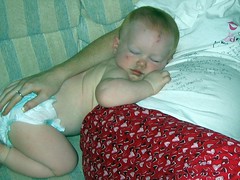
Landon Sleeping on Mommy's Tummy

MSNBC reports on the recent trend towards more mothers undergoing dramatic cosmetic surgery to alter their bodies post-birth.

The trend…

Among women in their 30s, there was a 9 percent to 12 percent rise in tummy tucks and breast surgery between 2005 and 2006. In 2007, 59 percent of American Society of Plastic Surgeons members surveyed said they saw an increase in patients seeking post-childbirth cosmetic surgery procedures in the previous three years. “Many of my patients are young moms who are doing their best to take care of themselves, but their bodies have gone through some irreversible changes that they find discouraging,” says David Stoker, M.D., of Marina Plastic Surgery Associates in Marina del Rey, Calif.

The sociologist’s commentary…

Others point out that many mothers today are not “just” mothers — they have professional and personal lives outside of the home and don’t want to look like the stereotypical mom. They want to feel better about their bodies, and that desire shouldn’t be dismissed or criticized, says sociologist Victoria Pitts-Taylor, Ph.D., author of “Surgery Junkies: Wellness and Pathology in Cosmetic Culture” (Rutgers University Press). “I don’t think we should judge women for wanting to look like they did before they got pregnant,” Pitts-Taylor adds. “Social approval is empowering in our society.”

Read on…

ParisThe latest issue of Newsweek featured an article entitled, ‘The Future of Freedom: The Fate Of Liberty In The Next Century Is Fragile, In Part, Because The Very Notion Is Now So Ill-Defined.’

Newsweek reporter Robert J. Samuelson writes,

In a century scarred by the gulags, concentration camps and secret-police terror, freedom is now spreading to an expanding swath of humanity. It is not only growing but also changing–becoming more ambitious and ambiguous–in ways that might, perversely, spawn disappointment and disorder in the new century.

Undoubtedly, it was time for some sociologists to weigh in…

In 1900, this was unimaginable. “Freedom in the modern sense [then] existed only for the upper crust,” says political sociologist Seymour Martin Lipset of George Mason University. There were exceptions–America certainly, but even its freedom was conspicuously curtailed, particularly for women and blacks.

Traditional freedom historically meant liberation from oppression. But now freedom increasingly involves “self-realization.” People need, it’s argued, to be freed from whatever prevents them becoming whoever they want to be. There’s a drift toward “positive liberty” that emphasizes “the things that government ought to do for us,” says sociologist Alan Wolfe of Boston College. This newer freedom blends into individual “rights” (for women, minorities, the disabled) and “entitlements” (for health care, education and income support) deemed essential for self-realization.

Read more.

smile Contexts contributor Robin Simon graced the pages of Newsweek recently to offer some comments on the debate as to whether or not having children contributes to or detracts from overall happiness. While Simon’s perspective has garnered some negative attention, her numerous publications on the subject of parenting have brought her significant media attention.

Newsweek’s Lorraine Ali writes,

The most recent comprehensive study on the emotional state of those with kids shows us that the term “bundle of joy” may not be the most accurate way to describe our offspring. “Parents experience lower levels of emotional well-being, less frequent positive emotions and more frequent negative emotions than their childless peers,” says Florida State University’s Robin Simon, a sociology professor who’s conducted several recent parenting studies, the most thorough of which came out in 2005 and looked at data gathered from 13,000 Americans by the National Survey of Families and Households. “In fact, no group of parents—married, single, step or even empty nest—reported significantly greater emotional well-being than people who never had children. It’s such a counterintuitive finding because we have these cultural beliefs that children are the key to happiness and a healthy life, and they’re not.”

Simon’s findings have not always been well-received…

Simon received plenty of hate mail in response to her research (“Obviously Professor Simon hates her kids,” read one), which isn’t surprising. Her findings shake the very foundation of what we’ve been raised to believe is true. In a recent NEWSWEEK Poll, 50 percent of Americans said that adding new children to the family tends to increase happiness levels. Only one in six (16 percent) said that adding new children had a negative effect on the parents’ happiness. But which parent is willing to admit that the greatest gift life has to offer has in fact made his or her life less enjoyable?

Read more.

The Washington Post reports, “the question of whether the country is happier today than it was in, say, 1970 turns out to have a surprisingly good empirical answer. For nearly four decades, researchers have regularly asked a large sample of Americans a simple question: ‘Taken all together, how would you say things are these days — would you say that you are very happy, pretty happy or not too happy?'”

This new article includes the addition of commentary from sociologist Ruut Veenhoven who disputes a widely accepted theory from USC economist Richard Easterlin, known as the ‘Easterlin Paradox,’ which highlights the paradoxical disconnect between a nation’s economic growth and the growth of its happiness. This theory has traditionally been confined to rich, Western countries.

Easterlin attributes the phenomenon of happiness levels not keeping pace with economic gains to the fact that people’s desires and expectations change along with their material fortunes. Where an American in 1970 may have once dreamed about owning a house, he or she might now dream of owning two. Where people once dreamed of buying a new car, they now dream of buying a luxury model.

“People are wedded to the idea that more money will bring them more happiness,” Easterlin said. “When they think of the effects of more money, they are failing to factor in the fact that when they get more money they are going to want even more money. When they get more money, they are going to want a bigger house. They never have enough money, but what they do is sacrifice their family life and health to get more money.”

Sociologist Ruut Veenhoven counters:

Not everyone agrees with Easterlin and his economic-growth-is-not-the-way-to-happiness theory. Ruut Veenhoven, a sociologist in the Netherlands and the director of the World Database of Happiness, argues that wealth is actually a very reliable predictor of happiness. If you take a snapshot of people in different countries, he argues, the data shows that people in Denmark, Switzerland and Austria report being happier than people in the Philippines, India and Iran, and the people in those nations report being happier than those in Armenia, Ukraine and Zimbabwe.

Veenhoven has even come up with a measure similar to one used by public health officials to measure the burden of disease — how many years of happiness a person might enjoy in different countries. The Swiss apparently have the highest number of “happy life years” — 63.9 — while Zimbabweans have the least — 11.5. People in the United States have an average happiness of 57 happy life years.

Read more.

The Boston Globe reports on how the increasing potency of marijuana fuels the fires of partisan marijuana debates.

“…The polarized debate about [marijuana’s] safety has been rekindled by two reports released separately this month by the federal government and a leading drug prohibition group. Both studies conclude that marijuana’s potency has increased, which they link to reports of more addiction, mental health problems, and emergency room admissions related to marijuana use among teenagers.”

And the sociologist weighs in…

In a field with limited research, partisans tend to create paper thin arguments, as easily made as they are countered, said Roger Roffman, professor of sociology at the University of Washington.

“I think [both sides] do a disservice to the general public,” said Roffman, who has written papers and edited books on marijuana use and dependence. On websites of drug policy reform advocates, “you’ll find lots of information about the very adverse consequences of criminalizing marijuana and very little mention of the very real harm associated with marijuana among some people in some circumstances,” he said.

Meanwhile, on government and prohibitionist websites, he said, “you’ll find plenty of information on the harmful consequences of marijuana abuse and very little information, perhaps, on the harmful consequences of criminalizing marijuana.”

Read on.

A recent article in the Washington Post discusses how members of the clergy, who have traditionally been courted by presidential candidates, are now liabilities, furhter complicating the role of religion in politics.

Washington Post staff writer, Michelle Boorstein writes,

“First it was Republicans, and now Democrats, scrambling in recent presidential elections to snuggle up closely to men of the cloth, seeking the endorsement of well-known clergymen and campaigning with preachers, all in an effort to demonstrate how godly they are.”

“But a curious thing has happened in this year’s contest for the White House. Candidates are having to distance themselves from preachers, almost as quickly as they had sought their embrace. Sen. Barack Obama (D-Ill.) denounced his former pastor, the Rev. Jeremiah A. Wright Jr., who was videotaped asserting that the federal government had brought the AIDS virus into black communities and that God should “damn” America.

Sociologist Jacques Berlinerblau weighs in…

“The chickens are coming home to roost,” said Jacques Berlinerblau, a Georgetown University sociologist who writes a religion and politics blog called “The God Vote.” A post that got 50,000 hits called “Huckobama” asked why Democrats who have criticized President Bush’s overt faith expressions aren’t more critical of Obama.

“That’s the new Faith-and-Values friendly liberalism of the Democratic Party in 2008. And that’s something that might make it hard for secularists to live their lives in peace,” he wrote.

Among the speeches Berlinerblau cited was one Obama made in February, preaching at length about Jeremiah 29, saying, “God has a plan for his people.” The separationist group Interfaith Alliance has been sending out alerts about candidates for months, including when Clinton said last June that she’d like to “inject” faith into policy and when McCain said in September that the Constitution established “a Christian nation.” The group also included an Obama speech in October in which he told an audience that, with prayer and praise, “I am confident that we can create a kingdom right here on Earth.”