culture

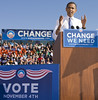
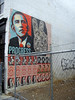
ObeyThe New Pittsburgh Courier ran a story about sociologist Eduardo Bonilla-Silva’s recent lecture in which he discussed how presidential candidate Barack Obama is “not the symbol many perceive him to be.” The story ran under the headline “Sociologist Says Obama is Raceless.”

The Courier reports:

“Symbols work in many directions,” said Bonilla-Silva, a sociology professor at Duke University. “(Obama’s) going to be a truncated symbol; both segments happy, but for totally different reasons—we have to understand what does it mean for Black communities and White communities.”

He discussed “new-racism,” meaning “the post-civil rights racial system of subtle, institutionalized, and apparently non-racial practices that maintains White supremacy and its accompanying racial ideology of color-blind racism.” Instead of seeing Obama as the end of this racism, Bonilla-Silva said his campaign success has been based largely on his ability to appear raceless. Although he admitted Obama could be a good role model, Bonilla-Silva said it is more important for him to create “real change.” — Read more

Eduardo Bonilla-Silva was also a contributing writer to Contexts Magazine‘s feature on the “Social Significance of Barack Obama.” Take a look at Bonilla-Silva’s commentary, here.

The November issue of The Atlantic has an article by psychologist Paul Bloom called, ‘First Person Plural.’ In the piece Bloom explores a number of new ideas about ‘the self.’ He writes, “An evolving approach to the science of pleasure suggests that each of us contains multiple selves—all with different desires, and all fighting for control. If this is right, the pursuit of happiness becomes even trickier. Can one self bind another self if the two want different things? Are you always better off when a Good Self wins? And should outsiders, such as employers and policy makers, get into the fray?”

In the piece Bloom draws upon work by sociologist Sherry Turkle about online avatars:

Sometimes we get pleasure from sampling alternative selves. Again, you can see the phenomenon in young children, who get a kick out of temporarily adopting the identity of a soldier or a lion. Adults get the same sort of kick; exploring alternative identities seems to be what the Internet was invented for. The sociologist Sherry Turkle has found that people commonly create avatars so as to explore their options in a relatively safe environment. She describes how one 16-year-old girl with an abusive father tried out multiple characters online—a 16-year-old boy, a stronger, more assertive girl—to try to work out what to do in the real world. But often the shift in identity is purely for pleasure. A man can have an alternate identity as a woman; a heterosexual can explore homosexuality; a shy person can try being the life of the party.

Read the full story.

20081025_Reno_NV_Rally0177Salon Magazine interviewed Georgetown University sociologist Michael Eric Dyson about Barack Obama and race in America. Salon writes, “According to sociologist and Georgetown University professor Michael Eric Dyson, Barack Obama has already won the election. But if he were white, ‘he’d be up by 15 to 20 points in the polls.'”

An excerpt from the interview: 

Does it not surprise you that two-thirds of black Americans say race relations are poor?

Not at all. Regardless of whether or not they make $100,000, they still see barriers imposed that white brothers and sisters don’t see. If you were stopped by a policeman, as a black person you think: Will they make up some story that I tried to run and shoot me in the back? I use that example because I have been pulled over by the police several times despite the fact that I have a Ph.D. from Princeton and some notoriety. It makes no difference. You are still afraid. That is the great equalizer among black people, regardless of how rich or well-known they are.

It would obviously be an enormous achievement if Barack Obama were to be elected president. What would he be able to change for black Americans?

Well, let’s start with what he can’t change. Given the investment of black people in Mr. Obama’s success, you would think that he was a kind of political Santa Claus, that the day after he was elected, black people wouldn’t have to pay taxes or would get a get-out-of-jail-free card. But social inequalities will still be real. Ironically enough, he has imposed upon himself certain restrictions when it comes to showing a willingness to be susceptible to the demands of black people.

Read Cordula Meyer’s interview with Dyson here.

The Washington Post is running a story on common misperceptions about how American voters base their decisions on moral values. 

The myths: (1)”Moral values” determine who wins elections. (2) Americans have broadly rejected “traditional values.” (3) Americans are polarized and fighting a culture war over values. (4) Traditional values are “family values” or “moral values.” (5) Basic values, properly understood, are compatible and harmonious.

In support of myth #2, the Post draws upon the work of sociologist Wayne Baker. MYTH #2: “Americans have broadly rejected ‘traditional values.’ — Actually, Americans retain our traditional values more than just about any other developed country in the world.”

That’s what University of Michigan sociologist Wayne Baker found in his 2005 book, “America’s Crisis of Values: Reality and Perception.” Baker uses the World Values Surveys to look at American values from a broad, global perspective. He describes human values on two planes. The first is a scale of values from traditional to secular-rationalist. Societies with more traditional values emphasize the importance of God and religion, family and parenting, national identity and pride and absolute standards of morality, not relative ones. Secular-rationalist values are pretty much the opposite: nonreligious, open to abortion and euthanasia, skeptical of national pride or patriotism and evolving away from family, duty and authority.

The second range of values runs from survival values to self-expression ones. In less developed and safe societies, survival values reign. Procuring physical security and meeting basic material needs dominate; foreigners and ethnic diversity are seen as threatening; intolerance is exaggerated. Self-expression values concern creativity, self-fulfillment and lifestyle.

Fascinating. Read more about the other myths here.

Respect
Reuters reported yesterday on how the downturn in the economy is a ‘double whammy’ for police in many cities as they face budgets cuts while they simultaneously brace themselves for a rise in burglaries, robberies and theft.

Although there has long been debate over the connection between crime and the economy, most of the criminologists, sociologists and police chiefs interviewed by Reuters forecast a rise in crimes in certain categories in the coming months as the United States heads deeper into recession territory.

Crime has increased during every recession since the late 1950s, said Richard Rosenfeld, a sociologist at the University of Missouri-St Louis.

Those interviewed stressed they were not talking about an increase in overall levels of crime, which have been falling in the United States since the 1990s, but an uptick in opportunistic crimes like theft and burglary. They say most crimes will still be committed by career criminals but that others in the ranks of the newly unemployed could become drawn in for a variety of reasons.

Reuters also draws upon the work of another sociologist to help explain the potential impact of budget cuts on urban crime…

Lesley Williams Reid, a sociologist at Georgia State University who has studied urban crime, said any cuts to police budgets would be bad news, particularly if the economic downturn is prolonged and more people become unemployed.

“I don’t want to add to a culture of fear, but there is a clear reason to be worried about how this is going to affect crime rates,” she said.

Read more from Reuters.

IMG_1813The folks over at the Freakonomics blog (housed by the New York Times) recently posed the question: ‘Who are the modern-day outlaws? Do we still have outlaws or did they die off with the last of the frontier towns — or maybe later, with the Hell’s Angels?’

Stephen Dubner, the post’s author, approached a number of experts on the issue, including well-known sociologist Chris Uggen. Dubner presented each expert with the following set of questions:  Does America still have an outlaw group? If so, why do you consider them outlaws?Does society need outlaws?

Check out this sociologist’s response…

Chris Uggen, Distinguished McKnight Professor and chair of sociology at the University of Minnesota, executive secretary of the American Society of Criminology, co-author of Locked Out: Felon Disenfranchisement and American Democracy, and co-editor of Contexts Magazine.

Oh, hell yes, there are outlaws in America — and everywhere else, for that matter. Anyone who breaks rules is in some sense an outlaw, subject to social or legal sanctions if their outlawry is detected. These penalties operate on a sliding scale, depending on whether the outlaw smokes cigarettes or meth, pirates DVD’s or ships, or violates college hate-speech codes or state hate-crime laws.

But our standards for outlaws are relative, not absolute; they change over time and social space.

Societies are constantly raising or lowering the bar, outlawing formerly accepted behaviors — like smoking — and legalizing former crimes, like lotteries.

In any group, those with greater power tend to control the rule-making process. And they sometimes go to great lengths to make outlaws out of those who might threaten their power, by restricting their ability to vote or work or have children. Regardless of who holds power, societies operate with a basic set of rules that necessarily beget a basic set of rule violators.

Just imagine, as sociologist Emile Durkheim did, a society of saints made up of exemplary citizens. Would there be no outlaws in such a group? No! They’d pick at each other for minor peccadilloes and trivial misdeeds. In that crowd, even a burp or blemish could mark one as a real bada–.

Nobody is arguing that contemporary America is a society of saints. To the contrary, it often seems as though we’re “defining deviancy down,” as senator and sociologist Daniel Patrick Moynihan put it.

Cultural critics of the hell-in-a-handbasket school worry that our blasé attitudes toward once-shocking behavior –- network telecasts of ultimate fighters beating the bloody snot out of one another, for example — diminish us all. But don’t forget that we’re simultaneously outlawing other nasty conduct that shocks our collective conscience, such as date rape or sexual harassment.

Whether you view our culture’s current constellation of outlaws as ennobling or diminishing is largely a matter of value preferences.

And remember that outlaws put in some important work for a society. When they expose their bodies at the Super Bowl, our reactions — the extent to which we freak out — tell us something about the current boundaries between proper and improper public conduct. When outlaws are arrested at a political convention, we get a heads-up that change is in the wind. When outlaws sell sex or drugs, we get a safety valve to release pent-up frustrations.

Even when outlaws commit consensus crimes like murder, we get a needed opportunity to publicly condemn them and reaffirm our shared values with our fellow citizens.

While society needs outlaws, it doesn’t need a permanent outlaw class. We’d do well to remember that today’s outlaws are tomorrow’s good citizens; and there’s no citizen more zealous than an outlaw redeemed.

Read the full story, here.

Bromfield St.In ‘A Walk on the Seamy Side,’ the Boston Globe reports on a remnant of the American Sociological Association annual meetings which occurred in Boston in early August. The article highlights a different kind of Boston history tour – visiting sites of homicides, arsons, and other illegal activities – creatively developed by sociologists. 

Two local criminal experts created this “Immoral Boston” tour for a recent sociology conference – and it may be no less insightful than walking along the red bricks of the Freedom Trail. James Alan Fox, a professor of criminal justice, law, policy, and society at Northeastern University, sees the tour as a way to understand the influence major crimes have had on the city. Tour cocreator Jack Levin, a Northeastern sociology and criminology professor, has a slightly different perspective: “Crimes can be very abstract,” he said. Real crime “isn’t something you see on prime-time TV, like in ‘Law & Order,’ ‘CSI.’ I think what a tour does, by focusing on the particular spots where crimes have occurred, is lend some reality.”

The Globe concludes:

The men acknowledge their tour caters to the public’s lurid interest in terrible crimes. “For most people, Hannibal Lecter is as real as Jeffrey Dahmer. It’s a fascination, an escape,” Levin said. But “if what you know about crime is based on books, on television, movies, sometimes, it’s difficult to distinguish . . . an actual trial from ‘Boston Legal,’ ” Fox said. “Therefore [we have] a very glamorized perception of what’s happened.

“By going to the sites, it reminds us that people actually died,” he said. “It is difficult to glamorize something when you remember how many people were killed.”

Read the full story.

Left screenThis Sunday’s New York Times ran a piece titled ‘Overfeeding on Information’ about our obsession with the news, especially during such a closely contested presidential election and in the midst of an economic crisis.

The Times describes this compulsion for constant updates:

This explosion of information technology, when combined with an unusual confluence of dramatic — and ongoing — news events, has led many people to conclude that they have given their lives over to a news obsession. They find themselves taking breaks at work every 15 minutes to check the latest updates, and at the end of the day, taking laptops to bed. Then they pad through darkened homes in the predawn to check on the Asian markets.

Sociologist Eric Klinenberg is asked to weigh in on this trend…

ERIC KLINENBERG, a sociology professor at New York University, said people are unusually transfixed by news of the day because the economic crisis in particular seems to reach into every corner of their lives. Usually, he added, people can compartmentalize their lives into different spheres of activity, such as work, family and leisure. But now, “those spheres are collapsing into each other.”

And the news is not just consequential, but whipsaw-volatile. Financial markets swing hundreds of points within an hour; poll numbers shift. This means that news these days has an unbelievably short shelf life, news addicts said. If you haven’t checked the headlines in the last half-hour, the world may already have changed.

And commentary from a psychologist…

For others, information serves as social currency. Crises, like soap operas or sports teams, can provide a serial drama for people to talk about and bond over, said Kenneth J. Gergen, a senior research psychologist at Swarthmore College who studies technology and culture. “It gives us the stuff that keeps the community together,” he said. And for those whose social circles think of knowledge as power, having the latest information can also enhance status, Dr. Gergen said. “If you can just say what somebody said yesterday, that doesn’t do the trick,” he said.

Read the full story.

t w e n t yScience Daily News reports on a new national study from two sociologists out of Brigham Young University which concluded that religious involvement makes teenagers half as likely to use marijuana. The findings from the study are available in the October volume of the Journal of Drug Issues – allegedly settling a question scholars have traditionally disagreed upon.

Science Daily News:

“Some may think this is an obvious finding, but research and expert opinion on this issue have not been consistent,” said BYU sociology professor Stephen Bahr and an author on the study. “After we accounted for family and peer characteristics, and regardless of denomination, there was an independent effect that those who were religious were less likely to do drugs, even when their friends were users.”

The study, co-authored by BYU sociologist John Hoffmann, also found individual religiosity buffered peer pressure for cigarette smoking and heavy drinking.

What is it about religiousity?

The term religiosity as used in the study has to do with people’s participation in a religion and not the particular denomination. Hoffmann said the protective effect of church and spirituality supplements the influence of parents.

“Parents shouldn’t force it, but they can encourage spirituality and religion in their families, which in itself becomes a positive influence in their children’s lives,” Hoffmann said.

Read more.

Manhattan SkylineThe New York Times reports this morning on the concern among New Yorkers about whether crime will return to the city ‘with a vengeance’ as the economy continues to falter. The Times contends, “Expert opinions differ, but the question is hardly illogical. The last time stocks on Wall Street fell hard, in 1987, crime was exploding, and the city saw historic highs in murders in the following years.”

And the Times calls in a sociologist…

“Every recession since the late ’50s has been associated with an increase in crime and, in particular, property crime and robbery, which would be most responsive to changes in economic conditions,” said Richard Rosenfeld, a sociologist at the University of Missouri-St. Louis. Typically, he said, “there is a year lag between the economic change and crime rates.”

The Times adds…

New York, of course, has over the last 15 years seen an extraordinary drop in crime, from the most serious to the mildly irritating. But across all those years, economists and sociologists have debated how much of the success was attributable to new trends in policing and how much to other factors, including a robust economy.

Read the full story.