
culture

Photo by Marion Doss, Flickr CC

In light of the recent attacks in Manchester and Kabul, National Public Radio talked to sociologist Charles Kurzman about the ways Americans perceive the threat of terrorism. Kurzman addressed how Americans focus heavily on every terrorist attack and how we often pin this on Islam, but he explains that Islamic extremism is a rare phenomenon.

As described in his book The Missing Martyrs: Why There Are So Few Muslim Terrorists, Kurzman’s research shows that Americans’ perceptions of the dangers posed by radical Islam are vastly overstated; though we focus on it at great length, violent extremism is relatively rare. Furthermore, it is disingenuous to claim that Islam or Muslim faith is driving this phenomenon. In addition, as Kurzman describes, Americans overstate the likelihood of dying at the hands of violent extremism:

Here in the United States, we have about 15,000 murders a year, and of those, a tiny proportion are from violent extremism. So when we focus just on that tiny proportion, even if we were to bring that down to zero, which we can unfortunately never count on doing, it’s not going to make a huge dent in the threat to public safety that we experience each year.”
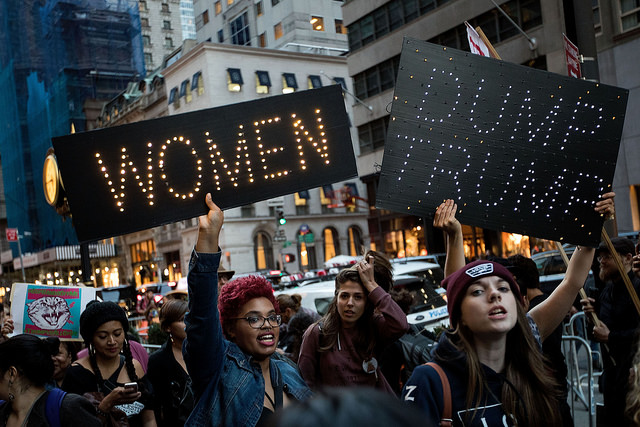

Photo by ResistFromDay1, Flickr CC

Since Donald Trump’s inauguration, the presence of social movements and protests has grown substantially. Most notable among this phenomenon have been large marches, such as the Women’s March and the March for Science. And according to an article in the Washington Post, these movements are showing no signs of slowing.    

Sociologist Dana Fisher, Director of the Program for Society and the Environment at the University of Maryland, investigates what has motivated people to more actively participate in democracy.  In the article, she explains that this shift to more collective and vocal action is to ensure people are heard, especially in light of the current administration.  According to Fisher,

“Most people used to be content to vote every four years and then disengage from politics … but many Americans no longer feel like their concerns are being heard just by voting.”

The protests have also been more ethnically diverse than is typical, and Fisher’s research shows that the rates of bachelor’s degrees among the protesters is higher than the general US population. Perhaps the most significant shift is the variety of issues in which participants are protesting. At the Women’s March, 60 percent said they were protesting for women’s rights, 36 percent indicated they were there for the environment, and 35 percent for racial justice. Fisher explains,  

“Since the inauguration … the resistance has become the umbrella for a suite of issues that used to have their own individual movements … They are not just coming out for the one issue that is their big issue. They have a much more intersectional sense of an identity as an activist.”

Photo by Global Panorama, Flickr CC

Summer is just around the corner, and in the U.S. that means not only warmer weather but an abundance of music festivals. From Lollapalooza to Austin City Limits, millions of people flock to these events each year, fueling the growth of a massive “festival industry” over the past decade. Recently, however, major festivals like Bonnaroo have seen a decrease in attendance rates. In an article in the Washington Post, sociologist Johnathan Wynn explains how growing commercialization and consolidation may diminish the quality of the musical experience for festival-goers.

Wynn outlines how  major festivals have relied on corporate interest to promote their brands. In 2014 alone, corporations spent $1.3 billion toward sponsoring festivals, tours, and music venues. Despite a growing corporate presence, most festival attendees in Wynn’s interviews were unphased by this increasing commercialization, viewing it as a trade off for low ticket prices. However, with this burgeoning success also comes the problem of consolidation — or putting numerous festivals under the purview of a few major live music conglomerates. Many popular shows are now owned by a single company. For example, Live Nation, one of the largest world music promoters, runs over 60 music festivals each year. According to Wynn, this “institutional isomorphism” leads to uniformity in the lineups of festivals:

“Sure enough, with only a couple of promoters organizing the biggest festivals, the same artists seem to be performing at the same ones. Twenty of the 103 performers at AEG’s Coachella this year are among the 166 acts playing at Live Nation’s Bonnaroo. That means that one-tenth of Bonnaroo’s lineup and one-fifth of Coachella’s lineup are exactly the same. Consolidation and uncertainty beget monotony.”

The combination of corporatization, consolidation, and uniformity may lead to what some are calling “festival fatigue,” but Wynn points to smaller productions such as the Newport Folk Festival as a beacon of hope. Shows like Newport are attempting to break the mold of commercialization by offering a more local and eclectic experience to their attendees. So music festivals have come a long way since Woodstock, but as Wynn suggests, it may not be for the better.

Photo by Sharon Wesilds, Sherry Photography. Flickr CC

As wedding season approaches, many of us are getting together our wedding outfits and ordering our wedding cakes. But things may be a bit quieter in Philadelphia, “The City of Brotherly Love,” however. Philadelphia has the highest rate of adults who have never been married out of all the major American cities. A study by the Pew Charitable Trust group found that nearly 52 percent of Philadelphia’s adult population have never been married, which is significantly higher than the national average of 33.5 percent. 

Judith Levine, a professor of sociology at Temple University, believes that high rates of poverty could be the reason for Philadelphia’s low marriage rates, as Philadelphia’s 26% poverty rate is much larger than other large U.S. cities. Levine explains,

“It’s no coincidence that the one with the highest percentage of people who have never married is also the one with the highest poverty rate. We’re really in this period where there’s just this huge class divide in who gets married …  [Many individuals] see marriage as a point along the transition to adulthood that happens after certain other things happen, like education or being able to buy a home.”

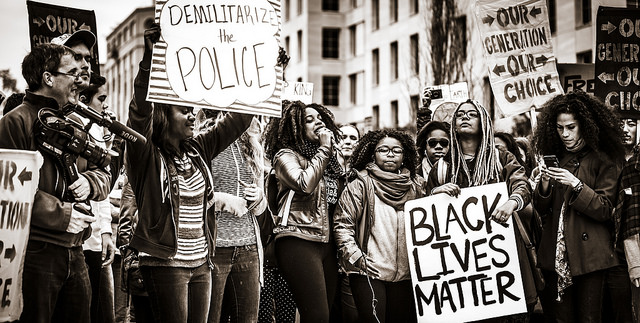
An actual Black Lives Matter protest. Photo by Johnny Silvercloud, Flickr CC

A few weeks ago, Pepsi released an advertisement with Kendall Jenner wherein the young celebrity takes a stroll through a crowded protest, sodas in hand. The commercial received a lot of criticism and was taken off the air almost immediately. In an article in The Ubyssey, University of British Columbia sociologist Rimal Wilkes describes some of the issues with the commercial, particularly how it misrepresents the nature of protests.

To begin with, the commercial sports a diverse set of protesters, but that makes it difficult to imagine what exactly they’re protesting — Racial inequality? Environmental issues? Furthermore, the crowd in the ad looks like people who are quite privileged, which goes against what protest is about. As Wilkes explains, Kendall Jenner—as a famous fashion persona—is unlikely to share in the same risks or dangers associated with protesting or the issues which drive it. Wilkes explains, 

“It’s too overtly politically correct. The diversity doesn’t look right … This ad is about protest as a way of expressing coolness. Those aren’t the people we should be celebrating. We should celebrate the people who are putting in so much work and whose lives are on the line.”

Further, an advertisement like Pepsi’s glorifies a pro-capitalist corporation and ethos, which also goes against most protest and resistance mentalities. Wilkes argues,

“I can’t think of too many [protest] movements that are pro-capitalist. Real young people in a real protest simply wouldn’t rally around a product like the way they do in this ad. Pepsi’s goal, then, is about branding. They want you to think, ‘I’m like these people! I’m young and good looking and cool!’ … This kind of insidious branding is everywhere. This commercial is getting picked on, but there’s an element of randomness to that. This isn’t the first commercial to have problematic representation.”

Photo by Christian Schnettelker, Flickr CC

The recent media attention surrounding Fox News and accusations of sexual harassment are high-profile examples of the everyday experiences that many victims of sexual harassment face in the workplace. An article in the New York Times explores research on the factors that discourage people from reporting harassment, citing work from University of Illinois sociologist Anna-Maria Marshall and others.

Sexual harassment often goes under-reported, especially in male-dominated settings with rigid hierarchies like the military and large corporate companies. Sometimes victims are uncertain of what qualifies as illegal harassment — one meta-analysis by Remus Ilies and colleagues found that reports doubled when asked about specific behaviors rather than just using the term “sexual harassment.” Many women also fear retaliation for pursuing formal action, or at the very least disbelief or inaction from their employers. These fears appear to be well placed, however, and one study found that two-thirds of workers reported retaliation from their employers after reporting mistreatment.  

While many startup companies do not have human resource departments to handle sexual harassment issues, Marshall’s research demonstrates that even organizations with official harassment policies and procedures create hurdles that keep legal action from being taken. Marshall finds that policies on paper are much different in practice, and that managers often interpret policies to protect the interests of their organization, and not the employee. Marshall explains,

“Companies put [policies and procedures] into place as mini litigation defense centers … The way employers deal with it is to prepare to show a court or jury that they did everything they could, rather than to protect women in the workplace.”

Photo by dion gillard, Flickr CC

Recently, a video showing a United Airlines passenger being forcefully dragged out off the plane after refusing to give up his seat went viral. The airline had double-booked the seat, a common occurrence, but this passenger was not persuaded by the standard incentives offered and tensions escalated quickly. The New York Times recently discussed the history of these airline practices and looked to sociology to help explain what happened on that United flight. 

As the article explains, the government controlled airfares and routes before the Airline Deregulation Act of 1978. From then on, airlines have diverged in terms of prices, accommodations, and business practices. Due to fears surrounding 9/11 and tighter wallets due to the global recession of 2008, airlines began to ramp up their practice of double-booking flights in order to guarantee that planes are always full and to maximize profits. 

This business practice may make sense to the airline, but it is not typically appreciated by its clientele. Elizabeth Popp Berman, a sociologist at the University at Albany, explains that there is well-documented research that could have predicted the United incident. She states,  

“There is a lot of research in organizational settings that suggests perceptions of unfairness lead to anger, hostility and spiteful behavior … When an airline’s decision to remove passengers is seen as unfair because it does not conform to expectations about passengers’ rights or the airline’s obligations, it is not surprising that passengers will become less compliant.”

Photo by CDA, Flickr CC

Support for gender equality in the work place — such as equal pay and equal chance of promotion — has continued to grow.  However, a recent article in Time suggests that young people today are less supportive of gender equality than they were 20 years ago when it comes to household norms and roles.

Joanna Pepin, a sociology doctoral candidate at the University of Maryland, finds that millennials are supportive of gender equality in the workplace but still prefer standard gendered roles at home, a stark contrast to previous expectations based on other generations’ dispositions towards the matter.  In 1994, only 42% of high school seniors agreed that men should be the primary breadwinners and women should manage domestic life and raising of the family.  Now 58% of high school seniors believe that these traditional gender norms are best.

“We thought that as women entered the workplace, as they gained more access to income and their days started to look more like men’s, that that would translate to more equality in the home … but that’s really not what these attitudes trends are showing.”

Pepin and her co-authors argue that a new cultural ideology of “equal, but different” has taken hold. However, Daniel Carlson, a sociologist at University of Utah, points to obstacles that working families face as the primary reason for reduced gender egalitarianism in the home. Carlson argues,

“As couples struggled with inflexible workplaces and public policies that didn’t support working families, they’ve ‘reverted to conventional gender arrangements and traditional beliefs, transmitting their attitudes to their teenage children.'”

Either way, these new trends highlight the complexity of gender attitudes and the various social forces that shape them.

Photo by momo, Flickr CC

In America, conventional wisdom has long stated that hard work is the most important ingredient in the formula for success. Many social scientists, however, have discussed how systematic and institutional practices mean that this age-old adage is often more idealistic than reality, and this particularly comes into play when explaining underprivilege and disadvantage. Though “hard work” gives you a chance at climbing up the ladder, the way the ladder is designed plays a big part as well, making it harder for some people than others. In a recent interview with The Atlantic, Brandeis University professor of law and sociology Tom Shapiro discusses how these processes are extremely pronounced for people of color due to historical and contemporary policy norms.

From the GI bill to the implementation of social security, African-Americans were disadvantaged the most in the mid-20th century as the American social state expanded but excluded people of color. Today, even though opportunities for African-Americans increased near the end of the 20th century, black-middle class families still live in worse neighborhoods and have lower amounts of family wealth than their white middle-class counterparts. This means that economic mobility—the concept of families and their children advancing up the economic ladder—becomes much harder for black families. Shapiro explains that a large part of the solution to this will be convincing the white working class to work with, not against, communities of color. Shapiro concludes: 

“Part of the challenge is helping the white working class — if I can use that generic phrase — to understand how economic pain is felt elsewhere, by people who may or may not be similarly situated. And, yeah, your sense of status might be changing, but the pain is much more widespread, and surely deeper in communities of color. Which is not to say you don’t count. But if you’re not in this together, the divide and conquer strategy will be successful.

You can read more about these phenomena in Dr. Shapiro’s book Toxic Inequality: How America’s Wealth Gap Destroys Mobility, Deepens the Racial Divide, and Threatens our Future.  

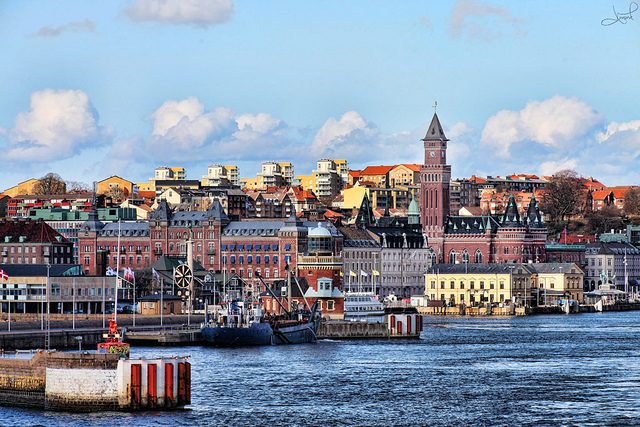
Helsingborg Waterfront, Sweden. Photo by tsaiproject, Flickr CC

Sweden has a long tradition of supporting its citizens with protective regulations and social services, including 480 days of paid parental leave, universal health care, and free higher education.  But now, a new proposal has come forward in the Swedish town of Overtonea: to give municipal employees a paid hour break during the week to go home and have sex.  A recent article in the New York Times explains that the policy, a brainchild of councilman Per-Erik Muskos, could help with the decreasing population in Overtonea, improve marriages, and improve employee satisfaction. 

Muskos’ idea has garnered as much praise as criticism. Many believe that it will encourage single workers to go on dates that will take longer than the one hour. And many wonder how such something like this could be enforced. Others believe that it is an excellent idea, as it will help with work-life balance. Lotta Dellve, sociologist from the University of Gothenburg, believes that her research supports Muskos’ plan. Her findings show that short bursts of physical activity during office hours are correlated with work satisfaction and productivity. Dellve believes that sex can fulfill these needed bursts, but noted that a lot of people might struggle to find the motivation to come back to work.