politics

Photo by Joka Madruga, Flickr CC

As troops leave the military in droves, Nicolas Maduro appears to be losing his grip on the presidency in Venezuela. Presiding over a long running national crisis, Maduro remains in power nearly a year after an election that much of his political opposition, the United States, and many U.S. allies deemed fraudulent. Much of Maduro’s opposition claims the presidency should go to his political rival, Juan Guaidó. Possible intervention of the United States remains on the table, and there is a long history of U.S. intervention in the nation, which, if it happens again, could garner more support for Maduro.

As Guaidó now calls for national protest against Maduro, top military generals and a significant portion of Venezuelans, the chavistas remain at the president’s side. A recent article in The Nation by sociologists Tim Gill and Rebecca Hanson argues Guaidó should attend to the plights of chavistas — historic backers of Maduro’s far-left predecessor Hugo Chávez –for any presidential transition to be successful.

Gill argues that Guaidó’s initial rise was due in part to the U.S. influence on student movements that Guaidó was a part of meant to rid Chávez of his office, and enable the U.S. to retain a foothold in political and economic matters in Venezuela. Guaidó’s association with the United States comes at a price.

Hanson’s decade-long work with Venezuelans in Caracas suggests that even though many have continued to oppose Maduro, “some would prefer that [Guaidó] ‘put his house in order’ without outside intervention—that he demonstrate his ability to generate support within Venezuela.”

Whether it is Guaidó or Maduro in power, many Venezuelans believe that their country will be under the service of the United States or Russia and China, respectively.  

Gill and Hanson argue that Guaidó should instead attend more to his own people — such as offering free healthcare and the protection of human rights — which would serve the poor and working class through and after his transition into power. They also state this strategy should include aligning himself with former president, Hugo Chávez and his followers, the chavistas. Chávez remains a political icon beyond his death due to his legacy as an advocate for the poor and his outspokenness against American intervention in Venezuela. To these ends, Gill and Hanson conclude:

“There is no political future in Venezuela without chavista participation, and, one way or another, the opposition and chavismo will eventually need to work together toward a new future.”
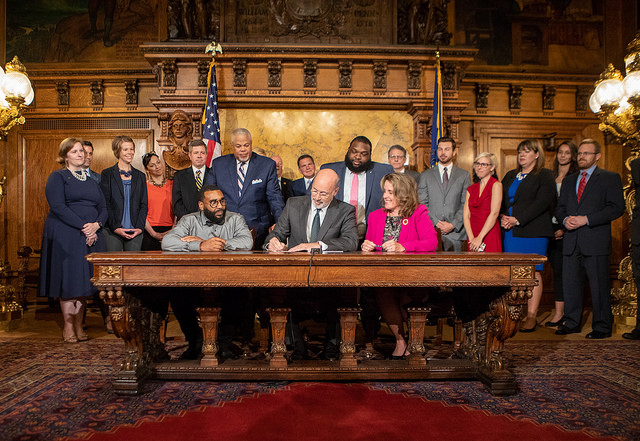
A politician signs a criminal justice reform bill at a large desk while others look on. Photo by Governor Tom Wolf, Flickr CC

Given the current polarization of American politics, it often comes as a pleasant surprise when Republicans and Democrats can agree on new legislation. This was exactly the case for the passage of the First Step Act in Congress, a criminal justice reform measure aimed at reducing prison sentences and increasing prison programming in the federal system. Backed by the White House, the First Step Act was also supported by an unlikely coalition of Republican and Democratic leaders, as well as the conservative political powers like the Koch Brothers and progressive non-profits like the American Civil Liberties Union. Drawing from her own research, Michelle Phelps explains in The Conversation how politicians’ attempts to change the criminal justice system has often been through uneasy alliances, and many of these policy efforts fall through in their implementation.

Phelps contends that much of the current academic and media discussions about criminal justice frames it as a pendulum that swings back and forth between the two poles of either  “get tough on crime” punishments or a more lenient system with treatment and rehabilitation. In her book, Breaking the Pendulum, with Phil Goodman and Josh Page, she argues that a better way to describe criminal justice reform efforts is tectonic plates. Phelps explains,

“…a better metaphor is the constant, low-level grinding of tectonic plates that continually produce friction and occasionally erupt in earthquakes. This friction manifests in traditional political combat, mass demonstrations, prison rebellions, and academic and policy work. Periodically, major changes in conditions like crime rates and the economy change to provide support and opportunities to one side or another.”

She highlights how this combination of social changes often produce alliances among Republicans and Democrats. For example, we often associate “get tough on crime” approaches with past and current Republican presidents, but one of the toughest crime bills, the 1994 Violent Crime Control and Law Enforcement Act, passed with bipartisan consensus under the leadership of president and Democrat Bill Clinton. While the 1994 bill was extremely popular and overly punitive, evidence suggests that it had a limited impact on the prison boom of recent decades. This highlights another major concern with the future of the First Step Act, a lack of meaningful implementation by key stakeholders, such as Trump’s new pick for U.S. Attorney General, William Barr. Phelps concludes,

“Like the ‘94 bill before it, this indicates that the First Step Act will likely be more bark than bite. The First Step Act might provide relief to several thousand current federal prisoners. But Barr will likely follow Sessions and direct his prosecutors to seek the maximum criminal penalties against current defendants, including for drug offenses, limiting the impact of the First Step Act’s sentencing reform. And the bill will have no practical effect on state prison systems, which in some cases have already embraced much more radical reforms…While the First Step Act is a move in the direction of more humane and moderate criminal justice practices, I think it will likely be a very small first step indeed.”

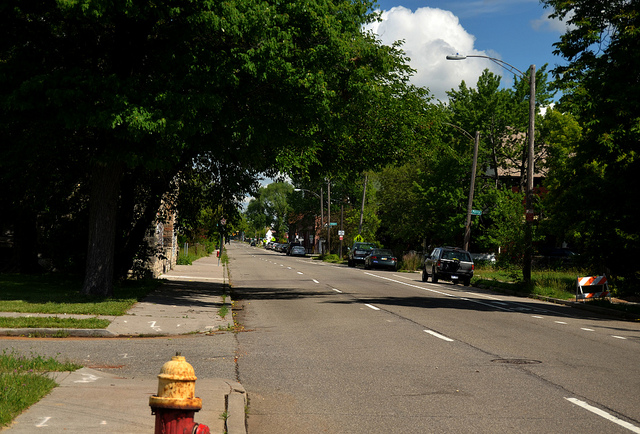
Photo of a street lined with trees in Detroit. Photo by Nic Redhead, Flickr CCi

Evidence shows that trees and green spaces in urban areas offer a number of benefits, such as reducing stress and improving air quality. Despite these benefits, many residents of Detroit refused to allow the city to plant trees in front of their houses during a recent city “greening” initiative. An article appearing in CityLab draws from sociological research to demonstrate how a history of government abuses and lack of inclusivity of communities of color in key decisions explains why many Detroiters had this reaction.

Sociologist Dorceta Taylor published a report in 2014, arguing that white environmentalists make environmental justice projects less effective when they assume they know what is good for a neighborhood. By leaving communities of color out of the planning process, they are not able to anticipate or overcome challenges along the way. This proved true in Detroit. A recent article by Christine Carmichael and Maureen McDonough examined the reasons why Black residents resisted the city’s trees. CityLab reports: “It’s not that they didn’t trust the trees; they didn’t trust the city.”

Carmichael and McDonough found that Black residents were aware of the many benefits of living near trees. However, to some, the trees were a symbol of the city’s unwanted intervention in their lives. Amidst racial tension in the 1960s, the city began clearing trees from Black neighborhoods — ostensibly to combat Dutch elm disease, but some interviewees. Yet, some people believed the city cut down trees to increase police surveillance. This memory triggered their reaction to the modern tree-planting. Carmichael says:

“In this case, the women felt that [after the race rebellion] the city just came in and cut down their trees, and now they want to just come in planting trees. … But they felt they should have a choice in this since they’ll be the ones caring for the trees and raking up the leaves when the planters leave. They felt that the decisions regarding whether to cut down trees or plant new ones were being made by someone else, and they were going to have to deal with the consequences.”

This failed initiative in Detroit highlights the social forces that environmental organizations must consider when working in marginalized neighborhoods. Recruiting volunteers and administrators who come from the communities they are serving (something Detroit did not do) could help improve the process. As CityLab reports:

“[E]nvironmental justice is not just about the distribution of bad stuff, like pollution, or good stuff, like forestry projects across disadvantaged communities. It’s also about the distribution of power among communities that have historically only been the subjects and experiments of power structures.”

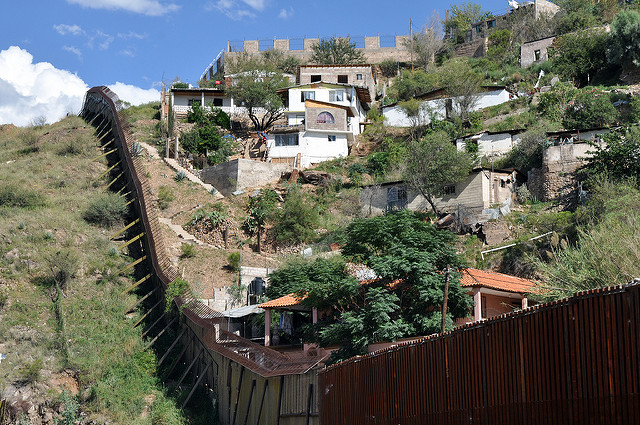
Photo of the wall in Nogales that divides Mexico and the United States. Photo by Jonathan McIntosh, Flickr CC

Current pressure for a wall on the United States’ southern border has been a centerpiece in politics and the media, but push for a wall is one recent development in a complex history of border politics. For centuries, the border has been a site for war, conflict, immigration, and trade. A recent article in The Washington Post highlights how these historic events have contributed to defining what the border means today, and how — especially in recent decades — this has led to calls for heightened security and enforcement.

The border itself is a powerful political symbol. According to sociologist Douglas Massey, it is not just

a border but the border, and its enforcement has become a central means by which politicians signal their concern for citizens’ safety and security in a hostile world.”

Recent work by Massey highlights how throughout history this “hostile” world has been defined and composed of dissident actors — drug traffickers, terrorists, communists, or criminals — with politicians using them as political chips to peddle and spin different narratives on how and why we should protect the border.  

This research demonstrates that whether the southern border is an invisible line, physical fence, or wall, it continues to be a symbolic boundary for people who hold a profound fear of those who are non-white or of different cultural backgrounds. For example, recent political positions towards Central American migration to the United States seem to echo historic anti-immigrant attitudes. During the late 19th century, Chinese laborers were banned for decades from immigrating to the U.S. for their perceived cultural and economic threat to American society.

As debates continue over the construction of a southern wall, it is worthwhile to question if anti-immigrant attitudes and fears are haunting reverberations of the past. Recognition of the complex history of the U.S.-Mexico border and its connection to fear of crime and xenophobic attitudes may be a useful starting point so that today’s politics do not become “another brick in the wall” in the history of the border.

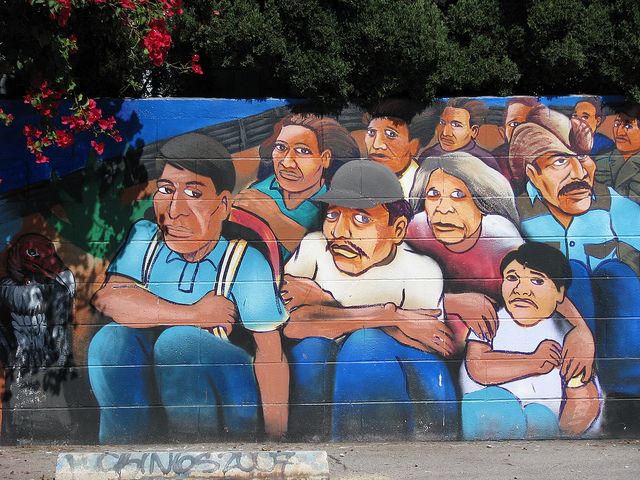
Photo of a mural in Los Angeles, California of people huddled together and a wall in the background. Photo by claumoho, Flickr CC

Even after signing a resolution to suspend the longest government shutdown in U.S. history, President Trump remains committed to delivering his long-promised southern border wall. In defense of the wall and the recently failed $5.7 billion Senate proposal, Trump again made comments on national security that contradict numerous studies and immigration scholars. However, the wall is not the only immigration policy proposed by the administration that could have dire social repercussions.

In a recent op-ed for the MinnPost, an interdisciplinary team of expert immigration scholars at the University of Minnesota, including Ryan Allen, Jack DeWaard, Erika Lee, and Chris Levesque, argues that the administrative changes to the ‘public charge’ rule is one such policy. The ‘public charge’ rule is a policy used to evaluate non-U.S. citizen applicants for U.S. residency by how likely they are to become dependent on the government for support. The Trump administration aims to make it easier for government officials to decide an immigrant is ineligible for residency if they are in need of or use government assistance programs. The research team highlights serious consequences of such a policy: in the wake of this announcement, many legal immigrants who are entitled and in need of health and social assistance programs fail to use them out of fear. This could produce detrimental effects on public health by spreading certain diseases across communities and reducing economic productivity.

The research team, which includes community stakeholders and activists, is committed to igniting critical discussions that address these challenges faced by individuals and families who immigrate to U.S. communities. In a sole-authored piece for the Pioneer Press, Jack DeWaard writes,

“…discussions and debates about U.S. immigrants, immigration and immigration policy must start with the very simple recognition that immigrants are people — often facing incredible hardships — seeking to do the best for themselves, their children and their families against a backdrop of widening inequality, both globally and within the U.S. With this as the starting point, say what you will about issues like the economic impacts of immigration…, men and women of character and integrity neither promote nor sit idly by as immigrants, including young children, are…denied their rights…in the process for doing what any person in their position would do — namely, ask for help.”

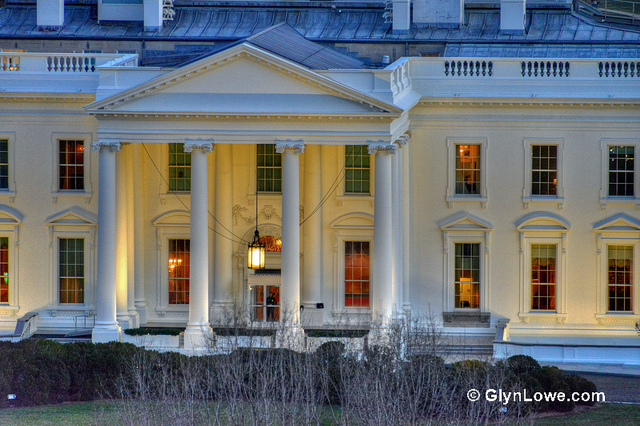
Photo of the White House by Glyn Lowe PhotoWorks, Flickr CC

As the recent partial government shutdown affected some 800,000 federal employees, Wilbur Ross, the Secretary of Commerce, made headlines for questioning why unpaid workers would need to visit a food shelf. Democrats responded that the millionaire investor is out of touch, as many Americans cannot afford to miss a paycheck and may not have access to credit to cover their basic expenses.

While Republicans are generally considered to be more corporate-friendly than Democrats, sociologist Timothy Gill argues in an op-ed for the Washington Post that both parties have had close ties to big business. According to his research, at least 70% of every presidential Cabinet since the Nixon administration has been staffed by former or future corporate executives.

Gill points out that sociologists have long been concerned about the connection between business and government. When C. Wright Mills published The Power Elite in 1956, he inspired new generations of social scientists to closely examine the concentration of corporate and political power among relatively few individuals.

The “power elite” have far more influence over public policy than the average American, and evidence suggests that they have used this influence in the past half century to serve their interests: tax rates have been slashed for corporations and wealthy individuals, union membership has declined, median wages have stagnated, and CEO compensation has soared. Gill argues that it is worth asking whether these policies are the result of the revolving door between business and politics. He writes:

“The mere presence of corporate elites in an administration, of course, does not mean that Cabinets necessarily represent elite corporate interests. But it does deeply influence what issues get discussed and what perspectives get considered as administrators grapple with policy questions.”

The government has been temporarily reopened, but as another funding deadline looms, federal employees may not be comforted to know that millionaires like Ross have more influence over the president than they do.

Photo by maxime raynal, Flickr CC

Originally posted April 12, 2018.

Throughout history, human beings have been enthralled by the idea of the paranormal. While we might think that UFOs and ghosts belong to a distant and obscure dimension, social circumstances help to shape how we envision the supernatural. In a recent interview with New York Magazine, sociologist Joseph O. Baker describes the social aspects of Americans’ beliefs about UFOs.  

Baker argues that pop culture shapes our understandings of aliens. In the 1950s and 1960s, pop culture imagined aliens in humanoid form, typically as very attractive Swedish blonde types with shining eyes. By the 1970s and 1980s, the abductor narrative took hold and extraterrestrials were represented as the now iconic image of the little gray abductor — small, grey-skinned life-forms with huge hairless heads and large black eyes. Baker posits that one of the main causes of UFOs’ heightened popularity during this time was the extreme distrust of the government following incidents such as Watergate. Baker elaborates,

“I think there is something to be said for a lack of faith in government and institutions in that era, and that coincided with UFOs’ rise in popularity. The lack of trust in the government, and the idea that the government knows something about this — those two things went together, and you can see it in the public reaction post-Vietnam, to Watergate, all that stuff.”

While the individual characteristics of “believers” are hard to determine, survey evidence suggests that men and people from low-income backgrounds are more likely to believe in the existence of alien life. Baker says that believing is also dependent upon religious participation rather than education or income. In his words,

“One of the other strongest predictors is not participating as strongly in forms of organized religion. In some sense, there’s a bit of a clue there about what’s going on with belief — it’s providing an alternative belief system. If you look at religious-service attendance, there will be a strong negative effect there for belief in UFOs.”

Baker’s research indicates that social circumstances influence belief in extraterrestrial beings. In short, these social factors help to shape whether you are a Mulder or a Scully. Believing in UFOs goes beyond abductions and encounters of the Third Kind. In the absence of trust in government and religious institutions, UFOs represent an appealing and mysterious alternative belief system.

Photo by Sandra Cohen-Rose and Colin Rose, Flickr CC

Originally published March 6, 2018.

In the United States, poor parents face intense scrutiny for their purchasing decisions, especially for buying unhealthy food for their children. New research sheds light parents’ decisions to buy or not buy junk food for their kids. In a recent op-ed for the Los Angeles Times, Priya Fielding-Singh explains that junk food consumption is an emotionally-rooted decision for impoverished parents.

Fielding-Singh observed the food-purchasing habits of 73 families. Families experiencing poverty honored their children’s requests for junk food more often than affluent parents. For poor families, junk food was one of few affordable luxuries. It was sometimes the only chance for parents to say “yes” to something their kids asked for. Fielding-Singh notes,

For parents raising their kids in poverty, having to say ‘no’ was a part of daily life. Their financial circumstances forced them to deny their children’s requests — for a new pair of Nikes, say, or a trip to Disneyland — all the time. This wasn’t tough for the kids alone; it also left the poor parents feeling guilty and inadequate.”

More affluent parents, on the other hand, had the means to grant these more indulgent requests. Saying “no” to junk food was their way of encouraging their children to have better dietary habits, as well as discipline and willpower. This doesn’t mean poor parents were unconcerned with their children’s nutrition. According to Fielding-Singh, “poor parents honored their kids’ junk food requests to nourish them emotionally, not to harm their health.” So, health disparities are not just about lacking healthy options or resources. This research shows that we also need t0 consider the emotional side of decision-making related to health. 

Photo of five students of different races sitting around a laptop. Photo by liz falconer, Flickr CC

The incoming congressional class will be the most diverse in history, including a record number of women of color. Although change is slow in the political realm, the changing face of Congress may reflect the changing face of the United States. The U.S. Census has long predicted that non-Hispanic whites will become a numerical minority, making up less than half of the U.S. population in the not-too-distant future. Recently The New York Times interviewed social scientists to get their reactions to this national “majority-minority” conversation. 

Social psychologists Maureen Craig and Jennifer Richeson recognized that these projections — that whites will no longer make up the majority — spark fear in many white Americans. Consistent with what researchers already know, that groups feel more threatened as their size declines, Craig and Richeson found that white Americans who read about the projections indicated more negativity toward racial minorities.

From his own experience presenting these census projections to others, demographer Dowell Myers observed that progressives were uninterested in finding ways to alleviate fears about this demographic shift. Instead, political progressives heralded these projections as a sign of “demographic destiny” that would inevitably sweep them into power.

Sociologists like Richard Alba question whether the Census is even using the right categories when they project a majority-minority country. Race is particularly difficult to project, considering the definition of race changes over time because it is always situated in a particular context and set of social relations. This leaves researchers with many questions, including whether the Census Bureau should continue to identify mixed-race individuals with both white and other racial backgrounds as non-white, as well as whether whiteness will shift to include current non-white groups. As sociologist Mary Waters concludes,

“The question really for us as a society is there are all these people who look white, act white, marry white and live white, so what does white even mean anymore?…We are in a really interesting time, an indeterminate time, when we are not policing the boundary very strongly.”

Photo of a an overturned wheel barrow in front of a solid metal fence. Photo by Michael Coghlan, Flickr CC

Addressing gun violence in the United States is often a heated political issue — polarizing constituents around what solutions are best to address it. Reducing the thousands of firearm homicides and nonfatal shootings that occur each year will require some serious debate and complex solutions. But there is one surprising factor that may reduce gun violence — cleaning up neighborhoods. A recent study featured in Huffington Post shows that this simple strategy of “cleaning and greening” vacant lots may have some far-reaching impacts on reducing crime.

The researchers partnered with the Pennsylvania Horticultural Society’s LandCare program to randomly select lots in Philadelphia for either a full transformation (picking up trash, putting up a fence and grass seed, and maintenance), a partial makeover (trash removal and mowing only), or left untouched.The researchers then measured shootings in the area from 2011 to 2015.

They found that areas that received the full “cleaning and greening” saw a 7% reduction in shootings, and the partially treated areas a 9% reduction, when compared to areas with no cleaning or maintenance. John Macdonald, one of the study authors, notes that this cleaning strategy did not appear to displace shootings to other blocks, and that cleaned up lots could have other health and safety benefits. He also noted that the solution has its limitations and needs more research to understand the impacts of “cleaning and greening”:

“You couldn’t green a city and just eliminate the chronic problems of gun violence that are highly concentrated in city blocks just by doing remediation to places.” 

Sociologist Eric Klinenberg notes “broken windows” theory — the idea that visible signs of crime, like broken windows, creates an environment that encourages further crime —  is the main impetus behind this experiment. However, he also points out that broken windows theory has been used to justify policing of low-level crimes like public drinking — particularly against people of color and homeless people. These policing practices were not only severely misguided, but completely overlooked the environmental aspects of the original theory:

“What’s so striking is that the [original 1982 article The Atlantic] was actually much more about broken windows than it was about bad people…For decades now, we have fought crime by trying to crack down on people.”

Rather than reducing crime “by punishing people,” Klinenberg suggests that we need more resources and social infrastructure in communities that are heavily impacted by crime. As he concludes, “What we have not done is invest in places and rebuild places where crime is concentrated.”