politics

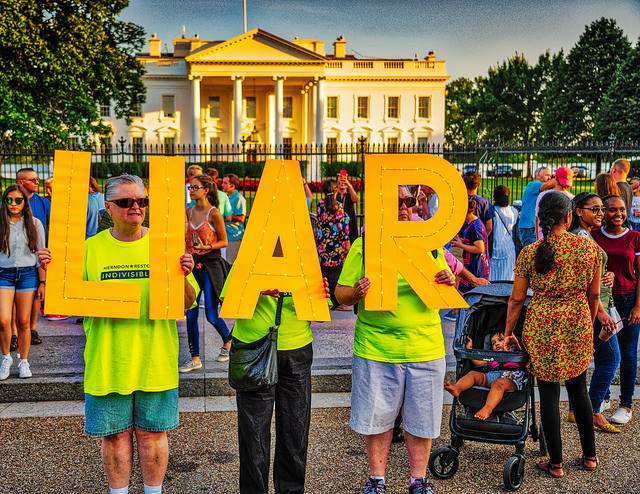
Protestors holding up letters that spell, “liar.” Photo by Mobilus in Mobili, Flickr CC

Vox writer Zack Beauchamp, among many other cultural critics and journalists, became “obsessed” with the question of why Kavanaugh supporters appear unfazed by potentially false claims during his testimony before the Senate Judiciary Committee. Beauchamp’s article on the subject relied extensively upon an American Sociological Review article (and an extensive tweet thread from one of the authors) to explain why this might be the case.

According to research from Oliver Hahl, Minjae Kim, and Ezra Zuckerman-Sivan, voters can recognize that a politician is lying but still consider them authentic. Their study includes analysis of President Trump’s claim during the 2016 campaign that global warming is a hoax developed by China, which most of the participants labeled as “highly false.” The authors found that,

“Trump voters were significantly more likely to justify the lie as a form of symbolic protest…[and they were] much more likely to think the statement ‘was his way of challenging the elite establishment’ than to see the statement as true.”

To test these findings further, Hahl and colleagues conducted an experiment that involved a simulated college election where the main issue was the imposition of a campus alcohol ban (which would threaten campus traditions). Participants who were assigned the traditionalist group and led to believe that the establishment was treating them unfairly supported a candidate who used clearly false data because they viewed the candidate as speaking toward a deeper truth. As demonstrated by the research, the election, and Kavanaugh’s hearings, there must be some sort of legitimacy crisis — either a corrupt establishment or unfair favoring of an upstart group — in order to set up an environment where lies resonate with a sense of truth for an aggrieved group. Beauchamp expands further,

“As with Trump, the deeper truth is that a particular group is treated unfairly by the establishment (recall Kavanaugh’s opening),” Zuckerman-Sivan wrote in a Twitter thread. “So long as the obvious lies can be framed as serving that larger truth, the liar can present himself as the group’s ‘authentic champion.’”

Importantly, Hahl and colleagues find that individuals from all across the political spectrum were susceptible to “the appeal of the lying demagogue” — making lies in search of a larger truth a more common occurrence than just in the last election.

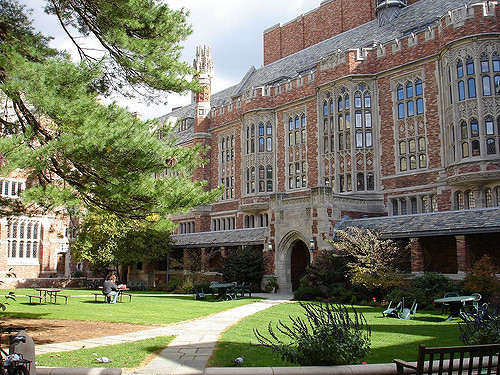
Photo by The Preiser Project, Flickr CC

While political unrest in the United States and in the Middle East may look very different on the surface, social media plays a key role in both contexts. In an article published by MIT Technology Review, Zeynep Tufekci uses her research on political upheaval and social media to show how digital connectivity can enable large-scale movements — like the one in Egypt that ousted an autocratic leader during the Arab Spring — but also has a “dark side” that includes things like online infighting among activists. 

Tufekci’s research further illustrates how traditional gatekeepers including mainstream media and NGOs have been removed from their positions of power by the swift rise of new, digital gatekeepers like Google, Facebook and Twitter. Politicians including Barack Obama and Donald Trump have used digital connectivity to bypass mainstream media and reach the public directly. While digital connectivity is useful to coordinate protests and create social communities, it can also polarize opinions — as was the case with Russian operatives who created fake local media brands and published polarizing content on social media during the 2016 presidential campaigns in the United States. Tufecki argues that social media is a double-edged sword: Both an instrument for spreading democracy and as a weapon that attacks it. Tufekci’s forward-looking proposition in the face of this reality is:

The way forward is not to cultivate nostalgia for the old-world information gatekeepers or for the idealism of the Arab Spring. It’s to figure out how our institutions, our checks and balances, and our societal safeguards should function in the 21st century — not just for digital technologies but for politics and the economy in general. This responsibility isn’t on Russia, or solely on Facebook or Google or Twitter. It’s on us.

Photo of Yale Law School courtyard. Photo by stepnout, Flickr CC

More than 20 million people tuned in to the Ford-Kavanaugh hearing on Thursday. Many sociologists provided perspectives on the hearing, outlining everything from the myths about rape to the connections (and differences) with the Anita Hill and Clarence Thomas case. In an op-ed for The Washington Post, Shamus Khan provides his take on how class privilege shaped many of Brett Kavanaugh’s actions.

In his book Privilege, Khan followed students at St. Paul’s, an elite private school in New Hampshire. He describes how elite institutions, including the ones Kavanaugh attended, like Yale, foster privilege among their predominantly upper-class student bodies. This privilege includes ideas that students are “exceptional” and that the “rules don’t really apply to them.” As Khan explains in the article,

“What makes these schools elite is that so few can attend. In the mythologies they construct, only those who are truly exceptional are admitted — precisely because they are not like everyone else…Schools often quite openly affirm the idea that, because you are better, you are not governed by the same dynamics as everyone else. They celebrate their astonishingly low acceptance rates and broadcast lists of notable alumni who have earned their places within the nation’s highest institutions, such as the Supreme Court.”

These narratives of privilege among the elite can have some pretty nasty implications. Khan cites research by economist Raj Chetty demonstrating that admission to an Ivy League school is rarely the result of educational aptitude, but rather extreme family wealth. He asserts that this class privilege, masked by notions of “exceptional qualities,” is tied to beliefs about special treatment among the elite. For example, Kavanaugh’s supporters argue that he deserves the Supreme Court nomination and accountability for actions he committed years ago doesn’t really apply to him. Khan illustrates further how this privilege also shaped Kavanaugh’s actions on Thursday:

“This collective agreement that accountability doesn’t apply to Kavanaugh (and, by extension, anybody in a similar position who was a youthful delinquent) may help explain why he seems to believe he can lie with impunity — a trend he continued Thursday, when he informed senators that he hadn’t seen the testimony of his accuser, Christine Blasey Ford, even though a committee aide told the Wall Street Journal he’d been watching.”

In short, Khan’s research demonstrates how class privilege has shaped Kavanaugh’s actions from the outset, and how this privilege is cemented by the institutions and social circles around him.

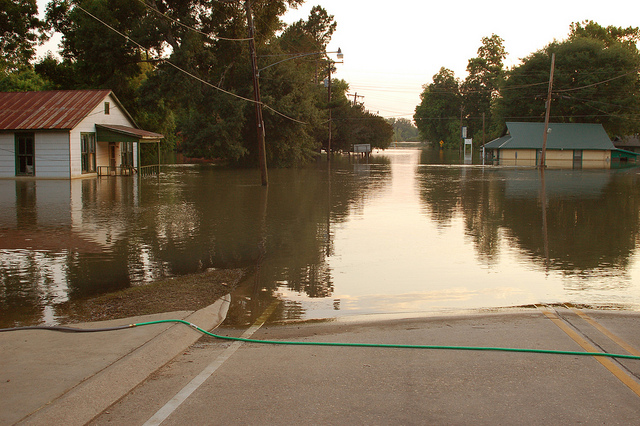
Photo of two houses in flooded area. Photo by Mary, Flickr CC

The National Weather Service estimates that Hurricane Florence dropped over 8 trillion gallons of rain across North Carolina, and the Federal Emergency Management Agency (FEMA) has just started evaluating how much damage was done. While Hurricane Florence and other natural disasters impact thousands of lives every year, not all groups recover equally. Recent research reported by Mic reveals that non-white households tend to lose wealth after a natural disaster, while white households often profit.

Tracking families from 1999 to 2013, sociologists Junia Howell and Jim Elliot found that white families in the most disaster-hit counties gained $126,000 in wealth on average over the 14 years of the study. By contrast, Back, Latinx, and Asian families in the same counties lost $27,000, $29,000 and $10,000 respectively. “Put another way, whites accumulate more wealth after natural disasters while residents of color accumulate less,” Elliot explained.

After a natural disaster, FEMA provides grants and low-interest loans to offset the cost of property damage. While it would make sense that federal disaster relief would mitigate racial disparity, Howell and Elliot’s research shows that it actually makes it worse. Counties receiving the most FEMA aid experienced the starkest widening of the racial wealth gap. Black families in counties that received the least FEMA aid accumulated $82,000 more wealth on average than Black families in counties that received the most aid. The researchers tried to explain this puzzling finding:

“Based on previous work on disasters such as hurricanes Katrina and Harvey, we know FEMA aid is not equitably distributed across communities … When certain areas receive more redevelopment aid and those neighborhoods also are primarily white, racial inequality is going to be amplified.”

In other words, one potential explanation for this trend is that white communities within counties receiving federal aid tend to receive more investment for rebuilding after a disaster than non-white communities in the same county. And with climate change increasing the frequency and intensity of natural disasters, this discovery implies worsening racial wealth gaps in the future. However, Howell and Elliot see reason to be hopeful,

“The good news is that if we develop more equitable approaches to disaster recover, we can not only better tackle that problem but also help build a more just and resilient society.”

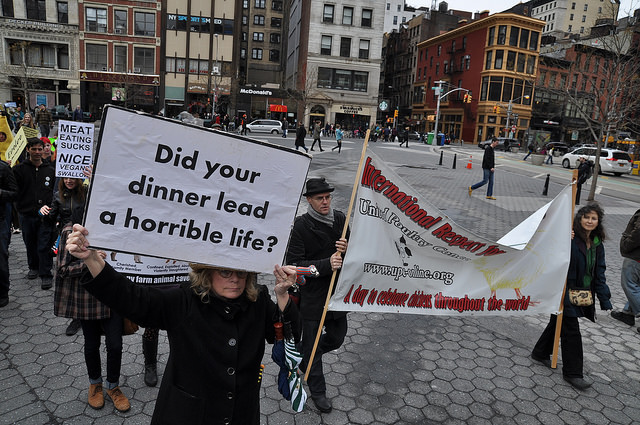
Protester holding a sign that says “did your dinner lead a horrible life?” Photo by Alan & Pamela Rice, Flickr CC

The devastation of Hurricane Florence is not limited to the loss of human lives. It is estimated that millions of chickens and thousands of pigs died in North Carolina from the flooding. Vegan social movements have pointed to this major loss of animal life as one of the many reasons to reduce our reliance on meat and the consumption of other animal products. However, these groups face a difficult path ahead as factory farming is a massive U.S. industry. A recent article in The Atlantic highlights research by sociologists Corey Wrenn, Nina Gheihman, and Elizabeth Cherry on the many obstacles that can thwart veganism from blossoming into a large-scale social movement.

According to Wrenn, one of the main barriers to mobilization of any social movement is that they allow “free-riders”, or individuals who may identify with the movement but do not change their behavior. In the case of veganism, including “flexitarians” — people who are interested in vegetarianism or veganism but still eat meat and other animal products — waters down the cause’s overall message. Wrenn argues that including flexitarians “maintain[s] the illusion of mass support, [while] real power is reserved for core members.” Wrenn suggests that smoking cessation campaigns provide a key example of how an “all or nothing” approach can bring about meaningful change in consumption behaviors.

In the same article, Elizabeth Cherry and Nina Gheihman push back against Wrenn’s claims, advocating that incrementalism and inclusion of those who aren’t strictly vegan may lead to more success for vegan social movements. Cherry, who has a book comparing animal rights activism in France and the United States, argues that vegan social movements promoting meat reduction rather than complete elimination parallels the often incremental shift by many vegans into a plant-based diet. Gheihman agrees with Wrenn that flexitarianism may damage vegan social movements in the long-term, but also believes that including those at the margins of the movement accounts for the multiple motivations people may have for going vegan. Gheihman expands further,

“I do believe that flexitarianism as an initial approach is worthwhile, as there are many people who are not willing to adopt the ideological stance of the animal-rights movement within a society that does not yet embrace it. As well, they may have alternate motivations for following a plant-based diet, including health and environmentalism, and I believe these motivations are as valid as that of animal rights.”

Photo by Fibonacci Blue, Flickr CC

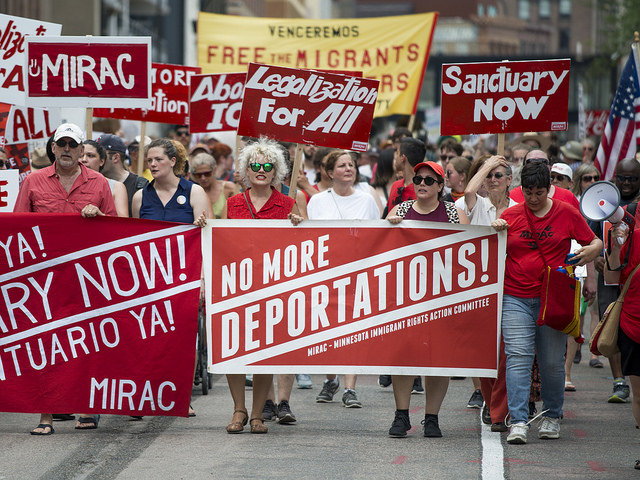
The current immigration policies and practices of the Trump administration have received significant scrutiny. Many detainees are subjected to inhumane treatment in Immigration and Customs Enforcement (ICE) facilities around the nation, demonstrated in recent reports of  sexual assault and the potential death of a migrant child upon release from detention. In a recent article in The Conversation, sociologist Tanya Golash-Boza argues that the criminalization and deportation of immigrants is nothing new, but rather that the Trump administration’s actions are part of a broader pattern of mass deportation.

In 2003, the Department of Homeland Security was created, and upon its inception housed both ICE (which was also formed in 2003) and Customs and Border Protection to enforce immigration laws. According to Golash-Boza, the transferral of immigration law enforcement from the Department of Justice to the Department of Homeland Security served two purposes: changing the tone of immigration enforcement as an issue of national security and a massive cash flow to immigration law enforcement agencies.

Even though immigration is central to Trump’s image and platform, deportations were actually highest under President Obama, with three million people deported during his tenure. Tough immigration enforcement has occurred across party lines and is about more than just ICE. Golash-Boza expands,

“For the past 20 years, aggressive immigration law enforcement has been a constant across Democrat and Republican administrations. Democratic President Bill Clinton signed laws in 1996 that greatly expanded deportations. Republican George Bush created the Department of Homeland Security and, in effect, ICE. The creation of the Department of Homeland Security led to a spike in the number of people deported from the U.S.”

Golash-Boza’s research demonstrates that ending mass deportation in the United States will require more than just standing up to Trump and ICE, but addressing our history of aggressive immigration policies and its connections to the “war on terror.”

Photo by mathiaswasik, Flickr CC

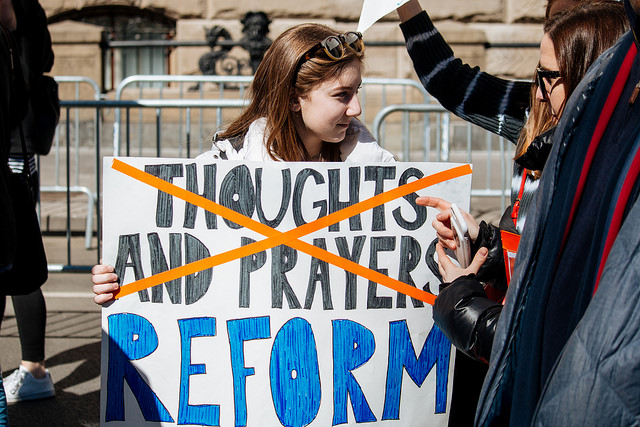
As debates about gun control continue amid mass shootings, compromise continues to be elusive. One step toward compromise is understanding what drives attitudes about gun control. Conventional wisdom suggests attitudes about gun control are closely tied to other political views, party affiliation, or past experiences with using firearms for hunting or personal protection. Sociologists have shown that attitudes about guns are also cultural, tapping into deep assumptions about what it means to protect and provide for loved ones. Now, a new study finds an even more surprising link: attitudes about guns are closely associated with core assumptions about religion in society.

In a recent article for the Washington Post, Andrew Whitehead, Landon Schnabel, and Samuel Perry summarize the findings from their study:

“Americans who subscribe to Christian nationalism believe that America has always been ― and should always be ― distinctively Christian in its national identity, sacred symbols and public policies…the connection between Christian nationalism and gun control attitudes proves stronger than we expected. It turns out that how intensely someone adheres to Christian nationalism is one of the strongest predictors of whether someone supports gun control. One’s political party, religiosity, gender, education or age doesn’t matter.”

These findings highlight how attitudes about guns are connected to some Americans’ core sense of social identity. This makes the policy debate a proxy for arguing about who we are as a country, and such a high stakes argument invites deeply entrenched positions.

Photo by ShironekoEuro, Flickr CC

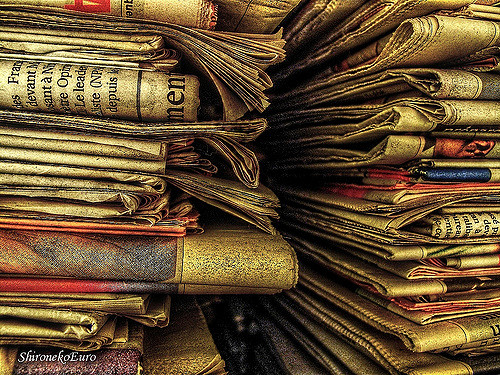
Among America’s history of race and racism, one particularly ugly violent memory is the practice of lynching in the late 19th and early 20th centuries. White mobs would often capture and kill Black men on false accusations as part of a system of racial domination and oppression. While lynching is often cast as a distinctly Southern problem, a recent article in The New York Times by sociologist Charles Seguin discusses how newspaper coverage in both the South and the North used racist language and symbolism when reporting on lynching incidents.

Seguin argues that work by activists — including sociologist Ida B. Wells and especially newspaper coverage on American lynchings around the globe — led to international embarrassment for the United States, questioning America’s image as an advanced nation and model democracy. With this increased scrutiny in the international spotlight, many Northern newspapers became more critical of lynchings, framing it is a shameful part of the South. As he describes,

What these outside agitators — Wells, the British press and the Italian Embassy — accomplished was to embarrass the Northern newspapers, which eventually denounced lynching communities as barbarous and anarchic with headlines like “More Southern Savagery.”

Seguin’s article provides a rich discussion of how the intersections of racism, region, and press shaped the history of newspaper coverage surrounding lynching in the United States. Though Southern newspapers such as the Montgomery Advertiser have made public apologies for their role in racist coverage regarding lynchings, it is important to remember that this issue was not just confined to the South.

Photo by Elvert Barnes, Flickr CC

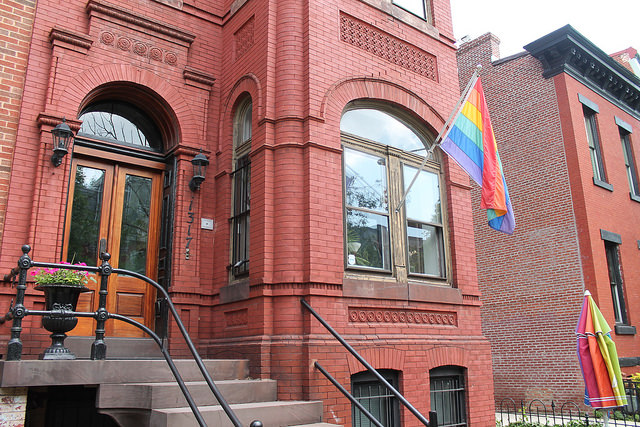
Pride month, with all its fun and flair, has come to a close as various parades and festivals to celebrate LGBTQ rights and inclusion finished up around the world. But now that Pride is over for another year, this doesn’t mean we can forget about LGBTQ communities. While the social acceptance of LGBT communities has increased in recent decades, this does not necessarily mean these communities receive support in practice. 

In a recent Op-Ed for the Los Angeles Times, sociologist Amin Ghaziani discusses his research on heterosexual attitudes towards same-sex relationships. While heterosexuals are willing to extend ‘formal rights’ to gay couples, like hospital visitation and family leave, studies reveal that straight people are less willing to demonstrate political engagement or material support for LGBTQ communities. In their research on ‘Gayborhoods” — urban districts with a prominent LGBT presence — Amin Ghaziani and Adriana Brodyn find that increased liberal attitudes towards homosexuality may actually mask the persistence of discrimination and prejudices among straight residents.

While Ghaziani’s participants generally accepted gay rights, the residents often did not make a concerted effort as allies to help improve LGBTQ livelihoods. Ghaziani describes the concept of ‘privilege fatigue’ — frustration that stems from the coexistence between progressive attitudes about homosexuality and conservative-to-apathetic behavior towards the LGBTQ community. Ghaziani’s research demonstrates that prejudice remains, and that acceptability does not necessarily translate into advocacy for queer lives. As Ghaziani concludes,

“We are mistaken if we interpret — or celebrate — straight people moving into gay neighborhoods as evidence that we have made significant strides toward equality. True progress would be things like employment and housing non-discrimination laws, closing the sexual orientation wage gap, addressing anti-gay and anti-trans hate crimes, and other pressing social problems. Unless progressive straights are helping on those fronts, they may be gays’ neighbors, but they aren’t their allies.”

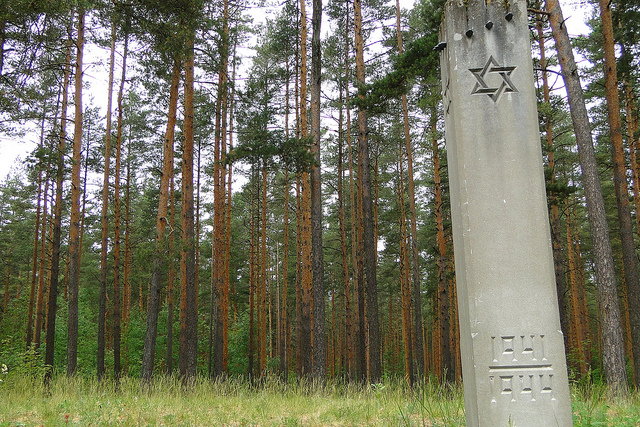
Star of David marker at Bikernieku Forest mass grave site in Latvia. Photo by Adam Jones, Flickr CC

The White House recently published a press release decrying the violent behavior of MS-13 members, referring to the group as “animals” 10 times throughout the short post. In response, researchers Aliza Luft and Daniel Solomon wrote a Washington Post article discussing how dehumanizing language can enable violence. They draw upon historical examples, referencing animalistic rhetoric used in Nazi Germany and the 1994 Rwandan genocide. As Luft and Solomon explain, dehumanizing language alone cannot directly incite violence:

“Recent research suggests that promoting negative views of others can go only so far in motivating people to kill. In Rwanda, for example, Hutu militants issued calls on the radio to exterminate inyenzi, the Kinyarwanda word for ‘cockroach.’ But some Hutus refused to kill, saved Tutsis, or shifted stances from killing to not killing neighbors. This suggests that the decision to commit murder and other violence was difficult for Hutu civilians. Dehumanizing propaganda alone didn’t persuade Hutus to suddenly turn on their Tutsi peers.”

However, the researchers describe a number of ways dehumanizing language can, in fact, heighten tensions or lessen the cost of violent behavior:

“Language is not innocent. Dehumanizing propaganda helps to normalize extreme perspectives on how to address social problems. It grants legitimacy to those who do believe that certain others are inherently threatening, dangerous and ought to be eliminated from the community…Dehumanizing propaganda alters norms of what is and isn’t perceived as acceptable views or behavior. Even when people don’t believe what they hear on the radio or on TV, dehumanizing propaganda might make them hesitate more to speak out against it.”

In closing, Luft and Solomon argue that public action can counter the negative potential of dehumanizing language. They note, for example, that protest by Catholic leaders in Nazi Germany mobilized otherwise complacent members of the public into resistance. In an American context where communities of color face daily systemic violence, protest against dehumanizing language may serve a protective function.