
culture

Photo by Nuno Luz, Flickr CC

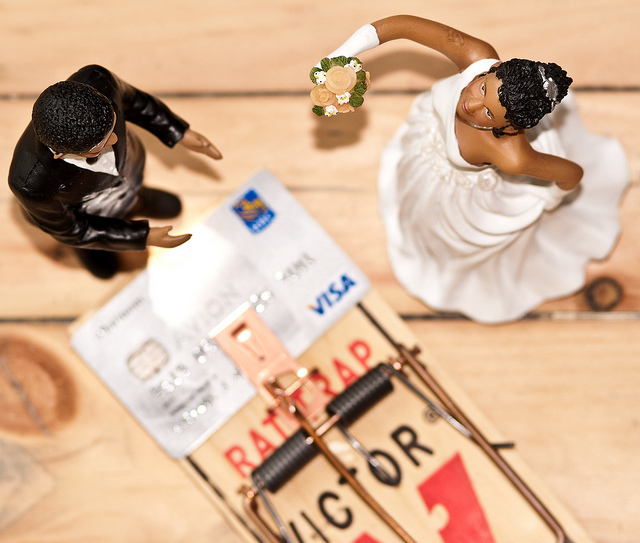
Summer is wedding season, but according to sociologists Julie Brines and Brian Serafini, late summer may also be divorce season. New York Magazine recently featured new findings that indicate divorce may follow seasonal trends. Brines’ and Serafini’s analysis of several U.S. states, including Washington, Ohio, Minnesota, Florida, and Arizona, shows that divorce filings were at their highest in March and August. The researchers believe that these trends may reflect a “last-ditch effort” by couples to repair their relationships during holiday seasons. According to a University of Washington press release,

“Troubled couples may see the holidays as a time to mend relationships and start anew: We’ll have a happy Christmas together as a family or take the kids for a nice camping trip, the thinking goes, and things will be better.”

As a result, divorce rates seem to be highest when the holiday spirit has passed. The approaching school year may also push couples to file for divorce before September, further accounting for the August peak.


Photo by WOCinTech Chat, Flickr CC

A lot of things go into making your appearance – fashion, accessories, grooming … and race? As described in an article on Vox, research by Duke sociologist Robert L. Reece shows that black people are seen as more attractive if they tell others that they’re mixed-race. A research team conducted over 3,200 interviews with black people and ranked their attractiveness on a scale of 1-5. Those who said they were mixed-race received a higher score. Reese concluded that these findings are not a result of physical attributes or colorism; rather, they are about perceived racial identity. Vox reports,

“[Reece said] results could be partially explained by the fact that people think ‘being exotic is a compelling idea.’ But, he added, ‘It’s also partially just racism — the notion that black people are less attractive, so being partially not-black makes you more attractive.'”

This is not the first research to address this troubling dynamic; numerous studies have shown that resumes with white names are more likely to receive callbacks than those with black names. Other research has shown similar results for college applicants, those seeking health care, and people looking for mortgages or loans. This new research, however, shows that the effects of race go beyond the above-described settings, and that who’s considered “good-looking” is itself a product of racial hierarchies. 

Photo by verkeorg, Flickr CC

We tend to think of the world wide web as a place of equal opportunity, granted everyone has access to it. But NYU’s At A Glance recently covered Charlton McIlwain’s new study that reveals how systemic racial inequality forms and operates on the internet. The study looks beyond lone bigots who make racist comments and analyzes how site traffic steers users to certain kinds of pages. People who visit non-racial sites tend to visit other non-racial sites, more than just by chance, while those who browse pages with race-specific content find themselves jumping to other race-specific sites. McIlwain says,

“The evidence suggests a tendency toward racially segregated site navigation. Web producers seem to build pathways providing equitable access to sites, without concern for the racial nature of the site.”

While segregation may not be the intention of site builders, user’s personal preferences and search engines intervene to influence how web surfers get from point A to point B.  

“These results, along with disparities in website traffic rankings, show how a race-based hierarchy might systematically emerge on the web in ways that exemplify disparate forms of value, influence, and power that exist within the web environment.”

Photo by Randy Lemoine, Flickr CC

Many are sure to remember the historic peace talks between Israeli Prime Minister Rabin and Palestine leader Yasser Arafat in 1993, negotiations which were facilitated by the White House. The iconic pictures of a smiling Rabin, Arafat, and then-president Bill Clinton were facilitated by secret talks in Oslo, Norway, and the story of these negotiations are the subject of the new play Oslo, which is set to appear on Broadway next spring. As described in an article on The Voice of America, the talks were actually set in motion by sociologist Terje Rød-Larsen and his wife Mona Juul, a foreign-service officer. The play captures the unique story of these talks, where Rød-Larsen and Juul facilitated a new kind of negotiation. Rød-Larsen describes below:

“We did it in a way, exactly the opposite way of what it was done in Washington. We did not put proposals on the table. We said we would facilitate, bring the parties together, be go-between, assist them in any way, saying It’s your problem, you have to resolve it yourself. We don’t want to push anything on you.’ And number two, we set up the delegations, should never exceed three persons on each side, because trust is dependent on personal relationships and to build personal relationships. And then we also insisted that they should live in the same house. They should have all meals together; breakfast, lunch and dinner. When there were breaks they could go for walks together, etc. They had to live together.”

The play captures the intertwined nature of the personal and the political, while highlighting the effectiveness of such methods. Of course, the play isn’t some dry paper; the actors have described making the play as a “wild improvisation” and it’s being called a great thriller. Playwright J.T Rogers’ Oslo has sold out at the Lincoln Center, and is sure to be a hit on Broadway, meaning the story of this little sociological experiment is far from curtains.

Photo by Denis Bocquet, Flickr CC

Online dating has grown substantially in both acceptability and use in the past few years. But because it is still relatively new, Tinder sociologist Jessica Carbino says the norms regarding online dating interactions are “very much still being negotiated.” What’s at the top of the list for women? Calling out the harassment they experience from many of their male suitors. 

Women are starting to speak out about their experiences of harassment from men on online dating sites. To combat these uncomfortable advances, some women are coming together to publicly shame men who harass them. Fast Company recently featured an article showcasing women’s attempts. One woman created an Instagram account called Bye Felipe; she compiled screenshots of online chats that captured uncomfortable messages women receive from men online. Many of the conversations include unwarranted aggression from men, especially after women ignore or reject their advances. Bye Felipe and similar blogs are not the only responses either. Another response is the creation of woman-friendly dating sites. Whitney Wolfe, former executive at Tinder, co-founded Bumble, which specifically lets women make the first move.

So why do men act this way on online dating? Carbino suggests that men’s aggressive advances and behavior may be connected to broader socializing patterns. “We do know that when individuals are removed from interactions where they’re in the presence of others, they may act differently — sometimes more boldly given the relative lack of social accountability,” says Carbino. However, as she’s quick to point out, the same has always been true in the offline world. Apps like Tinder, she notes, provide people with a way to “have a larger degree of contact” with that world.

See other ways women are calling out online dating harassment here.

Photo by Michael_swan via flickr.com CC

The “traditional family,” many would have us believe, is imperiled by everything from women in the workplace and same-sex couples in the bedroom. What these “traditionalists” fail to name among the various threats is income inequality. As described in research published in the American Sociological Review and discussed on Fortune.com, observed increases in the rate of couples having children before marriage can be explained by changing social landscapes.

It’s no surprise to anyone that the middle-class is shrinking or that finding a job can be a tough gig. Andrew Cherlin, David C. Ribar, and Suzumi Yasutake’s research shows people are more likely to postpone marriage, but not parenting, if they can’t get a job. So, with a distinct shortage of available living-wage jobs and growing income inequality, more and more American families are comprised of unmarried couples with children. As the class system becomes even more polarized, it seems marriage boosters might want to consider a different means to their favored end: reducing inequality.

tinder-app-logo

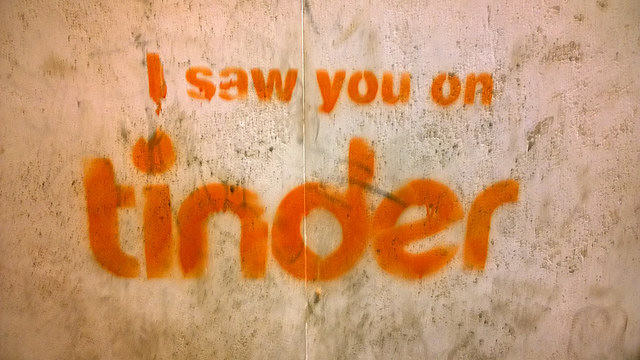
Every “single” person in the world enjoys traveling to exotic locations, eating at new restaurants, and generally trying new things according to Tinder. The dating app shows users a dating profile that takes seconds to view and is mostly photographs. However, Tinder analyst and sociologist Jessica Carbino explains that there’s a lot more nuance involved in Tinder swiping.

The app has a simple premise: it shows the user a photograph and short biography of a potential partner. The user can swipe right or swipe left. If both the user and the person whose profile is shown swipe right, a match is made and the users have a chance to exchange messages.

While the app is streamlined, the behavior of the users is quite complex. Los Angeles Magazine interviewed the UCLA PhD about her role as a sociologist for Tinder and her role in deciphering what leads to matches between users. Carbino explains “I think Tinder is far more complex than simply physical attractiveness… With photos, people are not simply looking at whether someone has a nice smile or a nice face per se.”

Through coding Tinder profiles, running focus groups, and creating surveys for people who do and do not use Tinder, Carbino has found a lot of sociology imbedded in the process. She proposes that many sociological factors, like socioeconomic status, contribute to a successful match. Simply dividing users as ‘hot and not hot’ is too simplistic and does not provide a useful or nuanced definition of what other users are looking for. Whether or not users are consciously making these distinctions Carbino notes that men with softer jawlines are perceived as kinder, women wearing make up get more matches, and that a group photo is never a good choice for a user’s first picture.

Another interesting find of Carbino’s is what users are trying to get out of the app. She found that about 80% of Tinder users are looking for long-term relationships. Given the speed of the first step of the dating process on Tinder, this high percentage seems surprising on the surface. However, finding the reasons why is precisely what Carbino is trying to figure out by casting a sociological lens over Tinder data. With a glance at a smart phone and a swipe of the thumb, the 21st century relationship is just getting started.

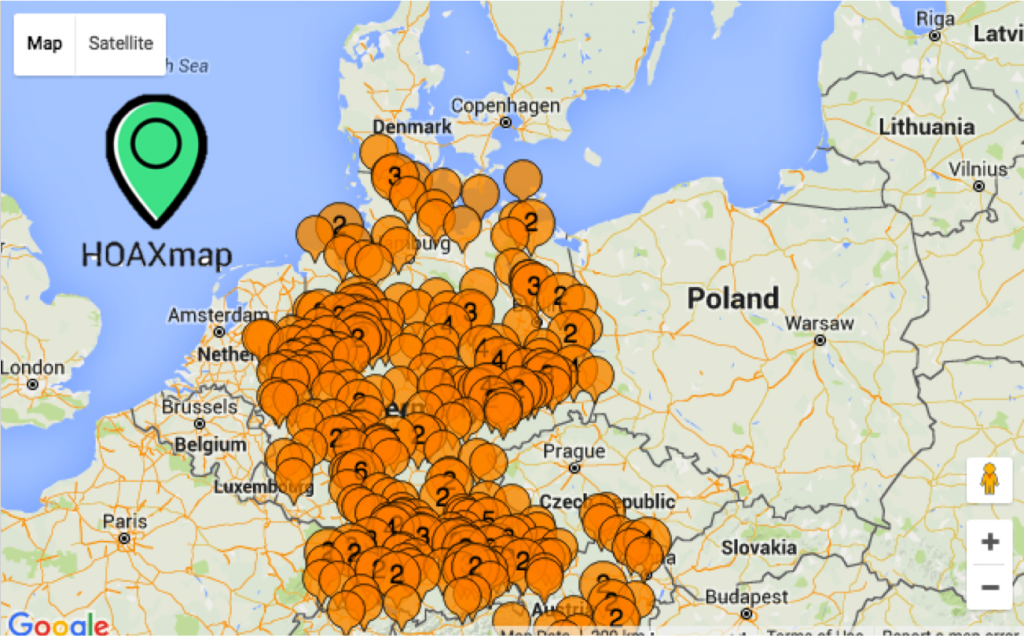
Click to visit Hoaxmap.

Over a million migrants and refugees entered Europe in 2015, leading many to dub this mass migration a “crisis.” Many are seeking asylum, especially those from countries experiencing considerable violence like Syria, Afghanistan, and Iraq. Many Europeans have reacted to the influx with fear, spreading stories that associate refugees and migrants with crime (something social scientists like to call “crimmigration”). In response, two German women created Hoaxmap to track and dispel rumors about refugees in Germany (a country that has been particularly welcoming to immigrants, per its Chancellor Angela Merkel’s directives). Of the 40 types of rumors tracked on Hoaxmap, most pertain to theft or sexual assault.

The discrepancy between documented and rumored crimes may reflect the way rumors spread and their connections to real events that people believe are plausible. Sociologist Gary Alan Fine, recently featured in an Atlantic article, agrees: “Once you have a plausible story then the criteria for information you need in order to believe [a new story] is much lower, because you would say ‘this is like what happened elsewhere.’” In fact, almost half of the rumors about sexual assault and rape associated with the contemporary immigrants cropped up in the two months following reported New Year’s Eve assaults on women in Cologne. Sociologist Mar Warr concurs that “even a small increase in apparent risk (like a locally reported rape or rapes) can generate substantial and widespread fear.” In reality, most crime in destination locations appears to have been directed at asylum seekers, rather than perpetrated by them.

Frank and Claire Underwood House of Cards Promo

Spoiler alert! This season the popular Netflix series “House of Cards” got a bit more radical. Main characters and power couple Claire and Frank Underwood are unapologetically, consensually non-monogamous. In fact, sociologist Mimi Schippers says the show portrays “one of the best television representations of an open/poly relationship I’ve seen.” In the fourth season, Claire, married to the President of the United States, becomes sexually involved with Thomas Yates, a writer. While many shows depict “extramarital affairs” as inherently negative, “House of Cards” Frank affirms that Tom can “give” Claire things he can’t.

In a blog post for NYU Press, Schippers argues that the Underwoods go “beyond” marriage, monogamy, and dominant gender norms. According to research she conducted for her upcoming book, men in polyamorous relationships tend to shift their understanding of masculinity because they must forgo jealousy and control over the women in their lives. The openly non-monogamous relationships on “House of Cards” thus challenge more than just ideas about what relationships should look like. It confronts gendered expectations for men to be competitive and possessive and grants women sexual autonomy, independent of men.

[T]he Underwoods distinguish themselves from society’s ideas of the “perfect couple” by being both child-free and consensually non-monogamous. They are something else–something beyond “perfect”, beyond marriage, and beyond traditional gender arrangements. Rather than representing bad character or immorality, Claire’s increasingly intimate relationship with Tom and Frank’s enthusiastic acceptance of it (the very definition of polyamory) punctuates and solidifies the strength of their marriage as one between equals.

Virtual reality still sees sexism. Photo by Nan Palmero, Flickr CC.

Star Wars conventions: one place where everyone is equal (if they hate Jar-Jar Binks). Or maybe not. As it turns out, even Star Wars has become a controversial area for discussing the place of feminism and powerful women in society. Work by sociologists CJ Pascoe and Tristan Bridges sheds more light on how sexism has infiltrated nerd culture. Following their recent book release, Pascoe and Bridges were interviewed by Broadly to help explain sexism in an unlikely arena.

Pascoe explains that “nerds” are consistently emasculated in society because they don’t participate in the same types of gendered dominance displays expected of young men. That might make it seem they exist away from expected dichotomies of gender roles. Bridges adds, however, that nerdy activities have become more mainstream due to popular television and media, so now the traditional nerd versus jock relationship is more nuanced.

Bridges said,

Nerds are, as a cultural “type,” emasculated… But it’s also true that there is a lot of toxic masculine behavior in nerd cultures. Think about it: #GamerGate happened among the nerds, not the jocks.

Pascoe agreed, explaining that fandom cultures create a space for men to be dominant even if they do not follow mainstream masculine pressures. The presence of women in these spaces might constitute a threat to the men within them. Still, Pascoe concludes that feminism is still a benefit for nerd culture overall. She says hopefully,

Increasing including and visibility of women, trans folk, and LGBQ folk in fandom communities will result in less damaging gender socialization for everyone—men included—and will help to change the way in which nerds themselves are placed on the bottom rung of some masculinity hierarchy.