marriage

This paper is part of the Council on Contemporary Families’ Online Symposium “New Inequalities.”.

In contrast to the seeming stabilization of divorce rates for the general population over the past two decades, the gray divorce rate has doubled: Married individuals aged 50 and older, including the college-educated, are twice as likely to experience a divorce today as they were in 1990. For married individuals aged 65 and older, the risk of divorce has more than doubled since 1990. Researchers explain why.
–Stephanie Coontz

Contrary to the popular notion that divorce is increasing in the United States, the divorce rate has changed relatively little in recent decades. Marriages are not much more likely to end through divorce these days than they were 30 years ago. Yet this overall pattern of stability obscures important variations by class and age.

Generally, education tends to be protective against divorce. In fact, the marriages of college-educated couples seem to be lasting longer than they were 30 years ago. Among couples aged 40-49, the divorce rate for those with a college degree is about 50 percent lower than the rate for those with a high school diploma. This differential holds for younger adults ages 25-39, too. more...
This paper is part of the Council on Contemporary Families’ Online Symposium “New Inequalities.”.

It is quite likely that the economic crisis both caused some divorces and prevented some divorces. However, the balance of the evidence suggests it prevented more than it caused. I would not read this as good news for marriage and families, however, because there may be negative consequences for people who want to part but cannot divorce because of economic constraints. The enforced wait could simply prolong or exacerbate marital stress and family conflict, rather than saving or restoring a happy marriage.
–Stephanie Coontz

In the wake of several news reports claiming that a falling divorce rate was the “silver lining” around the clouds of the Great Recession, I analyzed divorce patterns using the American Community Survey (ACS) from 2008 to 2011 to look for evidence of whether the economic crisis had increased or decreased the divorce rate. On the one hand, economic stress, job loss, and home foreclosure tend to be associated with marital tension and thus might be expected to increase the number of divorces. On the other hand, divorce is expensive, especially the cost of establishing a new household, and people who can’t sell their homes, or who have suffered a job loss, might not be able to manage a divorce and thus end up postponing or foregoing it. more...

In the last 50 years, the percentage of men and women who cohabit before marriage – “living in sin” as it was still called in the 1960s – has increased by almost 900 percent. Today 70 percent of women aged 30 to 34 have cohabited with a male partner, and two-thirds of new marriages take place between couples who have already lived together for an average of 31 months.

These trends are troubling to some because nearly a dozen studies from the 1970s into the early 2000s showed that men and women who lived together before marriage were far more likely to divorce than couples who moved directly from dating to marriage. In fact, on average, researchers found that couples who cohabited before marriage had a 33 percent higher chance of divorcing than couples who moved in together after the wedding ceremony. In light of those findings, some commentators have argued that reducing the stigma attached to living together outside marriage has been a mistake, leading many young couples to make decisions that put their future marriage at risk. more...

This paper is part of the Council on Contemporary Families Gender Revolution Rebound Symposium

This look at sexual frequency among younger couples in equal marriages refutes recent claims that when a man shares the housework equally, it is bad for the couple’s sex life.

For several decades, research has suggested that attitudes and laws favoring gender equity have changed more quickly than people’s actual behavior in intimate relationships. One recent highly publicized article reported that married couples who split domestic chores in an egalitarian manner had sex less often, and reported less satisfaction with their sex lives, than couples who adhered to more to conventional gender behaviors. The depressing message heard round the world was that couples remain stalled in their attachment to old “gender scripts,” and that attempts to revise these scripts decrease sexual desire and satisfaction, even among couples who claim to hold egalitarian values. more...

Update on Research from Jennifer Glass

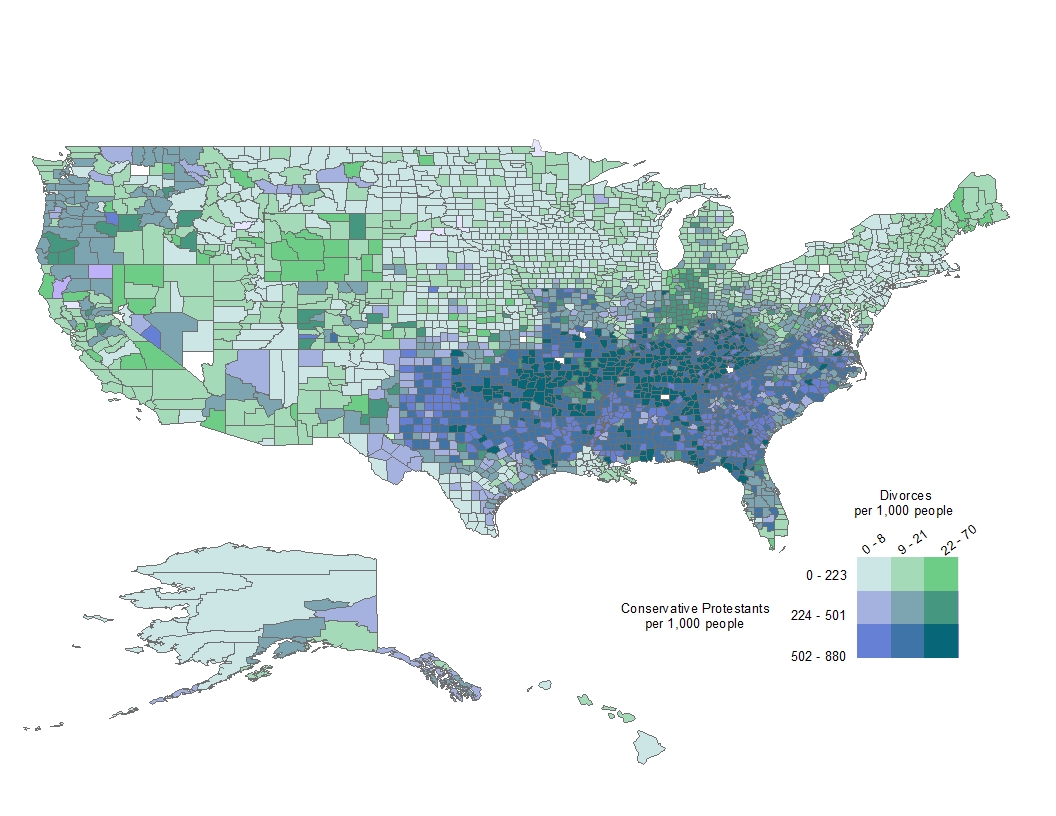
Why are divorce rates higher in religiously conservative “red” states and lower in less religiously conservative “blue” states? After all, most conservatives frown upon divorce, and religious commitment is believed to strengthen marriage, not erode it. Even so, religiously conservative states Alabama and Arkansas have the second and third highest divorce rates in the U.S., at 13 per 1000 people per year while New Jersey and Massachusetts, more liberal states, are two of the lowest at 6 and 7 per 1000 people per year.

Evangelicals and divorce. For a study earlier this year in the American Journal of Sociology (abstract only), Demographers Jennifer Glass at the University of Texas and Philip Levchak at the University of Iowa looked at the entire map of the United States, going county by county, to examine where divorces occurred in 2000 and what the characteristics of those counties were. Their work confirms that one of the strongest factors predicting divorce rates (per 1000 married couples) is the concentration of conservative or evangelical Protestants in that county.

DivorceFinalPrevious discussions of this puzzling paradox have focused on three alternative explanations.

Is it poverty? Some scholars argue that it has nothing to do with religious beliefs and practices, but reflects the fact that conservative religious groups are most concentrated in rural and Southern counties, which tend to have lower wages than the national average and higher rates of poverty. And research does show that such conditions do raise the risk of divorce. Yet even controlling for income and region, divorce rates tend to be especially high in areas where conservative religious groups are prominent. more...

Stephanie Coontz has an excellent Op-Ed on the front of today’s New York Times Sunday Review, which draws out the implications for family instability of the connection between increasing gender equality on the one hand, and increasing economic inequality and insecurity on the other. The new instability is disproportionately concentrated among the population with less than a college degree.

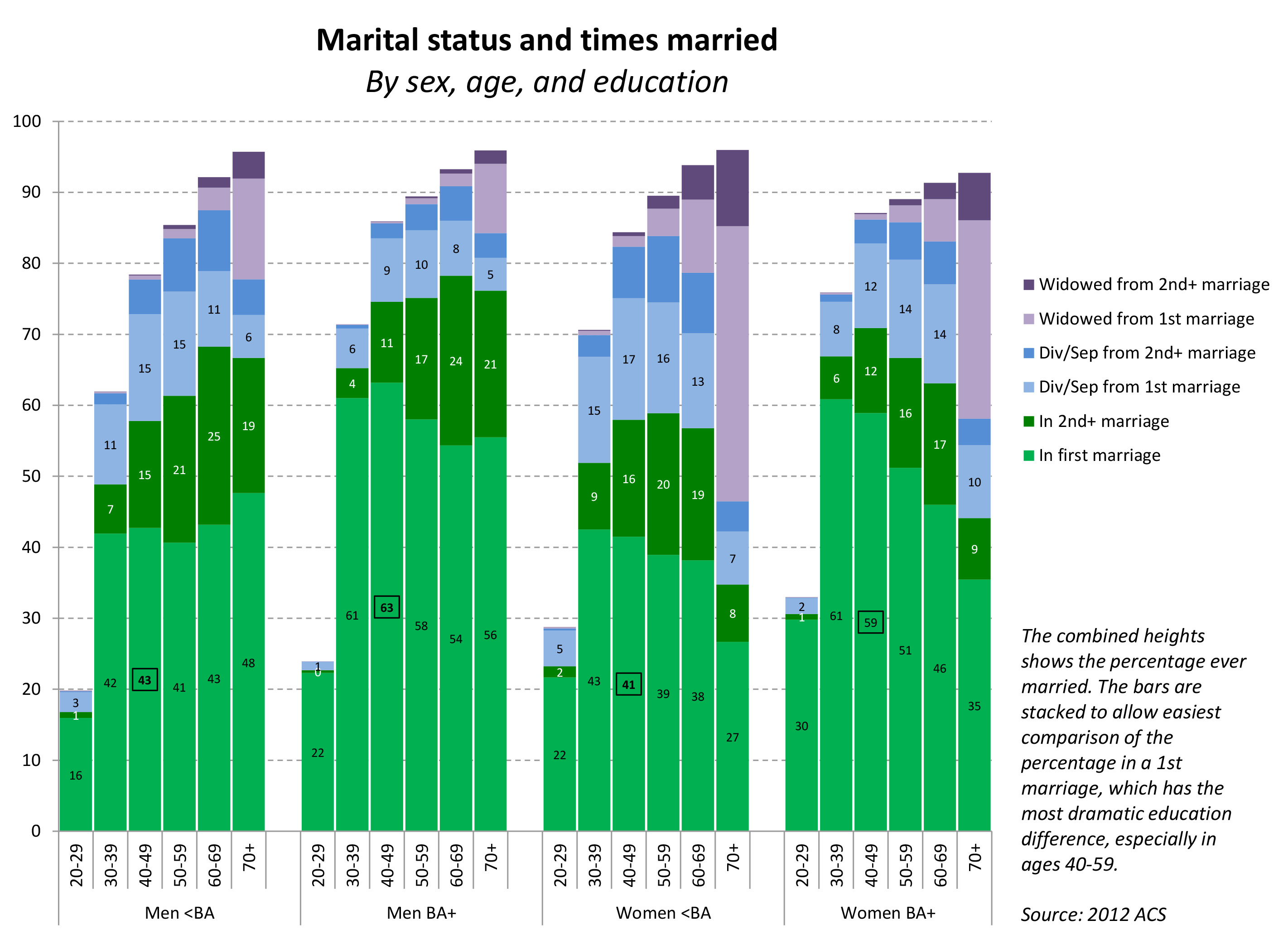
To help with her research, I gave Stephanie the figure below, but it didn’t make the final cut. This shows the marriage history of men and women by education and age. She wrote:

According to the sociologist Philip N. Cohen, among 40-somethings with at least a bachelor’s degree, as of 2012, 63 percent of men and 59 percent of women were in their first marriage, compared to just 43 percent of men and 42 percent of women without a bachelor’s degree.

I highlighted those numbers in the figure. Also striking is the higher percentage of divorced people among those with less than a BA degree (and higher widowhood rates). Click to enlarge:

age marriage history

Cross-posted on the Family Inequality blog.

Joanna Pepin is a graduate student in sociology at the University of Maryland, College Park. Follow her on Twitter at @CoffeeBaseball.

Comedian Louis C.K. has a comedy bit about the bravery necessary for heterosexual dating. He points out, perceptively and with humor, that (traditionally) men have to summon the courage to ask out a potential partner while women are courageous for dating men at all.

How do women still go out with guys, when you consider that there is no greater threat to women than men? We’re the number one threat to women! Globally and historically, we’re the number one cause of injury and mayhem to women. You know what our [men’s] number one threat is? Heart disease.

Although women continue to date, love, and sometimes marry men, marriage has been in decline for decades.

The response to this demographic shift has been to invest billions of dollars in marriage promotion. Although the primary (flawed) justification given to emphasize marriage is to decrease poverty – especially for single mothers and their children – marriage promotion activists also have argued that “marriage dramatically reduces the risk that mothers will suffer from domestic abuse.” This ideological thinking was debunked as early as 2004, but was revived when Brad Wilcox and Robin Fretwell Wilson published a piece in the Washington Post claiming the solution to violence against women is marriage.

The pro-marriage activists rely on statistics that compare rates of violence between cohabiting and married couples.  What they ignore are selection effects. For instance, research from the longitudinal Fragile Families and Child Wellbeing Study illustrated mothers’ strategies to keep their children safe by leaving relationships they see as unhealthy, especially those involving physical abuse. Sociologists Catherine Kenney and Sara McLanahan show in their research analysis of data from the National Survey of Families and Households that selection out of cohabitation and into marriage – and selection out of marriage through divorce – creates an apples-and-oranges comparison between these two groups.

Another talking point for the marriage promoters is that married men have lower rates of criminal activity compared to non-married men. However, the research is still unclear on whether marriage per se decreases criminal activity, or if crime cessation is associated with stable family ties — cohabiting, married, or otherwise. Moreover, this line of research investigates generalized crime and not intimate partner violence (IPV) specifically. There is no reason to think IPV operates in the same way, given that DV is characteristically a uniquely individual dynamic of one person establishing power and control over another. It also ignores research on violence in later life, which shows that violence doesn’t decrease over the course of a relationship, but rather abusive tactics change. If the marker of a lifelong commitment is what decreases IPV, having children together should also be associated with lower rates of DV.  However, many survivors of IPV continue to experience abuse during their pregnancies (and after) and there is some evidence that the risk of violence increases during pregnancy.

To no one’s surprise, the federally funded marriage promotion programs have had no impact on relationship quality of participants, couples were no more likely to stay together or marry after participating, and they had no effect on the frequency or severity of IPV. Yet, we continue to spend scarce welfare dollars on marriage promotion at the expense of the very real economic resources survivors of domestic violence need.  For example, although a Family Violence Prevention option grants temporary waivers of public assistance requirements for survivors of domestic violence, women are rarely screened for domestic violence and few are able to obtain the mandated services even when they do report domestic violence to their case worker.

Contrary to the theory that marriage reduces IPV, one could theorize that marriage is actually more dangerous for women. Sociologist Philip Cohen showed that prevalence of IPV has been declining over the same time period as marriage rates have been falling. While the myth of widespread stranger danger is pervasive, according to a report from the U.S. Department of Justice, in two thirds of female homicides, women were killed by an intimate partner or family member (24% were killed by a spouse or ex-spouse; 21% were killed by a boyfriend or girlfriend). Marriage theoretically increases perpetrator access to victims, and social sanctions as well as legal ties make it more difficult to leave dangerous situations.

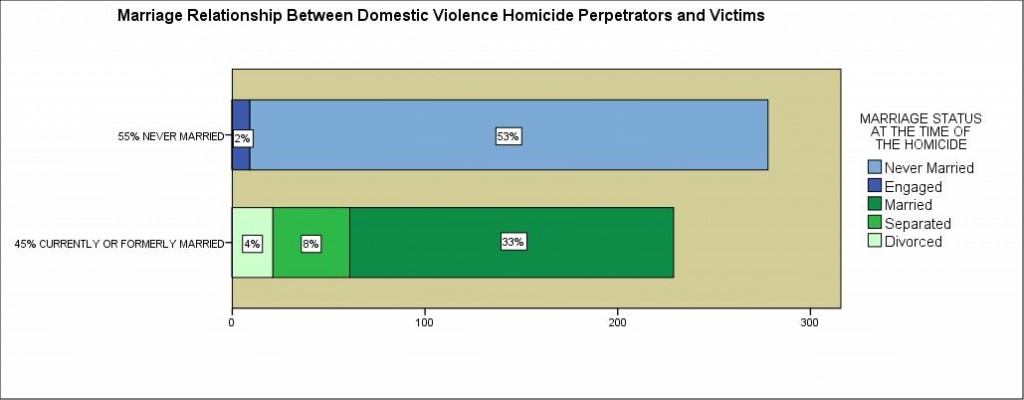
Indeed, evidence we do have demonstrates marriage is no safe haven for women. In some ways our societal obsession with the institution of marriage may be placing more women at risk. Data from the Washington State Coalition Against Domestic Violence Fatality Review Project reveal that 45% of the women killed in DV homicides committed by male perpetrators had been married. These couples were more likely to be living together, have children together, and be in the process of ending the relationship. Public health researcher Sara Shoener affirmed what I witnessed as an advocate working with survivors of abuse: cultural narratives of linking marriage with success, the stigma of single motherhood, and religious beliefs about divorce hinder survivors’ ability to access the vital resources they need to keep themselves and their children safe. Creating a no-win situation, mothers are condemned if they raise their children alone, blamed if they don’t leave an abusive relationship to protect their children, and criticized for deliberately obstructing relationships between children and fathers if they exit an abusive relationship.

Image by the Washington State Coalition Against Domestic Violence. Data from Domestic Violence Fatality Review Project.

The pro-marriage movement seems to be borrowing a concept from the National Rifle Association, that “the only way to stop a bad guy with a gun is with a good guy with a gun.” As the NRA asserts that the solution to gun violence is more gun violence, pro-marriage advocates assert the solution to men’s violence against women is for women to marry men. Increase both access and dependence. Raise the stakes. Make the relationship permanent. This solution is not only illogical and unsubstantiated, it’s dangerous.