

marriage

Just dust it off? Photo by Derek Gavey, Flickr CC.

If at first they don’t succeed, do most Americans “try, try again”?

Wedding season is here again, and for many couples that is literally true. In 2013, 40 percent of all marriages — four out of every ten — were remarriages for either the bride or groom. One in five were remarriages for boththe bride and groom (Lewis and Kreider 2015; Livingston 2014).

Among men and women in their early 40s, more than half of all marriages are remarriages.

And among divorced or widowed individuals under age 45 who are not yet married, more than half (56 percent) say they expect to marry again. Remarriage is not the only way that previously-married individuals establish new relationships. As of 2013, almost half (47 percent) of cohabiting adults were previously married.

Despite this enthusiasm for repartnering, remarriage rates have been falling. In 2013, of every 1,000 previously-married man and woman in the country, 28 got married. But this is down from 50 per 1,000 in 1990, a decline of 40 percent (Payne 2015). Men are either more eager or more able to find new spouses than women. The current remarriage rate is nearly twice as high for men as for women (40 per 1,000 for men and 21 per 1,000 for women) (Payne 2015). In 1995, 54 percent of women who divorced before age 45 had remarried within five years of divorce. A decade later that had declined to 38 percent (NCHS).

People are taking more time to remarry than in the past. Half of men and women who remarry after a divorce from a first marriage do so within about four years (Kreider and Ellis 2011). A decade earlier, half remarried in about three years (Kreider and Fields 2002). more...

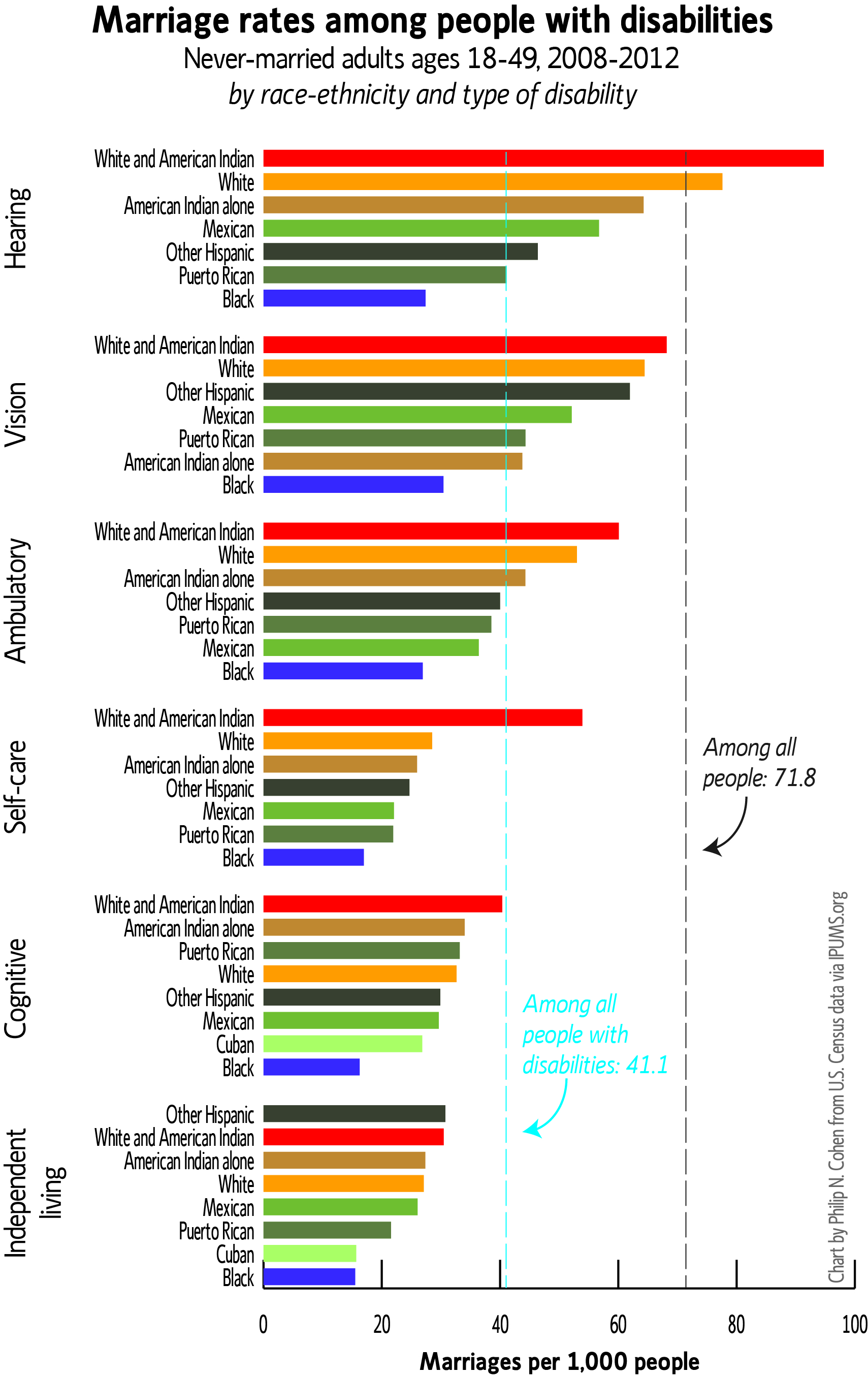
Image by Perry Threlfall

So the story goes, few behaviors incite more intense feelings of betrayal than infidelity. A partner’s infidelity can invite feelings of anger, disappointment, depression, anxiety, and distrust. It is the most often reported reason for divorce, as well as its strongest predictor. The majority of infidelity research has been conducted by psychologists, evolutionary biologists, and marriage and family therapists. Sociologists, however, are uniquely positioned to shed light on the situational and structural forces at play. For example, in a recent study published this month in American Sociological Review, Christin Munsch examined the relationship between relative earnings—that is, one’s income in relation to his or her spouse—and marital infidelity in heterosexual couples.

It would be logical to assume that economic dependence on one’s spouse would deter cheating. After all, why would anyone bite the hand that feeds? However, the study finds the opposite: economic dependence increases one’s likelihood of engaging in infidelity. For both men and women, as they became more economically dependent on their spouses, their odds of engaging in infidelity increased. Although this may seem counterintuitive, we consider this to be encouraging in that it suggests relative equality between spouses is good for marital stability.

The study also sheds light on the ways in which the effect of relative earnings on infidelity is gendered. Namely, although economic dependence increased the likelihood of infidelity for both men and women, the increase was much greater for men than for women. Munsch attributes this finding to breadwinning norms and the relational, hierarchical nature of gender. Previous research finds that men respond to masculinity threats with extreme demonstrations of masculinity, whereas women are less affected—or unaffected—by femininity threats. Traditionally, breadwinning has been a central component of masculine identity. Accordingly, economic dependence threatens masculinity whereas infidelity allows threatened men to compensate by engaging in a behavior culturally associated with masculinity. For men, particularly young men, dominant definitions of masculinity call for sexual virility and conquest. Infidelity allows threatened men to enact masculinity while simultaneously distancing themselves from, and perhaps punishing, their breadwinning wives.

Given its focus on sex, money, and gender, this research has garnered recent media attention. Yet, many of these accounts tend to sensationalize and overstate men’s disloyalty. For example, in a recent Wall Street Journal article entitled, “When a Man Depends on a Woman, He May Be More Likely to Cheat,” Neil Shah writes, “Despite strides toward sexual equality, American men still can’t handle not being a breadwinner…” While we appreciate Shah’s attention to the gendered nature of this phenomenon, we suspect most men can handle “not being a breadwinner” – and the findings support this interpretation. In the study, men who were 100 percent economically dependent on their wives had a .15 predicted probability of cheating of in any given year—the highest predicted probability of infidelity across all models. In other words, the overwhelming majority of economically dependent men are not expected to cheat.

Most of us know at least a handful of men who would accept, appreciate, and embrace a breadwinning wife. Similarly, most of us can think of men for whom being economically dependent might be a real problem. Here, we wish to clarify this distinction and shed light on the kinds of men who might feel threatened by economic dependence and seek to overcompensate by engaging in infidelity.

As Michael Kimmel suggests, the era of unquestioned male privilege is over. In response, some men—primarily white, downwardly mobile men, without significant career or family successes – who were simultaneously raised to expect unparalleled social and economic privilege – have come to believe that they have been unjustly denied what is rightfully theirs. (Of course, this ignores the myriad of ways heterosexual white men have been and continue to be privileged.) Nonetheless, the sense of “aggrieved entitlement” in these men breeds resentment towards a host of “others” including the government, immigrants, minorities, and, of course, women. We suspect it is these men—those experiencing aggrieved entitlement—who are the most likely to feel threatened by women’s economic advancement and compensate by engaging in infidelity.

Interestingly, and perhaps ironically, persons (primarily men) have left vitriolic comments in response to recent newspaper articles covering this new research, and Munsch herself has received harassing emails. For example, one man wrote to say that women, especially “self-serving, idiot feminists,” shouldn’t conduct research because they have no sense of pragmatism. It seems likely that the same aggrieved entitlement that legitimates infidelity for some economically dependent men also underlies these comments.

The only reason to respond with malice to the publication of scientific research documenting the benefits of marital equality is fear. A host of social psychological research confirms that, when threatened, individuals are more likely to cause harm to relevant out-group members (as found here, and here, and here, and here). In fact, in one pertinent study, researchers found that men undergoing prototypicality, legitimacy, and distinctiveness threats were more likely to harass to a virtual female interaction partner compared to those who had not been threatened. (Prototypicality threats challenge a man’s status as a good or as a prototypical man; legitimacy threats question the validity of men’s social standing and privileges; and, distinctiveness threats suggest men and women are becoming increasingly similar.) In other words, in an ironic twist, the malicious responses incited in these men substantiate the very claims made in the paper.

So, what advice can we offer those seeking happy, stable relationships? Despite Deborah Netburn’s well-meaning Los Angeles Times advice (“To minimize risk of infidelity, make sure you earn as much as your spouse”), we contend that the answer is not to focus on relative earnings. After all, career trajectories can be unpredictable. Although two people may start off on relatively equal footing, one spouse may climb the corporate ladder faster than the other, one or both spouses may get laid off, or one may choose to leave the labor force altogether. Rather, it lies in our ability to recognize aggrieved entitlement and seek relationships with persons who will feel genuinely happy, rather than threatened, when we succeed. Mutual respect and support serve to safeguard relationships from the effects of dependency on infidelity.

Matthew Rogers is a Ph.D. student at the University of Connecticut. His research is focused on masculinities, identity, and violence.

Christin L. Munsch is an Assistant Professor of Sociology at the University of Connecticut. The overarching goal of her research is to identify the ways in which contemporary, dual earner families organize interaction based on a traditional, breadwinner-homemaker model and the consequences of this mismatch for individuals, relationships, and the reproduction of inequality. She is currently completing a manuscript that examines the ways in which penalties for flexible work vary by family structure.

Drowned out by the shocking stories in the popular media about brutal domestic violence cases, rape, spouse murders, and child abuse is a startling and well-documented trend in American life – violence among intimates is down. And the decline is not small. Between 1993 and 2010, “Intimate partner violence” fell by 64 percent.

The decline in intimate partner violence, moreover, is common to all racial and ethnic groups. In the 1994-2010 period, violence declined 61 percent among non-Hispanic whites, 62 percent among African Americans, and 78 percent among Hispanics.

This startling and under-publicized development has major implications for how we think about family and intimate partnerships in America and how we should think about family-related social policies.

The data come from the National Crime Victimization Survey (NCVS), an annual national household survey that collects self-reported data on victimization from persons 12 years of age or older, conducted by the U.S. Justice Department and the Census Bureau. The 2010 survey of intimate partner violence involved 73,300 individuals in about 41,000 households. The methodology is similar to other national-level social surveys. more...

For many years, family researchers and working mothers have talked about “the second shift” – the extra work that employed women put in at home after their paid work day ends. And for just as long, feminist assessments of marriage have been shaped by earlier findings that when people married, the women began doing more household work, while the men started doing less.

Some research still seems to support this. Women continue to do a disproportionate amount of housework in families, despite an increase in men’s housework since the 1960s. Furthermore, in the late 1990s and early 2000s, the increase in men’s housework slowed or even declined, as did several others measures of progress toward gender equity. And on average, notes Liana Sayer, director of the Maryland Time Use Laboratory, women get 30 minutes less leisure time per day than men. That gap increases to an hour when researchers adjust for employment, education, family status, and age. more...

A report and commentary prepared for the Council on Contemporary Families.

A set of tables released by the U.S. Census this month provides new evidence of how much the structure, composition, and life-course of American families have changed over the past 55 years. Poverty figures in the same report show that having two parents may help in keeping children out of poverty, but by no means guarantee it. And other research shows that the relationship between income and family structure goes both ways: People who are well above the poverty line are more likely to get and stay married.

In 1960, according to Census figures from that year, nearly 90 percent American children lived in two-parent families, with only 8 percent in mother-only families. A miniscule 1 percent resided in father-only families, and 3 percent lived either with grandparents, other relatives, or in other arrangements (Census, 1960).

By 2014, according to figures newly released by the U.S. Census Bureau (CPS ASEC, 2015), almost a quarter of American children (24 percent) lived in a mother-only household, a 300 percent increase since 1960. Four percent lived in a father-only household, still a small percentage but a four-fold increase since 1960. Another 4 percent were living either with grandparents or in other arrangements. Just 68 percent of American children were living in two-parent families. more...

What do you plan to give your valentine this February 14th – a bouquet of flowers, a heart-shaped box of chocolates, a candlelit dinner? If celebration plans include any type of sexual activities, then perhaps it is worth considering how to avoid giving or receiving one of the most-unwanted gifts: a sexually transmitted disease (STD).

The reality is that several STDs have reached epidemic proportions here in the U.S. and have become pandemics throughout the rest of the world. Therefore, a day that celebrates love, romance, and sexuality is a good reason to focus on sexual health. While researchers have discovered a lot of useful information about STDs, many people continue to come up with reasons to avoid learning the truth about these socially taboo infections. So, whether or not sex is part of your plans for this Valentine’s Day, consider these myths and facts about STDs: more...

Cross posted on the Family Inequality blog.

Disability is a very broad concept, representing a wide array of conditions that are not easily captured in a simple demographic survey. However, disabilities are very prevalent, especially in an aging society, and the people who experience disabilities differ in important ways from those who do not. Previously I reported — in a preliminary way — that people with disabilities are much more likely to divorce than those without. Here I present some numbers on marriage rates.

This isn’t the kind of thorough, probing analysis this subject requires. But I have two reasons to do it now. First is that I hope to motivate other people to pursue this issue in greater depth. And second, I want to highlight the importance of the data I’m using — the American Community Survey (ACS) — because it might be not available for much longer. These questions have been slated for demolition by the U.S. Census Bureau on cost-saving grounds. I put details about this issue — and how to register your opinion with the federal government — at the end of the post.

Disabilities

The ACS asks five disability questions (I put the shorthand label after each):

  1. Is this person deaf or does he/she have serious difficulty hearing? (Hearing)
  2. Is this person blind or does he/she have serious difficulty seeing even when wearing glasses? (Vision)
  3. Because of a physical, mental, or emotional condition, does this person have serious difficulty concentrating, remembering, or making decisions? (Cognitive)
  4. Does this person have serious difficulty walking or climbing stairs? (Ambulatory)
  5. Does this person have difficulty dressing or bathing? (Independent living)

These aren’t perfect questions, but they cover a lot of ground, and the ACS — which involves about 3 million households — can’t get into too much detail.

One great thing about having these questions on the giant ACS is you can use the data to get all the way down to the local level, or into small race/ethnic groups. And with the marital events questions, you can combine disability information and marriage information.

First-marriage rates

Using marital events (did you get married in the last year), marital history (how many times have you been married), detailed race and ethnicity breakdowns, and the disability questions above, I produced the following figure. This uses the combined 2008-2012 ACS data because these are small groups, but even with five years of data these groups get quite small. There are about 90,000 non-Hispanic Whites with a cognitive disability in my sample, but only 356 people who are both White and American Indian with a hearing disability (the smallest group I included). This sample is people ages 18-49 who have never been married (or just got married).

disab-marriage-rates

The overall first-marriage rate for people ages 18-49 is 71.8 per 1,000. For people with disabilities it’s 41.1 (shown by the blue line). So that’s much lower than for the general population. But there is a very wide variation across these groups, from 15.5 per thousand for Blacks with disabilities in independent living all the way up to above the national average for Whites and White/American Indians with hearing disabilities. (For every condition, Blacks with disabilities have the lowest marriage rates.)

I don’t draw any conclusions here, except that this is an important subject and I hope more people will study it. Also, we need data like this.

In previous posts demonstrating the value of this data source, I wrote about:

Whether you are a researcher or some other member of the concerned public, I hope you will consider dropping the government a line about this before the end of the year.

The information about the planned cuts to the American Community Survey is here: https://www.federalregister.gov/articles/2014/10/31/2014-25912/proposed-information-collection-comment-request-the-american-community-survey-content-review-results:

Direct all written comments to Jennifer Jessup, Departmental Paperwork Clearance Officer, Department of Commerce, Room 6616, 14th and Constitution Avenue NW., Washington, DC 20230 (or via the Internet at jjessup@doc.gov).

Comments will be accepted until December 30.

Husbands and wives who share similar levels of education now enjoy a lower risk of divorce than those in which husbands have more education—a trend consistent with a shift toward egalitarian marriages. This brief was part of the Gender Revolution Rebound Symposium first published July, 2014.

The prevailing view for the past several years has been that the gender revolution stalled in the 1990s. In that decade, there was a flattening or slowdown in many trends associated with progress toward gender equality: women’s labor force participation, women’s entry into male-dominated occupations, reductions of the gender pay gap, and egalitarian gender attitudes.

But recent research throws doubt on the conclusion that the gender revolution has stalled. Through the 1990s and 2000s, for example, one trend that did not slow was women’s increasing educational advantage over men. more...

October 12 marks the fourth anniversary of when the United States became a “no-fault nation.” On that date in 2010, New York, the last holdout, finally joined the 49 other states in eliminating the need for divorcing couples to state that the dissolution of their marriage was the “fault” of one or the other. Today, every state offers the possibility of a no-fault divorce. Three years later, the co-chair of The Coalition for Divorce Reform claims that “no-fault divorce has been a disaster,” leading to record numbers of divorces and plummeting rates of
marriage. Sociologist Philip Cohen confirms that New York had a big spike in divorce in 2010, from 2.6 to 2.9, as measured by the crude divorce rate. But many researchers have found that although every state that adopted no-fault divorce saw a burst of pent-up divorces in the first few years after passage, divorce rates leveled off thereafter and have actually fallen since no-fault became the norm. more...

This paper is part of the Council on Contemporary Families’ Online Symposium “New Inequalities.”.

Contrary to popular opinion, growing instability in American families, reflected not just in divorce rates but falling rates of marriage and high rates of unwed motherhood, is not caused by people abandoning traditional concerns for children’s well-being. It is a class issue caused by the growing gap between the job options, resources, economic stability, and personal safety nets available to college-educated Americans and less-educated workers. The authors explain.
–Stephanie Coontz

For the past two decades, countless media reports have claimed that we face a crisis in Americans’ commitment to their children, as falling rates of marriage, high divorce rates, and soaring numbers of non-marital births have affected millions of children. Contrary to popular opinion, this crisis is not caused by people abandoning traditional concerns for children’s well-being. It is a class crisis caused by the growing gap between the job options, resources, economic stability, and personal safety nets available to college-educated Americans and less-educated workers. more...