
marriage

Photo Credit: skeeze via pixabay

New research in the Journal of Marriage and Family by Hui Liu and Lindsey Wilkinson reveals that married trans people (and particularly trans women) experience less discrimination than those who are unmarried. This doesn’t mean that marriage per se is what protects trans people from discrimination. As with other work examining the benefits of marriage, the issue of “selection into marriage” – or the idea that being well-off is a precursor to, rather than a result of marriage – seems to come up for trans women as well. “Transition stage,” or the extent of a respondent’s transgender visibility, as well as income and health insurance access, was linked to perceived discrimination more so than marital status. In the end, a few differences between married vs. cohabiting vs. previously-married trans people remained, but those who were never married at all perceived nearly the same (lower) amount of discrimination as married respondents.

The data come from the National Transgender Discrimination Survey, a non-representative sample of 6,456 respondents collected between 2008 and 2009. The analyses are based on a sub-sample of 4,286 transgender (thus, excluding people who identify as non-binary) respondents who sufficiently answered questions about marital status and their perceptions of discrimination in the areas of work, family, public accommodations, and health care. In addition to analyzing the relationship between marital status and discrimination for the entire trans sample, the authors looked for differences by gender.

Initially, Hui and Wilkinson found the hypothesized differences by marital status: trans people who were married experienced significantly less discrimination than those who weren’t. This would make sense, according to some sociological theorizing on marriage. On the one hand, being in a “stigmatized category” generates negative effects, including discrimination (per the minority stress perspective). Yet, if one follows the marital advantage theory, that observes that there are distinct economic and social benefits to marriage, it appeared to be the case that marriage protects against transphobic discrimination. Before engaging this possibility, though, the authors accounted for other factors beyond marital status that could conceivably relate to discrimination against trans people.

Hui and Wilkinson understand that not all trans people are the same, and investigated the impact of transition stage on perceived discrimination, including how well the respondent “passed,” whether the respondent had medically transitioned, and whether they were out about their trans identity. Some of the power previously attributed to marital status was shifted after accounting for transition stage, because married people generally had characteristics that were less conducive to discrimination than those who weren’t married. Married trans women, for example, were less likely to live full-time as transgender or to be out about their trans identity than individuals in other categories, and rated their visual conformity higher than those who were never- or previously-married.  

 When taking transition stage into account, the “benefits” of marriage were still present, but they were reduced. Previously-married and cohabiting respondents still perceived more discrimination than married respondents in three out of the four areas each, but the disparities were less drastic. Never-married trans people reported nearly the same perception of discrimination as married trans respondents in all cases except for family discrimination. With family discrimination – indicated by relationship dissolution and family- and court-based restrictions on being with children – never-married respondents experienced more discrimination than those who were married. In other words, marriage for trans people was associated with also being more conventional; that conventionality—more so than marriage itself—explained the lower level of perceived discrimination, particularly for women.

There is also economics. Married trans men and women were better off, and this may have made a difference for perceptions of discrimination too. In the National Transgender Discrimination Survey sample, for example, the median family income for married trans women was at least $30,000 more than for unmarried respondents. More than 90 percent of married trans women had health insurance, compared to only 76 percent of those who weren’t married.  The greater economic and insurance advantages held by married trans women, Hui and Wilkinson found, helped to explain why they felt less discrimination. After considering economic resources, there were very few differences in discrimination by marital status. Still, cohabiters experienced more discrimination in family and public accommodations, and those who were previously married experienced more family discrimination, when compared to married trans people. There were no differences in perceived discrimination in work, family, public accommodations, or health care between never-married and married trans people.

The few remaining differences in discrimination by marital status were mostly confined to trans women. Even before considering transition stage and economic resources, there were fewer differences in discrimination by marital status for trans men, and these were mostly in the family. After accounting for socio-demographics, transition stage, and economic factors, married and unmarried trans men did not perceive differences in discrimination in work, health care, or public accommodations. In the final model, the only difference in perceived discrimination by marital status for trans men was that previously-married trans men experienced more family discrimination than married trans men. There are many possible explanations for why there were fewer differences in discrimination by marital status for trans men when compared to women. It could relate to findings that trans men generally experience less discrimination than trans women. It may also be because there were fewer differences by trans men’s marital status on other key explanatory variables. Unlike for women, for example, there were no differences for men in being out as transgender by marital status in any of the four areas studied by the researchers.

Hui and Wilkinson ask the question, “Does marriage matter?” In statistical models, and in predicting disadvantage, the answer is a qualified yes.  But it’s not quite clear, according to the authors, if marriage is responsible for reduced disadvantage, or if trans women with more disadvantage are simply less likely to marry in the first place. This means that, as with efforts to reduce disadvantage for cisgender couples, effective policy will likely require more than simply recommending marriage to trans individuals. By re-attributing much of the initial discrepancies in discrimination by marital status to economic factors, this research suggests that a fruitful avenue for reform will be addressing the economic injustices faced by trans people. In addition to transphobia, these economic injustices may actually contribute to the low ranking of trans people in the marriage market identified by the researchers.

Braxton Jones earned his MA in Sociology at the University of New Hampshire, and will begin a doctoral program at Boston University in the fall. He serves as a CCF Graduate Research and Public Affairs Scholar.
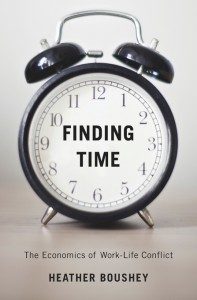
Families at all levels of income are struggling in our economy simply because it does not allow congenial coexistence of work and family life. Lives have become busier and busier and policies have not changed to reflect that. In her book, Finding Time: The Economics of Work-Life Conflict (Harvard University Press), Heather Boushey thoughtfully and comprehensively explains the problems with work-life conflict for women. Her book presents a set of solutions, too, that could make work-life conflict a thing of the past. While the story leads with the tale of what happens to women, Boushey takes the very issues that working women with families face and shows how these dilemmas are not about being a woman, they are about economics, and are shackling our entire economy. A valuable contribution is her portrait of contrasting work-life conflicts across income groups and family composition. She uses data as a skilled economist—which is her discipline—yet builds sensitively from history and social theory in a compelling book. Ultimately, her grounded arguments deliver detailed explanations as to why family policy needs to change and change quickly. Boushey, who is Executive Director and Chief Economist at the Washington Center for Equitable Growth, has decades of work bringing careful research to bear on key policy issues—and is successful at making the research and policy issues understandable to people who are really affected by the policies.

DUAL EARNING FAMILY DEPENDENCE

Boushey sets the table with locating economics in social context. The deal with capitalism is that by design the economy is ever-changing. Since the 1970s it has become heavily dependent upon women’s earnings. Families can no longer get by on the earnings of just one parent as they could before around 1979. So if our economy is so dependent upon a dual income family, then why aren’t there policies that support families’ need to manage work and family care? In Boushey’s words: “The hodgepodge of work and family policies that has evolved over the years does not address how people can have the time to deal with conflicts between work and home life” (p. 250). Finding Time explains the factors that determine what needs to change and how that change can happen.

COMPOSITION OF THE FAMILY IS CHANGING

The composition of families, Boushey reminds readers, are a lot different now than they used to be. While in the past families typically consisted of a mother, a father, and children, families now are more complex and could be classified in a burgeoning array. Single parent families make up about 27 percent of families today, for example. While in the past families could survive off of one parent being the breadwinner, that is nearly impossible now, especially for single parent families. She explains that single parent families are more likely to be low-income than families that have two (married) parents. Where are U.S. policies that make single-parent families able to thrive? Yes, they are already at a disadvantage with only one income, but policies that work will empower single parents to earn money and do the carework, which are two key things parents need to do.

WHO WILL BE THE “SILENT PARTNER” NOW?

Boushey makes a great point when she explains that women have always been the “silent partner” to businesses. Starting with the 19th century “family wage” and ending somewhere after the 1950s boom, men could go to work and not have to worry about their family because they knew their wives would be taking care of it. Businesses never had to take family into account because men never had to worry about theirs. In Boushey’s phrase, women were the “silent partners” to business. However, now that women’s incomes are key to family survival, the country is still not doing anything to lessen the burden of the work-family conflicts. Meanwhile, businesses reap benefits from having more capable workers in a larger labor pool, for whom wages are stagnant.

HOW CAN WE BE HERE, THERE, PROVIDE CARE, AND MAKE SURE ITS FAIR?

Women do not have a “silent partner.” But Boushey has a recommendation to fix this. She found that there is not one sure-fire way to fix the work-life conflict that families are facing. She argues that we need solutions in four areas that she calls Here, There, Care, and Fair.

Here: Policies for when women need to be Here (in the home). These policies include paid sick leave for medical needs and other time that would need to be spent with children.

There: Policies to make sure that the amount of hours that women are working leaves room for managing their family so that they do not always need to be There (at work).

Care: Policies regarding high-quality Care for children and aging family members.

Fair: Overall, policies need to be fair for everyone. This means that no matter what your income or familial composition is, you are still afforded the same work-family policies and no added responsibilities should hinder that.

Not only would adding this support make it less stressful for families to balance work and life, but such supports decrease costly turnover rates and increase productivity.

FINAL THOUGHTS

Women (and men!) need family policy as our silent partner to help us provide for our families. The “family policy” men had in the past was a housewife—and this policy is out of date. The economy has grown with the growth of women’s participation in the work force. It is time, Boushey demonstrates, that this growth should extend to benefits for women and their familial responsibilities.

This book was a great read. Along with clear explanations of economic concepts, Boushey uses her personal experience growing up in a working-class, union family in Washington State along with her knowledge of economics and history to show that to grow our economy and bring us out of the doldrums, working women need family-friendly policies. As a young woman looking ahead to a life of work-life conflict, I gained clarity and direction for my own work. Work-life conflict is a topic that needs recognition and Boushey is helping to spread knowledge and awareness. Boushey’s book still left me wondering how race may factor into this work-life conflict, maybe in a future addition we will be given some insight!

Originally posted 7/29/2016

Molly McNulty is a former CCF public affairs intern at Framingham State University. She graduated in May, 2017, as a Sociology and Education major.

photo credit: Taco Hoekwater via Wikimedia Commons

This month in the media, Council on Contemporary Families (CCF) scholars made some good points about how social context contributes to the diversity of families and relationships in the United States and abroad.

TIME: Marriage rate decline over time yet strong relationships increase

The University of Texas Daily Beacon covered a popular issue – Millennial sex and dating. Media often latches on to (decontextualized) statistics about lower marriage rates of millennials, tsk-tsk-ing all the way. But the UT Daily Beacon pointed out some less-talked-about generational differences. More millennials are “sexually inactive” at age twenty, for instance, than those born in the 1980s. And, even though millennials might have lower marriage rates, there is reason to believe that they have closer relationships than those of previous generations with higher marriage rates. Stephanie Coontz suggests (as she has elsewhere) that this is in part due to rising gender equality that has empowered many women to resist coercive relationships.

PLACE: Around the world and around the U.S. great varieties and change in divorce

The BBC recently discussed the current state of “Divorce in the Islamic World,” where divorce activists are pushing for reform because of the inherent gender inequality in many divorce laws. To unfamiliar listeners, thinking about divorce in the Islamic world may be exotic. But Stephanie Coontz shows that there has been variation in divorce practices – and their impact on family life – by place within the United States, too. States adopted no-fault divorce individually starting during the 1970s, and up until 2010 in New York. This makes it possible to determine that despite initially high divorce rates following the adoption of no-fault divorce, divorce rates tend to decrease in the long-term. Fewer instances of domestic violence and suicides by wives are also related to the adoption of no-fault divorce. Coontz suggests that many of the problems people associate with divorce are not necessarily caused by divorce as much as caused by the stigmatization of divorce.

RACE & CLASS: Not family structure

NPR further illustrates the way that immutable contextual factors can impact family outcomes: “Black and Latino Two-Parent Families Have Half the Wealth of White Single Parents.” The report discussed on NPR references a CCF brief report by Philip Cohen, Heidi Hartmann, Chandra Childers, and Jeffrey Hayes. In “Moynihan’s Half Century: Have We Gone to Hell in a Handbasket?” Cohen, Hartmann, Childers, and Hayes discussed how, since 1965, anti-poverty efforts have mistakenly focused on changing individual behaviors, like getting black single mothers to get married. The much larger source of much economic inequality, find these studies, is racial inequality. Poor families often have lower rates or marriage because of economic inequality. Coontz, in her BBC interview, cautions against using blanket statements that almost half of married couples divorce. Those who are highly educated and who put off marriage – who tend to be wealthier – have significantly lower divorce rates.

The take-away? The theme is family diversity and family change. The evidence supports it. Ignore at our peril. Policy that draws on the “mythical” traditional family is not going to work if the goal is to reduce inequality in all these elements of family: generation, place, race, and class (and many others, too!)

Braxton Jones is a graduate student in sociology at the University of New Hampshire, and serves as a CCF Graduate Research and Public Affairs Scholar.

discuss-1702638__180
photo credit: jamesoladujoye via pixabay

Revisiting a NICE WORK column at Girlwpen, written in 2012 during the last presidential campaign.

What to do when I read a study that so appeals to my worldview that I want to shout it out? Should I just kinda act cool, not let on that I wanna say, I knew it! See? SEE?!!!! That is how it is. We all have biases and preferences and a worldview that shape how we process information. And we all have choices about what to do with them. And that brings me to a study about how dudes in traditional marriages have traditional views that influence their judgments at work, too.

In a new working paper called “Marriage Structure and Resistance to the Gender Revolution in the Workplace” (.pdf), three business school professors investigate why, despite notable progress, the gender revolution appears to have “petered out.”  (An accessible overview of just this puzzle from the Council on Contemporary Families is in Gender Revolution? Or Not So Much.)

The new paper is novel: it asked, is it is possible that there are well-placed pockets of resistance in the workplace that help account for impeded progress? The authors hypothesized that, perhaps, men in cross-sex marriages with stay-at-home wives might have a different view of women in the workplace than married men with full-time working wives.

They hypothesized correctly. In particular, they found that (1) men in traditional marriages (MITM) had more negative attitudes towards working women (controlling for selection!); (2) MITM perceived the workplace as running less smoothly when more women worked there; (3) MITM also found more gender-egalitarian organizations less attractive; and (4) MITM, when asked to rate the quality of workers who were exactly equivalent, rated women lower than men. They controlled for selection (or the way it might be that sexist guys at work choose traditional marriages rather than guys being influenced by their traditional marriages to have traditional views at work) and for education (more educated guys espouse more ostensibly feminist views).

The study excited me because it provided support for that sinking feeling that some of us can have when working with guys who lead traditional private lives. At work, it can seem, they just don’t “get it.” Hard to put one’s finger on it. But they keep doing stuff like thanking their wives for all they do at home, thinking that this shows their respect for women.

The study also excited me because it was an example of the kind of research that I was talking about when I wrote about the neglect of men as focal points for research on gender, and my suspicion that the neglect stems from a sneaky sensibility that men’s vantage point is natural and therefore can go without examination. But without investigating the impact traditional marriages on work practices (instead of the more common investigation of egalitarian marriages on home practices), we are at risk of naturalizing “traditional” just as we naturalize “men.” To understand how gender operates, it helps to look at men at the center of power not just those at the margins. And this study did so.

Perhaps now you see the irony that I felt when I noticed my enthusiasm. The study shows how worldview lines up with personal life. This might influence your judgment at work. Back in the day, feminists said the personal is political. Thing is, the personal is political for everyone, including those who follow conventions. Even for those who don’t believe in this stuff. That means the personal is political, too, for MITM (the M is silent, by the way).


Marriage promotion doesn't fix poverty. More usefully, classes might focus on couples' strategies to handle the chronic stress of economic deprivation and insecurity on families. Image by Bill Strain/Flickr CC.
Marriage promotion doesn’t fix poverty. More usefully, classes might focus on couples’ strategies to handle the chronic stress of economic deprivation and insecurity together. Image by Bill Strain/Flickr CC.

“Marriage is the foundation of a successful society.”

“Promotion of responsible fatherhood and motherhood is integral to successful child rearing and the well-being of children.”

These were the assumptions that most members of Congress made as they designed the 1996 law that became the Personal Responsibility and Work Opportunity Reconciliation Act. Welfare reform’s strategy to decrease poverty involved increasing the number of children raised in two-parent, married families.

In the 20 years since President Bill Clinton signed that bill into law, Congress has earmarked $150 million of welfare money annually for marriage promotion and responsible fatherhood programs. Federal funding has been continuously renewed through 2016. That’s almost a billion dollars spent on marriage programs alone since welfare reform. Funding continues to mount through current “Healthy Marriage and Relationship Education” and “New Pathways for Fathers and Families” grants. These grants support state, local government, and community-based programs that provide marriage/relationship and parenting education and services believed to increase the economic stability of participants, mostly low-income parents. more...

The rapid rise in nonmarital fertility is arguably the most significant demographic trend of the past two decades. The proportion of births to unmarried women grew 46 percent over the past 20 years so that more than four in ten births now occur to unmarried women. Nonmarital fertility is quickly becoming a dominant pathway to family formation, especially among the disadvantaged. This is worrisome because decades of research show that children raised in single-parent homes fare worse on a wide range of outcomes (e.g. poverty, educational attainment, nonmarital and teen childbearing) than children raised by two biological parents. The poverty rates of single parent households are particularly striking. According to recent data from the U.S. Census Bureau, approximately 46 percent of children in single mother households were living in poverty in 2013 compared to 11 percent of children living with two married parents.

How can we improve the lives of the growing numbers of unmarried mothers and their children? So far, a dominant approach has been to encourage their mothers to marry.  At first glance, the logic makes sense. If growing up in a two-parent home is best for children, then adding a second parent to a single-mother home should at least partially address the problem. The 1996 welfare reform legislation and its subsequent reauthorization institutionalized this focus on marriage by allowing states to spend welfare funds on a range of marriage promotion efforts. more...

finding time book coverFamilies at all levels of income are struggling in our economy simply because it does not allow congenial coexistence of work and family life. Lives have become busier and busier and policies have not changed to reflect that. In her book, Finding Time: The Economics of Work-Life Conflict (Harvard University Press), Heather Boushey thoughtfully and comprehensively explains the problems with work-life conflict for women. Her book presents a set of solutions, too, that could make work-life conflict a thing of the past. While the story leads with the tale of what happens to women, Boushey takes the very issues that working women with families face and shows how these dilemmas are not about being a woman, they are about economics, and are shackling our entire economy. A valuable contribution is her portrait of contrasting work-life conflicts across income groups and family composition. She uses data as a skilled economist—which is her discipline—yet builds sensitively from history and social theory in a compelling book. Ultimately, her grounded arguments deliver detailed explanations as to why family policy needs to change and change quickly. Boushey, who is Executive Director and Chief Economist at the Washington Center for Equitable Growth, has decades of work bringing careful research to bear on key policy issues—and is successful at making the research and policy issues understandable to people who are really affected by the policies.

DUAL EARNING FAMILY DEPENDENCE

Boushey sets the table with locating economics in social context. The deal with capitalism is that by design the economy is ever-changing. Since the 1970s it has become heavily dependent upon women’s earnings. Families can no longer get by on the earnings of just one parent as they could before around 1979. So if our economy is so dependent upon a dual income family, then why aren’t there policies that support families’ need to manage work and family care? In Boushey’s words: “The hodgepodge of work and family policies that has evolved over the years does not address how people can have the time to deal with conflicts between work and home life” (p. 250). Finding Time explains the factors that determine what needs to change and how that change can happen.

COMPOSITION OF THE FAMILY IS CHANGING

The composition of families, Boushey reminds readers, are a lot different now than they used to be. While in the past families typically consisted of a mother, a father, and children, families now are more complex and could be classified in a burgeoning array. Single parent families make up about 27 percent of families today, for example. While in the past families could survive off of one parent being the breadwinner, that is nearly impossible now, especially for single parent families. She explains that single parent families are more likely to be low-income than families that have two (married) parents. Where are U.S. policies that make single-parent families able to thrive? Yes, they are already at a disadvantage with only one income, but policies that work will empower single parents to earn money and do the carework, which are two key things parents need to do.

WHO WILL BE THE “SILENT PARTNER” NOW?

Boushey makes a great point when she explains that women have always been the “silent partner” to businesses. Starting with the 19th century “family wage” and ending somewhere after the 1950s boom, men could go to work and not have to worry about their family because they knew their wives would be taking care of it. Businesses never had to take family into account because men never had to worry about theirs. In Boushey’s phrase, women were the “silent partners” to business. However, now that women’s incomes are key to family survival, the country is still not doing anything to lessen the burden of the work-family conflicts. Meanwhile, businesses reap benefits from having more capable workers in a larger labor pool, for whom wages are stagnant.

HOW CAN WE BE HERE, THERE, PROVIDE CARE, AND MAKE SURE ITS FAIR?

Women do not have a “silent partner.” But Boushey has a recommendation to fix this. She found that there is not one sure-fire way to fix the work-life conflict that families are facing. She argues that we need solutions in four areas that she calls Here, There, Care, and Fair.

Here: Policies for when women need to be Here (in the home). These policies include paid sick leave for medical needs and other time that would need to be spent with children.

There: Policies to make sure that the amount of hours that women are working leaves room for managing their family so that they do not always need to be There (at work).

Care: Policies regarding high-quality Care for children and aging family members.

Fair: Overall, policies need to be fair for everyone. This means that no matter what your income or familial composition is, you are still afforded the same work-family policies and no added responsibilities should hinder that.

Not only would adding this support make it less stressful for families to balance work and life, but such supports decrease costly turnover rates and increase productivity.

FINAL THOUGHTS

Women (and men!) need family policy as our silent partner to help us provide for our families. The “family policy” men had in the past was a housewife—and this policy is out of date. The economy has grown with the growth of women’s participation in the work force. It is time, Boushey demonstrates, that this growth should extend to benefits for women and their familial responsibilities.

This book was a great read. Along with clear explanations of economic concepts, Boushey uses her personal experience growing up in a working-class, union family in Washington State along with her knowledge of economics and history to show that to grow our economy and bring us out of the doldrums, working women need family-friendly policies. As a young woman looking ahead to a life of work-life conflict, I gained clarity and direction for my own work. Work-life conflict is a topic that needs recognition and Boushey is helping to spread knowledge and awareness. Boushey’s book still left me wondering how race may factor into this work-life conflict, maybe in a future addition we will be given some insight!

Molly McNulty is a CCF public affairs intern at Framingham State University. She is a senior Sociology and Education major.

Photo by Derek Gavey, Flickr CC.

A briefing paper prepared for the Council on Contemporary Families by Sharon Sassler, Professor, Department of Policy Analysis & Management, Cornell University. You can also see some of the popular impact here. 

In the 1940s and 1950s, the consensus of the emerging profession of marital counseling was that marital happiness and sexual satisfaction depended upon a couple’s adherence to traditional gender roles, with the husband doing the bulk of the breadwinning and the wife doing most of the housework. Influential economists such as Gary Becker (A Treatise on the Family, 1981) argued that following such a conventional division of labor by gender would lead to the greatest marital intimacy and sexual attraction between husband and wife.

Indeed, as recently as 2013, an article in the American Sociological Review found that couples who divided housework more equally had lower marital and sexual satisfaction and less frequent sex than couples where the woman did the bulk of the household labor.[i] The authors concluded that conventional masculine and feminine behaviors at home served as sexual “turn-ons” for men and women, while nontraditional behaviors, consciously or unconsciously, turned people off.

But these studies relied on data from the 1980s and early 1990s, and thus represented marriages formed before the recent surge in dual-earner families and social approval of egalitarian gender roles. My co-authors and I compared findings based on data collected 22 to 24 years ago, in the second wave of the National Survey on Families and Households, with data from the 2006 Marital and Relationship Survey. As we describe in a forthcoming study in The Journal of Marriage and Family, the association between a non-traditional division of labor at home and couples’ sexual satisfaction and frequency has changed dramatically over the past two decades. By 2006, couples who reported sharing housework fairly equally, with the man doing more than a third and up to 65 percent of the housework, reported having sex significantly more often than did couples where the woman (or the man) did 65 percent or more of the housework.

In fact, contemporary couples who adhere to this more egalitarian division of labor are the only couples who have experienced an increase in sexual frequency compared to their counterparts of the past, whereas other groups – including those where the woman does the bulk of the housework – have experienced declines in sexual frequency. This finding is particularly notable given reports indicating that sexual frequency has generally declined worldwide over the past few decades.[ii]

What’s going on here? Couples report having more and higher quality sex when they are satisfied with their relationships. In today’s social climate, relationship quality and stability are generally highest when couples divide up the household labor in a way they see as equitable or fair. And the evidence shows that when men do a greater share of housework, women’s perceptions of relationship fairness and satisfaction are greater. In fact, how housework was arranged mattered more for couples surveyed in 2006 than it did among those interviewed in the late 1980s. It is therefore not surprising that couples with more egalitarian divisions of routine housework report being more satisfied with sexual intimacy today than they did 20 years ago. Sharing housework is now perceived as a sexual turn-on.

In our study, the reported sexual satisfaction of couples with egalitarian housework arrangements was about the same as that of more traditional couples, even though sexual frequency was higher. A different analysis of the same data–which compared the sexual satisfaction of couples who shared childcare equally, couples where the woman did most of the childcare, and couples where men did most of the childcare–found that the egalitarian child-raising couples not only reported more frequent sex but also higher sexual satisfaction than couples where the woman did most of the childcare. Today’s sexual scripts clearly have been realigned to value sharing the housework load over role specialization.

As June brides and grooms settle in for the long haul after coming back from the honeymoon and writing their thank-you notes, they might want to make sure their “to do” lists include a fair division of the dishes and laundry.

First published 6/20/2016.

About the author: Sharon Sassler is Professor, Department of Policy Analysis & Management, Cornell University. (Sharon.Sassler@Cornell.Edu).

_____________________________________

[i] Kornrich, S., Brines, J., & Leupp, K. (2013). Egalitarianism, housework, and sexual frequency in marriage. American Sociological Review, 78, 26–50. doi:10.1177/0003122412472340.

[ii] Mercer, C. A., Tanton, C., Prah, P., Erens, B., Sonnenberg, P, Clifton, S., … Johnson, A. M. (2013). Changes in sexual attitudes and lifestyles in Britain through the life course and over time: Findings from the National Surveys of Sexual Attitudes and Lifestyles. The Lancet, 382, 1781–1794. doi:10.1016/S0140-6736(13)62035-8.

Photo via VelvetTangerine, Flickr CC.

One of the consistent findings of sociological research in recent decades has been that couples who had a child before getting married had substantially higher odds of divorcing than couples who married first. This held true even when researchers controlled for other factors that tend to distinguish such couples from those who marry directly—education, family background, race and ethnicity. But considering the tremendous increase in premarital cohabitation and childbearing over the past quarter century, and in light of new evidence that many other longstanding “laws” of marriage and divorce have been overturned (e.g., see “It’s Not Just Attitudes: Marriage Is Also Becoming More Egalitarian”; Are Individuals Who Marry at an Older Age Too Set in Their Ways to Make Their Marriages Work?), we set out to investigate whether this particular sociological “rule” still applies. more...

photo via pixabay.com

Last month, the Council on Contemporary Families (CCF) released a brief report, “The way we still never were,” to coincide with the new, revised, and updated 2016 version of Stephanie Coontz’s classic book, The Way We Never Were: American Families and the Nostalgia Trap. As a result, journalists identified many trends they saw as positive:

more...